Anhydrous Ammonia 29 CFR 1910.111 Storage Tank Requirements: Nurse Tank vs Stationary
Anhydrous Ammonia 29 CFR 1910.111 Storage Tank Requirements: Nurse Tank vs Stationary
Filed under: ag retailer compliance, OSHA process safety, fertilizer storage. Companion read: Anhydrous Ammonia Compatibility Pillar and State Tank Regulation Index.
Why anhydrous ammonia gets its own OSHA standard
Anhydrous ammonia (NH3) is the most efficient nitrogen fertilizer source in modern row-crop agriculture and one of the most hazardous materials commonly stored at scale on rural retail sites. It is liquefied under pressure (about 145 PSIG at 80F vapor pressure), it boils at minus 28F, and a release vaporizes immediately into a toxic and flammable cloud. Inhalation at 300 ppm is immediately dangerous to life and health (IDLH) per NIOSH; concentrations above 16% in air are flammable.
OSHA published 29 CFR 1910.111, Storage and Handling of Anhydrous Ammonia, in 1971 with subsequent amendments. The standard is unusual in two ways: it is highly prescriptive (specifying tank construction, valve types, gauge details, safety equipment by name and location), and it has separate sections for transportation containers (nurse tanks), stationary storage installations, refrigerated storage, and systems mounted on farm vehicles. Each section's requirements differ.
OneSource does not stock anhydrous ammonia tanks — those are ASME Section VIII pressure vessels in steel, fabricated by specialty manufacturers like Trinity Industries and ConVault. We sell the polyethylene tanks that surround the NH3 infrastructure: emergency wash water tanks, decontamination shower water tanks, equipment wash-down tanks, and the chemical-feed tanks for liquid fertilizer applications that follow NH3 in the field. This guide walks through the 1910.111 framework so ag retailers, agronomy customers, and safety staff understand where polyethylene fits and where it absolutely does not.
The structure of 29 CFR 1910.111
The standard is organized into seven main paragraphs (a) through (g):
- (a) Approval of equipment and systems. Defines what containers, valves, fittings, and accessories are acceptable.
- (b) Basic rules. Marking, signage, container construction, valve and fitting requirements common to all installations.
- (c) Systems other than those mounted on farm vehicles. Nurse tanks at the dealer site, transport tanks in transit, etc.
- (d) Systems mounted on farm vehicles (other than for the application of ammonia).
- (e) Systems mounted on farm vehicles for the application of ammonia. The applicator on the back of the tractor.
- (f) Refrigerated storage systems. Large bulk terminals.
- (g) DOT containers for the storage of anhydrous ammonia.
Within each paragraph, requirements address container design (referencing ASME Section VIII pressure-vessel code), valves, gauges, relief devices, hoses, transfer connections, signage, and personal-protective requirements. Read 1910.111 in full at the OSHA standards portal before any installation work — this article summarizes selected provisions and is not legal advice.
Nurse tank vs stationary — the central distinction
A "nurse tank" in ag-retail vernacular is a 1,000-gallon-class transportable container that the dealer fills at the bulk plant and tows to the farm field, where it is parked next to the applicator tractor and the operator transfers ammonia from the nurse tank to the applicator. The nurse tank then returns to the dealer for refill.
A "stationary storage installation" is a permanent vessel at the dealer's bulk plant — typically 12,000 to 30,000 gallons — that is filled from a rail car or transport trailer and from which the dealer fills the nurse tanks for distribution. Some large farms also have permanent stationary storage on-site.
The OSHA standard treats the two differently because the failure modes and operational contexts differ:
| Feature | Nurse tank | Stationary installation |
|---|---|---|
| Typical capacity | 500-1,450 gallons | 6,000-30,000 gallons (and larger refrigerated) |
| Construction code | ASME Section VIII Div 1 (or DOT MC-330/MC-331 if rolling stock) | ASME Section VIII Div 1 |
| Mounted on | Wheeled chassis, towed | Saddles on a concrete foundation |
| OSHA paragraph | (c) and (d) | (c) primarily |
| Gage glass type | Tubular (rotary or tubular) per (b)(8) | Columnar gage glass permitted with metallic handwheel shutoff valves and excess-flow valves per (b)(8)(i) |
| Required emergency equipment | Per (c) — typically PPE on the towing vehicle | Per (c) — at minimum two suitable gas masks in readily-accessible locations and an easily accessible shower or 50-gallon drum of water |
| Marking | "Anhydrous Ammonia" in letters at least 4 inches high | Same plus capacity and operator-identification signage |
| Relief device | Spring-loaded pressure-relief valve sized per CGA S-1.1 / API 520 | Same, sized to vessel |
The single most-cited safety requirement that distinguishes stationary installations from nurse tanks is the eye-wash and shower provision in 1910.111(b)(10) and the gas-mask provision in (c). Stationary installations need at least two suitable gas masks readily accessible at the installation, and an easily accessible shower or 50-gallon drum of water. Nurse tanks in transit do not — but the towing vehicle must carry appropriate PPE for emergency response.
Container marking — 1910.111(b)(7)
Every anhydrous ammonia container must be marked with the words "Anhydrous Ammonia" in letters at least 4 inches high. Stationary installations also typically include the maximum allowable working pressure (MAWP), capacity, and a serial number tied to the manufacturer's data report. The marking is for emergency responder identification first and OSHA inspector compliance second.
Containers mounted on farm vehicles for application have additional marking requirements per 1910.111(d): in addition to "Anhydrous Ammonia," the slow-moving-vehicle emblem and reflective markings per 49 CFR vehicle requirements when traveling on public roads.
Gauges and instruments — 1910.111(b)(8)
Pressure and liquid-level gauges are the operator's window into the tank, and 1910.111 specifies them carefully because gauge failure has been the proximate cause of multiple historic fatalities. Selected requirements:
- Gage glasses of the columnar type are restricted to stationary storage installations and must have shutoff valves with metallic handwheels, excess-flow valves, and extra-heavy glass adequately protected with a metal housing applied by the gage manufacturer. The shutoff valves must be located at the top and bottom of the gage glass.
- Float gages are permitted on both stationary and nurse-tank service.
- Magnetic-driven (rotary) gages are common on nurse tanks because they survive vibration and frost better than tubular glass.
- Pressure gages must have a dial graduated to read at least 1.2 times but not more than twice the maximum allowable working pressure of the container.
Operators are trained to never trust a single gauge — cross-check pressure against ambient temperature using saturation tables (vapor pressure of ammonia is roughly 100 PSIG at 60F, 145 PSIG at 80F, 200 PSIG at 100F). A pressure reading wildly disconnected from temperature signals gauge failure or unusual condition (water contamination, foreign chemistry).
Pressure relief — 1910.111(b)(11)
Every anhydrous ammonia container must have one or more spring-loaded pressure-relief valves sized to discharge the maximum credible pressure rise — typically fire exposure scenario per CGA S-1.1 sizing rules. The relief valve discharge must be vertical and unobstructed, and the discharge stack must be high enough that a relief event vents above operator workspace.
Common relief sizing rule of thumb: 250 PSIG set pressure for vessels rated to 250 PSIG MAWP, with full-flow capacity per CGA S-1.1. Verify with the vessel manufacturer's data report and consult a pressure-vessel specialist for sizing on any new installation.
Where polyethylene fits in the NH3 ecosystem
Anhydrous ammonia itself is never stored in polyethylene. The vapor pressure, the temperature swing, and the chemistry all preclude polyethylene as a primary containment vessel. But polyethylene plays critical supporting roles at every NH3 installation:
Emergency safety shower and eye-wash water reserves
1910.111(b)(10) requires an easily accessible shower or 50-gallon drum of water at stationary installations. ANSI Z358.1-2014 sets the broader standard: 20 GPM continuous flow for at least 15 minutes, equating to a 300-gallon minimum reserve for a single-station shower. Many ag retailers exceed this with a 500-1500 gallon water tank dedicated to emergency response.
Real OneSource SKUs commonly specified for NH3-installation emergency water reserves:
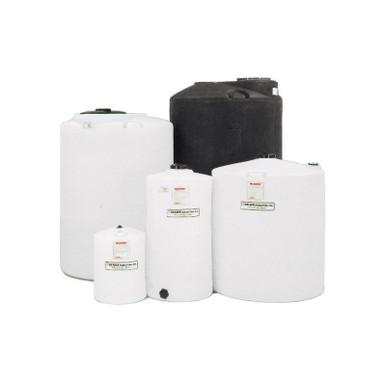
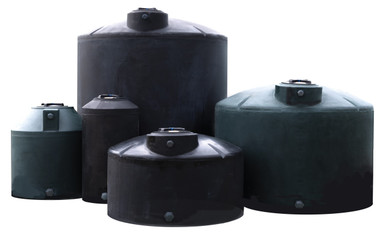
- Norwesco MPN 41500 — 1000 Gallon Vertical Water Storage Tank in Black, listed at $1,699.00. Black resin reduces algal growth; sized for ~50 minutes continuous emergency shower flow.
- Norwesco MPN 43808 — 1525 Gallon Vertical Water Storage Tank in Black, listed at $1,799.00. Sized for multi-station shower or extended-duration single-station flow.
- Bushman MPN WW-1500-GL-NAT — 1500 Gallon Water Storage Tank Natural, listed at $1,998.99. Natural translucent walls allow visual level check at a glance during routine safety inspection.
- Enduraplas MPN TLV02100 — 2100 Gallon Vertical Water Storage Tank in Black, listed at $2,188.40. Larger reserve for sites with multiple shower stations or full-decontamination capability.
The water tank for emergency safety shower service must be heat-traced and insulated in cold-climate installations to ensure the water does not freeze in winter, when many serious NH3 incidents historically occur (winter NH3 transport during the spring fertilizer push window).
Decontamination water for victim treatment
Beyond the immediate eye-wash and shower requirement, NH3 dealer sites often maintain additional water reserves for decontaminating contaminated PPE, equipment rinsing, and supporting EMS response. A 1000-1500 gallon polyethylene tank with a quick-connect hose fitting at the bottom outlet is the standard answer.
Liquid-fertilizer storage downstream of NH3 conversion
Most modern dealer plants use anhydrous ammonia as the source nitrogen for converting to liquid fertilizers — UAN 28%, UAN 32%, urea-ammonium nitrate solution. The downstream UAN is corrosive and is stored in polyethylene or coated steel. OneSource catalog covers the polyethylene side of this:
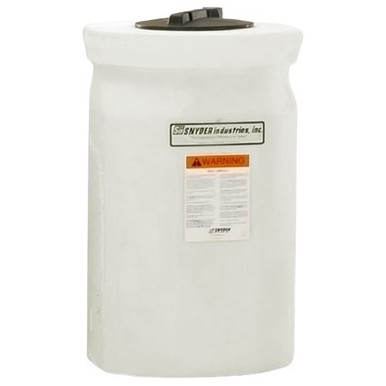
- Snyder MPN 5490000N42 — 1550 Gallon Vertical Double Wall XLPE Liquid Chemical Storage Tank in White, listed at $10,091.93. The double-wall integral containment satisfies SPCC if the plant stores enough oil-equivalent inventory to be subject. The XLPE construction tolerates UAN chemistry indefinitely.
- Enduraplas MPN THV02500 — 2500 Gallon Vertical in Faint Green, listed at $2,769.85. Suited to UAN day-tank service feeding the field-loading pad.
Equipment wash-down water
Field application equipment returning from a day's work needs a wash-down station. Polyethylene water tanks with dedicated pumping infrastructure handle this routine but compliance-relevant role.
The specific 1910.111 provisions ag retailers cite most often
1910.111(b)(10) — Emergency shower and eye-wash
"Stationary storage installations shall have an easily accessible shower or a 50-gallon drum of water." This is the statutory floor; ANSI Z358.1-2014 is the practical engineering standard most AHJs reference for the shower design. The 50-gallon-drum-of-water provision is a literal-text fallback for installations that cannot supply continuous-flow water; most modern dealer plants exceed it by orders of magnitude with engineered shower stations fed from polyethylene reserve tanks.
1910.111(c)(3) — Gas masks at stationary installations
"Stationary storage installations shall have at least two suitable gas masks in readily-accessible locations." The gas masks must be NIOSH-approved full-face masks with ammonia canisters for emergency action involving most ammonia leaks (particularly outdoor leaks). For concentrated ammonia atmospheres, a self-contained breathing apparatus (SCBA) is required. The masks are typically housed in a wall-mounted cabinet near the operator's station, not in the office building.
1910.111(b)(13) — Hose specifications
Transfer hoses must be designed for at least 350 PSIG working pressure and a 5:1 minimum safety factor. Quick-disconnect couplings on the hose ends must include excess-flow shut-off valves that automatically close on hose rupture. Hose inspection is a daily operator task at any active dealer plant.
1910.111(b)(15) — Markings
Container markings include the words "Anhydrous Ammonia," the maximum allowable working pressure, and the manufacturer's nameplate per ASME Section VIII. The 4-inch-letter rule is universally followed.
Process Safety Management (29 CFR 1910.119) overlay
OSHA's broader Process Safety Management (PSM) standard at 29 CFR 1910.119 applies to facilities with 10,000 pounds or more of anhydrous ammonia in a single process. At 5.15 pounds per gallon (NH3 liquid density), 10,000 pounds equates to about 1,940 gallons — well below the typical 12,000-30,000 gallon dealer plant inventory. Dealer plants are PSM-covered facilities and must implement the full 14-element PSM program: Process Safety Information, Process Hazard Analysis, Operating Procedures, Training, Contractors, Pre-Startup Safety Review, Mechanical Integrity, Hot Work Permits, Management of Change, Incident Investigation, Emergency Planning and Response, Compliance Audits, Trade Secrets, and Employee Participation.
EPA's parallel Risk Management Program (RMP) at 40 CFR Part 68 imposes similar requirements for offsite consequence analysis, with the same 10,000-pound threshold for anhydrous ammonia. Dealer plants subject to PSM are also subject to RMP and must submit a Risk Management Plan to EPA.
Polyethylene tanks at dealer sites supporting safety infrastructure (emergency water, decontamination, downstream liquid fertilizer) are not themselves covered processes, but their availability and integrity feed into the PSM mechanical integrity program and the RMP emergency response plan.
State-level layering on the federal floor
OSHA 1910.111 is the federal floor. State agencies layer additional requirements:
- State chemigation rules — many ag states require backflow prevention on chemigation systems where NH3 or downstream chemistry is injected into irrigation water.
- State fire codes — typically reference NFPA 55 (Compressed Gases and Cryogenic Fluids Code) which has separate NH3 storage provisions sometimes more strict than 1910.111.
- State environmental regulations — Tier I and Tier II reporting under EPCRA section 312 for any facility storing more than 500 pounds of anhydrous ammonia at any time during the calendar year.
- Local zoning — many AHJs restrict NH3 storage to industrial-zoned land with specific setback requirements from residential property lines.
Ag retail customers typically work with their state Department of Agriculture, state OSHA-equivalent agency, state fire marshal, and EPA Region for the full compliance map. OneSource supports the polyethylene-side infrastructure that surrounds these installations; we do not advise on the NH3 vessel itself.
Common compliance findings on NH3 dealer plant inspections
- Eye-wash and shower water tank empty or contaminated. The polyethylene reserve tank is in place but has not been refilled, drained for winter and not refilled in spring, or is full of stagnant water that has not been turned over in months.
- Gas mask cabinet present but cartridges expired or PPE missing. The 1910.111(c)(3) requirement is satisfied physically but not functionally.
- Container marking faded. The 4-inch "Anhydrous Ammonia" lettering has weathered to the point of illegibility from 50 feet.
- Relief valve overdue for inspection. CGA S-1.1 and most state codes require periodic relief valve inspection or replacement on a 5-10 year cycle; many sites lose track of the schedule.
- Transfer hose failure inspection records missing. Daily visual + monthly documented hose inspection records are commonly cited as missing or incomplete.
- SPCC plan does not include NH3 inventory in oil-equivalent calculations. NH3 is not oil under 40 CFR 112, but downstream UAN often is, and the SPCC plan must reflect both the NH3 process and the UAN storage if combined inventory triggers the threshold.
Bottom line for ag retailers and farm operations
Anhydrous ammonia tanks themselves are ASME Section VIII steel pressure vessels — not in the OneSource catalog. The polyethylene infrastructure surrounding NH3 installations — emergency safety shower water reserves, decontamination water, equipment wash-down, downstream UAN liquid fertilizer storage — is the OneSource lane. Specify those tanks against ANSI Z358.1-2014 for emergency-shower service and against 40 CFR 112 for any oil-equivalent SPCC implications, and pair them with the rest of the 1910.111 compliance program your ag retail customer or farm operation is running.
Browse the Vertical Water Storage Tank Category for emergency-water reserve options. For UAN and downstream fertilizer chemistry, see the Chemical Storage Tank Category. Freight on any tank is quoted to ZIP through the Freight Cost Estimator or by phone at 866-418-1777.
Recommended Tanks for This Guide
Live pricing, updated automatically · estimate freight to your ZIP.