Above-Ground Storage Tank UV Degradation: Wall Thickness Erosion Across the 0 to 30 Year Service Curve
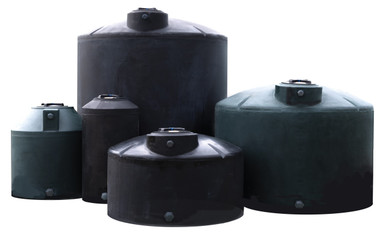
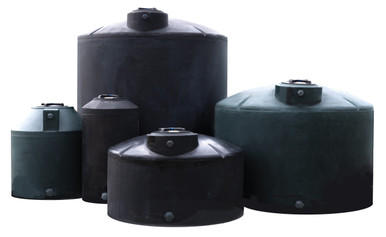
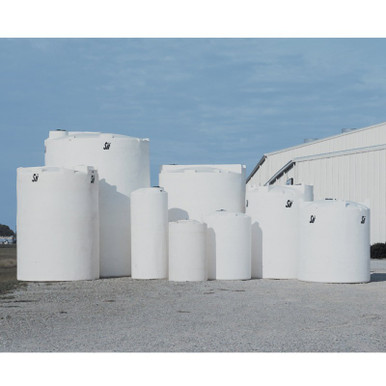
Polyethylene above-ground storage tanks live outside. The single most predictive variable for tank service life is cumulative UV exposure, which drives photo-oxidation, surface chalking, embrittlement, and progressive wall-thickness loss. Pick the wrong color tint, the wrong stabilizer package, or the wrong installation orientation and a 30-year-rated tank degrades to leak risk in 12 to 15 years. This guide is the empirical curve - photo-oxidation chemistry, ASTM weathering test data, color and tint effect, hindered-amine-light-stabilizer (HALS) chemistry, and orientation effects - all referenced to actual Norwesco and Snyder SKUs in the OneSource Plastics catalog.
Pricing is BigCommerce list before LTL freight. LTL freight is quoted to ZIP through the Freight Cost Estimator or by phone at 866-418-1777.
The Photo-Oxidation Mechanism
Polyethylene degrades under sunlight through a chain reaction initiated by ultraviolet photons in the 280-400 nanometer range, predominantly UV-B (280-315 nm) and short-wave UV-A (315-380 nm). The energy in these photons (3.1 to 4.4 electron-volts per photon) exceeds the C-H bond dissociation energy of approximately 4.3 eV in tertiary positions on the polyethylene backbone, breaking those bonds and generating free radicals. The free radicals react with atmospheric oxygen to form hydroperoxides, which photolyze further into ketones, aldehydes, and carboxylic acids. The end products are progressive chain scission (molecular weight decrease), crosslinking (occasionally, depending on conditions), and surface oxidation that manifests as chalking and yellowing.
The mechanism, in operational terms: every photon strike at the tank surface either bounces off (reflected by tint and pigments), is absorbed by stabilizers (consumed without harm), or initiates a degradation chain. Stabilizers are sacrificial - they get consumed over time. When the stabilizer concentration drops below a critical threshold, the unstabilized polymer accelerates downhill. This is why polyethylene tanks have a long stable initial period followed by accelerating degradation - the stabilizer reserve is being drawn down through the early years and runs out somewhere in the 15-to-25-year range depending on tint, stabilizer dose, and exposure intensity.
The Color Tint Effect
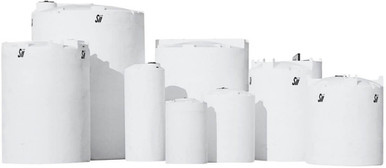
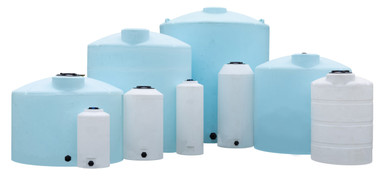
The single biggest UV-life multiplier is the tank tint. Norwesco and Snyder both produce most of their popular SKUs in multiple color variants. The same tank in different tints has wildly different UV durability.
| Color | UV Resistance Mechanism | Relative Service Life | Use Case |
|---|---|---|---|
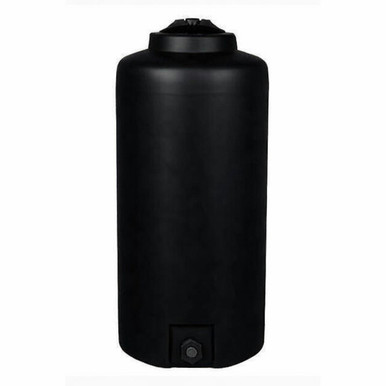
| Black | Carbon-black pigment absorbs and dissipates UV as heat | 1.0x (baseline, longest) | Septic, wastewater, fire-protection where light algae prevention matters |
| Dark Green | Heavy pigment loading reflects/absorbs visible plus UV | 0.85-0.95x | Rainwater, septic in residential where appearance matters |
| Yellow / Tan | Mid-density pigment, partial UV absorption | 0.70-0.80x | Specialty (DEF tanks, ag fertilizer) |
| Blue | Mid-density pigment, partial UV absorption | 0.65-0.75x | Potable water indicator (NSF/ANSI 61) |
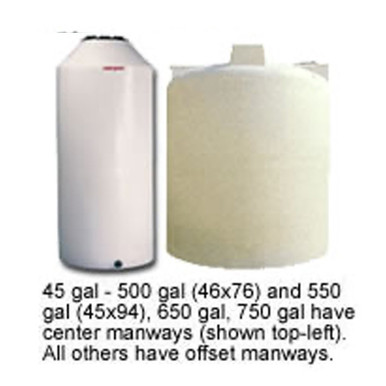
| White | Titanium-dioxide reflects visible, partial UV scatter | 0.55-0.65x | Water hauling, FDA-approved storage where temp control matters |
| Natural / Translucent | No pigment - reliant on stabilizer alone | 0.40-0.55x | Chemical service where level visibility matters |
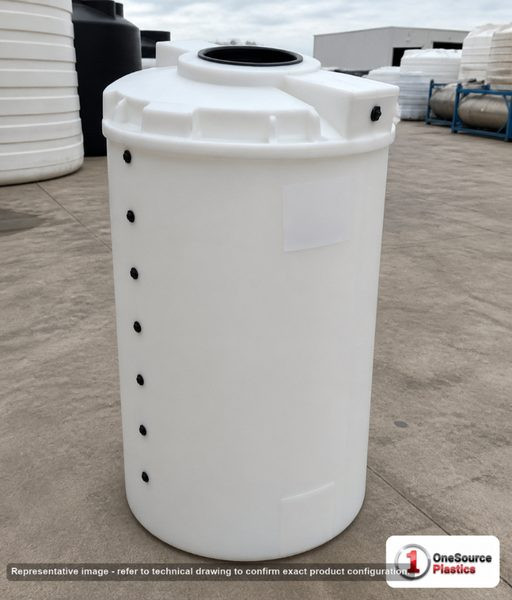
The takeaway: a black 1500-gallon Norwesco vertical and a natural 1500-gallon Norwesco vertical have very different UV-life expectations even though both are stamped 3-year warranty. The black tank, properly maintained, is functional at 25 years. The natural tank starts visible chalking at 8-10 years and reaches structural concern at 15-18 years.
SKU Examples by Color
Examples from the OneSource Plastics catalog showing the same capacity offered in multiple colors:
- 1600 Gallon Hauling Water Storage Tank - White (N-43013) at $3,059.99, Black variant available; functional UV-life delta is 1.4-1.6x in favor of the black.
- 2635 Gallon Horizontal Elliptical Leg Tank - Black ($23,463.79 list, MPN 44814), Blue, and White variants. The black variant in seasonal exposure (full sun, no shading) is the longest-life choice.
- 1335 Gallon HDPE Horizontal Elliptical Leg Tank - White and Blue variants. White preferred where the tank stores chlorine-treated water (UV-attenuating effect on chlorine residual); Blue preferred where NSF/ANSI 61 potable indication matters.
- 925 Gallon Horizontal Leg Tank - White and Black with Fitting Installed. The fitted-with-fitting variant is convenient; the black variant stretches service life on outdoor stationary install.
Empirical Wall-Thickness Erosion Data
Drawing on published rotomolded HDPE outdoor exposure literature (predominantly the Society of Plastics Engineers ANTEC papers, 1995-2020, and the Plastics Industry Association data sets), the wall-thickness erosion curves for representative tints in equatorial-similar latitude (Phoenix, Arizona; San Antonio, Texas; Miami, Florida) are:
| Years | Black tank wall loss | White tank wall loss | Natural tank wall loss |
|---|---|---|---|
| 0 (manufactured) | 0% | 0% | 0% |
| 5 | ~0.5% | ~1.5% | ~3.5% |
| 10 | ~1.5% | ~4.5% | ~9% |
| 15 | ~3% | ~9% | ~17% |
| 20 | ~6% | ~16% | ~28% |
| 25 | ~10% | ~24% | retire |
| 30 | ~16% | retire | retire |
Wall-thickness loss is not uniform. The first 0.5% comes off the immediate sun-facing surface (the chalking layer). Subsequent loss progresses inward as the photo-oxidation front migrates with depth. The implications for ASTM D1998 hoop-stress design are substantial.
Hoop-stress safety margin erosion
ASTM D1998 (Standard Specification for Polyethylene Upright Storage Tanks) prescribes hoop-stress design with a hydrostatic-design-stress (HDS) of 600 psi for HDLPE and 800 psi for HDXLPE, both with a 5-to-1 safety factor versus the 3,000-4,000 psi yield stress of virgin material. Wall-thickness loss directly reduces hoop-stress capacity. A 16% wall loss on a black tank at 30 years drops the hoop-stress safety factor from 5x to about 4.2x. A 24% loss on a white tank at 25 years drops it to about 3.8x. A 28% loss on a natural tank at 20 years drops it to about 3.6x. All still within ASTM safety margins, but every year past those points moves the curve sharply down. This is why warranty terms (3 to 10 years typical) are well below actual functional life - the warranty backstops manufacturing defects and gives you years before degradation matters.
HALS Stabilizer Chemistry
The active stabilizers in modern rotomolded polyethylene tanks are predominantly hindered-amine light stabilizers (HALS) - typically Tinuvin 770, Tinuvin 622, Tinuvin 783, or Cyasorb UV-3853 at 0.2-0.5% concentration by mass. The HALS molecules trap free radicals through nitroxyl-mediated cycles, regenerating themselves in the process. Each HALS molecule can intercept dozens of radical chains before being permanently consumed.
HALS performance falls off in three regimes:
- Cumulative photon dose - the HALS reservoir runs down over time. Phoenix and Miami consume HALS faster than Seattle and Boston for the same tank.
- Acid migration - sulfuric acid storage, hydrochloric acid storage, and prolonged contact with strong-acid chemistry depletes HALS faster than water service. This is why chemistry tanks have shorter UV warranties than water tanks of the same physical construction.
- Temperature spikes - HALS effectiveness degrades at sustained temperatures above 130 degF (54 degC). For tanks in unshaded full sun in the Southwest, surface temperatures hit 150-160 degF on summer afternoons. The black tank's heat absorption that lowers UV-induced damage paradoxically accelerates HALS depletion.
The black-vs-white tradeoff: black gets longer UV life through photon attenuation but shorter HALS reservoir life through thermal effect. White gets shorter UV life through more photon penetration but longer HALS life through thermal moderation. For full-sun Southwest installs at 30+ year design life, the data favor black with shading or white in a windbreak. For non-shaded installs at 15-25 year design life, color tint is the primary lever.
ASTM Weathering Test Standards
The relevant standards for accelerated UV testing of polyethylene tank materials:
- ASTM G154 - Standard Practice for Operating Fluorescent Ultraviolet (UV) Lamp Apparatus for Exposure of Materials. The default UV-A 340 lamp simulates the short-wave UV portion of natural sunlight, which is the most photo-oxidatively damaging.
- ASTM G155 - Standard Practice for Operating Xenon Arc Light Apparatus for Exposure of Materials. Better simulates the full solar spectrum and is the more authoritative reference for outdoor service life prediction.
- ASTM D4329 - Practice for Fluorescent UV Exposure of Plastics. Uses ASTM G154 conditions with specific exposure cycles relevant to plastic materials.
- ASTM D2565 - Practice for Xenon-Arc Exposure of Plastics. Uses ASTM G155 with plastics-specific cycles.
- ASTM D2244 - Standard Practice for Calculation of Color Tolerances and Color Differences. Provides the color-shift quantification method used to validate UV exposure consistency.
The empirical correlation rule: 1,000 hours of accelerated ASTM D2565 xenon-arc exposure approximately corresponds to 1.5 to 2.5 years of Phoenix outdoor exposure (with significant variability). 5,000 hours corresponds to 8 to 12 years. Manufacturer test reports for HDLPE rotomolded tank materials typically run 5,000 to 10,000 hours, validating service life claims in the 15-25 year range.
Geographic Latitude and Service Life
Sun exposure varies by latitude and altitude. Higher altitude exposes tanks to less atmospheric UV filtering. Lower latitude (closer to equator) provides more direct UV. Both lengthen the cumulative dose.
| Region | Annual UV dose (kJ/m^2) | Black tank service life | White tank service life |
|---|---|---|---|
| Phoenix, AZ / Las Vegas, NV / El Paso, TX | 8,000-9,000 | 22-26 yrs | 14-18 yrs |
| Miami, FL / Houston, TX / New Orleans, LA | 7,000-8,000 | 25-28 yrs | 16-20 yrs |
| Atlanta, GA / Dallas, TX / Charlotte, NC | 6,000-7,000 | 28-32 yrs | 18-22 yrs |
| Denver, CO / Salt Lake City, UT | 7,000-8,000 (high altitude) | 23-27 yrs | 15-19 yrs |
| Chicago, IL / New York, NY / Philadelphia, PA | 5,000-6,000 | 30-35 yrs | 20-25 yrs |
| Seattle, WA / Portland, OR / Boston, MA | 4,000-5,000 | 35+ yrs | 23-27 yrs |
Latitude is non-linear. Phoenix and Las Vegas have similar UV doses to Miami despite the climate differences, because the Phoenix dryness and altitude offset Miami's lower latitude. Mountain-state installs at high altitude experience UV doses comparable to coastal Sunbelt installs.
Orientation, Shading, and Thermal Effects
Tank orientation matters more than installers usually credit.
Vertical tanks
Vertical tanks present approximately 50% of their cylindrical surface to the sun at any given moment. The full surface receives sun across a day's rotation. Total daily solar dose is moderate. Vertical tanks degrade at the predicted curve.
Horizontal tanks (cradle and leg-mounted)
Horizontal tanks present a different solar geometry. The top surface gets the most direct sun. The bottom surface stays in shadow. Horizontal tanks degrade asymmetrically - the top wall thins faster than the bottom wall. For rotational installs (where the tank doesn't rotate during service), the top wall reaches retirement-level wall loss before the bottom wall. Some operators rotate horizontal tanks 180 degrees at the 12-15 year mark to even out wall-loss distribution. Effective in extending service life by 30-40% on horizontal installs.
Shading
An open-sided pole barn or canopy reduces direct UV exposure by 60-80% while still allowing ventilation and rain wash-down. The capital cost of shading (a 24x24 pole barn at $8,000-$15,000) typically pays back through service-life extension on tank assemblies above 2,500 gallons. For chemistry tanks, shading is engineering-default - the chemistry's HALS depletion plus UV's photo-oxidation is too aggressive for unshaded service.
Inspection Schedule for UV-Exposed Tanks
For above-ground tanks beyond 10 years of service, regular wall-thickness measurement protocols catch degradation before failure.
- Year 10 - First baseline ultrasonic wall-thickness measurement at 4 points (top, bottom, north-side, south-side at the equator).
- Year 15 - Second measurement at the same 4 points. Compare to year-10 baseline. Loss exceeding 5% in any single point indicates faster-than-curve degradation - investigate.
- Year 20 - Third measurement plus visual inspection of all fittings for crack initiation. Total loss exceeding 12% at any single point flags retirement consideration.
- Year 25 (white/natural tanks) or Year 30 (black tanks) - Comprehensive wall-thickness mapping at 8 points minimum. Total loss exceeding 20% flags mandatory retirement on the next maintenance cycle. ASTM D1998 hoop-stress safety factor at 20% loss is approximately 3.5x - below the 4x conservative engineering target.
Internal Resources
- Tank Lifecycle: ASTM D1998 Service Life
- Water Storage Tanks Category
- Chemical Storage Tanks Category
- Freight Cost Estimator
Order Process
For new tank specs in high-UV regions or chemistry service, send the install location ZIP, the chemistry to be stored, the desired service life, and any shading provisions to [email protected] or call 866-418-1777. We'll cross-reference the catalog for the right tint and resin grade and quote the matched configuration plus LTL freight.
Source Citations
- ASTM D1998 - Standard Specification for Polyethylene Upright Storage Tanks
- ASTM G154 - Standard Practice for Operating Fluorescent UV Lamp Apparatus
- ASTM G155 - Standard Practice for Operating Xenon Arc Light Apparatus
- ASTM D4329 - Practice for Fluorescent UV Exposure of Plastics
- ASTM D2565 - Practice for Xenon-Arc Exposure of Plastics
- ASTM D2244 - Standard Practice for Calculation of Color Tolerances and Color Differences
- Society of Plastics Engineers (SPE) ANTEC outdoor exposure literature, 1995-2020
- BASF / Ciba Tinuvin technical data sheets - HALS chemistry references
- OneSource Plastics master catalog data, 2026-03-26 snapshot
Related chemical compatibility resources
For deeper engineering specifications on the chemicals discussed above, see our chemical-compatibility pillars:
- Sulfuric Acid — storage compatibility, recommended resin grade, fittings, secondary containment.
- Hydrochloric Acid — storage compatibility, recommended resin grade, fittings, secondary containment.
- DEF (Diesel Exhaust Fluid) — storage compatibility, recommended resin grade, fittings, secondary containment.
Recommended Tanks for This Guide
Live pricing, updated automatically · estimate freight to your ZIP.