ASTM D1998 vs D2282 for Plastic Storage Tanks: What Each Certifies and What It Doesn't
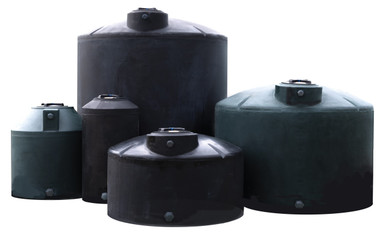
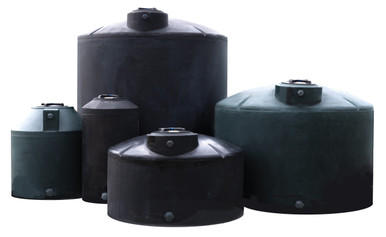
Buyers reading plastic-tank spec sheets routinely encounter two ASTM designations that look related but are not interchangeable: D1998 and D2282. Sales literature sometimes references both. Engineers writing specifications occasionally cite the wrong one. The result is procurement decisions made against a standard that does not actually govern the equipment in question. This post separates the two, explains what each one actually certifies, and clarifies what neither one proves on its own.
The short version
- ASTM D1998-19 is the design and construction standard for polyethylene upright storage tanks. It governs wall thickness, hydrostatic design stress, fitting placement, and quality testing for finished rotomolded HDPE / XLPE tanks. This is what 99% of buyers actually need to verify on a tank purchase.
- ASTM D2282-99 (reapproved 2014) is a material classification standard for acrylonitrile-butadiene-styrene (ABS) plastic compounds — not for tanks. It classifies ABS resin properties for downstream use in pipe, sheet, profile, and other extruded/molded products. It does not address tank construction, wall thickness, or hydrostatic design.
Citing D2282 on a polyethylene tank specification is a category error. Citing D1998 on an ABS pipe is the same kind of category error in the other direction. Below, both standards in detail.
ASTM D1998-19 in detail
ASTM D1998 ("Standard Specification for Polyethylene Upright Storage Tanks") is the governing specification for cylindrical, vertical, atmospheric polyethylene tanks. Key provisions:
1. Wall thickness based on hoop stress
Section 8 of D1998 specifies that wall thickness shall be calculated to keep hoop stress at or below the published Hydrostatic Design Stress (HDS) for the resin grade. The governing equation:
t = (SG × H × D × 0.433) / HDS
where t = wall thickness (in), SG = specific gravity, H = head height (ft), D = inside diameter (in), HDS = hydrostatic design stress (psi)
HDS is published per resin grade in the standard. For Type II HDPE, the HDS is approximately 600 psi at 23°C; for Type V XLPE, approximately 700 psi. Cross-linked polyethylene allows thinner walls at the same stored fluid SG, which is why XLPE tanks tend to weigh less than HDPE tanks of equivalent rating.
2. Specific gravity rating tiers
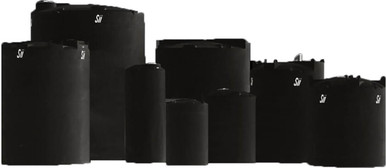
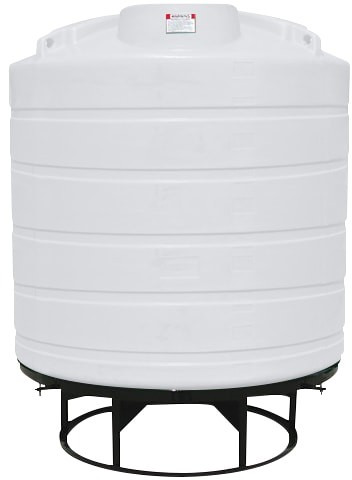
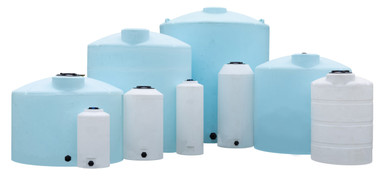
D1998 publishes discrete SG rating tiers: 1.5, 1.7, 1.9, and 2.0 are the common ones. A tank rated 1.5 SG is constructed with wall thickness sufficient for fluids up to 1.5 SG; using it on a 1.9 SG fluid would put hoop stress past the design HDS and accelerate creep. Always verify the SG rating of a tank against the actual stored fluid before purchase. The SII-1006600N42 (Snyder 10,000 Gallon XLPE Captor Double Wall Tank, Listed at $91,468.99) and the SII-5490000N42 (Snyder 1550 Gallon Vertical Double Wall XLPE Liquid Chemical Storage Tank, Listed at $10,091.93) are explicit XLPE 1.9 SG ratings; standard HDPE catalog tanks are typically 1.5 SG.
3. Required fittings and reinforcement
D1998 governs the location, type, and reinforcement of fittings. A bulkhead fitting penetrating the tank wall must be placed in a region of acceptable hoop stress (not at the bottom-knuckle radius, where stress concentration is highest), and the fitting must be installed with appropriate gasket and torque. Manufacturers publish fitting schedules that comply with D1998; resellers should not relocate fittings without manufacturer engineering review.
4. Quality control testing
D1998 Section 11 specifies hydrostatic load testing, leak testing, and visual inspection requirements before a tank ships. Reputable manufacturers (Norwesco, Snyder, Chem-Tainer, Enduraplas, Bushman) maintain quality records that an end customer can request for a specific serial number.
5. Service life
D1998 itself does not publish a service life — but Annex A1 ("Estimated Service Life") provides guidance. The fundamental message is that polyethylene tanks creep. Hoop stress drives long-term creep. Tanks operated near their HDS and at elevated temperature creep faster than tanks operated at lower stress and ambient temperature. Reasonable service life expectations for HDPE tanks at ambient temperature in non-aggressive fluid service are 15-25 years; XLPE typically 20-30 years.
ASTM D2282 in detail
ASTM D2282-99(2014) ("Standard Classification System for Acrylonitrile-Butadiene-Styrene (ABS) Plastic Pipe Compounds") is a material classification standard. It does not specify a finished product. It specifies how an ABS resin compound is classified by:
- Designation cell — Type, Grade, Hydrostatic Design Stress at 23°C, etc.
- Tensile properties — yield strength, elongation, modulus.
- Izod impact strength.
- Heat distortion temperature.
- Chemical resistance categories.
The classification cell is used by downstream specifications — for example, ASTM D2661 specifies ABS DWV pipe and fittings using D2282-classified compounds, and ASTM F628 specifies ABS DWV pipe with foam core. These downstream standards are what govern actual ABS pipe products.
D2282 has nothing to say about polyethylene tanks. None of the products in the OneSource catalog are ABS construction. Any tank specification that cites D2282 against a polyethylene rotomolded tank is incorrectly written, and operators should request clarification from the spec author.
Where the confusion comes from
Three sources contribute to this confusion in the field:
1. Sales sheets that cite both
Some legacy product literature lists "ASTM D1998 / D2282" as a generic compliance statement, which is a careless conflation. The accurate citation for any rotomolded polyethylene storage tank is D1998 alone, full stop. If a vendor cites D2282 on a polyethylene tank, ask them to clarify.
2. Spec writers copying boilerplate
Engineers occasionally inherit specifications from older projects and propagate inappropriate ASTM citations. A 1985 specification for a process module that included ABS pipe and a polyethylene tank may have correctly cited both standards, with the D2282 reference applying only to the ABS lines. When the spec is excerpted and reused for a polyethylene-tank-only purchase, the D2282 reference becomes orphaned and misleading.
3. Confusion with D2412 and D2444
Other ASTM D2-series standards govern different plastics:
- D2412 — Standard Test Method for Determination of External Loading Characteristics of Plastic Pipe by Parallel-Plate Loading. Pipe, not tanks.
- D2444 — Standard Test Method for Determination of the Impact Resistance of Thermoplastic Pipe and Fittings by Means of a Tup (Falling Weight). Pipe, not tanks.
- D2837 — Standard Test Method for Obtaining Hydrostatic Design Basis for Thermoplastic Pipe Materials. Methodology for HDS development; tank standards reference its outputs.
None of these are tank standards. D1998 is the tank standard.
How to read a Snyder or Norwesco spec sheet
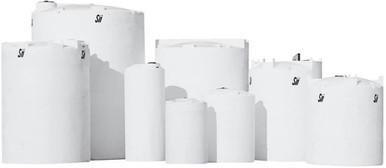
For a representative Snyder product such as the SII-32382 (Snyder Industries 5000 Gallon Plastic Vertical Water Storage Tank, Listed at $6,498.99), the spec sheet typically lists:
- Capacity, dimensions (diameter × height), weight.
- Resin type — HDPE, HDLPE, XLPE.
- SG rating — 1.5, 1.7, 1.9.
- ASTM D1998-19 compliance statement.
- Color and UV stabilization (e.g., Equator black for outdoor service, natural white for indoor).
- Fitting placement diagram (top inlet, side outlet, vent location).
- Manway location and size.
- Standard warranty terms (typically 3-year warranty on rotomolded tanks).
If the spec sheet only lists D2282, that is a red flag. If it lists D1998 with a specific SG rating that matches your fluid, that is the correct certification.
Other relevant standards on a real tank purchase
Beyond D1998, the certifications worth verifying on a polyethylene tank purchase include:
- NSF/ANSI 61 — Drinking Water System Components - Health Effects. Required for any tank used in potable water service. Verify NSF 61 listing for the specific resin and tank model. Not all polyethylene tanks are NSF 61 certified — natural-white food-grade resins typically are; black UV-stabilized resins typically are not.
- FDA 21 CFR 177.1520 — Polyolefin compliance for food contact. Lower-tier than NSF 61 but relevant for non-potable food-adjacent service.
- UV stabilization classification — manufacturers publish UV ratings (typically 8-12 years outdoor service before 50% retained tensile strength).
- Resin chemical resistance — published per fluid in manufacturer compatibility charts; cross-reference against your stored fluid before purchase.
For chemical service, see the /chemical-compatibility/ database for fluid-specific compatibility data on each resin.
What D1998 does not prove
D1998 compliance is necessary but not sufficient for a successful tank installation. The standard does not address:
- Foundation design — D1998 assumes a flat, level, fully-supporting foundation. Foundation engineering is the buyer's responsibility.
- Seismic anchoring — D1998 does not specify seismic restraint. ASCE 7-22 governs seismic design loads in the US; AHJ rules apply in seismic zones.
- Wind load anchoring — D1998 does not specify wind restraint. ASCE 7-22 wind-load provisions apply.
- Snow load on flat tops — D1998 specifies tank-top design but assumes specific snow-load conditions. ASCE 7-22 governs.
- Specific chemical compatibility — D1998 specifies the resin family; chemical compatibility is per-fluid and requires manufacturer compatibility chart review.
- Operating temperature — D1998 derates HDS at elevated temperature but does not specify a maximum operating temperature. Standard polyethylene tanks are rated for ambient (typically 100-120°F max continuous service).
A correctly D1998-compliant tank can still fail in the field if foundation, anchoring, fluid compatibility, or operating temperature is misspecified. The certification is the floor, not the ceiling.
How to specify correctly
A correctly written specification clause for a polyethylene rotomolded vertical tank reads approximately:
"Furnish one [capacity] polyethylene vertical storage tank, manufactured in accordance with ASTM D1998-19, Type [II HDPE / V XLPE], rated for [SG] specific gravity service. Provide [color] resin with [UV stabilization rating]. Fittings per manufacturer's standard schedule. Provide certified test report per ASTM D1998 Section 11 prior to shipment. NSF/ANSI 61 listing required for potable water service."
That clause is unambiguous, ties to a specific governing standard, specifies the rating tier, and triggers documentation. It does not cite D2282, because D2282 does not apply.
Bottom line
D1998 is the polyethylene tank standard. D2282 is the ABS-pipe-compound classification. They cover different materials in different applications. Specifying D2282 on a polyethylene tank is incorrect; specifying D1998 on an ABS pipe is incorrect. On a tank purchase, ask for the manufacturer's D1998 compliance statement, the SG rating tier, and the resin type. That is what governs how the tank performs over its 15-30 year service life.
For specification support on a specific tank SKU or to request a manufacturer's D1998 compliance documentation, call 866-418-1777 or use /freight-cost-estimator/ with your application details.
Field Operations Addendum
The two standards solve different problems, and confusing the two is the most common spec-sheet error I see when an authority having jurisdiction reviews a tank submittal. Read the cover page of each before quoting them, because the AHJ will.
Test vessel vs production tank. ASTM D1998 is the standard specification for polyethylene upright storage tanks — it covers the finished tank as built, including wall thickness, hydrostatic design, manway and fitting requirements, and the testing protocol the tank itself has to pass. ASTM D2282 (and its sibling D1693, environmental stress-crack resistance) operate at the resin level: they are bench tests run on small specimens cut from the resin or from a controlled molding, and they characterize the polymer, not the tank. A tank can be molded from a resin that passes D2282 and still fail D1998 if the molder gets the wall thickness or the rotational profile wrong. Conversely, a tank that passes D1998 is implicitly relying on a resin that meets the relevant resin-grade standard, but the resin certification is upstream paperwork — it is not what the tank inspector stamps.
Finished-tank cert vs resin-grade cert. When a project specification calls for "ASTM D1998 compliant," the supplier owes you a tank-level certificate of conformance: serial number, build date, design specific gravity, wall-thickness profile, and hydrostatic test result. When a spec calls for "ASTM D2282 resin," the supplier owes you a resin data sheet from the polymer producer showing the test result on the resin lot. Both can be required on the same project; they are not interchangeable.
What AHJs actually accept. Plan reviewers in fire, building, and environmental departments overwhelmingly look for D1998 on the tank submittal — that is the standard cited in the IFC and most state fire codes for atmospheric polyethylene tanks. Resin-level standards are accepted as supporting documentation but rarely as the primary compliance citation. If your spec only lists a resin standard, expect a request-for-information from the reviewer asking for the tank-level certificate before the permit clears.
Recommended Tanks for This Guide
Live pricing, updated automatically · estimate freight to your ZIP.