Chemical Secondary-Containment Sizing under 40 CFR 264.175 (RCRA) and Where 264.193 Takes Over
RCRA secondary containment is one of the most misquoted regulations in industrial chemistry. Plant engineers cite "110 percent" as if it were universal. It is not. The 110 percent rule is the SPCC oil-storage rule under 40 CFR 112; RCRA hazardous-waste containment uses a different math, a different applicability boundary, and a different set of design constraints. This guide walks 40 CFR 264.175 (containers, like drums and totes), 40 CFR 264.193 (tank systems), and the seam where one applies and the other takes over — with real OneSource SKUs you can put behind a permit submittal.
The two regulatory provisions
Under the federal Resource Conservation and Recovery Act, hazardous waste storage is governed by two distinct sections of 40 CFR Part 264 Subpart I and Subpart J:
- 40 CFR 264.175 — Containment. Applies to portable storage containers (drums, totes, smaller IBCs) holding hazardous waste at permitted Treatment, Storage, and Disposal Facilities (TSDFs). The containment system must have a base free of cracks and gaps, sufficiently impervious to contain leaks, and capacity equal to the greater of 10 percent of the total volume of all containers or the volume of the largest single container.
- 40 CFR 264.193 — Containment and detection of releases. Applies to tank systems holding hazardous waste. Requires secondary containment that prevents migration of waste to soil, groundwater, or surface water during the active life of the system, plus leak detection capable of detecting a release within 24 hours.
The threshold question for the engineer: is the storage unit a container (drum, tote, IBC, smaller portable vessel) or a tank system (stationary, plumbed, fixed)? Get that wrong and the wrong sizing math gets applied. RCRA permit reviewers will catch the misclassification.
40 CFR 264.175 sizing math — the "greater of" rule
For container storage areas, the containment volume V_c is:
V_c = max( 0.10 * sum(V_i), max(V_i) )
where V_i is the volume of each individual container in the area. Two worked examples:
- Example A — uniform 55-gallon drums. Twenty drums of 55 gallons each = 1,100 gallons total. 10 percent = 110 gallons. Largest single = 55 gallons. The "greater of" gives 110 gallons of required containment volume. Plus freeboard for precipitation if the storage area is exposed.
- Example B — mixed drums and one 330-gallon tote. Five drums of 55 gallons (= 275 gallons) plus one 330-gallon tote = 605 gallons total. 10 percent = 60.5 gallons. Largest single = 330 gallons. The "greater of" gives 330 gallons. The single tote drives the sizing — the 10 percent rule never controls when one container exceeds 10 percent of the total inventory.
This is structurally different from SPCC's 110 percent of the largest container. SPCC is more conservative on a single-tank basis. RCRA 264.175 is more conservative on the inventory basis, but only matters when the population of containers is reasonably uniform.
40 CFR 264.193 sizing math — tank systems
For tank systems, the containment requirement is qualitative and capability-based, not volumetric: the secondary containment must prevent migration of waste, and the system must include leak detection capable of identifying a release within 24 hours. In practice, RCRA permit writers translate this into one of three engineered approaches:
- Liner system. The tank sits inside a synthetic or earthen liner sized to hold the volume of the largest tank in the system plus precipitation freeboard for the 25-year, 24-hour storm event.
- Vault. The tank sits inside a concrete or polymer vault sized similarly.
- Double-walled tank. The tank is fabricated as an integrated primary-and-secondary vessel with a continuously monitored interstitial space.
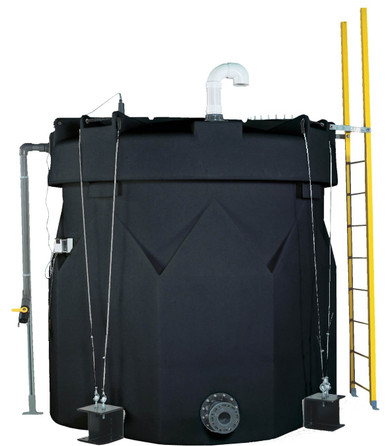
Double-wall tank systems compress the regulatory footprint dramatically. Snyder's Captor double-wall HDLPE tank (MPN 1006600N43, 10,000 gallons, 1.5 SG, listed at $70,408.99) integrates the primary and secondary in one rotomolded assembly with a leak-detection interstitial port. The engineering value: zero footprint outside the tank shell, leak detection inside 24 hours by design, and no separate liner to maintain.
For the regulatory walkthrough on Captor and SPCC see our pillar at Snyder Captor for SPCC 40 CFR 112. The same hardware addresses both rules — 40 CFR 264.193 for hazardous waste tanks and 40 CFR 112 for oil — with one purchase.
Where 264.175 ends and 264.193 takes over
The dividing line is plumbing. A 330-gallon tote with a manual gravity drain into a separate transfer drum is a container under 264.175. A 1,500-gallon polyethylene tank piped to a process feed pump on a permanent plumbing run is a tank system under 264.193. The EPA decision tree treats anything with fixed plumbing, an installed pump, or integration into a process line as a tank system — even if the same vessel could hypothetically be lifted and moved.
Two practical implications:
- Adding plumbing escalates the regulatory category. A site that bought a 1,000-gallon tank intending to move it on a forklift becomes a tank system the moment it gets bolted to a slab and piped to a feeder.
- Tote farms are container farms. Even at large inventory, totes plumbed only via cam-lock quick-disconnects are containers. Permanent welds or threaded plumbing change the classification.
Material compatibility — RCRA does not exempt the wall
40 CFR 264.193(c)(1) requires the secondary containment system to be "compatible with the waste(s) to be placed in the tank system." This is not a polymer-class assertion. It is a per-chemistry compatibility verification. Polyethylene tanks under ASTM D1998-19 are tested for service against specific gravity ratings (1.5 SG and 1.9 SG most common) but RCRA compliance demands a chemistry-by-chemistry compatibility review — not just a wall-thickness adequacy check.
For chemistry-resolved tank selection see Chemical Compatibility Database. For the polyethylene engineering context see Polyethylene Tank for Industrial Chemistry Service.
Catalog options for RCRA 264.175 container storage
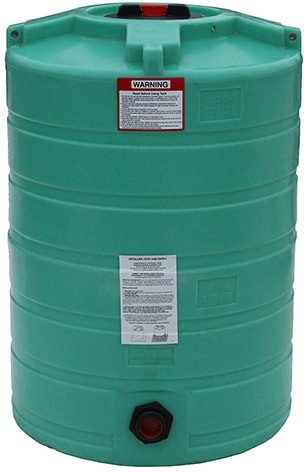
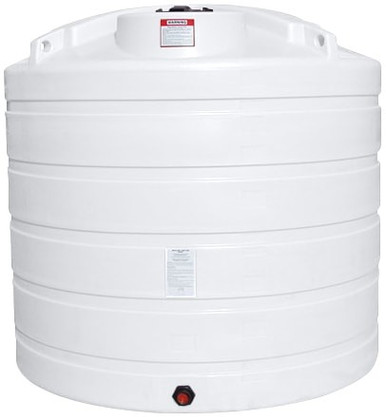
For container-area containment under 264.175, the relevant inventory is open-top spill containment pallets and bermed pads. While OneSource focuses on stationary vessels rather than spill pallets, the upstream container choice — drums and totes that feed into the storage area — is part of the same regulatory hardware decision. Single-wall vertical chemical tanks at 100 to 1,500 gallons fill the role of the "largest container" that drives the "greater of" sizing rule. Snyder MPN 1012700N42 (100 gallon XLPE vertical chemical, 1.9 SG) lists at $924.89; MPN 1830000N42 (1,100 gallon XLPE vertical) lists at $2,911.09. Both are XLPE crosslinked polyethylene under ASTM D1998-19 Type II.
For high-SG aggressive chemistries above 1.5 SG see XLPE selection guidance at Polyethylene Tank for Industrial Chemistry Service.
Catalog options for RCRA 264.193 tank systems
The double-wall route compresses regulatory complexity. Snyder Captor double-wall:
- MPN 5490000N42 — 1,550 gallon vertical XLPE double-wall, white, listed at $10,091.93
- MPN 1006600N43 — 10,000 gallon HDLPE Captor double-wall, 1.5 SG, listed at $70,408.99
- MPN 1006600N42 — 10,000 gallon XLPE Captor double-wall, 1.9 SG, listed at $91,468.99
The single-wall plus engineered berm or vault route can be more capital-efficient at smaller capacities. The breakeven typically lands somewhere between 1,500 and 5,000 gallons depending on regional concrete and excavation costs and on whether the site already has an SPCC-compliant berm in place.
Leak detection — the 24-hour rule
40 CFR 264.193(c)(3) requires leak detection capable of identifying a release within 24 hours. Three engineering approaches:
- Visual interstitial inspection. Daily walk-down with a sight tube or float in the interstitial space. Compliant on paper but vulnerable to operator drift.
- Continuous interstitial level sensor. Hydrostatic, capacitance, or float switch wired to a SCADA alarm. The default for double-wall tank installations.
- Vacuum-monitored interstitial space. A small continuous vacuum pulled on the interstitial; loss of vacuum triggers an alarm. Used in vapor-tight service.
For sensor selection see Tank Level Sensor Selection.
Foundation requirements under both rules
40 CFR 264.175 requires a base "free of cracks and gaps, sufficiently impervious." 40 CFR 264.193(c)(2) requires the secondary containment to be capable of preventing migration of waste "during the use of the tank system." Both translate practically to:
- Concrete pad with engineered joints (sealed expansion joints, no cold joints in the wetted surface).
- Slope toward a sump or pickup point.
- Coating or liner where the chemistry attacks bare concrete (acids, caustics).
- Permanent labeling consistent with 40 CFR 262.32 marking and 40 CFR 264.31 contingency planning.
For pad engineering see Tank Foundation Pad Engineering. For pad-vs-pavement decision see Concrete Pad vs Pavement vs Compacted Gravel.
State-by-state augmentation
RCRA is a federal floor. Authorized states administer the program with provisions at least as stringent as federal RCRA, and many add detail. Common state augmentations:
- California (DTSC). Hazardous Waste Control Law (Health and Safety Code Division 20, Chapter 6.5) and Title 22 CCR add California-specific definitions and listing thresholds. See California Tank Regulations.
- Texas (TCEQ). 30 TAC Chapter 335 incorporates RCRA with state-specific permit-by-rule provisions. See Texas Tank Regulations.
- New York (NYSDEC). 6 NYCRR Parts 370-376 implement RCRA in New York. See New York Tank Regulations.
- Ohio (Ohio EPA). OAC 3745-50 through 3745-69 implement RCRA in Ohio. See Ohio Tank Regulations.
State-by-state guidance: confirm your state's authorized program with your state environmental agency before specifying. RCRA permit writers will not waive 264.175 or 264.193 requirements but they may demand additional documentation, more frequent inspection schedules, or more conservative sizing.
Common compliance failures
Field experience surfaces a short list of recurring failures on RCRA secondary containment audits:
- Sizing to SPCC's 110 percent rule when 264.175's "greater of" controls. The 110 percent number undersizes when 10 percent of the total inventory exceeds the largest container — even though the engineer may believe they were "being conservative."
- Treating a tote farm as a tank system. Tote farms with quick-disconnect plumbing are containers. Treating them as tank systems triggers 264.193's 24-hour leak detection requirement unnecessarily.
- Ignoring precipitation freeboard. Outdoor container areas in the Southeast and coastal must accommodate the 25-year, 24-hour storm event. Sizing only to the "greater of" rule and forgetting the storm volume is a common audit finding.
- Specifying a polymer pad coating that is incompatible with the waste. Coatings that look generic-chemical-resistant on a data sheet can fail with specific oxidizers, peroxides, or solvents. Verify the coating against the actual waste chemistry.
- Missing the leak detection inspection log. 264.193 requires leak detection plus documentation of inspection. Operators add the sensor and forget the binder.
Documenting compliance — what the binder needs to contain
An RCRA inspector arriving on site asks for a binder, not a tour. The binder for a 264.175 container area or a 264.193 tank system should contain, at minimum:
- The waste analysis plan. Identifies each waste stream by EPA waste code (D, F, K, P, U series), characterizes the chemistry, and maps it to the containment design.
- The containment sizing calculation. Show the math. For 264.175, write out the "greater of" comparison explicitly — 10 percent of total inventory versus the largest single container — and document which controls. For 264.193, document the engineered approach (liner, vault, double-wall) and the basis for compatibility with the chemistry.
- The leak-detection design and inspection log. For 264.193, the sensor specification, the alarm setpoint, and a daily or shift-based inspection log demonstrating the 24-hour detection capability is exercised.
- The contingency plan. Per 40 CFR 264.51 through 264.56, including emergency coordinator contact information, the spill response procedure, and the closure plan.
- Personnel training records. Per 40 CFR 264.16, annual hazardous waste training documented for each operator with access to the storage area.
None of this is exotic, and none of it is expensive when set up correctly the first time. The expensive failure mode is retrofitting documentation after a Notice of Violation is already in hand.
Bottom line
40 CFR 264.175 governs container storage areas with the "greater of" sizing rule (10 percent of total volume or the volume of the largest container). 40 CFR 264.193 governs tank systems with capability-based secondary containment plus 24-hour leak detection. Get the classification right first, then size to the right rule. Snyder Captor double-wall tanks compress the 264.193 footprint. Single-wall tanks plus engineered berms and liners remain capital-efficient at smaller capacities. State authorized programs may augment the federal floor — confirm with the state environmental agency before locking the design.
For our SPCC pillar see Snyder Captor SPCC Walkthrough. For 110 percent containment math see Secondary Containment Volume Math. For full chemical-storage product family browse Chemical Storage Tanks.
Recommended Tanks for This Guide
Live pricing, updated automatically · estimate freight to your ZIP.