Cold-Weather Polyethylene Tank Selection: Low-Temperature Mechanical Behavior, Thermal Contraction, and Tie-Down Compensation
The common shorthand that polyethylene tanks become brittle in winter is technically incorrect for the temperature ranges most operators encounter. Virgin HDPE has a glass transition temperature near minus 110 degrees Celsius and a measured ductile-to-brittle transition (per ASTM impact testing) typically below minus 70 degrees Celsius. At minus 20 to minus 40 degrees Fahrenheit (the cold extremes most rural and northern installations see), HDPE remains in its ductile range. The actual engineering problems in cold-weather PE tank service are different, and ignoring them is what produces the failures that get blamed on brittleness. This piece walks the real cold-weather engineering — low-temperature stiffness gain, thermal contraction at fittings and bulkheads, freeze loading from contained water, and how tie-down compensation must be adjusted for winter conditions.
What changes in HDPE at low temperature (and what does not)
Three properties shift meaningfully in HDPE between summer and deep-winter service temperatures, and one critical property does not change appreciably:
Stiffness rises
HDPE flexural modulus increases substantially as temperature drops. Published ASTM D790 flexural modulus values for typical rotomolded HDPE rise from approximately 130,000 psi at 73 degrees Fahrenheit to approximately 200,000 to 230,000 psi at minus 20 degrees Fahrenheit. The tank wall is stiffer in winter. This shifts the dynamic response of the tank to wind loading, fluid sloshing, and impact events.
Tensile strength rises
Yield strength of HDPE rises with falling temperature, typical values moving from approximately 3,400 psi at 73 degrees Fahrenheit to approximately 4,500 to 5,000 psi at minus 20 degrees Fahrenheit. The wall can carry more static stress at low temperature.
Impact toughness drops
Notched Izod impact strength (ASTM D256) for typical HDPE drops from approximately 4 to 8 ft-lbf/inch at 73 degrees Fahrenheit to approximately 1.5 to 3 ft-lbf/inch at minus 20 degrees Fahrenheit. The tank does not become brittle in the classical glass-transition sense, but it is more vulnerable to impact damage at low temperature, particularly at notched or stress-concentration features (bulkhead penetrations, lid threads, manway seams).
Ductility (elongation at break) does not collapse
Per ASTM D638 tensile testing, HDPE elongation at break remains substantial even at minus 40 degrees Fahrenheit (typically still 200 to 400 percent elongation versus 600 to 800 percent at room temperature). The polymer continues to draw and yield rather than fracturing brittle-flat. This is the reason HDPE is a reliable cold-climate material at all — and the reason the brittleness narrative is overblown.
The cross-link advantage — XLPE for cold service
Cross-linked polyethylene (XLPE) is HDPE that has been chemically cross-linked during the rotomolding cycle. The cross-links pin polymer chains and reduce environmental stress cracking. For cold-climate service, XLPE adds two practical advantages over standard HDPE:
- Higher impact toughness retention at low temperature. The cross-link network distributes impact energy more uniformly. Notched Izod values at minus 20 degrees Fahrenheit for ASTM D1998 XLPE typically run 30 to 50 percent higher than equivalent HDPE.
- Better resistance to slow crack growth (SCG). Cold-weather installations often see thermal cycling between minus 20 degrees Fahrenheit overnight and plus 30 degrees Fahrenheit afternoon. Each cycle drives stress at fittings and seams. Cross-linking suppresses the SCG mechanism that would propagate a notch crack over hundreds of cycles.
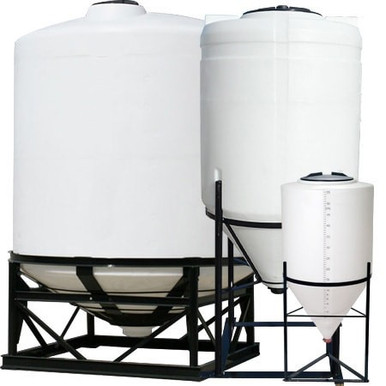
Real catalog example: Snyder ASTM XLPE 1500-gallon, 45-degree cone bottom tank (MPN 5010000N42, listed at $4,428.99) is the cross-linked option for a cold-climate process tank. The standard HDPE equivalent is appropriate for ambient-only service; the XLPE is the right call for installations that see sub-zero ambient with thermal-cycling solar gain.
For a deeper material comparison see XLPE vs HDPE Chemistry and Duty Cycle.
Thermal contraction — the under-appreciated cold-weather load
Polyethylene has a coefficient of linear thermal expansion (CLTE) of approximately 9 to 11 x 10 to the minus 5 inches per inch per degree Fahrenheit. That is roughly an order of magnitude higher than steel (6.5 x 10 to the minus 6) and several times higher than aluminum.
For a 95-inch diameter Norwesco 2,500-gallon vertical (MPN 42040, listed at $2,399.00), the diameter contraction between 80 degrees Fahrenheit summer ambient and minus 20 degrees Fahrenheit winter overnight is:
delta_D = D * CLTE * delta_T = 95 * 0.0001 * 100 = 0.95 inches
Almost an inch of diametral contraction. Tank height contracts proportionally — 91-inch tall, contracting roughly 0.91 inches over the same temperature swing. These contractions are mostly absorbed by the tank wall flexing inward; they become a problem only at fittings, bulkheads, and rigid connections.
Where thermal contraction breaks things
The failure modes are predictable:
- Bulkhead fitting leaks. A rigid PVC nipple bonded into a polyethylene bulkhead does not shrink at the same rate. The tank wall pulls away from the rigid fitting in winter. Static seals strained beyond their compression range leak.
- Cracked lid threads. Threaded plastic lids screwed snug at 80 degrees Fahrenheit ambient become over-torqued from differential contraction at minus 20 degrees Fahrenheit. The thread interface develops hoop stress and can crack at start-of-thread stress concentrations.
- Strain at downstream rigid plumbing. A 2-inch PVC line glued tight to a tank discharge fitting with the tank installed warm will experience axial strain when the tank shrinks below the pipe. This shows up as either a leaking pipe joint or a deformed tank discharge boss.
Engineering responses
Three field practices reduce thermal-contraction failure:
- Use compression-fit bulkhead fittings. The Banjo-style compression bulkhead with a flexible rubber gasket accommodates differential contraction. Avoid thread-in or solvent-bonded rigid PVC at the tank wall in cold-climate service.
- Install plumbing with a flex element. A flex hose section, a slip joint, or a deliberately-formed expansion loop in the discharge plumbing accommodates shrinkage without straining the tank.
- Tighten lids hand-snug at moderate ambient. Avoid wrench-tightening lids in cold weather — at warmer service ambient the joint will be over-stressed.
Freeze loading — when contained water freezes inside the tank
Water expands approximately 9 percent in volume on freezing. A partially-filled PE tank can accommodate top-surface ice formation without damage — the ice floats and the unfrozen water below absorbs the volume expansion through the open free surface. The damage scenarios are:
- Full or near-full tank with no free surface. If a tank is filled to the brim and freezes top-down, the freeze front eventually meets a rigid lid or flange. The expansion has nowhere to go and the wall takes the hoop stress. Fitting bosses, lid threads, and bottom-shell seams are typical failure points.
- Discharge plumbing freeze. A liquid-line freeze in the discharge piping below the tank can produce back-pressure into the tank. The tank wall is generally tougher than the piping, so the pipe usually fails first — but the tank can be pulled inward at the discharge boss as the line freezes solid.
- Freeze-thaw cycling at fittings. Not catastrophic on a single cycle, but a fitting that sees daily freeze-thaw at the gasket interface develops fatigue. The seal weeps, ice forms, the fitting cracks, the tank loses fluid.
Operating practice
For winter water-storage tanks in zones that see sustained sub-freezing ambient:
- Maintain at least 10 to 15 percent ullage (free-surface headspace) on any tank that may freeze. The ice expansion goes into the headspace, not into the wall.
- Heat-trace and insulate any below-tank discharge plumbing that runs above grade.
- Insulate the tank itself for any process tank that must stay above freezing for service reasons. R-12 to R-19 wraps in foil-faced batts work for most installations.
- Drain and idle any tank that is going to be unattended through deep-freeze conditions and is not actively heated.
For full insulation and heat-tracing engineering see Tank Insulation and Heat Tracing.
Tie-down compensation for cold-weather service
Cold-weather tie-down engineering layers two effects on top of the standard ASCE 7-22 wind-load case:
Snow loading on roof / dome
Snow accumulation on the dome of a vertical PE tank adds dead load. ASCE 7-22 Chapter 7 provides ground snow load p_g for the location, and the flat-roof snow load p_f follows:
p_f = 0.7 * C_e * C_t * I_s * p_g
For most rural installations: C_e = 1.0 (Exposure C), C_t = 1.0 (heated structure not applicable, use 1.2 for unheated), I_s = 1.0 (Risk II). With p_g = 50 psf in northern Vermont, p_f = 0.7 * 1.0 * 1.2 * 1.0 * 50 = 42 psf flat-roof equivalent.
The dome of a 2,500-gallon PE tank has a roof projected area of approximately 49 square feet. The snow load is 42 * 49 = 2,058 lbf of dead load on the dome. This is well below the dome ultimate load, but it adds an inverted moment at the tank-to-foundation connection that opposes wind uplift — beneficial for the tie-down case but adverse for any structural lifting (cranes, rigging) that might happen later.
Reduced strap retention force
Polyester webbing straps retain rated working load at low temperature reasonably well, but the polyester loses 5 to 15 percent tension over the first cold cycle as the webbing shrinks and the buckle settles. Cold-installed straps tend to relax over the first few weeks. Practical compensation: re-tension straps after the first week of installation, then re-tension annually as part of routine maintenance.
Anchor concrete
Concrete pad strength is unaffected by sub-freezing ambient once the concrete is cured. The exception is a tank installed during a winter pour where the concrete did not reach 70 to 75 percent of design strength before cold-weather hydration shutdown. ICC 318-19 and ACI 306 cover cold-weather concrete placement; the practical implication for tank installations is to specify either summer pour or winter pour with insulating blankets and accelerator additive. Pad failure traced to inadequate cold-weather curing is a recurring AHJ deficiency.
For full ASCE 7-22 wind-load engineering see Hurricane Tie-Down Design for Coastal Water Tanks.
Resin-grade selection for cold-climate service
Three rotomolding resin grades are common in OneSource catalog tanks and have meaningfully different cold-weather behavior:
Standard HDPE (FDA virgin)
The default resin for ASTM D1998 vertical tanks. Acceptable for ambient down to approximately minus 20 degrees Fahrenheit for static water-storage service. Above minus 20 degrees Fahrenheit, no special selection required. Below minus 20 degrees Fahrenheit, consider impact-rated grades or XLPE.
Impact-modified HDPE (ASTM D1998 with elastomer toughener)
Some Norwesco and Snyder lines use an impact-modified HDPE blend that increases the low-temperature notched Izod and slows slow-crack growth. These are typically marketed as cold-rated or arctic-grade. For sustained service below minus 20 degrees Fahrenheit, the impact-modified grade is the responsible choice.
XLPE (ASTM D1998 cross-linked)
The cross-linked grade is the toughest cold-weather option. Higher cost, but the cross-link network resists slow crack growth and impact damage at low temperature meaningfully better than HDPE. For severe cold-climate process tanks (paper mills in Maine, mines in Alaska), XLPE is the standard specification.
Real Snyder XLPE catalog options:
- 1500 gallon, 45-degree cone bottom XLPE in white, MPN 5010000N42, listed at $4,428.99
- 3600 gallon, 15-degree cone bottom XLPE in white, MPN 8050000N42, listed at $9,578.99
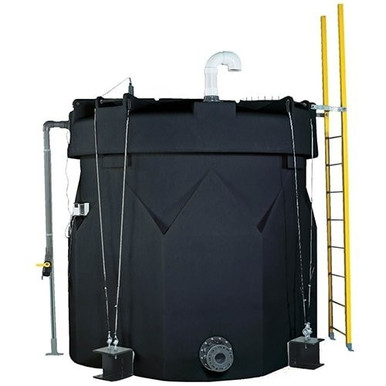
- 3500 gallon ASTM XLPE Captor double-wall, MPN 5600000N42, listed at $25,399.00
For full Snyder catalog browse Snyder Industries Tanks.
Cold-climate state regulation context
State regulators in the cold-climate northern tier have specific provisions for above-ground tank installations:
- Minnesota requires winter installation submittals to address freeze protection.
- Wisconsin rural-water installations frequently require a cold-weather operations plan as part of the well-and-tank permit package.
- North Dakota and South Dakota have specific guidance on winter water-hauling reservoir storage.
- Alaska rural community water systems require XLPE or impact-modified HDPE for winter service.
- Maine cold-pour installations need ACI 306 documentation in the permit package.
Pre-installation checklist for cold-climate tanks
Before sign-off on any sub-freezing service installation:
- Resin grade verified — XLPE or impact-modified HDPE for sustained sub-zero service.
- Bulkhead fittings — compression-style with flexible gasket, not bonded rigid PVC.
- Discharge plumbing — flex element or expansion loop; insulation and heat-trace as applicable.
- Lid torque — hand-snug at moderate ambient, not wrench-tightened at extremes.
- Free surface (ullage) — minimum 10 percent for winter water service.
- Tie-down straps — re-tension scheduled at one week and annually thereafter.
- Concrete pad — cured to 75 percent design strength before tank install in cold-weather pour situations.
- Snow load addition to wind tie-down case — verified for the local ground snow load.
Bottom line
HDPE does not get brittle at typical North American winter service temperatures — the ductile-to-brittle transition is well below minus 70 degrees Fahrenheit for ASTM D1998 grade resin. The actual cold-weather engineering issues are differential thermal contraction at fittings, freeze-loading from contained water with no free surface, snow-load addition to the tie-down case, and reduced impact toughness at low temperature making notched stress concentrations more vulnerable. Resin selection (XLPE or impact-modified HDPE for severe cold), fitting style (compression bulkheads, not rigid bonded), free surface (minimum 10 percent ullage), and tie-down compensation (re-tension after first cold cycle) cover the engineering. Static water-storage tanks installed and operated to these specs perform well through northern-tier winters; the failure modes that get blamed on brittleness are almost always traceable to an avoidable installation deficiency.
For full HDPE vs XLPE catalog options browse Poly Tanks. For cold-climate insulation engineering see Tank Insulation and Heat Tracing. For the related cold-cycle field-performance pillar see Cold Climate Tank Field Performance.
Recommended Tanks for This Guide
Live pricing, updated automatically · estimate freight to your ZIP.