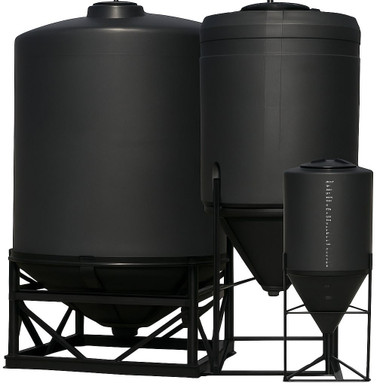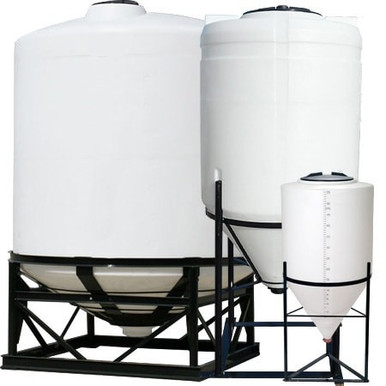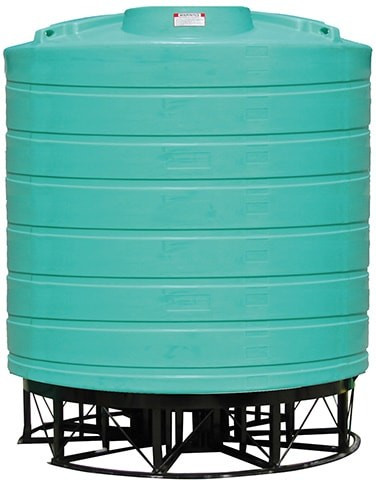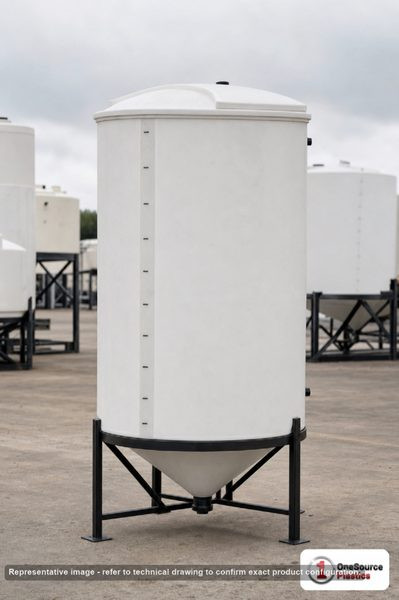
Cone Bottom Tank Stand Selection: Steel Frame vs Polyethylene Stand Decision Tree
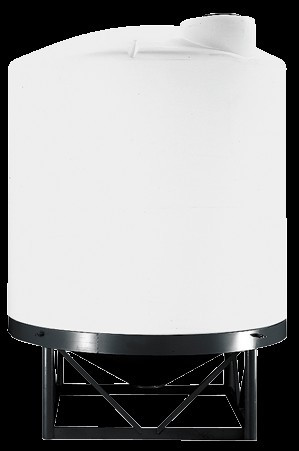
The cone-bottom stand is structurally the most critical accessory in a process-tank installation. It carries 100% of the static fluid load, transfers the load into a concrete pad or platform, holds the cone at a consistent angle through fill/drain cycles, and lives in whatever splash environment the tank generates. Pick the wrong stand material and you trade a 30-year tank life for a 7-year stand life, with the failure mode showing up as cone deformation, weld cracking, or corrosion-induced collapse.
This guide is a decision tree for the steel-vs-polyethylene stand question, with real Norwesco, Snyder Industries, and Enduraplas stand SKUs cross-referenced to the cone-bottom tanks they support. Pricing is BigCommerce list before LTL freight; freight is quoted to ZIP through the Freight Cost Estimator or by calling 866-418-1777.
The Two Architectures
Cone-bottom stands fall into two architectural families.
Welded steel frame
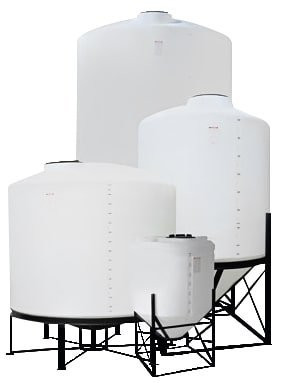
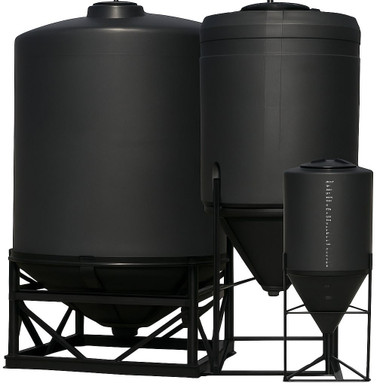
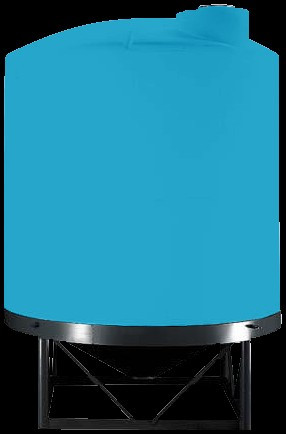
A bolted or welded structural-steel frame, typically powder-coated, with a contoured upper cradle that supports the cone-to-sidewall transition of the tank. Norwesco's N-63933 (300/500 gallon, $819.99 list), N-63934 (1000/1500 gallon, $1,379.14), N-64076 (2500/3000 gallon, $2,739.99), N-60358 (5500 gallon, $7,279.99), and N-64070 (7500/10000 gallon, $7,279.99) are all welded-steel architecture. Snyder's SII-1370000N97601 (22-inch diameter, $575.57), SII-1690001N97601 (30-inch diameter, $996.70), SII-1760000N97601 (48-inch diameter, $1,613.00), and SII-1760001N97601 (48-inch diameter with 18-inch outlet clearance, $1,854.00) are also welded steel.
Polyethylene-integrated
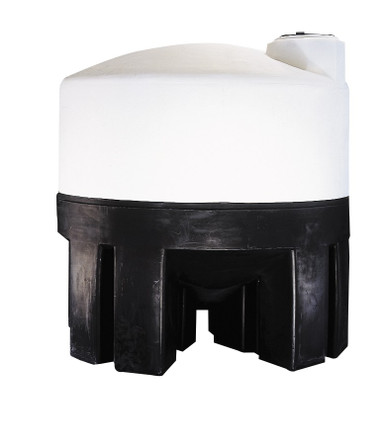
A poly cradle either molded as part of the tank assembly (Enduraplas approach: the THM060KWH01 60-gallon cone-bottom with integrated stand at $648, the larger Enduraplas integrated cone-bottom assemblies in the same family) or molded as a separate poly cradle that bolts to the tank (Snyder's SII-1003700N97802 for 65 and 125 gallon at $402, SII-1004000N97802 for 225 gallon at $625, SII-1004200N97802 for 335 gallon at $675). Norwesco does not currently produce polyethylene-integrated stands; their entire cone-bottom stand catalog is steel.
Decision Tree: When to Choose Steel
Steel wins on five engineering criteria:
1. Capacity above 500 gallons
A 1,000-gallon cone-bottom full of brine at SG 1.2 weighs 10,000 pounds. A 5,500-gallon cone full of 31.45% urea-ammonium-nitrate (UAN-32) at SG 1.32 weighs 60,500 pounds. The poly-integrated cradle that ships with the Snyder 65-gallon (550 pounds full at SG 1.0) does not scale to those loads. Above approximately 500 gallons, every commercial cone-bottom on the market uses welded steel, because the moment loading at the cradle-to-frame interface exceeds what polyethylene can carry without creep deformation. Norwesco's lineup confirms this: every Norwesco stand from 1000-gallon up is steel. There is no commercial poly stand option at those capacities.
2. Outdoor non-chemistry installations
Powder-coated steel handles weather. The exterior coating sheds rain and resists UV. For water, brine, fertilizer, or food-grade installations outdoors with no chemistry splash on the stand, steel is the cost-leader and the maintenance is minimal (occasional touch-up of nicks where the powder coat gets scratched). Pairing a 1500-gallon Norwesco vertical-cone with the N-63934 stand for $1,379.14 is the standard approach for ag-water or municipal-water cone-bottom installs in the 1000-2500 gallon range.
3. Seismic anchoring
For tanks larger than 1,000 gallons in seismic zones (California, Pacific Northwest, parts of Alaska, Puerto Rico, certain Nevada and Utah counties), the stand needs anchoring to a concrete pad sized for the seismic shear and overturning loads. The 2022 California Building Code Chapter 16 references ASCE 7-22 Chapter 15 for non-building structures, with IBC seismic categories driving the design. Snyder's SII-79800000 seismic stand for 3900-4400 gallon cone-bottom is engineered with anchor-bolt geometry rated for the moment loading; standard cone stands are not. Steel is the only structural option here because the anchor-bolt-to-base-plate interface needs the load capacity that only steel provides.
4. Process retrofit where the tank changes
If you anticipate tank replacement on a 5 to 10 year cadence (food-grade rotation, regulatory recertification, capacity step-up), steel stands have a modest reuse value. Replacing a tank inside an existing steel cradle is a two-hour crane lift. Replacing a tank with an integrated poly cradle means buying a new tank+stand assembly. For 5,500-gallon and larger installs where the tank cost dominates, the difference is small; for the 60 to 500 gallon segment where the stand cost approaches 30% of the tank cost, the replacement strategy matters.
5. Lower upfront cost
Steel is cheaper per pound of supported load. The Norwesco 300/500 stand at $819.99 supports 500 gallons (about 5,000 pounds) - call it $164 per kilopound. The Snyder SII-1003700N97802 poly stand at $402 supports 125 gallons (1,250 pounds) - that's $322 per kilopound. The poly premium is real and it's significant.
Decision Tree: When to Choose Polyethylene
Polyethylene wins on a different set of criteria:
1. Aggressive chemistry with splash exposure
Sulfuric acid 93%, sodium hypochlorite 12.5%, hydrochloric acid 32%, ferric chloride 30%, sodium hydroxide 50%, and hydrogen peroxide 35% all corrode powder-coated steel where the chemistry hits a coating defect. Polyethylene is immune to all of these at standard concentrations. For chemical-feed stations (sulfuric in cooling-tower acid feed, hypochlorite in potable water disinfection, ferric chloride in wastewater coagulation), the poly stand is engineering-default. Snyder's Chemical Feed Station (CFWS) line is built around exactly this: SII-1000124CFWS-42 (35 gallon XLPE), SII-5680024CFWS45 (60 gallon HDLPE), SII-5720104CFWS45 (200 gallon HDLPE), SII-5740104CFWS-42 (275 gallon XLPE), SII-5750104CFWS30 (330 gallon HDLPE for sulfuric acid with containment), SII-5770104CFWS42 (440 gallon XLPE) are all integrated tank+stand+containment poly assemblies.
2. Indoor wash-down environments
Food-and-beverage processing, USDA inspection facilities, pharmaceutical compounding, and indoor-pool water-treatment rooms all involve daily caustic and chlorinated wash-down. Powder-coated steel survives this for 5-8 years before the coating deteriorates around fittings and drain points. Polyethylene cradles have no coating to degrade and can be hosed daily with no maintenance impact. For sub-500-gallon installs in these environments, the poly cradle is the right choice.
3. Coastal or salt-fog exposure
Within 5 miles of saltwater (every Atlantic, Gulf, and Pacific coastal county; Hawaii statewide; coastal Alaska), salt-fog corrosion shortens powder-coated-steel stand life by 40-60% versus inland installations. Galvanized steel doesn't help much at the welds. The polyethylene cradle is corrosion-immune and has no installation-environment penalty. For coastal seafood processing, marine-fueling stations, and offshore-supply yards, the poly approach pays back in stand-replacement avoidance.
4. Single-SKU procurement preference
The Enduraplas integrated tank+stand assemblies (THM060KWH01 and the larger sizes) ship as one SKU. Procurement, freight, install, and warranty are all simplified - one PO, one truck, one warranty card, one part number. For sub-500-gallon orders where the procurement overhead matters, single-SKU integrated assemblies reduce paperwork and freight cost (one assembly takes one pallet position; tank-plus-separate-stand often takes two).
5. Sub-500-gallon capacity
Below 500 gallons, the load is small enough that polyethylene structural integrity is sufficient for static support and creep is negligible over 30+ year service life. The Snyder SII-1003700N97802 for 65/125 gallon, SII-1004000N97802 for 225 gallon, and SII-1004200N97802 for 335 gallon all carry their loads through HDLPE poly construction. Above 500 gallons the math flips and steel takes over.
The Decision Matrix
| Capacity | Service | Environment | Recommendation |
|---|---|---|---|
| 35-225 gal | Chemical feed | Indoor splash | Snyder CFWS poly integrated |
| 35-225 gal | Water/brine | Outdoor inland | SII-48600 steel ($340) or N-41477 ($509.99) |
| 300-500 gal | Chemistry | Indoor or coastal | Snyder CFWS-42/45/30 integrated |
| 300-500 gal | Water/ag | Outdoor inland | N-63933 ($819.99) steel |
| 1000-1500 gal | Any | Any | N-63934 ($1,379.14) steel - no poly option exists |
| 2500-3000 gal | Any | Any | N-64076 ($2,739.99) for 2014+ tanks; N-60059 ($4,037.50) legacy |
| 5500 gal | Any | Inland | N-60358 ($7,279.99) steel |
| 3900-4400 gal | Any | Seismic zones | SII-79800000 ($5,892.99) seismic-rated steel |
| 7500-10000 gal | Any | Any | N-64070 ($7,279.99) for 2014+; N-61860 ($11,269.85) legacy |
Load-Path Engineering Reality Check
The headline difference between steel and poly is rated load capacity at the cradle-to-frame interface.
Steel cradle load math
A welded steel frame with a 1/4-inch-thick contoured cradle plate and 2-inch square HSS structural members carries roughly 4,000 to 6,000 pounds per linear foot of cradle perimeter at standard yield-stress factor of safety. For a 1,000-gallon Norwesco cone tank with a 73-inch diameter and 360-degree cradle contact, the perimeter is approximately 19 feet, giving a load capacity ceiling around 80,000 pounds. The actual fluid load is 8,300 pounds for water at SG 1.0. The steel safety margin is roughly 10x. This is why steel scales without architectural change all the way up to 10,000-gallon class tanks.
Poly cradle load math
A 1/2-inch-thick rotomolded HDLPE cradle, 30-inch diameter (perimeter 7.85 feet), carries approximately 600 to 900 pounds per linear foot at long-term creep-stress limits. Total capacity around 5,000 to 7,000 pounds. For a 125-gallon tank at SG 1.0, the fluid load is 1,040 pounds and the safety margin is roughly 5x. Move to 225 gallons (1,875 pounds) and the safety margin drops to 3x. Move to 500 gallons (4,170 pounds) and the safety margin is 1.5x - too tight. This is the engineering reason poly stands top out around 335 gallons in the Snyder lineup.
Creep behavior
Polyethylene has measurable creep deformation under sustained load at room temperature. ASTM D1998 (the standard specification for polyethylene upright storage tanks) specifies hoop-stress design with a 5-to-1 hydrostatic-design-stress safety factor partly because of creep. A poly stand carrying 80% of its rated load 24/7 will deform measurably over 10-15 years and the cradle contour will shift, producing a stress point on the cone. Steel does not creep at room temperature.
Corrosion Lifecycle by Environment
| Environment | Powder-coated steel life | HDLPE poly life |
|---|---|---|
| Outdoor inland, water/brine | 25-30 years with touch-up | 30+ years |
| Outdoor coastal (within 5 miles of salt water) | 12-18 years | 30+ years |
| Indoor wash-down (food, pharma) | 5-10 years | 30+ years |
| Sulfuric acid splash | 2-4 years | 30+ years |
| Sodium hypochlorite splash | 3-5 years | 30+ years |
| Hydrochloric acid splash | 1-3 years | 30+ years |
The chemistry-splash columns drive the chemical-feed-station market entirely toward integrated polyethylene assemblies. The cost differential is real but a 4-year stand replacement cycle on a sulfuric acid feed station eats the savings in maintenance labor and contamination risk within the first replacement cycle.
Anchoring Considerations
Both stand families need anchoring on a concrete pad. The pad design depends on the stand architecture.
Steel stand anchoring
Steel cone-bottom stands typically use 1/2-inch or 5/8-inch wedge anchors (Hilti HSL-3, Powers Power-Stud, or equivalent) through anchor-bolt holes pre-drilled in the base plates. Hole locations are specified in the stand documentation. Pad concrete should be minimum 3,500 psi 28-day strength, 6-inch thickness for stands up to 3,000 gallon, 8-inch for 5,500 to 10,000 gallon. ACI 318 Chapter 17 covers anchor design for the cracked-concrete condition. For seismic installs the anchor count and bolt diameter step up - reference the seismic-rated stand spec sheet for the specific anchor schedule.
Poly stand anchoring
Polyethylene cradles bolt to the tank itself at the cone-to-sidewall transition. The tank-stand-cradle assembly then bolts or straps to the floor through the integrated tank tie-down provisions. The anchoring load is lower per anchor because the load is distributed across more attachment points, but the total number of anchors is higher. Consult the manufacturer install instructions for the specific anchor pattern.
The Retrofit Trap
The single most expensive mistake we see in cone-bottom retrofits: replacing a chemistry tank where the poly cradle has failed structurally with a same-capacity steel-frame substitute, ignoring that the chemistry will eat the steel. The steel stand looks fine for 18 months, then the powder coat gives at the first weld nicks, the steel pits, and the cradle distorts where corrosion has reduced the section. The replacement saved $300 in upfront cost and creates a $4,000 next-replacement plus contamination risk. Match material to chemistry, not to upfront cost. For chemistry installs, replace poly with poly even when the steel option is cheaper.
The reverse trap: replacing a water-service steel stand with a poly cradle assuming "newer is better" - the load capacity at 1,000+ gallons doesn't exist in the poly architecture. There is no Norwesco poly stand for 1,000-gallon class. There is no Snyder poly stand for 1,000-gallon class. Above 500 gallons the architectural choice has been made for you by the catalog. Don't try to engineer around it.
Stand Outlet Clearance: A Specification Often Missed
Snyder's 22-inch and 48-inch steel stands ship in two clearance variants: 12-inch (the default, fits a 90-degree elbow plus a 2-inch ball valve) and 18-inch (fits a Y-strainer, a sample port, a 3-inch valve, or a containment basin). The clearance is the height of the cone outlet above the finished floor. Once installed, you cannot change clearance without dismounting the tank.
For the SII-1370000N97601 22-inch stand at 12-inch clearance ($575.57) versus the SII-1370001N97601 22-inch stand at 18-inch clearance ($666.37), the price step is $90.80 - small relative to the rework cost of buying the wrong clearance and discovering it after install. Same for the SII-1760000N97601 48-inch stand at $1,613.00 versus the SII-1760001N97601 at $1,854.00 (a $241 step for the extra 6 inches of clearance).
The decision rule: if the cone outlet plumbing diagram has anything more than a 2-inch ball valve and a 90-degree elbow, order the 18-inch clearance. If the install is a simple drain to a sump, 12-inch is fine.
Order Process
Send the tank MPN, the cone angle (15-degree, 20-degree, 30-degree, or 45-degree), the chemistry to be stored, the install environment (indoor, outdoor inland, outdoor coastal), and the cone outlet plumbing diagram to [email protected] or call 866-418-1777. We'll cross-reference the tank against the matched stand catalog, validate the chemistry against the stand material, confirm seismic anchoring requirements per IBC seismic category, and quote the matched pair plus LTL freight to ZIP.
Internal Resources
- Cone Bottom Tanks Category
- Cone Bottom Stand Compatibility Matrix
- Chemical Storage Tanks
- Chemical Compatibility Library
- Freight Cost Estimator
Source Citations
- Norwesco cone-bottom stand specification sheets (N-63933, N-63934, N-64076, N-64070, N-60358, N-60059, N-61860, N-64113, N-41477, N-41493)
- Snyder Industries cone-bottom stand specifications (SII-48600, SII-1370000N97601, SII-1370001N97601, SII-1690001N97601, SII-1760000N97601, SII-1760001N97601, SII-79800000)
- Snyder Chemical Feed Station product literature (CFWS-42, CFWS-45, CFWS-30, CFWS-42 series)
- Enduraplas integrated cone-bottom THM-series catalog
- OneSource Plastics master catalog data, 2026-03-26 snapshot
- ASTM D1998 - Polyethylene Upright Storage Tanks
- ASCE 7-22 Chapter 15 - Seismic Design for Non-Building Structures
- 2022 California Building Code Chapter 16
- ACI 318 Chapter 17 - Anchoring to Concrete
Related chemical compatibility resources
For deeper engineering specifications on the chemicals discussed above, see our chemical-compatibility pillars:
- Sulfuric Acid — storage compatibility, recommended resin grade, fittings, secondary containment.
- Sodium Chloride — storage compatibility, recommended resin grade, fittings, secondary containment.
- Hydrochloric Acid — storage compatibility, recommended resin grade, fittings, secondary containment.
- Sodium Hypochlorite — storage compatibility, recommended resin grade, fittings, secondary containment.
Recommended Tanks for This Guide
Live pricing, updated automatically · estimate freight to your ZIP.