Cone-Bottom vs Flat-Bottom Tanks for High-SG Slurries: Where Each Design Fails
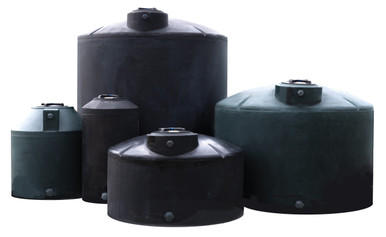
The mistake operators make most often with high-specific-gravity slurries is treating tank geometry as a preference instead of an engineering decision. A flat-bottom 2,500-gallon vertical tank holding water (SG 1.0) and the same flat-bottom tank holding a 1.6 SG mineral slurry are not the same system. Hoop stress is 60% higher on the slurry. Wall fatigue cycles accumulate faster. Solids accumulate at the bottom and bridge the discharge fitting. The tank that lasted 15 years in water service fails in 4 in slurry service.
This post walks through the actual failure modes of cone-bottom and flat-bottom rotomolded HDPE / XLPE tanks at SG 1.3-2.0, when each geometry is the right call, and where each one breaks in the field. References ASTM D1998 (Standard Specification for Polyethylene Upright Storage Tanks), and real Norwesco SKUs in the OneSource catalog.
The 1.5 SG threshold — why it matters
ASTM D1998-19 specifies wall thickness for polyethylene upright storage tanks based on hoop stress, which is a direct function of stored fluid SG. The ASTM equation is:
t = (SG × H × D) / (2 × HDS)
where t = wall thickness (in), SG = specific gravity, H = head height (ft), D = tank diameter (in), HDS = hydrostatic design stress (psi)
For an HDPE tank rated for 1.0 SG service, doubling SG to 2.0 doubles the wall thickness required to maintain the same factor of safety. Tanks not specifically rated for high-SG service will run their hoop stress past the design HDS, and creep accelerates. ASTM D1998 publishes 1.5 SG and 1.9 SG ratings as discrete rating tiers; tanks must be ordered to a specific SG bracket.
Most Norwesco vertical tanks in the catalog are rated for 1.5 SG service. A few large units are 1.9 SG rated. The N-40066 (2500 Gallon 30 Degree Cone Bottom Tank, Listed at $2,735.41) and the heavier-wall N-40674 (2500 Gallon 30 Degree HDPE Cone Bottom Tank with Poly Stand, Listed at $6,158) are both standard-SG units and need verification against your slurry SG before specification. Above 1.9 SG, you are typically out of standard rotomolded territory and into custom XLPE or steel.
Flat-bottom failure modes in slurry service
1. Solids accumulation and dead zones
A flat-bottom tank with a 2″ or 3″ bulkhead fitting installed near the floor depends on the fluid being thin enough to flow toward the outlet under gravity. With a 1.6 SG mineral slurry at 35 wt% solids, that assumption fails immediately. Solids settle in concentric rings out to the wall. The tank starts holding 2,500 gallons of nominal volume but actually delivering only 1,800 gallons of pumpable fluid, with 700 gallons of progressively-thickening slurry sitting in a dead zone the agitator cannot reach. Within a few weeks of operation, the solids harden into a paste that cannot be re-suspended without manual entry.
2. Agitator-driven wall flexing
To avoid solids settling, operators add an agitator. On a flat-bottom tank, the agitator shaft must be top-entry, the impeller must be deep enough to sweep the floor, and the impeller diameter must be large enough to move 2,500 gallons of dense fluid. The reaction torque transmits through the tank top and into the wall. Standard rotomolded HDPE tank tops are not load-rated for sustained agitator torque; they are rated for atmospheric pressure plus self-weight. ASTM D1998-19 requires a separate top-mount load test for any tank that will carry a top-mounted agitator, and most catalog tanks do not have that test.
3. Discharge fitting clog cycle
Flat-bottom tanks discharging high-SG slurry through a side-wall bulkhead fitting suffer a predictable clog cycle. As the tank drains, the slurry level falls below the fitting; the residual slurry between fitting and floor concentrates as water evaporates; the fitting cakes; on next fill, the cake breaks loose and slugs the downstream pump. Pumps in this duty cycle fail at 6-18 months instead of the 5-7 years they would last on clean fluid.
Cone-bottom — when it works and when it does not
Norwesco cone-bottom tanks are sold in 15°, 30°, 40°, 45°, 57°, and 60° cone-angle variants. The geometry choice is not aesthetic — each angle solves a different problem.
15° cone — wrong for most slurries
The 15° cone-bottom tanks like the N-43065 (2500 Gallon 15 Degree Cone Bottom Tank, Listed at $2,535.83) and the smaller N-41461 (100 Gallon 15 Degree Cone Bottom Tank, Listed at $409.99) have a shallow-pitch floor designed primarily to enhance drainage of low-viscosity, low-solids fluids. They are not slurry tanks. The 15° pitch is below the angle of repose of most settled mineral solids (typically 28-35°), which means solids will accumulate on the cone surface itself and bridge across to the discharge port. A 15° cone-bottom tank holding a 1.5 SG slurry behaves nearly identically to a flat-bottom tank in terms of solids accumulation.
30° cone — the engineering compromise
The 30° cone-bottom Norwesco N-40066 (Listed at $2,735.41) is the most-specified cone bottom in industrial slurry service. The 30° pitch is steeper than the angle of repose for most mineral solids (sand, lime, clay, fly ash), so settled solids slide toward the discharge port under gravity instead of bridging. The tradeoff is height: a 2,500-gallon 30° cone tank stands considerably taller than the flat-bottom equivalent because the cone displaces vertical space below the cylinder.
40-60° cones — induction and inductor service
Steeper cones (40° like the N-44978 at Listed at $197.33, 45° like the N-47190 at Listed at $351, 57° like the N-42066 at Listed at $239.99, 60° like the N-60214 at Listed at $128.47) are inductor tanks — designed for fast batch dissolution of dry chemical into a carrier fluid. These are not bulk-storage geometries; they are mixing geometries. Use them when you are dissolving 50 lb of dry product into 60 gallons of water in 90 seconds, not when you are storing 2,500 gallons of finished slurry.
The stand problem
Cone-bottom tanks must be supported on a stand because the cone cannot bear weight on its surface. Norwesco publishes matched stands like the N-60059 (2500/3000 Gallon Cone Bottom Stand, Listed at $4,037.50) and the steel-frame N-64076 (Listed at $2,739.99). The stand is not optional. Operators who try to install a cone-bottom tank on a poured slab without the matched stand load the cone-cylinder transition fillet at concentrated points, exceed the allowable bearing stress in the fillet, and crack the tank within 6-24 months. Always order the matched stand.
The stand also has implications for hopper geometry. The total vertical envelope (cone + stand + cylinder + headspace) for a 2,500-gallon 30° cone-bottom is in the 14-16 ft range. Operators with low-clearance buildings may not be able to install the tank without removing roof panels.
Decision matrix — when to pick which
| Service condition | Recommended geometry |
|---|---|
| SG 1.0-1.3, no settling solids, day tank | Flat-bottom vertical, side-discharge |
| SG 1.3-1.5, <5 wt% non-settling solids | Flat-bottom with bottom-center discharge |
| SG 1.5-1.9, 5-30 wt% slow-settling solids | 30° cone-bottom with matched stand |
| Fast-settling mineral slurry (sand, lime, clay) | 30-45° cone, top-mount agitator validated |
| Batch inductor / dissolution duty | 40-60° cone inductor, not bulk storage |
| SG > 1.9 or aggressive chemical attack | Out of rotomolded scope — XLPE custom or steel |
The agitator question
Any high-SG slurry service is going to need agitation. The decision tree:
- Side-mount or bottom-mount agitator: Better mechanically (no top loading) but only practical on cone-bottom tanks with appropriate fitting locations. Penetrates the tank wall with a sealed shaft assembly.
- Top-mount agitator: Requires the tank to be specifically rated for top-mounted load. Standard catalog tanks are typically not. Specify before purchase.
- External recirculation pump: Often the right answer for low-shear slurries. Pump suction is from the cone discharge, return enters near the top via a tangential nozzle that creates rotational flow.
For high-shear-sensitive slurries (polymer flocculants, biological cultures, paint pigments), external recirculation is almost always the correct choice over mechanical agitation, because the shear in a centrifugal pump is lower than the shear at the tip of a high-RPM impeller blade.
OSHA confined-space implications
OSHA 29 CFR 1910.146 (Permit-Required Confined Spaces) governs entry into any tank that meets the definition of a confined space. Both flat-bottom and cone-bottom slurry tanks meet that definition: limited means of entry/egress, not designed for continuous occupancy, sufficient size to enter. The agitator question above feeds directly into this — if your geometry choice forces frequent solids removal by manual entry, you are committing to a permit-required confined-space program. The OSHA program (atmospheric monitoring, attendant, retrieval system, written permit, rescue plan) is real overhead that operators sometimes do not budget. A correctly-specified 30° cone-bottom tank with matched stand and external recirculation can run for years without confined-space entry; a wrongly-specified flat-bottom in the same service requires monthly cleanout and corresponding permits.
Real-world failure case
One pattern we see in slurry service: an operator buys a flat-bottom 1,500-gallon tank like the N-41505 (Listed at $1,600) for water duty, repurposes it for a 1.6 SG mineral slurry as the operation evolves, and within a year is dealing with a cracked tank floor where the discharge fitting penetrates. Root cause is usually three-fold: (1) the tank is rated 1.0 SG and is now seeing hoop stress 60% higher than design; (2) the bulkhead fitting concentrates stress and the slurry attacks the gasket interface; (3) thermal cycling between filled-warm and emptied-cool conditions accelerates fatigue at the fitting penetration. The fix is to swap to a 30° cone-bottom rated for the actual SG, with the discharge at the cone apex where stress concentration is geometrically minimized.
Bottom line
For SG above 1.3 with any meaningful solids loading, default to a 30° cone-bottom tank with a matched stand and verify the tank's SG rating against your fluid. Below 1.3 with negligible solids, flat-bottom is fine and cheaper. The intermediate band — 1.3 to 1.5, <5 wt% solids, no settling — is where engineering judgment matters most, and where calling the OneSource freight + spec line at 866-418-1777 with your fluid analysis is worth the 10 minutes. We can pull the right SKU based on actual hoop-stress math instead of a guess.
Compare cone-bottom options across our Norwesco catalog and ask for a freight quote at /freight-cost-estimator/.
Field Operations Addendum
Specifying a cone-bottom for a high-specific-gravity slurry is one decision; commissioning it so it actually drains is another. Three field details decide whether the cone earns its keep or becomes a tank you have to wash out by hand every cycle.
Cone angle vs slurry rheology. A 15-degree cone drains thin liquids and clean water well but holds back anything with appreciable yield stress. A 30-degree cone is the workhorse for SG 1.2-1.5 slurries that still flow under gravity. A 45-degree (or 60-degree) cone is what you want for high-solids slurries, settled sludges, and anything that thixotropes when it sits. The trade is footprint and headroom — a 45-degree cone on a 5,000-gallon tank adds several feet of overall height versus a 15-degree, and the support stand has to clear that geometry. Pick the angle to the worst-case slurry the tank will see in the duty cycle, not the average.
Drainage rate per SG. A common mistake is assuming a 3-inch outlet drains an SG 1.6 brine at the same rate it drains water. It does not — viscous drag through the outlet rises sharply with SG and with any suspended solids. For dense slurries, the practical rule is to oversize the outlet one nominal pipe size above what the water-flow chart suggests, and to keep the outlet straight-vertical for at least four pipe diameters before any elbow. Side-fed cones and angled outlets bridge solids and stall the drain.
Support cradle inspection cadence. A cone-bottom tank rides in a steel stand or a polyethylene cradle, and that stand carries the entire wet weight — for a 2,500-gallon tank of SG 1.4 slurry, that is over 14 tons before the tank itself. Inspect the cradle at least every 12 months: look for weld cracks at the cone-stand interface, paint blistering that hides corrosion underneath, foot-pad settlement (pads sinking into the slab unevenly), and any gap between the cone wall and the cradle's contour. A cradle that no longer fits the cone — because the tank has crept under load — concentrates stress at the gap and will eventually crack the polyethylene from the outside in.
Recommended Tanks for This Guide
Live pricing, updated automatically · estimate freight to your ZIP.