EPA Method 9095B Paint Filter Liquids Test: Free Liquid Determination for Waste Storage Tanks under RCRA
The Paint Filter Liquids Test sounds like trade jargon and looks like a kitchen experiment. A 100-mL or 100-g representative sample of waste material is placed in a conical paint filter (mesh number 60), held above a graduated cylinder, and allowed to drain for 5 minutes. If a single drop of liquid passes through the filter in that time, the sample contains free liquid. That is the entire procedure. The implications for waste-tank operators, generators, and disposal facilities are not trivial: a positive Paint Filter result triggers liquids-restricted-waste regulation under 40 CFR 264.314, prohibits land disposal in lined landfills, and changes the entire compliance posture of the storage tank holding the material. This piece walks the regulatory citation, the practical sampling procedure, the RCRA implications, and the tank engineering that follows.
The regulatory citation chain
EPA Method 9095B is published in EPA SW-846, Test Methods for Evaluating Solid Waste, Physical/Chemical Methods. It is referenced in several places in the federal regulations:
- 40 CFR 264.314 — prohibits placement of bulk or non-containerized liquid hazardous waste, or hazardous waste containing free liquids (as determined by Method 9095), in landfills.
- 40 CFR 265.314 — analogous prohibition for interim status facilities.
- 40 CFR 264.190 — applicability of the tank standards subpart, which keys off whether a hazardous waste contains free liquids.
- 40 CFR 258.28 — municipal solid waste landfill prohibition of bulk and non-containerized liquid waste, again referencing Method 9095 for the free-liquid determination.
The method is what EPA refers to as a Method-Defined Parameter (MDP) — meaning the regulatory definition of "contains free liquid" IS the result of Method 9095B. There is no alternative test that satisfies the requirement; if the regulation says Method 9095, that is the test that must run.
The actual procedure (in operator terms)
The published method (EPA SW-846 Method 9095B, available from EPA at the SW-846 Compendium) is concise:
- Collect a representative sample of the waste. Minimum sample size is 100 mL or 100 g. If a single 100-unit sample is not representative of a heterogeneous waste, take multiple 100-unit samples in proportional sub-units.
- Place the sample in a conical paint filter — the standard hardware-store product, mesh number 60 (cotton or polyester). The filter must be the conical paper-cone type, not a flat coffee-filter-style device.
- Suspend the filter above a graduated cylinder, beaker, or any clean catch vessel.
- Allow the sample to drain for 5 minutes at room temperature.
- At the end of 5 minutes, observe the catch vessel. If any portion of the material has passed through the filter — including a single drop — the waste is determined to contain free liquid.
The test is binary. It does not quantify the volume of free liquid. It does not characterize the chemistry. It answers the single question: does the waste, when held in a sieve, drip?
What does and does not count as a "drop"
Practical interpretation by EPA Region offices and state implementing agencies: a single drop of liquid that passes through and falls into the catch vessel is a positive result. Liquid that wicks down the outside of the filter cone but does not actually drip is generally not counted. Liquid that beads up at the bottom of the filter cone but does not drop is not counted. The test is meant to be observable by an operator without instrumentation.
Sample temperature
The method specifies room temperature, generally interpreted as 20 to 25 degrees Celsius. Cold waste samples (refrigerated, below 10 degrees Celsius) can give false negatives because viscosity is elevated and the test runtime is fixed at 5 minutes. Heated waste samples (above 30 degrees Celsius) can give false positives. Samples should be allowed to equilibrate to room temperature before testing.
What waste materials typically test positive
Based on RCRA permit experience and state implementing-agency guidance:
- Sludges with high water content. Wastewater treatment sludges, paint sludges, refinery API separator sludges, electroplating sludges. These often test positive even after gravity dewatering.
- Filter cake from press operations. Filter cake at typical plate-and-frame press exit moisture (60 to 70 percent solids by weight) frequently tests positive.
- Stabilized waste with unbound free water. Cement-stabilized waste batches that were over-watered during mixing.
- Drum bottoms. Any drummed waste with free-liquid layers above settled solids.
Materials that typically test negative:
- Dewatered filter cake at 80 percent solids or higher.
- Properly stabilized solidified waste using portland cement, fly ash, or kiln dust.
- Granular dry materials (most foundry sand, most spent abrasive blast media).
- Dried evaporator bottoms.
RCRA implications of a positive result
A positive Method 9095B result on a hazardous waste produces a cascade of regulatory consequences:
Land disposal prohibition
40 CFR 264.314(a) (for permitted facilities) and 264.314(b) (for interim status facilities) prohibit placement of free-liquid hazardous waste in a landfill. The waste must be either solidified to a non-free-liquid state or disposed of by alternative methods (incineration, deep-well injection, or treatment).
Tank standards applicability
40 CFR Subpart J (264.190 through 264.200) applies to tanks storing hazardous waste with free liquids. The subpart requires:
- Secondary containment per 264.193 (subject to 264.193(c) capacity requirements).
- Integrity assessment by an independent qualified Professional Engineer per 264.191.
- Operating practices, inspection schedule, and corrective action plans per 264.194 through 264.196.
- Closure standards per 264.197.
Tanks storing waste that tests negative for free liquids (truly dry hazardous waste) are subject to different standards under Subpart I (Containers, 264.170 through 264.179) rather than Subpart J. The Method 9095B determination is the gateway between those two regulatory regimes.
Manifest and shipping classifications
Free-liquid waste must be shipped in DOT-compliant liquid-rated containers and tankers. Bulk DOT 412 trailers, IBC totes rated for liquid service, and lined dump trailers are common. The Hazardous Waste Manifest line items differ for free-liquid versus solidified waste.
Tank engineering for waste with free liquids
If the operator's waste consistently tests positive for free liquid, the storage tank must be engineered for hazardous waste storage under Subpart J. Practical implications for tank selection:
Secondary containment is mandatory
40 CFR 264.193 requires secondary containment capable of detecting and collecting releases. Common configurations:
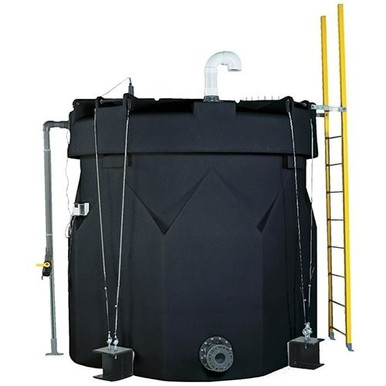
- Double-wall integral storage tank (Snyder Captor double-wall is the catalog example for polyethylene).
- Single-wall storage tank inside an external concrete or earthen secondary containment structure (110 percent of the largest tank volume per 264.193(c)).
- Vaulted tank with integral leak detection.
Real Snyder Captor catalog SKUs for free-liquid hazardous-waste service:
- 550-gallon ASTM HDPE black Captor double-wall, MPN 5040000N51, listed at $6,599.00
- 2,500-gallon Sodium Hypochlorite (UV) Captor double-wall, MPN 5580000N52, listed at $18,701.29
- 3,000-gallon HDLPE Captor double-wall, MPN 5590000N52, listed at $24,698.99
- 3,500-gallon ASTM XLPE Captor double-wall, MPN 5600000N42, listed at $25,399.00
- 10,000-gallon HDLPE Captor double-wall, MPN 1006600N43, listed at $70,408.99
Integrity assessment
40 CFR 264.191 requires that any new tank installation include an integrity assessment by an independent qualified Professional Engineer. The assessment evaluates:
- Design standards used for fabrication.
- Compatibility of construction materials with the waste being stored.
- Foundation, anchorage, and structural integrity.
- Pressure relief, vent design, and rupture protection.
- Corrosion protection (where applicable for metallic tanks).
For polyethylene tanks the assessment focuses on resin grade selection (ASTM D1998 verified), wall thickness conformance to design specification, fitting and bulkhead specification, secondary containment integrity, and chemical compatibility documentation per ASTM D2282 immersion testing or manufacturer chemical compatibility chart reference.
For full secondary containment regulation walkthrough see Chemical Secondary Containment Sizing under 40 CFR 264.175 and 264.193.
Routine operator inspection
40 CFR 264.195 requires daily inspection of overfill controls, monthly inspection of construction materials and aboveground tank surfaces, and other periodic inspections. The inspection log is part of the facility's operating record and is subject to EPA, state, and authorized-tribal inspection on demand.
The solidification path — when free liquid is unavoidable upstream
If the upstream process generates a waste stream that consistently tests positive for free liquid, the operator typically chooses one of two compliance paths:
Solidify before disposal
Common solidification reagents:
- Portland cement at 5 to 25 percent by weight, depending on waste characteristics.
- Fly ash (Class F or Class C) at 10 to 30 percent by weight.
- Cement kiln dust at 5 to 20 percent by weight.
- Proprietary stabilization reagents marketed for specific waste classes.
The solidified product is re-tested with Method 9095B to confirm a negative free-liquid result before disposal. Mix design verification with batch-by-batch testing is typical at TSDF (treatment, storage, and disposal facility) operations.
Treat the liquid by alternative method
Free-liquid hazardous waste that cannot be cost-effectively solidified is typically routed to:
- Permitted incineration facility for organic-rich liquid waste.
- Permitted treatment facility (chemical neutralization, precipitation, or biological treatment) for aqueous liquid waste.
- Permitted deep-well injection facility for compatible liquid waste streams (declining option as Class I injection-well permitting has tightened in recent years).
Common operator errors with Method 9095B
Field experience and EPA inspection findings reveal recurring mistakes:
Filter type substitution
Operators occasionally use coffee filters, cheesecloth, or shop-towel material instead of the specified mesh number 60 conical paint filter. The mesh size is part of the method specification — too fine and the test gives false negatives, too coarse and false positives. Use the specified filter.
Sample size shortfall
Running the test on 50 mL or 50 g samples gives results that are not defensible for regulatory purposes. The 100 mL or 100 g minimum is in the method specification.
Inadequate equilibration
Refrigerated samples tested cold give false negatives. Allow 30 to 60 minutes for thermal equilibration to room temperature before running the test.
Heterogeneous waste sampling
For waste streams with phase separation (settled solids with supernatant liquid), a single grab sample from the supernatant gives a positive result for the supernatant only. Defensible practice is multiple sub-samples spanning the depth of the waste container, tested individually or composited per the method's sub-sample provisions.
Test record retention
The test result, the sample location and date, the operator name, and the filter type used should be logged. EPA inspections frequently ask for the most recent year of Method 9095B logs as part of facility record review.
State agency variations
States authorized by EPA to implement RCRA have generally adopted Method 9095B by reference. State variation is minimal on the test itself; some states have additional testing requirements for specific waste streams, but the federal Method 9095B requirement is consistent. Common state-level overlay:
- California — DTSC sometimes requires duplicate testing or additional QC documentation for high-volume generators.
- Texas — TCEQ accepts Method 9095B with the federal protocol for hazardous waste characterization.
- New York — NYS DEC accepts Method 9095B; some industrial hazardous waste streams have additional state-specific solidification standards.
The recordkeeping rhythm
For a hazardous waste generator running a Method 9095B program, the typical recordkeeping cadence:
- Initial waste characterization with Method 9095B at process startup or stream introduction.
- Periodic re-characterization (typically annual) to confirm the waste stream has not changed.
- Re-characterization after any process change that might affect waste composition.
- Per-batch testing for solidified waste before disposal, with paired sample retention for AHJ verification.
- Inspection log for storage tanks holding free-liquid hazardous waste, per 264.195.
Bottom line
EPA Method 9095B is a binary go/no-go test that determines whether a waste material contains free liquid for purposes of RCRA regulatory classification. The test procedure is conceptually trivial but rigorously defined; deviation from the published method (filter type, sample size, temperature, drain time) produces results that are not defensible for regulatory purposes. A positive result triggers Subpart J tank standards including secondary containment under 264.193, integrity assessment under 264.191, and routine inspection under 264.195. The OneSource Snyder Captor double-wall product line covers the secondary-containment requirement for polyethylene tanks in the 550 to 10,000 gallon range. Operators with free-liquid waste streams either engineer their storage and disposal under Subpart J or solidify the waste upstream to a Method-9095B-negative product before land disposal. The test is small; the consequences of getting the answer wrong are not.
For double-wall Captor catalog browse Snyder Industries Tanks. For the related secondary containment regulatory walkthrough see Snyder Captor Double-Wall Tanks for SPCC 40 CFR 112 Compliance.
Recommended Tanks for This Guide
Live pricing, updated automatically · estimate freight to your ZIP.