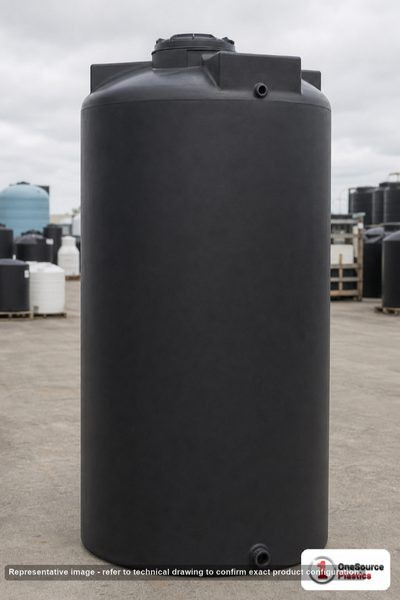
Industrial Pretreatment Wastewater Tank Selection: 40 CFR 403 Compliance Guide
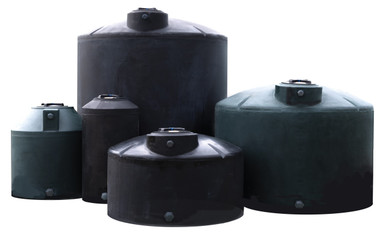
Industrial facilities discharging wastewater to a publicly owned treatment works (POTW) operate under the EPA General Pretreatment Regulations at 40 CFR 403. The pretreatment program requires affected industries to remove or reduce specific pollutants before discharge, using a treatment system sized and designed for the facility's wastewater characteristics. Polyethylene storage tanks are the workhorse vessels in most pretreatment systems because they handle the chemistries involved (caustic, acid, neutralized effluent, settled solids, batch holding) at moderate cost without the corrosion concerns of carbon steel.
This guide walks through pretreatment tank selection by unit operation. We cover equalization, neutralization, batch holding, settling, and discharge sampling. Real SKU references from the OneSource Plastics catalog. The regulatory framework is anchored in 40 CFR 403 (the federal General Pretreatment Regulation), 40 CFR 401 (general provisions for effluent guidelines), and the Categorical Pretreatment Standards in 40 CFR Parts 405 through 471 for specific industry categories.
The Pretreatment Compliance Framework
40 CFR 403 sets up a three-tier framework:
- Prohibited discharge standards (40 CFR 403.5). No discharger may discharge pollutants that pass through, interfere with the POTW, or violate specific prohibitions: pH below 5.0, fire/explosion hazard, obstructions, slug discharges, heat causing POTW influent above 104F (40C), petroleum oils above pass-through limits, oxygen-demanding pollutants causing pass-through.
- Categorical Pretreatment Standards (40 CFR Parts 405-471). Industry-specific numerical limits on regulated pollutants (Best Available Technology Economically Achievable, or BAT). Categories include metal finishing, electroplating, organic chemicals, pulp and paper, dairy, etc.
- Local limits (40 CFR 403.5(c)). POTW-specific limits established by the local control authority based on the POTW's treatment capacity and downstream water quality. Local limits often more stringent than federal categorical limits.
An industrial facility subject to pretreatment must:
- Submit a baseline monitoring report (BMR) under 40 CFR 403.12(b)
- Install treatment to meet the most stringent applicable limit
- Self-monitor and report under 40 CFR 403.12(g) and (h)
- Notify the control authority of slug discharges per 40 CFR 403.12(f)
The treatment system that achieves these limits is what your tank inventory has to support.
Unit Operation 1: Flow Equalization
Industrial wastewater is rarely steady-flow. Batch processes, shift starts and stops, cleaning cycles, and process upsets all create flow variability that overwhelms downstream pH adjustment and biological treatment. Equalization tanks buffer the flow to a steady rate downstream.
Sizing rule of thumb: equalization detention time of 4 to 24 hours at peak flow, depending on the variability of upstream operations. For a 50,000 gpd facility with 4-hour equalization, the tank is roughly 8,300 gallons. For 24-hour equalization on a 5,000 gpd facility, the tank is 5,000 gallons.
Equalization tank requirements:
- Mixing to prevent settling of suspended solids and maintain uniform composition. Typically 1 hp per 1,000-3,000 gallons.
- Cover or vent to control vapors. Open tanks emit VOCs, hydrogen sulfide, ammonia depending on chemistry.
- Level monitoring for downstream flow control.
- Sample tap at outlet for compliance monitoring.
Polyethylene EQ tank candidates:
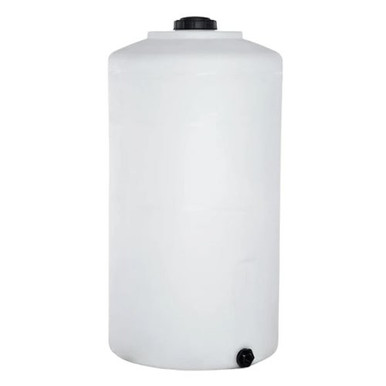
- SKU SII-1830000N45 (1100 Gallon HDPE Vertical Chemical, $2,468 list, 1.9 SG) for small flows, 1-2 hour detention.
- SKU SII-5090300N45 (2500 Gallon HDPE Vertical Chemical, $4,753 list, 1.9 SG) for moderate flows.
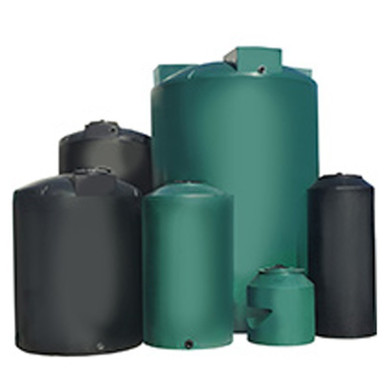
- SKU SII-5130000N43 (3000 Gallon HDPE Vertical Chemical, $5,157 list, 1.5 SG) for moderate-flow non-aggressive chemistry.
- Norwesco N-40941 (5000 Gallon Vertical, $4,799 list, 1.5 SG) for general industrial water at high flow.
- Norwesco N-47638 (10,500 Gallon Vertical, $15,999 list, 1.5 SG) for large facility EQ.
For aggressive industrial wastewater (pH below 4 or above 11, high chloride content, organic solvent content), specify the 1.9 SG XLPE construction (Snyder N42 series) regardless of fluid density. The chemistry envelope, not the fluid weight, drives the resin selection.
Unit Operation 2: pH Neutralization
40 CFR 403.5(b)(2) prohibits discharge below pH 5.0. Most local limits also cap pH at 9.0 or 10.0. Most industrial wastewater is acidic from process operations (metal finishing, electroplating, food processing), requiring caustic addition for neutralization. Some streams are alkaline (CIP, anodizing) requiring acid addition.
Neutralization typically uses a two-stage cascade:
- Stage 1 (rapid mix) — small tank (1-5 minute detention), aggressive mixing, pH probe, dosing pump on caustic or acid line.
- Stage 2 (slow mix) — larger tank (5-15 minute detention), gentler mixing, second pH probe for trim control, second dosing pump.
Two-stage cascade is necessary because pH adjustment in a single stage tends to overshoot. The first stage gets pH into the 5-9 range; the second stage trims to the target setpoint with minimal chemical addition.
Tank candidates for neutralization:
- Stage 1 (small fast-mix): 100-500 gallon Snyder XLPE chemical tank in 1.9 SG construction. Smaller is fine because residence time is short.
- Stage 2 (larger trim-mix): 500-2000 gallon vertical chemical tank, 1.9 SG construction.
Caustic storage (typically 50% sodium hydroxide, SG 1.52) requires 1.9 SG XLPE construction explicitly. SKU SII-1830000N42 (1100 Gallon XLPE Vertical, $2,497 list) is a common selection. For sulfuric acid storage (typically 93-98%, SG 1.83), 1.9 SG XLPE is also required, plus secondary containment per 40 CFR 264.193 (RCRA storage requirements where applicable). Acid and caustic storage must be in separate containment to prevent commingling on spill.
The HDPE-vs-XLPE call here matters because sodium hypochlorite and chlorine-bleach chemistries used in some pretreatment streams degrade HDPE faster than XLPE. For chlorinated streams, XLPE is the durability choice.
Unit Operation 3: Batch Holding for Slug Discharge Prevention
40 CFR 403.5(b) prohibits discharges that interfere with the POTW. "Slug" discharges are large transient releases that exceed normal flow and concentration patterns. The local control authority may require facilities with slug-discharge potential to install holding capacity to spread the slug into a manageable trickle release.
Slug-control holding tank sizing depends on the worst-case slug volume. For a metal-finishing facility with a 500-gallon plating bath dump, a 1,500-gallon holding tank with controlled bleed-out at 50 gpm protects the POTW. For larger industrial slugs, scale capacity proportionally.
Slug-control tanks need:
- Sufficient capacity for at least 1.5x the worst-case slug.
- Bleed-down control via metering pump or valve with flow setpoint.
- Level alarm at high level to alert operations of overflow risk.
- Sample tap for compliance monitoring before bleed-down to discharge.
Tank candidates: SKU SII-5090300N45 (2500 Gallon XLPE Vertical, $4,753) for moderate slug volume; SKU N-40941 (5000 Gallon Vertical, $4,799) for larger slug or longer-residence holding when chemistry is non-aggressive. For aggressive chemistry slugs, step up to the XLPE 1.9 SG line regardless of fluid density.
Unit Operation 4: Solids Settling and Sludge Holding
Many pretreatment streams contain suspended solids that must be removed before POTW discharge. Settling tanks (clarifiers) separate solids from liquid; the solids accumulate as sludge that needs holding capacity and periodic offsite disposal.
Settling tank design is more complex than equalization tanks because the geometry must support quiescent settling without short-circuit flow. Conical-bottom polyethylene tanks (cone tanks) are commonly used because the sloped bottom concentrates settled solids for periodic withdrawal.
For sludge holding (the downstream tank where settled solids accumulate before disposal pickup), cone-bottom polyethylene tanks earn their keep:
- Drain-down design with 100% solids withdrawal
- Sloped bottom prevents stagnant pockets and biological activity
- Removable lid for sludge removal access
- Cone-stand mounting at elevation for gravity discharge to disposal container
Cone-bottom tank candidates: see our cone-bottom stand compatibility post for specific stand-tank pairings. Typical capacity: 100 to 2,500 gallons depending on sludge generation rate and disposal frequency.
Sludge characteristics determine resin selection:
- Inorganic settled solids (heavy metals hydroxides, metal-finishing sludge) — HDPE compatible, 1.5 SG construction sufficient.
- Organic sludge with grease or oil — HDPE compatible but ESCR matters; specify 1.5 or 1.9 SG construction with documented ESCR rating.
- Aggressive chemistry sludge (low or high pH, chlorinated) — XLPE 1.9 SG construction.
Unit Operation 5: Discharge Compliance Sampling and Holding
40 CFR 403.12(g) requires self-monitoring sampling at the point of discharge. Many facilities install a small dedicated holding tank just upstream of the POTW connection where samples can be collected without disrupting the main flow.
Sample-station tank: 100 to 500 gallons, with composite-sampler suction line, level monitoring, automatic level-control bleed-down to POTW. Tank candidates: SKU N-44800 (100 Gallon Doorway Liquid Storage, $369) for small flows; SKU N-43856 (400 Gallon Doorway, $1,200) for moderate flows. The doorway form factor often fits well in mechanical-room sample stations.
The Pretreatment Tank Schedule
For a typical metal-finishing pretreatment system serving a 50,000 gpd facility, the tank inventory looks something like this:
| Unit Operation | Tank Type | Size | Resin | Example SKU |
|---|---|---|---|---|
| Equalization | Vertical, mixed | 8,000 gal | HDPE 1.5 | N-47638 prorated |
| pH Stage 1 (rapid) | Vertical, fast mix | 300 gal | XLPE 1.9 | SII series 300 gal |
| pH Stage 2 (trim) | Vertical, slow mix | 1,500 gal | XLPE 1.9 | SII-1770000N45 |
| Caustic storage | Vertical chem | 1,100 gal | XLPE 1.9 | SII-1830000N42 |
| Acid storage | Vertical chem (sep containment) | 1,100 gal | XLPE 1.9 | SII-1830000N42 |
| Slug holding | Vertical | 2,500 gal | XLPE 1.9 | SII-5090300N45 |
| Sludge holding | Cone-bottom | 500 gal | HDPE 1.5 | Cone-bottom catalog |
| Sample station | Doorway | 100-300 gal | HDPE 1.5 | N-44800 or N-44960 |
Total polyethylene tank cost for this 50K gpd metal-finishing pretreatment system: roughly $35,000 to $60,000 in tanks alone. Pumps, mixers, controls, and piping double or triple the system cost. The tank cost is the smallest line item but specifying it correctly determines whether the system runs reliably for 20 years or fails within 5.
Resin Selection by Pretreatment Chemistry
| Chemistry | SG | HDPE | XLPE | Recommendation |
|---|---|---|---|---|
| Sodium hydroxide 50% | 1.52 | OK | Excellent | XLPE 1.9 SG |
| Sulfuric acid 93% | 1.83 | Limited | Good | XLPE 1.9 SG |
| Hydrochloric acid 37% | 1.18 | Good | Excellent | XLPE 1.9 SG |
| Sodium hypochlorite 12.5% | 1.20 | Limited (1-2 yr life) | Good (5-7 yr) | XLPE 1.9 SG |
| Process water (pH 6-8) | 1.0 | Excellent | Excellent | HDPE 1.5 SG |
| Aluminum sulfate (alum) | 1.32 | Good | Excellent | HDPE or XLPE 1.5 SG |
| Ferric chloride 30-40% | 1.34-1.45 | Limited | Good | XLPE 1.9 SG |
| Aluminum chlorohydrate | 1.34 | Good | Excellent | XLPE 1.9 SG |
Always cross-reference your specific chemistry against a verified compatibility chart. See our chemical compatibility database with 309 chemicals indexed against HDPE and XLPE.
Categorical Pretreatment Standards Specific to Common Industries
Metal Finishing (40 CFR Part 433)
Covers electroplating, anodizing, etching, conversion coating. Regulated pollutants: chromium, copper, cyanide, lead, nickel, silver, zinc, total toxic organics. Tank selection: XLPE 1.9 SG construction throughout the chemical-handling chain (caustic, acid, hypochlorite for cyanide destruction, ferrous sulfate for chromium reduction).
Pulp, Paper and Paperboard (40 CFR Part 430)
Regulated pollutants: BOD, TSS, AOX, dioxins/furans for bleach lines. Tank selection: HDPE 1.5 SG for white-water and process-water tanks; XLPE 1.9 SG for chlorine dioxide and bleaching chemistry handling.
Organic Chemicals, Plastics and Synthetic Fibers (40 CFR Part 414)
Regulated pollutants: priority pollutants (volatile organic compounds, semivolatile organics, metals). Tank selection: case-by-case based on specific chemistry inventory; XLPE 1.9 SG default for unknown chemistry, with fluoropolymer-lined steel for solvents that exceed XLPE compatibility.
Dairy Products Processing (40 CFR Part 405)
Regulated pollutants: BOD, TSS, FOG, pH. Tank selection: HDPE 1.5 SG for whey holding, equalization, and CIP-rinse holding. XLPE 1.9 SG for caustic and nitric acid CIP chemical storage.
Petroleum Refining (40 CFR Part 419)
Regulated pollutants: BOD, COD, TSS, oil and grease, phenols, ammonia, sulfide, hexavalent chromium, hydrocarbons. Tank selection: depends on stream; for non-hydrocarbon process water, polyethylene is fine. For hydrocarbon-containing streams, polyethylene is unsuitable per NFPA 30; use steel or FRP.
Permitting and Reporting
The control authority for pretreatment is typically the local POTW or its delegated authority. Key reporting requirements under 40 CFR 403.12:
- Baseline Monitoring Report — submitted within 180 days of categorical standard becoming effective for the facility. Documents flow, pollutant concentrations, treatment system design.
- 90-day compliance report — documents compliance with categorical standards within 90 days of compliance deadline.
- Continued compliance reports — every 6 months, sample analysis and flow data.
- Slug discharge notification — immediate phone, written within 5 days, of any slug discharge.
Tank selection documentation should be maintained in the facility's pretreatment file: spec sheet, resin compatibility documentation, structural design (ASTM D1998 wall schedule), and any applicable certifications (NSF for potable water makeup, FDA for food-contact streams).
Common Mistakes
Mistake 1: Specifying HDPE for chlorinated chemistry
Sodium hypochlorite at 12.5% degrades HDPE walls within 1-2 years of service. XLPE handles the same chemistry for 5-7 years. The XLPE premium (typically 5-15% over HDPE) pays for itself in a single replacement cycle avoidance.
Mistake 2: Undersizing the equalization tank
Equalization that's too small lets flow variability propagate downstream, causing pH excursions and POTW notice-of-violations. Size for 24-hour detention if upstream operations are highly variable; size for 4-hour minimum even for steady operations.
Mistake 3: Combining acid and caustic storage in shared containment
Acid and caustic must be in physically separate secondary containment per OSHA 29 CFR 1910.106 and most state environmental regulations. Mixing on spill releases hydrogen, generates heat, and can cause secondary failures. Specify separate containment from day one.
Mistake 4: Skipping pH probe redundancy
Single pH probe failure is the most common cause of out-of-range discharge events. Specify dual pH probes on each neutralization stage with high/low alarm and lockout. Tank system can be perfect; if the pH probe fails, you'll still discharge non-compliant.
Mistake 5: Ignoring the temperature constraint
Polyethylene is rated to 100-120F at full SG. Pretreatment streams from hot processes (boiler blowdown, hot CIP returns, exothermic neutralization) may exceed this. Pre-cool with a heat exchanger or specify a steel tank for the hot section.
Internal Resources
- Chemical Storage Tanks Category — full XLPE 1.9 SG line
- Chemical Compatibility Database — 309 chemicals indexed
- Cone-Bottom Tanks — sludge holding and full-drain solids
- Cone-Bottom Stand Compatibility — companion post
- How to Read a Tank Spec Sheet — resin and SG fundamentals
- Freight Cost Estimator — LTL quote to your ZIP
Source Citations
- 40 CFR 403 — General Pretreatment Regulations for Existing and New Sources of Pollution
- 40 CFR 401 — General Provisions for Effluent Guidelines
- 40 CFR Part 405 — Dairy Products Processing
- 40 CFR Part 414 — Organic Chemicals, Plastics and Synthetic Fibers
- 40 CFR Part 419 — Petroleum Refining
- 40 CFR Part 430 — Pulp, Paper and Paperboard
- 40 CFR Part 433 — Metal Finishing
- 40 CFR 264.193 — RCRA Containment and Detection Systems
- OSHA 29 CFR 1910.106 — Flammable Liquids
- NFPA 30 — Flammable and Combustible Liquids Code
- ASTM D1998 — Polyethylene Upright Storage Tanks
- OneSource Plastics master catalog data, dated 2026-03-26 snapshot
Related chemical compatibility resources
For deeper engineering specifications on the chemicals discussed above, see our chemical-compatibility pillars:
- Sodium Hypochlorite — storage compatibility, recommended resin grade, fittings, secondary containment.
- Sulfuric Acid — storage compatibility, recommended resin grade, fittings, secondary containment.
- Sodium Hydroxide — storage compatibility, recommended resin grade, fittings, secondary containment.
- Aluminum Sulfate — storage compatibility, recommended resin grade, fittings, secondary containment.
Recommended Tanks for This Guide
Live pricing, updated automatically · estimate freight to your ZIP.