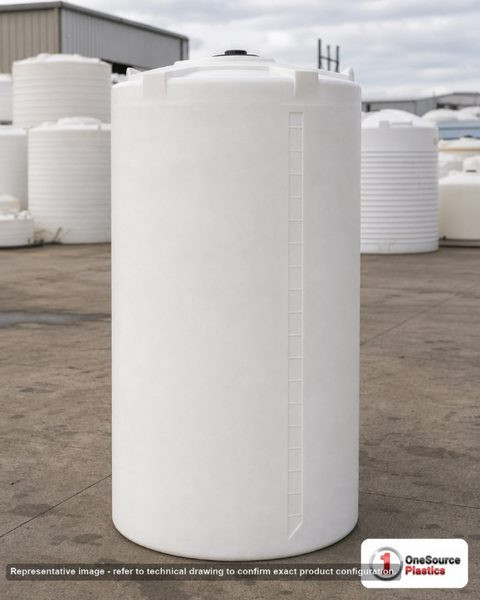
Picking a Polyethylene Tank for Industrial Chemistry Service: The 2026 OEM-Spec Decision Framework
Buying a chemical-storage tank in 2026 is a more complicated decision than it was a decade ago. The chemical compatibility picture has sharpened: manufacturers publish narrower operating windows, legal liability has pushed OEMs to warranty only specific resin grades for specific chemistries, and the cost gap between doing it right versus doing it cheap has widened. This guide synthesizes what Snyder Industries and Enduraplas publish today into a decision framework that moves from chemistry to tank specification in six concrete steps.
Every number cited here is from a published OEM compatibility chart. We don't invent resin codes, we don't speculate on service life, and we don't paraphrase internet chemistry folklore. When the data says "limited service at 140°F," that is literally what the Enduraplas / Equistar Technical Tip reports. When Snyder calls out resin #880046 for 98% sulfuric acid, that is exactly what their current chemical-resistance chart specifies.
Step 1 — Identify the Actual Chemistry, Not the Trade Name
Commercial labels are often misleading. "Muriatic acid" is 37% hydrochloric (HCl). "Caustic soda" is 50% sodium hydroxide (NaOH). "Bleach concentrate" can mean anything from 6% to 16% sodium hypochlorite (NaClO). Nitric acid at 68% is completely different chemistry than nitric acid at 98%. Before ordering any tank, write down the chemistry you actually have in hand:
- Active ingredient (HCl, NaOH, H2SO4, NaClO, NH4OH, etc.)
- Concentration as a percentage or molarity — specify precisely, not "concentrated"
- Any additives, buffers, surfactants, or trace contaminants (iron from source water, copper from piping, chloride from hard water)
- Service temperature range — especially any condition where the fluid exceeds 120°F
- Continuous vs intermittent service
This step matters because compatibility tables are indexed by chemistry, not by trade name. A Snyder spec for 98% sulfuric won't tell you anything about 37% muriatic, and vice versa.
Step 2 — Check the Resin Grade
Polyethylene tanks are not uniform. The industry sells at least three distinct polyethylene types, and they are not interchangeable for chemical service:
- Linear Polyethylene (HDLPE) — the most common high-density grade. Used for most acid and neutral chemistries.
- Crosslinked Polyethylene (XLPE) — better UV performance, better impact resistance, but NOT approved for some acids (sulfuric, nitric above 30%, hydrofluoric). The crosslinks give, but they also give the acid a pathway.
- Specialty formulations — Snyder's #880046 for sulfuric service, #880059 for UV-exposed sodium hypochlorite. These are specific resin lots tuned for specific chemistries.
For our most-researched chemistries, the Snyder-published resin selections are:
- Sulfuric acid (93–98%): HDLPE #880046 required
- Sodium hypochlorite (indoor): standard HDLPE
- Sodium hypochlorite (outdoor UV): HDLPE #880059
- Sodium hydroxide (50%): HDLPE OR XLPE both approved
- Calcium chloride brine (40%): HDLPE OR XLPE both approved
- Hydrofluoric acid (48%): HDLPE only (XLPE explicitly not approved)
Step 3 — Check the Specific Gravity Rating
Polyethylene tanks are manufactured to a specific design specific gravity (SG) rating that determines wall thickness. Ordering the wrong SG rating is a known failure mode:
- 1.0 ASTM — water-equivalent fluids, standard residential water tanks
- 1.35 ASTM — standard industrial chemistry (most mid-concentration acids and salts)
- 1.5 ASTM — mid-weight chemistry (calcium chloride brine, dilute acids)
- 1.9 ASTM — heavy-weight chemistry (concentrated sulfuric, hydrogen peroxide, phosphoric)
The specific gravity of your stored fluid must not exceed the tank's ASTM design SG. This isn't a suggestion — the tank wall is engineered for hoop stress at the design SG. A 1.5 ASTM tank filled with 1.84 SG sulfuric acid will fail.
Step 4 — Pick the Gasket Material
Gasket selection is where most chemical tank installations fail. The default "just use Viton" attitude is wrong about half the time. The Snyder-published gasket selections for our most-researched chemistries:
| Chemistry | Gasket | Why |
|---|---|---|
| Sulfuric acid | Viton | EPDM fails rapidly |
| Sodium hydroxide | EPDM | Viton actually worse here |
| Sodium hypochlorite | Viton | EPDM attacked by chloride |
| Calcium chloride brine | EPDM | Viton unnecessary |
| Hydrogen peroxide | Viton | Silicone seeds decomposition |
| Acetic acid | EPDM | Viton attacked by acetic |
| Peracetic acid | Aflas | Only elastomer approved |
| DEF (diesel exhaust fluid) | EPDM | ISO 22241 requirement |
The takeaway: chemistry-specific gasket selection isn't a choice between "nice" and "budget" — it's the difference between a tank that works and a tank that leaks within months. Match every wetted gasket to the Snyder-published spec for your chemistry. If you're using the tank for more than one service over its life, re-specify each time.
Step 5 — Pick the Bolt Material
Bolting is the second-most-common failure mode after gaskets. Snyder's approved bolt materials are always alloys chosen for the specific corrosion mechanism of the stored chemistry:
- 316SS — general-purpose for alkaline, organic, and mild acid service. Pits in chloride-containing chemistries.
- Hastelloy (C-276 or better) — acid and chloride service where 316SS pits. The standard for HCl and sulfuric.
- Titanium — chlorinated oxidizers (sodium hypochlorite, chloride-containing peroxides). NOT approved for HF or concentrated nitric.
- 316SS** (asterisk grade) — Snyder marks this for chemistries where 316SS pits on dry-out. OK for continuously-wet service, not OK for fill-drain cycles.
Step 6 — Pick the Fitting and Piping Material
Fitting material is usually the simplest decision but worth confirming:
- PVC — ambient-temperature acid and salt service. Most common.
- CPVC — warmer temperatures (up to ~140°F) or aggressive oxidizers.
- Polypropylene (PP) — acetic acid, some acids where PVC is marginal.
- 316SS — DEF (ISO 22241 required), food-grade chemistries, or where plasticizer leaching is a concern.
- PTFE-lined — concentrated oxidizers and anywhere the other options fail.
Putting It Together — Two Complete Worked Examples
Example 1: 37% Hydrochloric Acid (Muriatic)
A water-treatment plant ordering a 1,500-gallon HCl tank. From our hydrochloric acid page:
- Resin: HDLPE at 1.9 ASTM design SG
- Gasket: Viton on every wetted surface
- Bolts: Hastelloy C-276 (NOT 316SS — HCl fumes will pit it)
- Fittings: PVC
- Venting: Atmospheric, routed away from personnel and steel structure
Example 2: 50% Sodium Hydroxide (Caustic)
A food-plant CIP system ordering a 2,500-gallon caustic tank. From our sodium hydroxide page:
- Resin: HDLPE OR XLPE (both approved) at 1.9 ASTM design SG
- Gasket: EPDM (Viton is worse in caustic service)
- Bolts: 316SS (no need for exotic alloys)
- Fittings: PVC at ambient, CPVC if heated
- Heat trace: required in northern climates — 50% caustic crystallizes at 55°F
What We'd Build in Your Spec
OneSource Plastics is not a passive reseller. When you order a tank for chemical service, we verify the full specification stack — resin, SG, gasket, bolt, fitting — against the OEM recommendations above before shipment. If you haven't specified a critical component and the chemistry makes it important, we ask. If we find a mismatch between what you ordered and what the chemistry requires, we flag it.
We sell tanks from Snyder Industries, Norwesco, Enduraplas, Chem-Tainer, and Bushman — the five OEMs whose rotomolded polyethylene tanks dominate the industrial chemical-storage market. Our Chemical Compatibility Database covers 309 chemistries with published ratings and 15 hand-written pillar pages for the highest-volume industrial chemistries. Our State Regulation Guides cover the permitting and inspection rules for 11 states and growing.
If you are specifying a tank and want a second set of eyes on the MOC stack, email or call us with:
- The chemistry and concentration you're storing
- Ambient and any heated service temperatures
- Capacity and preferred dimensions
- Your state / county for permit verification
We'll come back with a complete specification — resin grade, design SG, gasket, bolt, fitting, vent, and any permitting notes. No obligation, no catalog dump.
Source Citations
- Snyder Industries — Chemical Resistance Recommendations (current edition)
- Enduraplas / Equistar Technical Tip — Chemical Resistance of Polyethylene (12-page reference)
- ASTM D1998 — Standard Specification for Polyethylene Upright Storage Tanks
- OneSource Plastics 15-page Chemical Compatibility Database (linked throughout)
Related chemical compatibility resources
For deeper engineering specifications on the chemicals discussed above, see our chemical-compatibility pillars:
- Hydrochloric Acid — storage compatibility, recommended resin grade, fittings, secondary containment.
- Sodium Hydroxide — storage compatibility, recommended resin grade, fittings, secondary containment.
- Sodium Hypochlorite — storage compatibility, recommended resin grade, fittings, secondary containment.
- Sulfuric Acid — storage compatibility, recommended resin grade, fittings, secondary containment.
Recommended Tanks for This Guide
Live pricing, updated automatically · estimate freight to your ZIP.