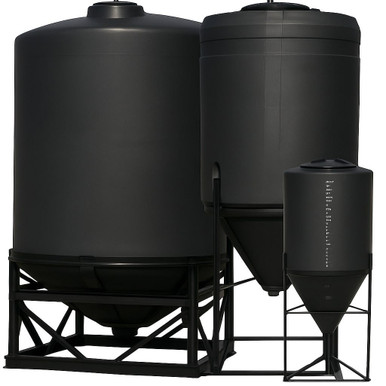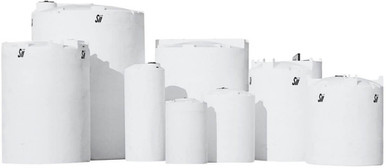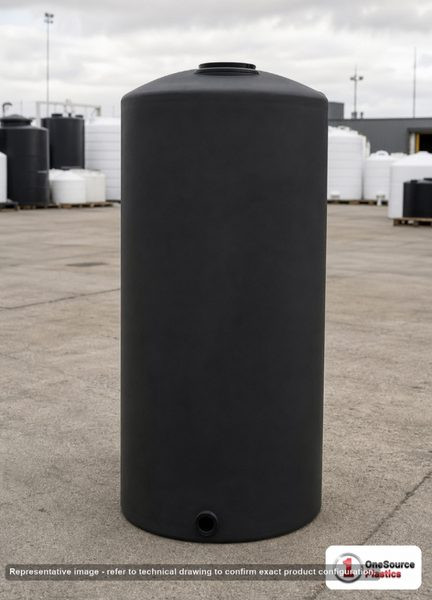
Snyder XLPE vs HDPE: When Crosslinking Matters for Chemistry Duty
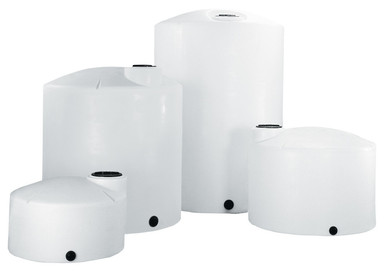
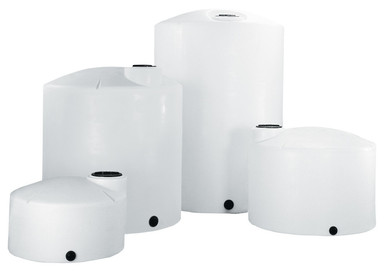
The XLPE-vs-HDPE choice is one of the most consequential decisions on a chemical storage tank purchase order, and one of the most consistently muddled. Sales sheets imply XLPE is "just better." Engineering reality is more nuanced: crosslinking pays off in specific service profiles and adds cost in others where it doesn't earn its premium. This guide walks the polymer chemistry, the ASTM D1998 type designations, the gel-content test, and the chemistry-by-chemistry selection logic — using real Snyder Industries SKUs from the OneSource catalog.
What crosslinking actually does
High-density polyethylene (HDPE) is a thermoplastic. The polymer chains are linear, entangled but not chemically bonded to each other. Heat softens the resin (which is why HDPE can be rotomolded). Crosslinked polyethylene (XLPE) is the same starting resin with a peroxide or silane crosslinking agent introduced during the rotomold cycle. The crosslinker drives covalent bonds between chains, converting the polymer from a thermoplastic to a thermoset. Once crosslinked, XLPE will not melt — it chars at high temperature instead.
The structural consequences:
- Environmental Stress Crack Resistance (ESCR) increases dramatically. Stress-cracking failures (slow-growth cracks under sustained tensile load in the presence of an aggressive medium) are the dominant failure mode for HDPE tanks in heavy chemistry duty. XLPE essentially eliminates the mechanism.
- Memory effect goes away. HDPE tanks can creep under sustained hydrostatic load, especially at warmer temperatures. XLPE resists creep because the crosslinks lock the chains in place.
- Impact resistance at low temperature improves. XLPE retains impact toughness deeper into negative-Fahrenheit territory than equivalent HDPE.
- Welding becomes impossible. XLPE cannot be heat-welded because it does not melt. Field repairs to XLPE tanks must use mechanical fittings only.
ASTM D1998 — Type I vs Type II
The American Society for Testing and Materials publishes ASTM D1998-19, Standard Specification for Polyethylene Upright Storage Tanks. The standard recognizes two types:
- Type I — HDPE. Linear high-density polyethylene with density typically 0.940 to 0.952 g/cm³. Used for most water and ag-chemical service.
- Type II — XLPE. Crosslinked polyethylene with crosslinking sufficient to achieve a defined gel content. ASTM D1998 sets the threshold at 60% minimum gel content measured per ASTM D2765 (the o-xylene-insoluble fraction test). Below 60% the tank cannot be marked Type II.
The 60% gel test is the regulatory sieve. A rotomolder cannot cure-cycle a tank to 30% crosslinks and call it XLPE — the test catches it. For a deeper read on D1998 and the related D2282 spec see our pillar at ASTM D1998 vs D2282.
Where XLPE earns its premium
Three classes of service genuinely reward the XLPE upgrade:
1. Surfactants, soaps, and polymer emulsions
Surfactant chemistries (anionic, nonionic, amphoteric) attack HDPE through environmental stress cracking far more aggressively than they attack XLPE. The mechanism is not simple chemical attack — surfactants don't dissolve polyethylene. They reduce surface tension at micro-cracks, accelerating slow-growth cracking under hydrostatic load. XLPE's crosslinked network resists the failure mode. Snyder MPN 5490000N42 (1,550 gallon double-wall XLPE, listed at $10,091.93) is the canonical surfactant-service tank in the catalog.
2. High specific gravity at sustained head
HDPE tanks rated at 1.5 SG are widely available; tanks rated at 1.9 SG are predominantly XLPE because the material strength reserves needed to hold dense liquid against creep over twenty years require the crosslinked network. Snyder MPN 1830000N42 (1,100 gallon vertical XLPE, white, listed at $2,911.09) and MPN 1006600N42 (10,000 gallon Captor double-wall XLPE at 1.9 SG, listed at $91,468.99) are typical premium-SG XLPE listings.
3. Long-duration storage at warm temperatures (above 100 F)
HDPE softens progressively above 100 F. By 140 F it is soft enough that sustained hydrostatic load drives meaningful creep. XLPE retains structural integrity much closer to the resin's heat-deflection temperature because it cannot melt. For warm process water (above 100 F) or warm process chemistry, XLPE is the default specification.
For elevated-temperature tank engineering see Tank Operating Temperature Engineering and Hot-Water Storage Temperature Engineering.
Where HDPE remains the right choice
Three classes of service where HDPE is the engineering-correct selection — and XLPE is the wrong tool, not just unnecessary:
1. Sodium hypochlorite (bleach) service
Industry compatibility data — including Poly Processing's published guidance — flags HDPE as preferred over XLPE for sodium hypochlorite. The mechanism is decomposition: hypochlorite slowly degrades polyethylene through chain scission. HDPE's linear structure tolerates the mechanism better than XLPE's crosslinked network, where localized chain breaks concentrate stress at the crosslink junctions. Specify HDPE for hypochlorite service. Snyder offers HDPE vertical chemical tanks across the bleach-service capacity range.
2. Hydrochloric acid service
HCl follows similar logic. Concentrated HCl service tanks are typically HDPE Type I rather than XLPE Type II. Verify the specific concentration and temperature against the manufacturer's compatibility chart before specifying.
3. Hydrogen peroxide service
H2O2 is an aggressive oxidizer. Industry compatibility guidance favors HDPE over XLPE for low-to-mid concentration peroxide. Higher concentrations (above 35%) typically require fluoropolymer (PFA, FEP) liner tanks, not bare polyethylene.
For chemistry-resolved selection see Chemical Compatibility Database. For sodium hypochlorite tank engineering see Sodium Hypochlorite Decay Rate.
Gel-content testing in production QA
The 60% gel-content threshold under ASTM D2765 is the regulatory line between Type I HDPE and Type II XLPE. Production QA at the rotomolder pulls coupons from each cured tank, immerses them in boiling o-xylene, and measures the insoluble fraction after 24 hours. The insoluble fraction is the crosslinked gel; the soluble fraction is uncrosslinked polyethylene.
A coupon at 30% gel is a process failure — likely an under-cured cycle, a bad batch of crosslinker, or a temperature deviation in the oven. A coupon at 70-85% gel is a typical mature XLPE rotomold result. Tanks above 85% gel content can become brittle in some service profiles and rotomolders typically target the 65-80% range as the production sweet spot. The takeaway: when ordering XLPE, the gel-content number on the QA report is the certificate of authenticity. Ask for it on permit submittals.
The cost premium
XLPE typically commands a 25 to 50 percent price premium over equivalent-capacity HDPE in the Snyder vertical chemical line. Real listed comparisons:
- Snyder MPN 1012700N42 — 100 gallon XLPE vertical, white, listed at $924.89.
- Snyder MPN 5090000N39 — 2,500 gallon HDPE vertical chemical, white, listed at $3,898.99.
- Snyder MPN 1830000N42 — 1,100 gallon XLPE vertical, white, listed at $2,911.09.
The capacity-normalized comparison (price per gallon stored) at 100 to 1,500 gallons typically runs $7 to $9 per gallon for HDPE and $9 to $12 per gallon for XLPE on the same vendor's catalog. The premium is real but not exotic. The question is whether the chemistry and service profile justify it.
For lifecycle-cost analysis see Tank Lifecycle Cost Math.
Decision framework
Five-question decision tree for XLPE-vs-HDPE:
- Specific gravity above 1.5? Yes → XLPE (or HDPE rated specifically to the SG; verify spec). No → HDPE acceptable.
- Sustained operating temperature above 100 F? Yes → XLPE. No → HDPE acceptable.
- Surfactant, polymer emulsion, or aggressive solvent service? Yes → XLPE. No → continue.
- Sodium hypochlorite, hydrochloric acid, or hydrogen peroxide service? Yes → HDPE preferred (XLPE is the wrong tool). No → continue.
- Default to HDPE for water, urea, glycol, fertilizer, brine, and agricultural chemistry duty within the temperature and SG bounds the SKU is rated for.
This is the engineering shortcut. The longer review consults the manufacturer's chemical compatibility chart for the specific chemistry, concentration, and temperature; verifies the tank's MPN-specific SG rating; and confirms the gasket and fitting materials match the chemistry profile (TFE, EPDM, Viton, or polyethylene weld depending on duty).
For fitting elastomer selection see Tank Fitting and Bulkhead Selection.
Field-failure forensics — where the wrong choice surfaces
Three common XLPE/HDPE misspecifications and how they fail:
HDPE specified for surfactant service
Failure presents as slow-growth radial cracks emanating from bulkhead inserts after 18-36 months of service. The crack faces are clean and brittle-looking. Mitigation: replace with XLPE. Repair-by-welding usually does not arrest the failure because the underlying ESCR mechanism continues at every stress concentration in the shell.
XLPE specified for sodium hypochlorite service
Failure presents as gradual yellowing of the inside wall, brittle surface chalking, and (eventually) localized hairline cracking at the bottom dome. The bleach attacks the crosslink network preferentially. Mitigation: replace with HDPE rated for hypochlorite duty.
HDPE specified for warm chemistry service (above 110 F sustained)
Failure presents as bottom-shell creep — the tank sags and deforms over years of service, eventually losing the round cross-section. Bulkhead fittings begin to drip as the shell migrates relative to the inserted hardware. Mitigation: replace with XLPE rated for the operating temperature.
For tank failure mode review see Plastic Tank Failure Mode Analysis.
The repair implication
One under-discussed consequence of crosslinking: XLPE tanks cannot be heat-welded. HDPE tanks can be repaired in the field by extrusion welding or hot-air welding with HDPE rod. XLPE tanks require mechanical fittings — bulkhead inserts with elastomeric gaskets, threaded boss inserts, or cold-applied epoxy patches that do not address structural integrity. The lifetime cost of XLPE is therefore higher when factoring in the inability to field-repair structural damage.
For repair vs replace economics see Tank Replacement Decision Framework.
Service-life expectations
Both Type I HDPE and Type II XLPE under ASTM D1998-19 are engineered for 20-year service life under nominal exposure (UV, hydrostatic head, ambient temperature). In aggressive chemistry duty, the service-life difference between HDPE and XLPE is real and measurable: surfactant service may halve HDPE life from 20 years to 8-12 years while XLPE retains the full design life. Sodium hypochlorite service may shorten HDPE life modestly (to 15 years) and shorten XLPE life more aggressively (to 8-10 years) — which is why the chemistry-specific guidance matters.
For service-life methodology see Plastic Storage Tank Lifecycle.
Specifying the right SKU at the catalog level
Snyder Industries' chemical storage line uses a structured part-number convention that encodes capacity, configuration, and resin type. Reading the MPN tells you what you are buying:
- MPN suffix "N42" typically denotes XLPE Type II construction in white pigment, 1.9 SG rating. Example: 1012700N42 (100 gallon XLPE), 1830000N42 (1,100 gallon XLPE), 5490000N42 (1,550 gallon double-wall XLPE).
- MPN suffix "N39" typically denotes HDPE Type I construction with white pigment at the standard 1.5 or 1.65 SG rating. Example: 5090000N39 (2,500 gallon HDPE).
- MPN suffix "N43" or "N45" denotes HDLPE (high-density linear polyethylene) configurations in the Captor double-wall family. Example: 1006600N43 (10,000 gallon Captor HDLPE).
The convention is consistent enough across the catalog that you can filter by suffix when shopping for a specific resin type. For brand-decision context see Norwesco vs Snyder Brand Decision Tree.
Norwesco's parallel position
Norwesco markets primarily HDPE Type I tanks with a few XLPE-capable specialty SKUs. Norwesco's strategic position has been to serve the agricultural-water and rural-water markets where HDPE is the right tool, ceding the high-SG and surfactant-heavy industrial chemistry to Snyder and Poly Processing. The catalog reflects this: most Norwesco vertical chemical SKUs are HDPE rated to 1.5 SG. Snyder's chemical line is more aggressively crosslinked, with deeper XLPE inventory across the 100-gallon to 15,000-gallon capacity band.
Mixing brands is acceptable and common. A site running an HDPE Norwesco bulk water reserve alongside an XLPE Snyder chemical storage tank is a typical layout. The decision is per-vessel, not per-site.
Bottom line
XLPE earns its premium in three service profiles: high specific gravity (above 1.5), sustained warm-temperature operation (above 100 F), and surfactant or polymer emulsion duty. HDPE is the right choice for sodium hypochlorite, hydrochloric acid, hydrogen peroxide, and the broad water and ag-chemistry duty within standard SG and temperature bounds. The decision is per-chemistry, not generic. The 25-50 percent price premium and the loss of weld-repair capability mean XLPE should be specified deliberately, not by default.
For Snyder Industries chemical tanks browse the Chemical Storage Tanks category. For Norwesco vs Snyder selection see Norwesco vs Snyder Industries. For full chemistry-resolved compatibility see the Chemical Compatibility Database.
Closing engineering note
Polymer-class generalizations rarely survive contact with field chemistry. The chart that says "polyethylene compatible" against any given chemical is the starting point of the analysis, not the conclusion. Verify against the manufacturer's MPN-specific compatibility data, the actual operating temperature, the actual specific gravity of the contents, and the gasket and elastomer materials in the wetted assembly. The XLPE-vs-HDPE choice is one decision in a chain of decisions that includes color, vent design, fitting elastomer, and bulkhead torque spec. Each link in the chain has its own failure modes, and the chain is only as strong as its weakest member. Specify deliberately, document the reasoning, and confirm the resin type on the as-shipped MPN before placing the tank into service.
Recommended Tanks for This Guide
Live pricing, updated automatically · estimate freight to your ZIP.