Tank Heat Trace + Insulation Cost-Benefit by Climate Zone (5 USDA Zones)
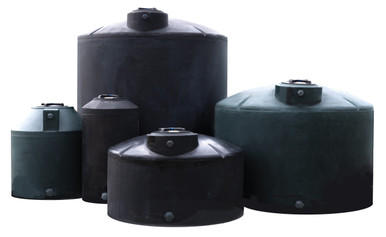
Freeze protection on outdoor polyethylene tanks is the single most under-budgeted line item in cold-climate water and chemistry storage. The tank list price is straightforward; the heat-trace and insulation envelope can equal or exceed the tank cost over a 20-year service life when amortized correctly. The right system in USDA Zone 4 looks nothing like the right system in USDA Zone 8, and applying the same spec across climates wastes capital in the south and ships frozen tanks in the north.
This guide works the cost-benefit by USDA Plant Hardiness Zone — the cleanest publicly-available proxy for design winter low — across five representative zones: 3 (northern Minnesota / Maine), 5 (Iowa / lower Michigan / upstate New York), 6 (mid-Atlantic / Pacific Northwest interior), 7 (mid-South / coastal Pacific Northwest), and 8 (coastal / Texas Hill Country). For each zone we model heat-trace power requirements, insulation R-value targets, capital cost, annual operating cost, and 20-year total cost of ownership against actual Norwesco vertical-tank SKUs in the OneSource catalog.
Why USDA Zones for Tank Engineering
USDA Plant Hardiness Zones are defined by the average annual extreme minimum temperature, mapped at 10-degree-F intervals. They are not a perfect engineering proxy — design conditions per ASHRAE Fundamentals are more rigorous — but they are publicly available, widely understood, and available at ZIP-code resolution. For tank freeze-protection sizing at the order-of-magnitude level they are the right tool.
The five-zone breakdown used in this guide:
- USDA Zone 3 — Average annual minimum -40 to -30 F. Bismarck ND, Duluth MN, Caribou ME, Fairbanks AK fringe.
- USDA Zone 5 — Average annual minimum -20 to -10 F. Des Moines IA, Indianapolis IN, Boston MA, Chicago IL.
- USDA Zone 6 — Average annual minimum -10 to 0 F. Kansas City MO, Cincinnati OH, Philadelphia PA, Portland OR interior.
- USDA Zone 7 — Average annual minimum 0 to 10 F. Atlanta GA, Raleigh NC, Memphis TN, Seattle WA, Norfolk VA.
- USDA Zone 8 — Average annual minimum 10 to 20 F. Houston TX, Charleston SC, Sacramento CA, Tucson AZ.
Below USDA Zone 3 (Zones 1-2 in interior Alaska) freeze-protection becomes life-safety critical and the engineering shifts toward burying or full thermal enclosures rather than retrofit heat trace. Above Zone 8 (Zones 9-10 along the southern Florida and southern California coasts) freeze events are statistical edge cases and most operators rely on wind-break siting and short-duration hardware.
The Physics: Heat Loss From a Polyethylene Tank
Steady-state heat loss from a tank is governed by Fourier's law applied across the tank wall and the surrounding air boundary layer. For an outdoor polyethylene vertical tank with internal water at 50F and ambient at 0F, heat loss per square foot of tank surface is approximately:
q = U * deltaT
where U is the overall heat transfer coefficient (BTU per hr per square foot per F) and deltaT is the temperature differential. For uninsulated half-inch HDPE tank wall in 5 mph wind, U is approximately 1.0-1.3 BTU/(hr * sqft * F). At deltaT of 50F that is 50-65 BTU/hr per square foot of exposed tank surface.
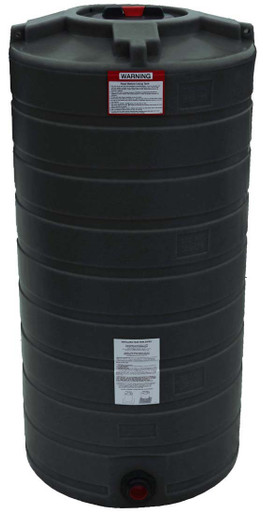
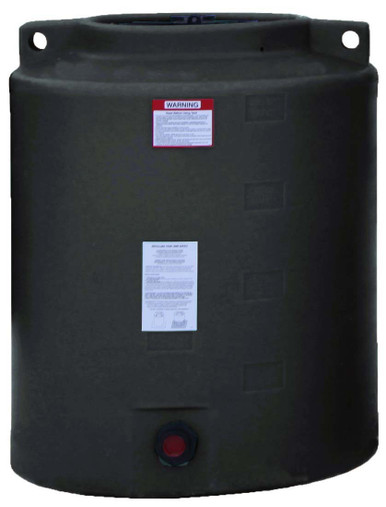
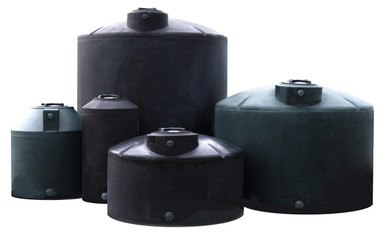
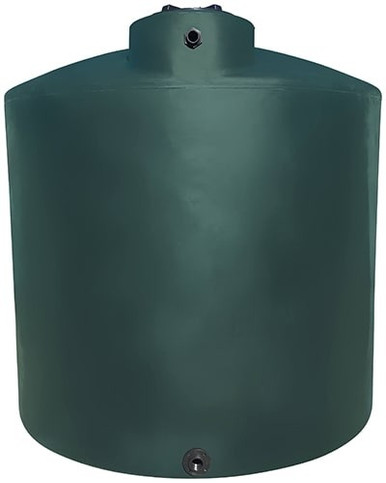
For a 1100-gallon Norwesco vertical tank (MPN 40704, listed at $1,232.23) with diameter 87 inches and shell height 65 inches, the exposed surface is approximately 175 square feet (sidewall plus dome). Bare-tank steady-state loss in 0F ambient with 50F internal water is roughly 9,000-11,000 BTU/hr or about 2.6-3.2 kW continuous. That is a substantial heat-trace load if relied on alone; insulation is the lever that knocks it down by 5-10x.
Insulation Strategy by Zone
| Zone | Recommended Insulation | Target R-Value | Heat Trace |
|---|---|---|---|
| Zone 3 | 3-inch polyiso jacket + outer alum | R-19 to R-22 | 8-12 W/ft self-regulating, full coverage |
| Zone 5 | 2-inch polyiso jacket + outer alum | R-13 to R-16 | 5-8 W/ft self-regulating, full coverage |
| Zone 6 | 1.5-inch polyiso or fiberglass jacket | R-9 to R-12 | 3-5 W/ft, full coverage |
| Zone 7 | 1-inch fiberglass jacket optional | R-5 to R-7 | 3-5 W/ft on fittings only OR full at low W/ft |
| Zone 8 | None typical; wind break | N/A | Fitting-only trace for hard-freeze events |
Heat Trace Sizing Methodology
Self-regulating heat-trace cable (typical product class is per IEEE 515 testing) is rated in watts per linear foot at a reference temperature, typically 50F. At lower ambient temperatures the cable conducts more current and outputs more heat — the "self-regulating" property. For tank freeze protection, you wrap the cable around the tank shell in a helical pattern, then add a separate run on the outlet plumbing and any exposed fittings.
For a 1100-gallon vertical tank in USDA Zone 5 with 2-inch polyiso (R-13) insulation and 5 W/ft heat-trace cable wrapped at one foot pitch over the cylindrical section:
- Cable length on shell: tank circumference (~280 inches = 23.4 ft) times shell-height-over-pitch (65 inches / 12 inches = 5.4 wraps) = ~125 feet of cable
- Cable length on outlet plumbing: 20-40 feet typical
- Total cable: ~150-165 feet
- Power draw at 0F ambient: ~750-825 W (cable runs above its 50F rating in cold weather)
- Power draw at 50F ambient: ~250-300 W (cable backs off near reference)
That is a continuous load comparable to a household refrigerator during peak winter. Annual energy use depends on heating-degree-days for the location and the on-time fraction; a Zone 5 install with thermostat control typically lands in the 2,500-4,500 kWh per year range for this tank size.
Capital Cost Buildout by Zone
Capital cost includes the insulation jacket, the heat-trace cable, the thermostat or controller, electrical conduit and breaker, and labor. The numbers below are illustrative ranges for a 1100-gallon Norwesco MPN 40704 (listed at $1,232.23) and a 2500-gallon Norwesco MPN 40703 / 42040 class.
USDA Zone 3 (extreme cold)
- 3-inch polyiso jacket with outer aluminum cladding: $1,800-3,500 per tank installed (1100 gal); $3,500-6,000 (2500 gal)
- 10 W/ft self-regulating cable + thermostat + GFCI breaker: $700-1,200 (1100 gal); $1,200-2,000 (2500 gal)
- Electrical install (conduit, weatherproof junction box, dedicated 20A circuit): $400-900
- Total install Zone 3: $2,900-5,600 on 1100 gal; $5,100-8,900 on 2500 gal
USDA Zone 5 (cold continental)
- 2-inch polyiso jacket: $1,200-2,400 (1100 gal); $2,400-4,200 (2500 gal)
- 5-8 W/ft cable + thermostat + breaker: $500-900 (1100 gal); $900-1,500 (2500 gal)
- Electrical install: $400-800
- Total install Zone 5: $2,100-4,100 on 1100 gal; $3,700-6,500 on 2500 gal
USDA Zone 6 (cold temperate)
- 1.5-inch polyiso or fiberglass jacket: $800-1,800 (1100 gal); $1,500-3,000 (2500 gal)
- 3-5 W/ft cable + thermostat + breaker: $400-700 (1100 gal); $700-1,200 (2500 gal)
- Electrical install: $400-700
- Total install Zone 6: $1,600-3,200 on 1100 gal; $2,600-4,900 on 2500 gal
USDA Zone 7 (moderate)
- Optional 1-inch fiberglass jacket: $500-1,200 (1100 gal); $900-1,800 (2500 gal). Many installs skip the jacket entirely.
- 3-5 W/ft cable on fittings + outlet only, or full coverage at low W/ft: $250-600
- Electrical install: $300-600
- Total install Zone 7: $1,050-2,400 on 1100 gal; $1,450-3,000 on 2500 gal — and many installs spend $0 by accepting freeze risk
USDA Zone 8 (warm)
- No jacket typical. Wind break (cedar fence panels or earth berm) preferred over insulation.
- Fitting-only trace (~10-25 ft of low-W/ft cable on outlet plumbing) for hard-freeze events 2-5 days per year
- Total install Zone 8: $200-500 typical, often handled as drain-down protocol instead of trace
Annual Operating Cost
Operating cost is energy draw times utility rate. National average residential electricity in 2026 is approximately $0.16-0.22 per kWh; commercial industrial rates run $0.09-0.14. For a 1100-gallon Zone 5 installation drawing 3,500 kWh per winter:
- Residential rate ($0.18 / kWh): $630 per year
- Commercial rate ($0.12 / kWh): $420 per year
For Zone 3 the same tank may draw 5,000-7,000 kWh per winter ($800-1,400 residential / $600-1,000 commercial). For Zone 7 with fitting-only trace operating ~200 hours per winter, the cost is under $50 per year. For Zone 8 the operating cost rounds to zero outside event-driven activation.
20-Year Total Cost of Ownership
The TCO calculation combines capital, replacement (heat-trace cable life is typically 10-15 years and requires replacement once or twice in 20 years), and operating energy. Below for the 1100-gallon Norwesco 40704 example.
| Zone | Capital (initial) | Cable replacement (yr 12) | 20-yr operating | 20-yr total |
|---|---|---|---|---|
| Zone 3 | $4,200 | $1,000 | $15,000 | $20,200 |
| Zone 5 | $3,100 | $700 | $8,000 | $11,800 |
| Zone 6 | $2,400 | $500 | $3,500 | $6,400 |
| Zone 7 | $1,500 | $300 | $800 | $2,600 |
| Zone 8 | $300 | $100 | $50 | $450 |
The Zone 3 freeze-protection envelope ($20,200 over 20 years) exceeds 16x the tank itself ($1,232 list). Insulation and heat trace are not accessories on northern installs — they are the dominant lifecycle cost. Operators in Zone 3 should specify the largest practical tank (5000 gallons via Norwesco MPN 40941 listed at $4,799.99 or MPN 42044 listed at $4,199.99) when capacity allows, because the per-gallon protection cost drops sharply at scale.
Per-Gallon Protection Cost
Scaling effect on freeze-protection capital cost is approximately D^1.6 where D is tank diameter, while capacity scales D^3. The result: per-gallon protection cost falls roughly by half each time tank size doubles.
| Tank (Zone 5 install) | Capital protection | $/gal protection |
|---|---|---|
| 550 gal Norwesco MPN 40703 (listed at $789.99) | $1,800-2,800 | $3.30-5.10 |
| 1100 gal Norwesco MPN 40704 (listed at $1,232.23) | $2,100-4,100 | $1.90-3.70 |
| 2500 gal Norwesco MPN 42040 (listed at $1,990.00) | $3,700-6,500 | $1.50-2.60 |
| 5000 gal Norwesco MPN 42044 (listed at $4,199.99) | $5,800-9,500 | $1.16-1.90 |
Operators with flexibility on tank size in cold climates should always lean larger; the tank itself is at most 50% of the installed cost in Zone 3 / Zone 5, and the insulation envelope amortizes much better at scale.
Code and Standard References
- NEC 2023 Article 427 — Fixed Electric Heating Equipment for Pipelines and Vessels. Required wiring methods, GFCI requirements, and ground-fault detection for tank heat-trace circuits.
- IEEE 515-2022 — Standard for the Testing, Design, Installation, and Maintenance of Electrical Resistance Heat Tracing for Industrial Applications. The reference for self-regulating cable performance and installation practice.
- NFPA 70 (2023) — National Electrical Code, including weatherproof junction-box and conduit requirements applicable to outdoor heat-trace installations.
- ASHRAE Fundamentals Handbook — chapter on heat transfer in piping and vessels; the engineering reference for U-value calculations used above.
- ASTM C552 — Standard Specification for Cellular Glass Thermal Insulation. Applicable when cellular-glass insulation is selected over polyiso for high-temperature or fire-rated installations.
- ASTM C612 — Standard Specification for Mineral Fiber Block and Board Thermal Insulation. Applicable to fiberglass-jacket selections.
- USDA Plant Hardiness Zone Map (2023 revision) — public reference for design winter low temperatures.
Common Mistakes
Mistake 1: Heat trace without insulation
Heat-trace cable on a bare tank is fighting the entire heat-loss surface area at full convective coupling to ambient. Energy use can be 5-10x higher than the same cable with even modest insulation. If the budget allows only one, insulation alone (with drain-down protocol for the coldest weeks) often outperforms unjacketed heat trace.
Mistake 2: Trace coverage on cylindrical only, not bottom dome
The bottom dome of a vertical polyethylene tank loses heat to the foundation pad (or to the slab if installed on concrete) at a higher rate than the cylindrical sidewall. Underbody trace via a fitted heat-pad accessory is recommended in Zone 3 and worth considering in Zone 5.
Mistake 3: Single-circuit for tank and plumbing
A single circuit feeding both the tank shell and the outlet plumbing means a fault on either disables both. Two dedicated circuits with separate GFCI per IEEE 515 is the engineered configuration.
Mistake 4: Foam-board insulation without weather jacket
Polyiso and EPS foam degrade rapidly under UV exposure and absorb water without a vapor barrier. A continuous metal cladding (aluminum or stainless) or fiberglass overlay is required for outdoor installs. Bare-foam install fails within 2-3 winters.
Mistake 5: Over-specifying for Zone 7 / Zone 8
Many Zone 7 operators waste capital on polyiso jackets and continuous trace appropriate for Zone 5. The Atlanta / Memphis / Seattle freeze profile is 5-15 hard-freeze hours per winter, not a multi-month sustained low. Fitting-only trace plus drain-down protocol on the worst nights is the engineered answer for most Zone 7 service.
How OneSource Specifies
Our default freeze-protection guidance:
- Identify USDA Zone for the installation ZIP.
- Cross-reference the table above for insulation and trace recommendation.
- Right-size the tank — bias toward larger capacity in Zone 3 / Zone 5 to amortize freeze-protection cost.
- Confirm electrical service is adequate for the heat-trace continuous load (most installs need a dedicated 20A circuit).
- Spec to NEC 2023 Article 427 + IEEE 515 for installation.
Tank SKUs referenced in this guide: Norwesco MPN 40703 (550 gal vertical water, listed at $789.99), MPN 40704 (1100 gal, listed at $1,232.23), MPN 42040 (2500 gal, listed at $1,990.00), MPN 42044 (5000 gal, listed at $4,199.99), MPN 40941 (5000 gal liquid storage, listed at $4,799.99). All BC list prices exclude LTL freight; quote the freight separately per ZIP via the Freight Estimator or by phone at 866-418-1777.
Internal Resources
- Insulation and Heat Tracing Engineering Guide
- Below-Grade Tank Engineering: Frost Line and Soil Loading
- Foundation Pad Engineering for Vertical Polyethylene Tanks
- UV Degradation and Tank Color Selection
- Site Survey Checklist for Tank Installation
- Installation Walkthrough for Vertical Polyethylene Tanks
- Freight Cost Estimator
Source Citations
- NEC 2023 (NFPA 70) Article 427 — Fixed Electric Heating Equipment for Pipelines and Vessels
- IEEE 515-2022 — Heat Tracing for Industrial Applications, Design and Installation
- NFPA 70 2023 Edition — National Electrical Code
- ASHRAE Fundamentals Handbook — Heat Transfer in Piping and Vessels
- ASTM C552 — Cellular Glass Thermal Insulation
- ASTM C612 — Mineral Fiber Block and Board Thermal Insulation
- USDA Plant Hardiness Zone Map, 2023 revision (planthardiness.ars.usda.gov)
- EIA Electric Power Monthly — average state utility rates, 2025-2026 baseline
- OneSource Plastics master catalog data, 2026-03-26 snapshot (9,419 products)
Recommended Tanks for This Guide
Live pricing, updated automatically · estimate freight to your ZIP.