Tank Insurance and Liability: Coverage Considerations for Industrial Storage
Industrial storage tanks are concentrated risk: thousands of gallons of fluid, often regulated chemistry, sitting on a pad or below grade, exposed to weather, equipment, and operator error. The catastrophic loss case — tank fails, fluid releases, contamination spreads, regulatory enforcement begins, downstream parties claim damages — can easily reach six- to seven-figure exposure. Insurance is how that risk gets transferred. The buyer's job is making sure the policies actually respond when the loss occurs.
This guide walks the four insurance lines that tank owners need to understand: Commercial General Liability (CGL), Pollution Liability, Property Insurance, and SPCC / regulatory financial responsibility. We cite 40 CFR 112 (SPCC), 40 CFR 280 (UST financial responsibility), state water-quality enforcement frameworks, and reference standard ISO insurance forms. This article is general guidance, not legal or insurance advice. Specific policy terms vary by carrier and jurisdiction; always work with a qualified insurance broker and legal counsel for your specific operation.
The Four Insurance Lines for Tank Owners
1. Commercial General Liability (CGL)
CGL covers third-party bodily injury and property damage arising from the insured's premises and operations. For tank owners, CGL responds to scenarios like: a tank delivery truck damages a customer's pavement, a visitor slips on a tank-related spill, a subcontractor is injured while installing the tank.
The critical limitation: standard ISO CGL forms include the "absolute pollution exclusion" (ISO CG 21 49 or similar) that excludes "bodily injury or property damage which would not have occurred in whole or in part but for the actual, alleged or threatened discharge, dispersal, seepage, migration, release or escape of pollutants." Translation: tank releases of regulated chemistry are typically excluded from CGL coverage.
CGL does cover sudden mechanical failures that cause physical damage without pollutant release: tank ruptures and floods a customer's basement with potable water, falling tank damages adjacent equipment, etc. For chemistry-bearing tanks, CGL alone is insufficient.
2. Pollution Liability (CPL / Site Pollution / EIL)
Pollution Liability fills the CGL pollution exclusion gap. Multiple product names exist: Contractor's Pollution Liability (CPL) for contractors, Site Pollution Liability (SPL) for fixed locations, Environmental Impairment Liability (EIL) for legacy / historic exposure. The forms cover: cleanup costs, third-party bodily injury and property damage from pollution, regulatory fines (where insurable), legal defense.
Critical buyer terms:
- Claims-made vs occurrence: most pollution policies are claims-made (coverage when claim is filed) rather than occurrence (coverage when event occurred). Continuous coverage discipline is essential; a coverage gap means losses fall outside policy.
- Retroactive date: claims-made policies cover events from a retroactive date forward. New policies often have retroactive date matching policy inception, leaving prior contamination uncovered.
- Sudden vs gradual: some pollution policies cover only sudden events; others cover gradual seepage. Tank UST contamination is typically gradual; verify policy responds.
- Site-specific or operations-wide: SPL is location-scheduled. Adding new tank locations requires policy endorsement.
- Limits: typical policies $1M / $2M / $5M; for petroleum / hazardous chemistry consider $5M-$25M.
- Self-insured retention (SIR): $5,000 - $250,000 typical; affects net loss.
3. Property Insurance
Property covers the tank itself and contents against named or all-risk perils. Tank property coverage considerations:
- Replacement cost vs actual cash value (ACV): ACV depreciates the tank with age, often to a fraction of replacement cost. Replacement-cost endorsement is generally worth the modest premium increase.
- Contents (the fluid): covered separately. Verify scheduled limit covers worst-case fluid value (chemistry inventory may exceed tank value).
- Flood and earth-movement: typically excluded; separate flood / earthquake coverage required for high-risk geography. Pad / foundation issues triggered by earth movement may not be covered without endorsement.
- Wind and hurricane: coverage varies. See the Hurricane Tie-Down guide for engineering side; insurance side often excludes named-storm losses or applies separate hurricane deductible.
- Equipment breakdown: covers mechanical / electrical breakdown of tank-related equipment (pumps, mixers, controls) but typically excludes the tank shell itself.
4. SPCC and Regulatory Financial Responsibility
EPA and state regulators require certain tank owners to demonstrate financial capacity to fund spill response. The mechanisms vary by tank type:
- SPCC (40 CFR 112): aboveground petroleum storage requires SPCC plan, but financial responsibility is generally not required at the federal level (state-specific exceptions exist).
- UST (40 CFR 280, Subpart H): underground petroleum storage requires demonstration of financial responsibility for taking corrective action and compensating third parties: $1M per occurrence, $1M-$2M aggregate depending on tank count and throughput. Common methods: insurance, surety bond, letter of credit, financial test, or state-specific UST trust fund.
- RCRA hazardous waste (40 CFR 264-265, Subpart H): hazardous waste storage requires closure and post-closure financial assurance.
- State-specific: California, Texas, Florida, and other states have additional financial responsibility requirements for petroleum and chemistry storage.
Coverage Considerations by Service Type
Residential / agricultural water (Norwesco, Enduraplas water tanks)
Coverage typically rolled into farm or homeowner policy. Tank as property (replacement cost endorsement); CGL standard. Pollution risk minimal; SPCC not applicable. SKU context: Norwesco N-41464 100 gal $393.86 list, EP-TLV02100 2,100 gal $1,858.99 list, EP-TLV03000 3,060 gal $2,399.99 list. Pricing reflects BC list before freight.
Potable water (NSF 61 plant primary)
Municipal or commercial water utility coverage. Property insurance for tank; CGL for facility operations; specific water-quality liability endorsement may apply. NSF 61 certification documentation maintained for regulatory compliance and insurance underwriting.
DEF (urea 32.5%)
Mild service; coverage similar to water but with industrial / commercial CGL. NSF 61 documentation; trucking-related CGL if hauling.
Sodium hypochlorite, sodium hydroxide, sulfuric acid (Snyder XLPE chemistry)
Pollution Liability essential. Site Pollution policy with sufficient limits ($5M-$25M depending on operation). SPCC plan if regulated. Annual inspection / maintenance documentation supports underwriting and claims. SKU context: SII-5490000N42 1,550 gal double-wall XLPE class is the canonical industrial chemistry tank in this catalog tier.
Diesel / petroleum aboveground (SPCC regulated)
SPCC plan + Pollution Liability. Double-wall construction strongly preferred (Snyder SII-5740102N95703 275 gal $2,299.99 list). Annual SPCC inspections; integrity testing on schedule. Pollution policy must cover both sudden and gradual release; verify retroactive date covers full ownership period.
Petroleum UST
40 CFR 280 financial responsibility ($1M-$2M); state UST trust fund participation if available; insurance to fill gaps. Cathodic protection annual report; release-detection records; tightness testing. UST insurance is specialized; work with carrier experienced in 40 CFR 280 compliance.
RCRA hazardous waste storage
RCRA financial assurance; closure / post-closure cost estimates; insurance, surety bond, or financial test mechanism. Pollution Liability with high limits ($10M-$50M); legal defense fund consideration.
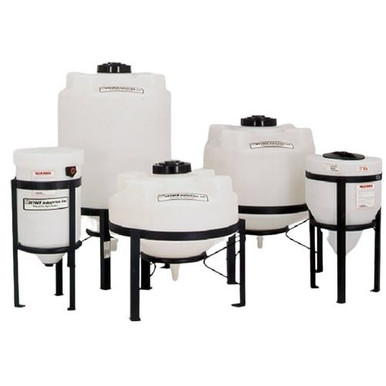
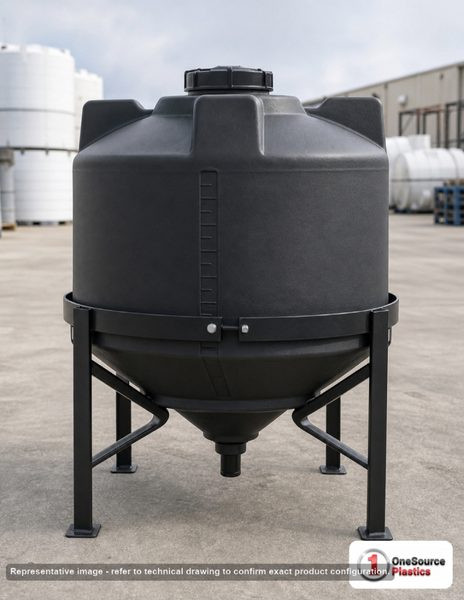
Cone-bottom chemistry mixing (Chem-Tainer process tanks)
Pollution Liability matched to chemistry. Process-specific HAZWOPER training documentation; equipment breakdown for mixer / piping. SKU context: TC-TC3148JP 100 gal $1,020 list, TC-TC3166JP 150 gal $1,190 list, TC-TC3177JP 200 gal $1,250 list.
Insurance Coverage Quick-Reference Table
| Service | CGL | Pollution | Property | Reg Financial Resp |
|---|---|---|---|---|
| Residential / agricultural water | Standard | Not required | Replacement cost | No |
| Potable plant primary (NSF 61) | Standard | Optional | Replacement cost | No (state-specific) |
| DEF (urea 32.5%) | Standard | Optional | Replacement cost | No |
| Sodium hypochlorite / hydroxide | Standard | Required ($5M-$25M) | Replacement + contents | State-specific |
| Sulfuric acid 50%-93% | Standard | Required ($5M-$25M) | Replacement + contents | State-specific |
| Diesel double-wall AST (SPCC) | Standard | Required ($1M-$5M) | Replacement + contents | State-specific |
| Petroleum UST | Standard | Required (40 CFR 280) | Replacement + contents | $1M-$2M (40 CFR 280) |
| RCRA hazardous waste storage | Standard | Required ($10M-$50M) | Replacement + contents | RCRA Subpart H (closure / post-closure) |
| Underground septic (residential) | Homeowner / farm | Optional | Bundled | No |
How Maintenance Documentation Affects Coverage
Insurance underwriting and claims response increasingly rely on maintenance documentation. The carrier's view:
- Underwriting: a tank with documented quarterly inspections and triennial cleanouts qualifies for better rates and broader coverage. A tank with no records is rated as higher-risk or excluded altogether.
- Claims: when a tank fails, the first carrier question is "show me the maintenance records." A documented maintenance program supports the claim; absence of records is grounds for coverage denial under "failure to maintain" exclusions in many policies.
- Service-life argument: tanks beyond manufacturer-rated service life often face exclusion or higher deductible. Maintenance records demonstrating ongoing fitness extend insurable service life.
Reference the Tank Cleaning and Maintenance Schedule for the documentation cadence carriers expect.
What's Typically Excluded
From CGL
- Pollution release (absolute pollution exclusion)
- Damage to the insured's own property
- Workers' compensation (separate policy)
- Auto-liability (separate policy)
- Professional services (separate E&O)
From Pollution Liability
- Pre-existing contamination (depending on retroactive date)
- Known conditions disclosed at policy inception
- Intentional acts
- Some natural disaster causation (verify policy)
- Mold / fungi (typically excluded or sub-limit)
- Lead / asbestos (typically excluded or separate)
From Property
- Wear and tear, gradual deterioration
- Inherent vice of stored fluid (chemistry attacking the tank)
- Failure to maintain
- Flood (separate coverage)
- Earth movement (separate coverage)
- Nuclear / war / terrorism (TRIA-eligible separate)
From SPCC / regulatory financial responsibility
- Punitive damages (in many states)
- Criminal fines (uninsurable)
- Some civil penalties (state-specific)
Pollution Liability Buyer Checklist
When purchasing pollution liability, verify the following with broker / underwriter:
- Retroactive date: earliest reasonable; ideally back to original tank installation.
- Sudden + gradual coverage: both, not just sudden.
- Site-scheduled vs blanket: all your tank locations listed; if blanket, verify policy language.
- Tank shell coverage: some pollution policies cover the cost of replacing the failed tank as part of cleanup; others don't. Verify.
- Closure / post-closure: if RCRA-regulated, financial assurance mechanism documented.
- Defense costs inside or outside limits: defense outside limits preferred (preserves indemnity capacity).
- Self-insured retention: reasonable for your operation; aggressive SIR reduces premium but increases net loss.
- Continuous coverage requirement: understand the implications of coverage gaps in claims-made structure.
- Underwriting documentation: tank inventory, maintenance records, integrity test history, prior claim history.
- State-specific endorsements: California Prop 65, NJ ECRA / ISRA, Florida 376 / 403, Texas Risk Reduction, etc.
Real Loss Scenarios and Coverage Response
Scenario 1: Outdoor 1,500-gallon ag water tank ruptures, floods adjacent shop
Loss: $15,000 shop equipment damage. Coverage path: CGL property damage to third party (the shop). Pollution excluded but not applicable (water isn't a pollutant). Tank replacement under property policy. Maintenance records support ACV vs replacement cost determination.
Scenario 2: 1,550-gallon XLPE caustic tank (SII-5490000N42 class) develops slow leak; soil contamination
Loss: $80,000 soil remediation, $20,000 legal defense, $15,000 regulatory fine (where insurable). Coverage path: Pollution Liability primary. Verify retroactive date covers tank install. Verify gradual seepage included. Maintenance records of quarterly thickness measurements and annual inspections support claim.
Scenario 3: Diesel double-wall AST (SII-5740102N95703 class) primary tank fails; secondary holds
Loss: tank replacement ($2,300 + freight + labor). Coverage path: property. Pollution typically not triggered because secondary held the spill (no environmental release). SPCC plan inspection record matters; tank replaced under property; SPCC plan amended to reflect new tank.
Scenario 4: Cone-bottom Chem-Tainer process tank (TC-TC3148JP class) fails during chemistry batch
Loss: tank, fluid, downstream piping. Coverage path: property (tank), Pollution (if release reaches drain or environment), CGL (if injury to operator), Equipment Breakdown (if mixer / piping).
Scenario 5: Hurricane uplifts unanchored Norwesco vertical water tank, damages adjacent residence
Loss: tank destroyed, residence damage $50,000. Coverage path: property may exclude wind / hurricane; CGL for third-party damage; potentially insured's property exclusion for own tank if storm wasn't covered. Reference the Hurricane Tie-Down guide; maintenance records of strap inspection support claim.
Liability Beyond Insurance
Insurance is risk transfer; it does not eliminate exposure. Strategies for liability minimization:
- Operating discipline: trained operators, written procedures, maintenance documentation, incident reporting.
- Engineering controls: double-wall construction (Snyder), secondary containment berms, leak-detection systems, alarms, automatic shutoffs.
- Code compliance: NFPA 30, UL 142, ASME, NSF 61, AWWA standards. Compliance reduces both regulatory exposure and insurance premium.
- Site selection: tank location away from waterways, wells, sensitive receptors. Setbacks per state-specific regulation.
- Contractor selection: licensed, insured installers; pre-install design review; commissioning documentation.
- Service-life management: proactive replacement (see Repair / Reline / Replace Framework); avoid running tanks beyond rated service life.
- Vendor agreements: warranty terms, indemnification clauses, hold-harmless provisions in purchase orders.
Common Insurance Mistakes
Mistake 1: Assuming CGL covers pollution release
It doesn't. Standard ISO CGL forms exclude pollution. A tank chemistry release without separate Pollution Liability is uninsured.
Mistake 2: Letting Pollution Liability lapse, even briefly
Claims-made structure means a coverage gap creates uninsured exposure for events that occur during the gap, even if reported later under new policy.
Mistake 3: Not documenting maintenance
"Failure to maintain" exclusion is the single largest claim denial source. Document quarterly inspections, annual entries, gasket replacements, integrity tests. The cost of documentation is trivial; the value at claim time is the coverage itself.
Mistake 4: Under-insuring tank contents
The fluid inventory often exceeds tank cost. A 6,000-gallon XLPE tank holding 5,500 gallons of high-value chemistry may have inventory worth $30,000-$200,000+ at replacement. Schedule contents separately or verify the property limit covers contents.
Mistake 5: Missing the SPCC / state regulatory financial responsibility piece
EPA and state regulators require demonstration of financial capacity for petroleum and certain chemistry storage. Insurance can satisfy financial responsibility but specific endorsements may be required. Don't assume a standard pollution policy meets the regulatory test; verify with broker and counsel.
Mistake 6: Skipping the broker review when changing service
If you change service in an existing tank (water to chemistry, chemistry concentration up, new chemistry added), the underwriting basis of the policy may change. Notify broker; update policy. Continuing to operate under the original underwriting can void coverage when claim arises.
Mistake 7: Buying a tank without verifying warranty + insurance interaction
Manufacturer warranty covers manufacturing defect; insurance covers other loss. Some warranties require specific maintenance / inspection / record-keeping. Both ecosystems function together. Read the warranty terms when buying; document compliance throughout service.
Working With Your Broker
Tank insurance is a specialty placement. General-purpose commercial brokers may not have the underwriting relationships or technical knowledge for industrial chemistry storage. Look for brokers with:
- Active pollution liability books with multiple carrier relationships
- Experience with SPCC / 40 CFR 280 / RCRA financial responsibility placement
- Familiarity with state-specific environmental insurance requirements
- Network of risk-engineering consultants for site assessments
- Claims advocacy capability for environmental claims
Annual policy review is the minimum cadence. Mid-term review when tank inventory changes (new tank, removed tank, service change). The broker should be familiar with your tank inventory, service types, maintenance records, and prior claims.
Internal Resources
- Cleaning and Maintenance Schedule
- Repair vs Reline vs Replace
- Failure Mode Analysis
- SPCC and Pretreatment 403
- Hurricane Tie-Down Engineering
- Below-Grade Tank Engineering
- Chemical Compatibility Database
- Contact OneSource — tank specification consultation, manufacturer warranty support
Source Citations
- 40 CFR 112 — SPCC (Spill Prevention, Control, and Countermeasure)
- 40 CFR 280 — Underground Storage Tanks (Subpart H Financial Responsibility)
- 40 CFR 264-265 — RCRA Hazardous Waste Storage Standards (Subpart H Financial Requirements)
- ISO Commercial General Liability Form CG 00 01 (general industry standard)
- ISO CG 21 49 — Total Pollution Exclusion endorsement
- NSF/ANSI 61 — Drinking Water System Components: Health Effects
- AWWA M42 — Steel Water-Storage Tanks (inspection / maintenance principles)
- NFPA 30 — Flammable and Combustible Liquids Code
- ASTM D1998 — Standard Specification for Polyethylene Upright Storage Tanks
- State environmental statutes: California Prop 65 / Health and Safety Code; Florida Chapter 376; Texas Risk Reduction Standards
- OneSource Plastics master catalog data, dated 2026-03-26 snapshot
Disclaimer: This article is general guidance for tank owners and is not legal or insurance advice. Specific policy terms, regulatory obligations, and coverage availability vary by carrier, state, and operation. Always consult a qualified insurance broker and legal counsel for your specific circumstances.
Related chemical compatibility resources
For deeper engineering specifications on the chemicals discussed above, see our chemical-compatibility pillars:
- Sulfuric Acid — storage compatibility, recommended resin grade, fittings, secondary containment.
- Sodium Hypochlorite — storage compatibility, recommended resin grade, fittings, secondary containment.
- DEF (Diesel Exhaust Fluid) — storage compatibility, recommended resin grade, fittings, secondary containment.
- Sodium Hydroxide — storage compatibility, recommended resin grade, fittings, secondary containment.
Recommended Tanks for This Guide
Live pricing, updated automatically · estimate freight to your ZIP.