Tank Level Gauge Selection for Chemical Service: Radar vs Ultrasonic vs Hydrostatic vs Magnetostrictive
Continuous-level measurement on chemical-service polyethylene tanks is the difference between predictable inventory management and reactive operations. The four dominant level technologies — radar (FMCW or pulsed time-domain), ultrasonic (acoustic time-of-flight), hydrostatic pressure (submersible or external), and magnetostrictive (float-on-stem) — each have specific application windows, accuracy and reliability profiles, chemistry compatibility constraints, and installation requirements. Choosing wrong leaves you with a gauge that drifts, fouls, fails, or reads inaccurately under the conditions you actually operate in. This walkthrough covers the technology comparison at the engineering level, what to specify for each chemical service class, and how the gauge interfaces with the OneSource catalog of vertical tanks across capacity ranges.
The Four Technologies at a Glance
| Technology | Measurement Principle | Typical Accuracy | Contact? | Affected by Density | Affected by Foam/Vapor |
|---|---|---|---|---|---|
| Radar (FMCW) | Microwave time-of-flight | ±1-3 mm | Non-contact | No | Penetrates foam/vapor well |
| Ultrasonic | Acoustic time-of-flight | ±0.25-0.5% | Non-contact | No | Affected by foam, vapor, temperature gradient |
| Hydrostatic | Pressure at fixed depth | ±0.1-0.5% | Wetted | Yes (must compensate) | Not affected |
| Magnetostrictive | Float position on guide stem | ±0.01-0.5 inch | Wetted | Float-buoyancy compensation | Not affected |
Radar (FMCW and Pulsed): The General-Purpose Choice for Chemicals
Frequency-modulated continuous-wave (FMCW) radar and pulsed-radar level transmitters dominate the chemical-tank level-measurement segment for one reason: the technology is non-contact, immune to density variation, immune to vapor or condensation in the headspace, and accurate to the millimeter range across the entire tank height. The radar antenna mounts on the tank top through a dedicated port (typically 2-inch or 3-inch NPT, BSP, or flange) and the microwave beam reflects off the liquid surface. The transmitter calculates the level from the time-of-flight (pulsed) or frequency-difference (FMCW) of the reflected signal.
For chemical service the radar wins on:
- No chemistry compatibility issue with the wetted parts — there are no wetted parts. The antenna sits in the vapor space; the radar beam reflects off the liquid surface. PTFE-encapsulated antennas are available for chemistries that condense aggressive vapor (acid mist).
- Density independence: the radar measures position, not pressure. Specific gravity, temperature, and concentration changes do not affect the reading. For high-SG sulfuric acid, sodium hydroxide, or ferric chloride solutions, the radar reads the same regardless of fluid density.
- Foam and vapor penetration: low-frequency radar (6 GHz) penetrates dense foam and water-vapor saturated headspace effectively. High-frequency radar (80 GHz+) trades some foam-penetration capability for tighter beam angle and higher accuracy, suiting tall-narrow tanks.
- Long service life: no moving parts, no consumables, sensor-only field replacement. Mean-time-between-failure typically exceeds 10 years for industrial-grade units.
Cost: a chemical-service guided-wave or non-contact radar transmitter typically runs $1,500 to $5,000 for a basic loop-powered 4-20 mA unit; HART-protocol or Foundation Fieldbus units run $3,000 to $8,000. For a large-volume vertical tank like the Snyder Industries 20,000-gallon class, the radar gauge cost is a small fraction of total tank investment and the data-quality return is high.
Ultrasonic: Cost-Effective for Compatible Conditions
Ultrasonic level transmitters use acoustic time-of-flight: a transducer at the tank top emits an ultrasonic pulse, the pulse reflects from the liquid surface, and the transit time gives the level. Cost is roughly half that of radar (typical $500 to $2,500), the technology is well-understood, and many small-tank applications run reliably on ultrasonic for years.
The limitations are real, however, and matter for chemical service:
- Vapor and foam interfere: dense foam absorbs the acoustic pulse. Saturated vapor (water-saturated headspace, condensing acid mist) attenuates the signal. Temperature stratification in the headspace bends the acoustic path and degrades accuracy.
- Surface turbulence affects reflection: an actively agitated tank surface scatters the acoustic pulse and gives noisy readings. Ultrasonic is best for quiescent tanks or with averaging algorithms.
- Mounting geometry matters: the dead-band near the transducer (typically 6 to 18 inches depending on transducer power) cannot be measured. Tall narrow tanks require careful transducer selection to ensure the beam does not interact with side walls.
- Chemistry compatibility for the transducer face: most industrial ultrasonics use PVDF or PTFE-faced transducers, but acid-mist condensation on the transducer face can degrade performance over time.
Ultrasonic is the right choice for clean water tanks, low-vapor-pressure chemistry, agitated-but-not-foaming applications where cost matters more than accuracy. For aggressive chemistry, particularly with vapor or foam, radar is the better engineering choice.
Hydrostatic: Reliable, but Density-Coupled
Hydrostatic level transmitters measure the pressure at a known depth in the tank; pressure equals fluid density times gravity times height. Inverting gives height. Two configurations:
- Submersible: a sensor at the bottom of a cable, lowered into the tank through the top. Wetted parts are typically PVC, PP, PVDF, or PTFE-coated for chemical service.
- External (tank-bottom): a pressure sensor mounted to a tank bottom port (usually a flush-diaphragm design to avoid clogging in slurries). Wetted parts are again PVC, PP, PVDF, or PTFE-coated.
Hydrostatic measurement is unaffected by vapor, foam, and surface turbulence — it sees only the pressure at the sensor depth. The main limitation is the density-coupling: pressure is density × gravity × height, so the calibration must account for the actual fluid density. For applications where the fluid density varies (sulfuric acid varying from 50 to 98 percent concentration; sodium hydroxide varying from 25 to 50 percent; brine solutions during preparation), the hydrostatic level reading is not a true level reading without density compensation.
For fixed-density applications (water, single-concentration chemistry held at constant strength, sodium hypochlorite at a stable manufactured concentration) hydrostatic is reliable, accurate, and inexpensive ($300 to $1,500 for a basic loop-powered transmitter). For variable-density applications, the density-compensation algorithm and concentration-monitoring infrastructure become part of the measurement system, complicating the engineering.
Magnetostrictive: High Accuracy, Bulk-Storage Sweet Spot
Magnetostrictive level transmitters use a sealed stem along which a magnetic float rides. The transmitter pulses the stem with a current; the magnetic field of the float creates a torsional pulse that travels back along the stem. Time-of-flight from pulse emission to torsional-pulse return gives float position with extreme accuracy, often ±0.01 inch on industrial transmitters. The technology is the dominant choice for petroleum bulk-storage inventory measurement (gasoline, diesel, jet fuel) and for high-accuracy inventory applications.
For polyethylene chemical-service tanks, magnetostrictive applies in select cases:
- High-accuracy inventory measurement on neutral or low-aggression fluids: water, glycol, DEF, biodiesel, mineral oil. The wetted-part materials (typically 316SS stem with PTFE or PFA-encapsulated float for compatible chemistry) limit the chemistry envelope.
- Inventory measurement integrated with overfill prevention: many magnetostrictive transmitters offer multiple float configurations on a single stem for level + interface (water bottom in petroleum) + density measurement.
For the aggressive-chemistry segment (concentrated sulfuric, hydrochloric, hydrofluoric, sodium hydroxide), the wetted-part chemistry compatibility limits magnetostrictive. Radar is generally the better engineering choice for these chemistries.
Application-Specific Recommendations by Chemistry
| Service | Recommended Primary | Acceptable Alternative | Avoid |
|---|---|---|---|
| Potable water (NSF 61) | Hydrostatic submersible | Ultrasonic, radar | — |
| Process water | Hydrostatic, ultrasonic | Radar | — |
| Sulfuric acid (98%) | Radar (PTFE antenna) | Hydrostatic with PVDF/PTFE diaphragm | Float-based, magnetostrictive |
| Sodium hypochlorite (12.5%) | Radar | Hydrostatic (PVDF wetted) | Float-based |
| Sodium hydroxide (50%) | Radar | Hydrostatic with HDPE/PVDF | — |
| Sodium hydroxide (25%) | Hydrostatic with HDPE/PVDF | Radar, ultrasonic | — |
| Hydrochloric acid (37%) | Radar (PTFE antenna) | Hydrostatic (PFA/PTFE diaphragm) | Magnetostrictive without PFA-encap |
| Glycol heat-transfer | Hydrostatic, magnetostrictive | Radar, ultrasonic | — |
| Diesel exhaust fluid (DEF) | Magnetostrictive, hydrostatic | Radar | Ultrasonic (foam risk) |
| Used oil | Magnetostrictive, hydrostatic | Radar | — |
| Brine (variable concentration) | Radar | Hydrostatic with density compensation | Hydrostatic without density comp |
| Liquid fertilizer (UAN, urea solution) | Radar | Hydrostatic with HDPE/PVDF | — |
Tank-Top Mounting on OneSource Vertical Tanks
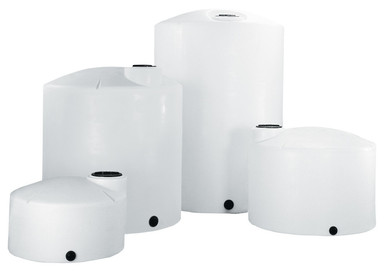
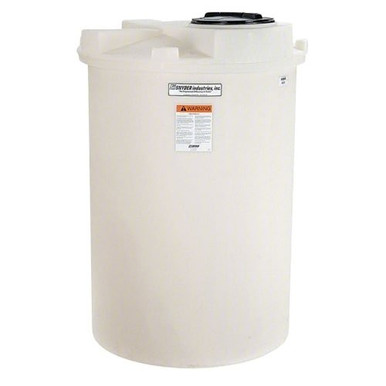
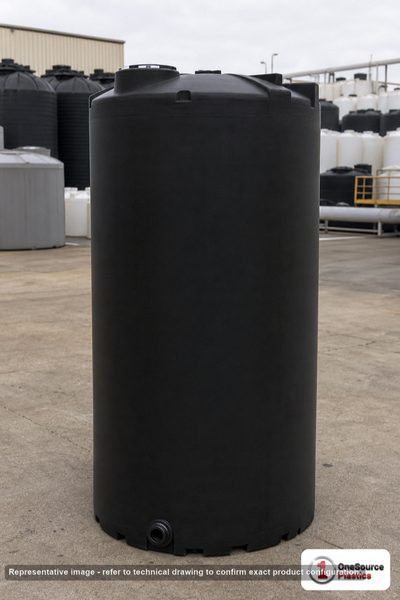
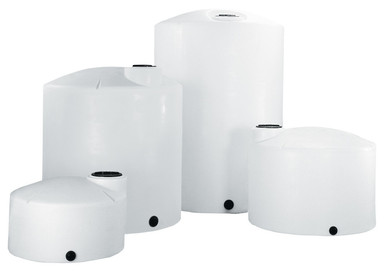
Most OneSource Norwesco, Snyder Industries, Chem-Tainer, and Enduraplas vertical tanks ship from the OEM with a 16-inch or 22-inch top manway and may have additional 2-inch or 4-inch top fittings available as a factory option or field-installed via the appropriate Hayward, Banjo, or Polylok bulkhead fitting. For radar or ultrasonic gauge installation, a dedicated 2-inch or 3-inch top port is the standard. The gauge mounts on a flange or threaded bulkhead with the antenna or transducer projecting into the tank vapor space.
Across the catalog, a few representative high-volume verticals where gauge selection matters most:
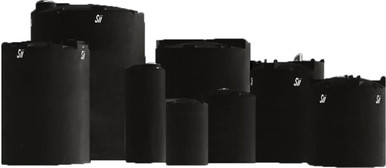
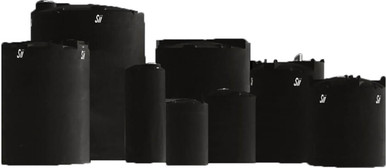
- Snyder Industries 18800 Gallon HDPE Vertical Liquid Storage Tank in Black (MPN 3030000N33, listed at $42,653.99) — 242 inches tall, 165-inch diameter. Tall-narrow geometry suits high-frequency radar (80 GHz+) for tight beam angle.
- Snyder Industries 18800 Gallon HDPE Vertical Liquid Storage Tank with ASTM rating (MPN 3030000N39, listed at $38,776.15) — same geometry, ASTM-rated wall section.
- Snyder Industries 18800 Gallon HDPE Vertical Liquid Storage Tank with ASTM rating (MPN 3030000N43, listed at $46,248.00) — heavier wall section for higher-SG service.
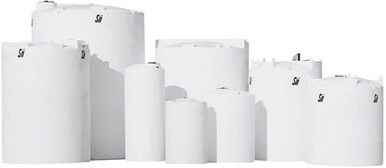
- Snyder Industries 20000 Gallon Plastic Vertical Liquid Storage Tank in White (MPN 3030000C37, listed at $37,724.00) — 20K vertical, similar gauge mounting considerations.
- Snyder Industries 20000 Gallon HDPE Vertical Liquid Storage Tank (MPN 3030000C26, listed at $48,171.00) — heavier-wall 20K vertical.
- Norwesco 20000 Gallon HDPE Vertical Liquid Storage Tank (MPN 43827, listed at $43,299.99) — 20K Norwesco workhorse.
- Norwesco 20000 Gallon Vertical Fertilizer Storage Tank in Yellow (MPN 44926, listed at $34,805.00) — fertilizer-service yellow pigmentation, radar suits well due to UAN density variation.
Installation Engineering: Radar Mounting Specifics
Radar gauge performance depends on a few installation details:
- Mount away from inlet, agitator, or pump return: turbulence under the antenna scatters the reflection. Mount over a quiescent zone, ideally diagonally across the tank from agitator or inlet.
- Avoid internal obstructions in the beam path: tank ladder rungs, internal piping, fill nozzles, mixers all create false reflections. Verify the beam path geometry to ensure 6 to 12 inches of clearance from any internal feature.
- Provide a stillwell for stratified or low-dielectric service: for fluids with poor radar reflectivity (low dielectric constant — kerosene, oils, some hydrocarbon products), a stillwell (a vertical pipe sleeve in the tank guiding the radar beam down to the surface) improves signal-to-noise. Stillwell is also useful for foam-prone or vapor-saturated service.
- Calibrate empty distance: program the radar with the tank empty distance (mount-flange to tank bottom). The transmitter then computes level as empty-distance minus measured-distance.
Reliability and Calibration Drift: What Operators See Over Time
Across 5 to 10 years of service, the four technologies show distinct reliability and drift profiles. Radar gauges (both FMCW and pulsed) typically hold calibration to within the original specification across the entire service interval, with drift driven mainly by mechanical mounting changes (gasket compression, fitting torque relaxation) rather than electronics. Mean-time-to-failure for industrial-grade radar transmitters routinely exceeds 10 years.
Ultrasonic gauges show modest drift over the service interval driven by transducer-face fouling (chemical-mist condensation, dust accumulation in dusty environments), and often require periodic visual inspection and cleaning of the transducer face to maintain accuracy. Mean-time-to-failure runs 5 to 8 years.
Hydrostatic gauges drift with diaphragm-membrane stress relaxation (a slow phenomenon that produces zero-shift over years). Most industrial hydrostatic transmitters tolerate field re-zeroing as part of annual calibration. Submersible cable insulation also degrades in chemical service over time and is the typical failure mode.
Magnetostrictive gauges hold calibration tightly across the service interval; the dominant failure mode is float-buoyancy degradation from chemistry attack on the float-encapsulation material. Selecting the right float chemistry-compatibility material upfront determines the service life.
Networking: 4-20 mA, HART, Modbus, Wireless
For ag-retail, fleet, or small-process facilities, the simplest gauge architecture is a loop-powered 4-20 mA transmitter wired to a panel meter or PLC analog input. For multi-tank inventory monitoring, HART-protocol overlay on the 4-20 mA loop or Modbus-RTU over RS-485 enables digital readback of multiple parameters (level, temperature, signal quality). For remote-site applications (tank yards, off-grid sites), wireless options including LoRaWAN and cellular-IoT level transmitters connect tanks to cloud inventory platforms without site-wired infrastructure.
The OneSource preferred-vendor gauge specifications (available on request) cover the basic 4-20 mA chemistry-rated radar configuration that suits the majority of polyethylene chemical-service tank installations. For HART, Modbus, or wireless requirements, gauge selection is project-specific.
Cross-References
For chemistry-compatibility verification on specific fluids referenced above, see the chemical compatibility hub including sulfuric acid, sodium hypochlorite, sodium hydroxide, hydrochloric acid, and glycol.
For tank specification, gauge port configuration, freight, and configuration on the Norwesco, Snyder Industries, Chem-Tainer, and Enduraplas vertical tank lineup, contact OneSource Plastics at 866-418-1777. For LTL freight quoting on tank delivery to your installation site, use the freight estimator.