Tank Stand Design for 5,000+ Gallon Vertical Tanks: FRP Saddle vs Steel Cradle vs Concrete Pad Engineering
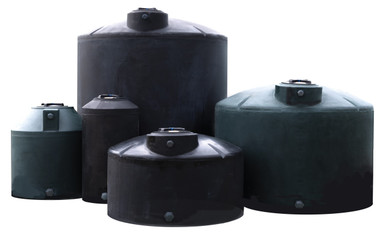
A 5,000-gallon polyethylene vertical storage tank fully loaded with water weighs 41,750 pounds. With a high-specific-gravity chemistry like 50% sodium hydroxide (SG 1.53) the same tank weighs 63,879 pounds. With sulfuric acid 93% (SG 1.84) it weighs 76,840 pounds. The foundation under that tank carries that load 365 days a year, freeze-thaw cycles included, with no service downtime to repair a settled corner. The decision between an FRP saddle, a steel cradle, and a poured concrete pad is not aesthetic. It is structural engineering with a 25-year service horizon, and getting it wrong puts the tank, the building, and downstream piping at risk of catastrophic failure.
This guide walks the engineering trade-offs for vertical tanks in the 5,000-15,000 gallon range — the size class where stand design matters most because the load gets large, the moment arm under wind loading gets long, and the consequences of a settled or cracked foundation are no longer cosmetic. The OneSource Plastics catalog covers this size class with Norwesco, Snyder, and Bushman vertical chemical and water storage tanks. Stand selection is the conversation that should happen before the freight truck arrives, because retrofitting a foundation under a full tank is a project that costs more than the tank itself.
The Three Foundation Architectures
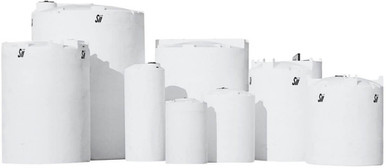
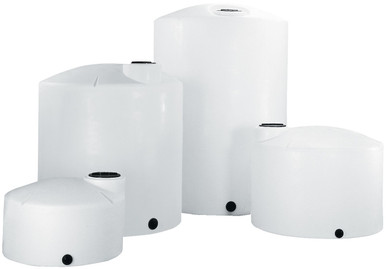
Vertical polyethylene tanks 5,000 gallons and up come from the rotomolder with a flat closed bottom. Some have a recessed bottom (the bottom is dished slightly upward) for outlet routing; most have a flat-flat bottom requiring a level support surface across the entire footprint. The structural job of the foundation is to (1) carry the dead load of the tank plus contents, (2) resist wind moment loading on tall vertical tanks, (3) prevent differential settlement that would induce unintended bending stresses in the tank shell, and (4) survive freeze-thaw heave and seismic loading per the project location.
The three production architectures used in industrial tank installations:
- Reinforced concrete pad — typically 6 to 12 inch poured slab with rebar mat, sized 12 inches wider than the tank diameter on each side. Carries load by direct bearing on subgrade. Requires soil bearing capacity confirmation and frost depth burial in cold climates.
- FRP (fiberglass reinforced polymer) saddle — a fabricated fiberglass saddle ring that supports a vertical tank's bottom edge while leaving the bottom center suspended. Used most often for chemistry tanks where steel corrosion is a concern under fume exposure.
- Steel cradle / steel ring — a fabricated steel ring (often hot-dip galvanized or epoxy-coated) bolted to a concrete sub-pad, supporting the tank perimeter. Common for tank farms with multiple tanks at standardized heights.
For closed-bottom flat polyethylene tanks, the OEM (Norwesco, Snyder) installation manuals are nearly unanimous: full-bottom support is required. Saddle support of a flat-bottom polyethylene tank concentrates load on the saddle ring contact area and creates bending stress in the tank floor that the rotomolded shell was never designed to carry. Saddle and cradle architectures are used for cone-bottom and dish-bottom tanks where the tank bottom geometry naturally suspends from the support ring. For flat-bottom verticals — which is the dominant geometry in the 5,000+ gallon polyethylene class — concrete pad with full-bottom contact is the engineering answer.
Concrete Pad Design for Polyethylene Vertical Tanks
Slab Thickness and Reinforcement
For a 5,000-gallon tank with a 90 inch diameter footprint and 41,750 lb water-filled weight, the bearing pressure is 41,750 / (pi * 45^2) = 6.6 PSI = 950 PSF. Standard residential and light-industrial soils support 1,500-3,000 PSF allowable bearing — so the bearing pressure is well within typical capacity. Slab thickness is set not by bearing pressure but by punching shear, edge bending under wind loading, and frost heave resistance.
The recommendation matrix for polyethylene vertical tanks 5,000-15,000 gallons:
- 5,000-7,500 gallon class: 6 inch slab, #4 rebar at 12" o.c. each way, slab extends 12" beyond tank perimeter, frost depth burial per ACI 332 and local code.
- 7,500-12,000 gallon class: 8 inch slab, #5 rebar at 12" o.c. each way, slab extends 18" beyond tank perimeter.
- 12,000-15,000 gallon class: 10 inch slab, #5 rebar at 10" o.c. top and bottom mats, slab extends 24" beyond tank perimeter.
The reinforcement is for shrinkage and temperature cracking control plus edge moment under wind loading — not for the gravity load of the tank, which the slab carries in pure compression. ACI 318 (Building Code Requirements for Structural Concrete) Section 7 governs the rebar cover and spacing requirements. ACI 332 covers residential / light industrial slab-on-grade. ACI 360 covers slabs-on-ground for industrial use.
Concrete Mix Design
For tank pad service, the mix design targets:
- Compressive strength: 4,000 PSI minimum at 28 days per ACI 318. Tank pads in chemical service should specify 4,500-5,000 PSI for chemical attack resistance.
- Slump: 4-5 inches for placeable but not over-watered concrete.
- Air entrainment: 5-7% in freeze-thaw exposure climates per ACI 318 Table 19.3.3.1.
- Water-cement ratio: 0.45 maximum for chemical exposure pads, 0.50 for ambient water service.
- Curing: 7 day wet cure or curing compound per ACI 308.
For tanks containing aggressive chemistry where leakage might attack concrete (sodium hydroxide is the classic — it dissolves the calcium silicate hydrate phase of cured cement), specify a chemical-resistant overlay or epoxy floor coating on the slab top before tank set. The overlay buys you 25 years of service on the slab vs the bare-concrete alternative which can be visibly etched within 2-3 years of even minor leakage exposure.
Frost Depth and Subgrade Preparation
Frost heave will lift and crack a tank pad if the slab edges are above frost line in cold climates. Frost depth varies from 6 inches in the coastal to 60+ inches in northern Minnesota and North Dakota. The pad either sits on a frost-protected shallow foundation (insulated below the slab perimeter) or on excavated footing extending below frost line. ASCE 32 (Design and Construction of Frost-Protected Shallow Foundations) covers the insulated approach. ACI 332 references local frost depth tables.
Subgrade preparation: 6 inches of compacted granular base (3/4" minus crushed stone, compacted to 95% modified Proctor density per ASTM D1557) under the slab. The granular base provides drainage, eliminates capillary moisture rise, and gives the slab a uniform bearing surface. Native subgrade with high clay content (more than 30% fines passing #200 sieve) needs the full 6" base course; well-drained sandy subgrade can sometimes get by with 4". Confirm with a geotechnical evaluation for tank installations over 10,000 gallons.
FRP Saddle Architecture: When and When Not
FRP saddles are the right answer for cone-bottom and dish-bottom tanks where the geometry suspends naturally from a perimeter ring. Chem-Tainer and Snyder both build cone-bottom tank stands in steel and FRP; the FRP option exists specifically for chemistry exposure environments where galvanized steel would corrode under fume attack.
FRP saddle construction is hand-laid fiberglass with vinyl ester or isophthalic polyester resin. The chemical resistance of vinyl ester FRP covers most of the chemistry envelope where you'd specify XLPE tanks (sulfuric, hydrochloric, sodium hydroxide, sodium hypochlorite). The mechanical advantage over steel: no corrosion under chemistry fume exposure, no galvanic interaction with the polyethylene tank shell, no need for periodic recoating.
The mechanical disadvantage: FRP creep behavior under sustained load. Polyester and vinyl ester FRP shows 10-20% strain creep over 25 years of service under constant stress per ASTM D2990 (Tensile, Compressive, and Flexural Creep). For tank stands carrying constant dead load, the saddle dimensions must be sized with a safety factor of 4-6 against the short-term failure load to keep long-term creep strain in the linear elastic range. This makes FRP saddles bigger and heavier than equivalent steel saddles — the saddle ring section is typically 2-3 inches thick for a 5,000-gallon cone-bottom tank vs 3/8" thick steel.
FRP saddles are NOT used for flat-bottom polyethylene verticals. The saddle support point load on the tank bottom edge will exceed the bottom shell flexural capacity over time. For flat-bottom verticals — Norwesco 5,000-15,000 gallon water and chemical service tanks — the answer is concrete pad full-bottom support.
Steel Cradle / Steel Ring Architecture
Steel cradles are the cost-economic stand for cone-bottom and dish-bottom tanks in non-corrosive service. Hot-dip galvanized A36 carbon steel ring with diagonal bracing, anchored to a concrete sub-pad with cast-in-place anchor bolts. For Chem-Tainer cone-bottom tanks the standard stand is steel; FRP is the upgrade option for chemistry service.
The Chem-Tainer 500 Gallon 45 Degree Cone Bottom Tank (MPN TC6568JC, listed at $1,400.00) ships with the standard steel stand option (MPN TC6568JK, $4,498.99 list) — the stand is more expensive than the tank because the stand carries the full tank weight on a 4-leg cradle frame transferring load through diagonal bracing to four anchor points. The cradle eliminates the slab requirement under the tank bottom (the cone hangs free) but requires a smaller concrete footing pad at the four anchor leg locations.
For larger cone-bottom tanks (1,500-3,000 gallons), the cradle leg count goes to 6 or 8, the cradle weighs 800-2,000 lb empty, and shipping freight on the cradle alone runs $400 to $1,200 via LTL (freight quoted to ZIP via the freight estimator). Cradle anchor bolts: 3/4" or 1" diameter, ASTM F1554 Grade 36 or 55, embedded 12" into 4,000 PSI concrete with appropriate edge distance per ACI 318 Chapter 17 anchorage provisions.
Wind Loading on Vertical Tanks: The Tall-Tank Problem
A 5,000-gallon vertical tank stands roughly 116 inches tall (Norwesco MPN 40941 — 5,000 gallon vertical, 64" diameter x 116" height, listed at $5,599.00). Empty, the tank weighs about 1,200 pounds. The exposed projected area to wind is 64" x 116" = 7,424 square inches = 51.6 square feet. At ASCE 7-22 design wind pressure for a Risk Category II structure in a 105 mph basic wind speed exposure (most of the contiguous US outside hurricane zones), the design wind pressure is approximately 25 PSF — giving a total wind force of about 1,290 pounds and a moment arm of 58" (half the height). The wind moment on the tank base is 1,290 x 58 = 74,820 in-lb = 6,235 ft-lb.
That wind moment must be resisted by the foundation tie-down. For a fully-loaded tank (41,750 lb water + tank empty weight), the gravity overturning resistance about the leeward edge is 41,750 x 32" / 12 = 111,333 ft-lb — comfortably 18x the wind moment. No tie-down required for the loaded condition.
The empty tank is the critical case. Wind moment 6,235 ft-lb against gravity resistance of 1,200 x 32 / 12 = 3,200 ft-lb. The tank wants to tip in 105 mph wind when empty. Tie-down is required. The standard solution: stainless steel tie-down straps anchored into the concrete pad, looped over the tank lid lugs, tensioned to keep the tank seated. Norwesco and Snyder publish tie-down details in their installation manuals — the strap configuration is 2 to 4 straps per tank depending on diameter.
For coastal locations (Risk Category II in 130-180 mph design wind speed per ASCE 7-22), the tie-down loading is 2-3x the inland values and the strap and anchor sizing scale accordingly. For tanks that will run empty during hurricane season (water tanks held empty during peak season) the tie-down is mandatory.
Seismic Loading: ASCE 7-22 Chapter 15 and Chapter 12 for Tank Anchorage
Tanks are non-building structures per ASCE 7-22 Chapter 15. Anchorage is required when seismic design category (SDC) C, D, E, or F applies (most of California, Oregon, Washington, parts of Utah, Tennessee, South Carolina). The anchorage forces are calculated using the simplified non-building structure provisions of ASCE 7-22 Section 15.4 with R = 3.0 for non-building anchored steel tanks (modified for polyethylene per the manufacturer's seismic engineering submittal).
For SDC D installations (San Francisco Bay Area, Los Angeles, Seattle), the lateral seismic force on a 5,000-gallon water-filled vertical tank is approximately 30-40% of the tank weight depending on site class and Ss value — meaning 12,500-16,700 lb of horizontal seismic shear at the base. The anchorage to the concrete pad must develop this shear without anchor pullout or concrete breakout. ACI 318 Chapter 17 anchorage provisions govern. Practical solution: 4-6 cast-in-place anchor bolts at 3/4" or 1" diameter, embedded 12-15" into 4,000 PSI concrete, located at the tank perimeter.
For seismic-rated installations, the tank attachment to the slab uses anchor lugs welded to a perimeter steel band that is field-installed around the tank. The band wraps the tank, anchor lugs project outward, and the lugs bolt into the cast-in-place anchors. This avoids drilling through the polyethylene shell (which would compromise the tank) and gives a code-compliant load path for seismic shear and overturning.
Differential Settlement: The Silent Tank Killer
The failure mode that gets overlooked: differential settlement. If one corner of the slab settles 1/2" more than the others over 10 years (perfectly possible on poorly compacted subgrade), the tank floor tilts and the tank shell now carries unbalanced bending. Polyethylene tanks tolerate some settlement — the rotomolded shell flexes — but settlement in excess of 1/2" across the tank diameter can crack the tank floor at the outlet boss, where the shell stress concentration is already high.
Prevention: geotechnical evaluation for any tank over 10,000 gallons or any installation on questionable subgrade. Compaction testing (proctor density per ASTM D1557, modified) on the granular base course before slab pour. Slab thickness oversized vs the minimum for additional bending capacity. For installations on suspect subgrade, the engineering answer is sometimes a structurally-engineered pile-supported pad or a thicker reinforced slab acting as a raft foundation.
Diagnostic: 6 months after tank fill, level the tank top with a laser level. Re-check at 1 year, 2 years, 5 years. Any divergence over 1/4" across the diameter is an early warning. The fix is hard once the tank is full — sometimes injection grouting under the settled corner, sometimes draining the tank and re-leveling with shim plates under the tank.
Tank-Pairing Selections from the OneSource Catalog
For the 5,000-15,000 gallon vertical class where stand design matters, the OneSource catalog covers the full envelope:
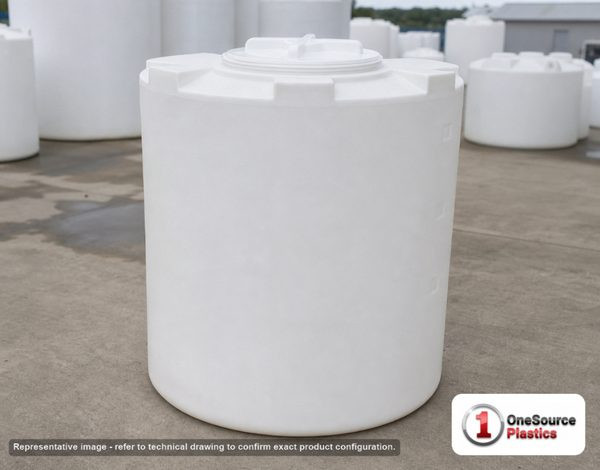
- Norwesco 5000 Gallon Vertical Liquid Storage Tank in White (MPN 40941, listed at $5,599.00) — 64" diameter, 116" height, NSF/ANSI 61 certified for potable water service.
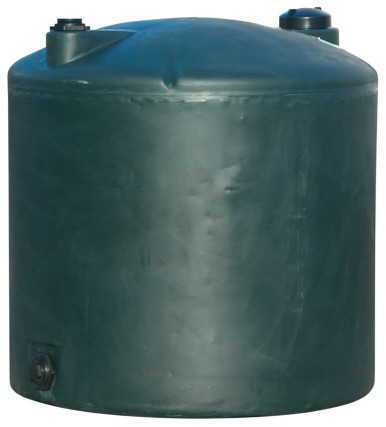
- Snyder 5000 Gallon Plastic Vertical Water Storage Tank in Black (MPN 32382, listed at $6,498.99) — black tank for outdoor UV resistance, sized for the same footprint class.
- Norwesco 6500 Gallon Vertical Liquid Storage Tank in White (MPN 42315, listed at $9,699.00) — 102" diameter footprint, requires 12-foot square pad minimum.
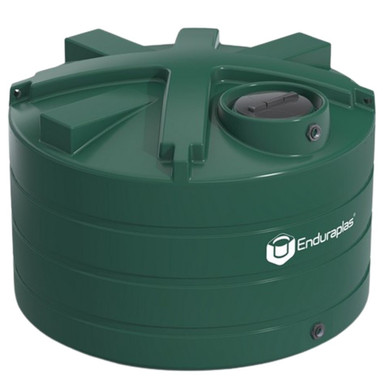
- Snyder 8000 Gallon Vertical Water Storage Tank in Green (MPN 32465, listed at $11,498.99).
- Snyder 10,000 Gallon HDPE Vertical Liquid Storage Tank in Green (MPN 32036, listed at $16,998.99).
- Norwesco 10,500 Gallon Vertical Liquid Storage Tank in White (MPN 47638, listed at $17,729.26).
- Snyder 12,000 Gallon Vertical Water Storage Tank in Green (MPN 32078, listed at $21,998.99).
For chemistry service in the same size class, the Snyder XLPE chemical tanks pair with concrete pad foundations sized for the chemistry-specific specific gravity. The Snyder 10,000 Gallon XLPE Captor Double Wall Liquid Storage Tank (MPN 1006600N42, listed at $91,468.99) is the 1.9 SG capable double-wall option for the high-density chemistry installations — the inner tank handles chemistry compatibility, the outer tank handles 110% containment, and the foundation under the assembly carries the combined dead weight (about 130,000 lb water-filled) plus chemistry weight in the high-SG case.
Pad Sizing Worksheet for Common Tank Sizes
A practical sizing table for water-service tanks on 4,000 PSI concrete with #4 or #5 rebar:
- 3,000 gallon vertical (95" tank diameter, 25,000 lb water-filled): 12 ft x 12 ft x 6" thick slab, #4 rebar 12" o.c. each way. Volume 4.0 cy concrete.
- 5,000 gallon vertical (64-90" tank diameter, 41,750 lb water-filled): 12 ft x 12 ft x 6" thick slab, #4 rebar 12" o.c. each way. Volume 4.0 cy concrete.
- 7,500 gallon vertical (102" tank diameter, 62,625 lb water-filled): 13 ft x 13 ft x 8" thick slab, #5 rebar 12" o.c. each way. Volume 6.3 cy concrete.
- 10,000 gallon vertical (120" tank diameter, 83,500 lb water-filled): 14 ft x 14 ft x 8" thick slab, #5 rebar 10" o.c. each way. Volume 7.3 cy concrete.
- 12,000-15,000 gallon vertical (135-150" tank diameter, 100,000-125,000 lb water-filled): 16 ft x 16 ft x 10" thick slab, #5 rebar 10" o.c. top and bottom mats. Volume 11.9 cy concrete.
These sizes assume soil bearing capacity of 1,500 PSF or higher (typical for compacted sandy subgrade or stable clay). For lower bearing capacity soils (loose silt, expansive clay, organic fill), the slab grows or you go to a structurally engineered raft foundation. Geotechnical investigation is the right answer for any tank installation over 10,000 gallons or any installation where soil quality is unknown.
Installation Sequence: From Bare Earth to Tank Set
The correct sequence for a 10,000 gallon vertical water tank installation:
- Site prep and excavation: clear topsoil and unsuitable fill, excavate to subgrade elevation accounting for slab thickness and granular base. Frost-depth excavation in cold climates.
- Subgrade compaction and proof-roll: confirm subgrade modulus per ASTM D1556 sand cone or ASTM D6938 nuclear gauge. Compaction to 95% modified Proctor.
- Granular base placement: 6" of 3/4" minus crushed stone, compacted in 3" lifts, final compaction confirmed.
- Forming and rebar placement: edge forms set to slab elevation, rebar mat suspended on chairs at 2" cover from bottom and 1.5" from top per ACI 318 Section 20.5.
- Concrete pour and finish: 4,000 PSI mix, slump 4-5", air-entrained 5-7% in freeze climates. Float and trowel finish. Mark anchor bolt locations if cradle stand is used.
- Curing: 7 day wet cure or curing compound per ACI 308. Strip forms at 7 days minimum.
- Anchor bolt placement: cast-in-place at slab pour, OR post-installed mechanical anchors per manufacturer's installation instructions if seismic anchorage required.
- Tank set: confirm slab is level within 1/4" across tank diameter. Set tank with crane, position precisely, verify level before disconnecting rigging.
- Tie-down installation: install tie-down straps if specified, tension to manufacturer's torque spec.
- Plumbing and fittings: install bulkhead fittings, vent, overflow, level instrumentation, and outlet plumbing. Pressure-test plumbing. Fill tank gradually, watch for pad differential settlement during initial fill.
The fill-and-watch step is critical. Fill the tank in 25% increments over 24 hours. Check pad level after each increment. Any visible settlement or pad cracking during fill is a stop-work indicator — drain and investigate before continuing.
Cost Comparison: The Real Numbers
For a typical 10,000-gallon vertical tank installation in 2026 dollars:
- Concrete pad (14 ft x 14 ft x 8"): 7.3 cy concrete at $180/cy = $1,314 material; 1,200 lb rebar at $1.10/lb = $1,320; forming, placement, finishing labor $2,200; subgrade prep and base course $1,400. Total roughly $6,200.
- FRP saddle (cone-bottom alternative, not applicable to flat-bottom verticals): 6,000-9,000 lb FRP saddle assembly priced at $8,000-$15,000 depending on chemistry rating, plus reduced concrete footing under each leg.
- Steel cradle (cone-bottom alternative): hot-dip galvanized cradle at $3,500-$6,000 for the 1,000-3,000 gallon size class, plus reduced concrete footing.
For flat-bottom verticals 5,000+ gallons, concrete pad is the only architecture. The cost is 5-15% of the total installed tank-and-foundation system. Cutting corners on the foundation to save $1,500 on a $30,000 installed system is an engineering decision that costs more in remediation when the slab cracks at year 6 than it saved at year 0.
When to Talk to a Structural Engineer
The threshold for stamped engineering on tank pad design:
- Any installation over 10,000 gallons
- Any installation in seismic design category D, E, or F (most of the West Coast)
- Any installation in 140+ mph design wind speed (Florida, coastal hurricane zone)
- Any installation on questionable subgrade (expansive clay, organic fill, near surface groundwater)
- Any installation requiring code permit signoff (most municipal jurisdictions for industrial sites)
- Any chemical service installation under SPCC 40 CFR 112 jurisdiction where the foundation is part of the secondary containment system
For installations under 10,000 gallons in non-seismic, non-coastal locations on stable subgrade, the manufacturer's installation manual and a credentialed concrete contractor produce a code-compliant installation. For everything above the threshold, hire a licensed structural engineer to size the pad and stamp the drawings. The engineering fee is $1,500-$5,000; the cost of a failed installation is the tank, the chemistry release, the regulatory penalty, and the downtime to rebuild.
For the upstream tank selection, the OneSource Plastics product catalog covers the full Norwesco, Snyder, and Bushman range in the 5,000-15,000 gallon class. Tank sizing should align with chemistry, footprint constraints, and code requirements before the foundation is sized. For chemistry-specific selection, see the chemical compatibility hub at /chemical-compatibility/; for state-specific code requirements that affect tank installation, see the state regulations hub at /state-regulations/. For freight and delivery economics on tanks shipping to your ZIP, use the freight estimator. For SPCC and RCRA applications where the foundation is part of the regulated system, see the secondary containment volume math walkthrough.
Recommended Tanks for This Guide
Live pricing, updated automatically · estimate freight to your ZIP.