Vertical vs Horizontal Water-Storage Tank Tradeoffs at 1,000 to 2,500 Gallons
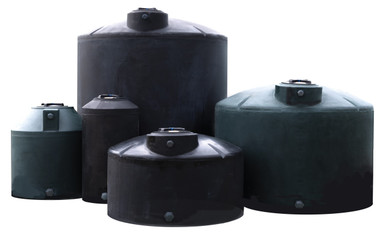
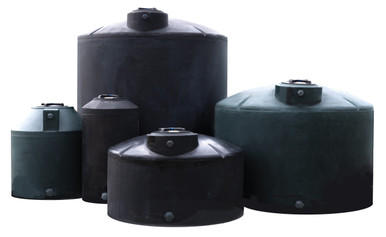
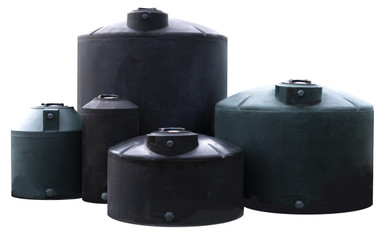
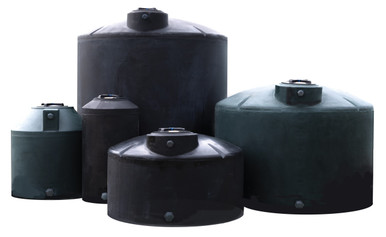
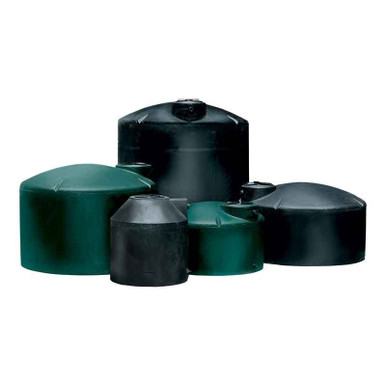
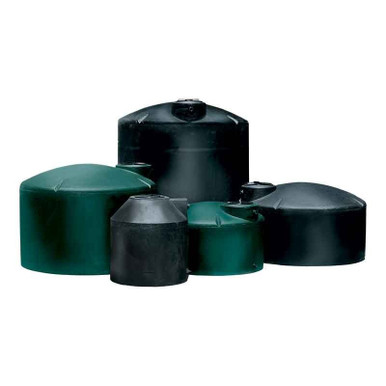
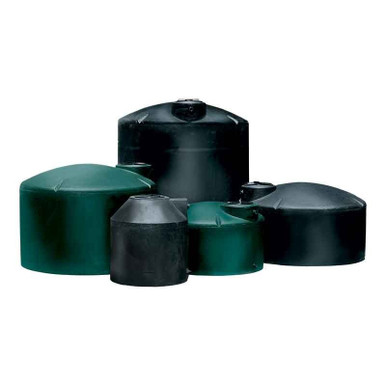
The 1,000 to 2,500 gallon water-storage band is the most contested capacity range in the rotomolded polyethylene market. Almost every farm tap, backup well, irrigation header, hauling rig, and small-system reserve falls inside that window. And almost every buyer at this scale faces the same fork in the road: vertical or horizontal? The catalog page makes the tanks look interchangeable. They are not. The wall section, the freight class, the anchorage math, the head pressure available at the pump suction, the footprint on a slab, and the realistic refill cadence all change with orientation. This guide walks the engineering tradeoffs the way an installer reviews them on the back of a quote sheet, with real OneSource SKUs you can pull up alongside.
The capacity band in context
Below 1,000 gallons the choice is usually decided by where the tank fits — under a bench, behind a pump shed, on a pickup bed. Above 2,500 gallons the choice usually defaults to vertical because horizontal HDPE rotomolded geometry begins to chase awkward freight footprints and aluminum or steel cradle costs grow non-linearly. The 1,000 to 2,500 gallon window is the only place where buyers genuinely have to weigh the geometry against the application.
Real listings from the OneSource catalog frame the choice. A Norwesco 1,000-gallon vertical (MPN 41500, 64" x 80", white, 1.5 SG, ASTM D1998) lists at $1,699.00. A Snyder 1,500-gallon vertical (MPN 32541, black, water duty) lists at $1,784.37. A Norwesco 2,500-gallon vertical (MPN 42040, 95" x 91", black, water duty) lists at $2,399.00. On the horizontal side, a Norwesco 1,610-gallon horizontal leg tank (MPN 40330, white, 1.7 SG) and the 2,035-gallon HDPE elliptical leg tank (MPN 40775, black, hauling-spec, 1.9 SG) bracket the same band. Same brands, same materials, same nominal capacities — the orientation is the variable.
Footprint and slab math
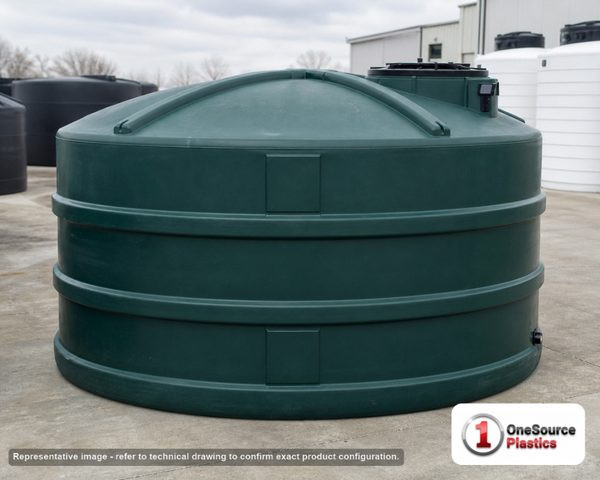
Vertical tanks at 1,000 to 2,500 gallons run roughly 64 to 102 inches in diameter. That is a tight footprint — a 5-foot-square pad anchors a 1,000-gallon vertical comfortably, and an 8-foot-square pad fits a 2,500-gallon vertical with skirt clearance. Horizontal leg tanks at the same capacities run 90 to 140 inches long and only 50 to 65 inches wide. The horizontal needs a longer rectangle of slab or compacted gravel, and the layout has to accommodate the legs (typically four to six on these capacities) bearing distinct point loads.
For dimensional concrete pad guidance keyed to capacity see our pillar at Tank Foundation Pad Engineering. On gravel base preparation cross-reference Concrete vs Pavement vs Gravel. The vertical wins on slab volume — you pour less concrete because you are pouring under a smaller circle. The horizontal wins on uplift behavior because the center of gravity sits lower.
Head pressure and pump suction
The thing the catalog does not say out loud: a vertical 2,500-gallon tank delivers more static head to a downstream pump than a horizontal of the same capacity. Static head equals the height of the water column above the suction port. For Norwesco MPN 42040 (2,500 gallons, 95" tall) the column is roughly 7.9 feet — about 3.4 psi at the bottom outlet. For a 2,500-gallon horizontal of similar capacity the water column is closer to 4.5 feet — about 1.95 psi at the outlet. That difference matters for gravity-fed irrigation tees, for transfer pump suction lift budgets, and for filter backwash systems where 1.5 psi can determine whether the cartridge head pressurizes at all.
If the downstream system needs head — gravity feed to a paddock, low-head drip emitters, a pressure tank that tops up on float — vertical wins. If the downstream system has its own boost pump and only needs raw storage, horizontal is acceptable.
Wall thickness and ASTM D1998 implications
Both vertical and horizontal rotomolded tanks at this capacity are produced under ASTM D1998-19 for upright vertical and the corresponding flat-pattern guidance for hauling and stationary horizontal HDPE. The vertical wall is engineered as variable thickness — thicker at the bottom, tapering up — because hydrostatic head increases linearly with column height. A 95-inch-tall vertical develops more than twice the bottom-shell hydrostatic stress of a 45-inch-tall horizontal at the same capacity. The vertical tanks compensate with thicker base walls; horizontals can run a more uniform shell because the head pressure never exceeds the short axis.
For a deeper read on D1998 wall-thickness math see ASTM D1998 vs D2282. For polyethylene density and resin selection see Polyethylene Resin Density Decoded.
Freight class and dimensional weight
LTL freight on rotomolded tanks is governed by the National Motor Freight Classification (NMFC) density-based item codes. Vertical tanks ship at higher density per pallet footprint because the cylinder stacks tightly to the deck; horizontal tanks consume more deck area per gallon stored. The economics flip around 1,500 gallons. Below that, the vertical and horizontal freight tickets are within a few percent. Above 1,500 gallons, the horizontal grows steeper because the 90 to 140 inch length forces partial-deck or single-shipment LTL handling. A 2,500-gallon vertical (95" x 91") ships standard LTL on most lanes; a 2,500-gallon horizontal of equivalent capacity often quotes 30-50% higher freight to the same ZIP.
For ZIP-resolved freight estimation use the live Freight Cost Estimator. For freight math at scale see 5,000-Gallon Freight ZIP-by-ZIP.
Wind load and uplift behavior
ASCE 7-22 governs structural wind loading for above-ground tanks. The H/D ratio drives the force coefficient C_f. A 2,500-gallon vertical (95" tall x 91" diameter, H/D = 1.04) sits inside the 0.25 to 4 range that ASCE 7-16/22 explicitly addresses for tank uplift loading. A horizontal at the same capacity behaves more like a saddled cylinder; its overturning moment is dominated by side-on projected area rather than uplift.
In practical terms: in coastal zones (Risk Category II, Vult ≥ 150 mph) the vertical tank needs anchor straps tied to a slab with engineered connections. The horizontal tank needs cradle restraint preventing roll. Both can be done; the costs are comparable. For state-by-state hurricane planning see Florida Water Tank Regulations, North Carolina, and Texas.
Refill cadence and turnover
Water-storage tanks store finite supply. The refill cadence — how often the tank is topped up — interacts with stagnation, biological growth in the headspace, and heat gain. The vertical's small footprint means the surface area exposed to the sun per gallon stored is lower. The horizontal's longer body and shorter water column mean a bigger surface-to-volume ratio. In high-solar-load locations (AZ, NM, southern CA, west TX) the horizontal will run warmer at the same fill level and age the same volume of water faster.
For potable applications, NSF/ANSI 61 certification is required on the resin and any internal coating. Norwesco and Snyder white and natural-pigment HDPE upright water tanks carry NSF/ANSI 61 listings on the resin grade for cold potable water; black agricultural water tanks typically do not. Confirm the listing on the tank's spec sheet before specifying potable service. For potable compliance walkthrough see our NSF 61 / Lead-Free / California AB1953 post.
Specific catalog SKUs at 1,000 gallons
At 1,000 gallons the vertical-vs-horizontal market is dense. Norwesco MPN 41500 (1,000 gallon, 64" x 80", black, 1.5 SG agricultural) lists at $1,699.00. Norwesco MPN 40892 (1,000 gallon, alternate pattern, black) lists at $1,699.00. Snyder 1,000-gallon water-duty verticals list at comparable price points and carry the same NSF 61 resin-listing posture. On the horizontal side, the 1,000 to 1,200 gallon HDPE elliptical leg tanks ship with integral feet but are generally specified for hauling-and-store use rather than stationary water reserves.
Decision shortcut at 1,000 gallons: if the tank stays put and feeds a downstream pump, go vertical. If the tank moves between fills (paddock service, mobile irrigation, contractor applications) the horizontal earns its complexity.
Specific catalog SKUs at 1,500 gallons
Snyder MPN 32541 (1,500 gallon vertical, black, water-duty) lists at $1,784.37. The matched-capacity Norwesco 1,500 gallon vertical (MPN 40144, 64" x 116") is the most common deck-stowed shipping configuration on this band. Horizontal alternatives at 1,500 gallons exist primarily as legged or skid-mounted hauling rigs rather than stationary storage. If the application is stationary water reserve at 1,500 gallons, vertical is the default.
Specific catalog SKUs at 2,000 to 2,500 gallons
Norwesco MPN 42040 (2,500 gallon vertical, 95" x 91", black, water) lists at $2,399.00. Norwesco MPN 42382 (2,500 gallon vertical, 102" x 79", white, water/light liquid) lists at $2,999.00. The price delta reflects color (white pigment costs more), wall section (the 102" diameter pattern uses a different mold), and shipping weight. Snyder MPN 32561 (2,500 gallon vertical, green) lists at $2,345.84 and is a common rural-water choice in agricultural regions where green tanks blend visually.
At 2,000 gallons specifically the vertical has dominant share. Norwesco's two patterns at this capacity (the 64" x 152" tall-thin and the 90" x 84" squat-wide) trade wall-section thickness for footprint, and both are LTL-friendly. Horizontal alternatives at 2,000 to 2,500 gallons are almost exclusively HDPE elliptical leg tanks intended for hauling rigs (DOT 49 CFR 173 hauling rules apply when the tank moves on public roads).
Anchorage hardware and cost-of-restraint
Vertical tank anchorage uses lug straps tied through a top dome or threaded inserts in the bottom shell to engineered anchor bolts. Horizontal tank anchorage uses saddle straps wrapping the tank body and bolting to the cradle or skid. Per-anchor hardware cost is similar (typically $15-$45 for the strap and turnbuckle), but the vertical needs fewer attachment points (typically four to six on a 2,500-gallon vertical) while the horizontal needs straps at every cradle (typically four to eight on a 2,500-gallon horizontal). Net hardware cost difference: usually $50-$120 across the range — not the deciding factor.
For seismic anchorage in Zone D-E (CA, AK, PR) see Earthquake Anchoring. For wind-zone anchorage in coastal AHJ jurisdictions see Vertical Tank Wind Load Engineering.
Service-life expectations
Both orientations rely on the same HDPE resin chemistry and the same UV-stabilizer package. Service life under ASTM D1998-19 is engineered for 20 years of upright water storage with 2% carbon black (the basis for black tanks) or shorter for translucent-white tanks (typically 12-15 years before HALS UV-package depletion drives wall replacement). Service life is not orientation-dependent in itself; it is dominated by UV exposure, freeze-thaw cycling, and chemical service (which we exclude here as this is a water-only post).
For a UV degradation curve over 0-30 years see Above-Ground Storage Tank UV Degradation. For freeze-thaw selection see Cold Climate Tank Field Performance.
Decision tree at a glance
- Stationary water reserve (1,000-2,500 gal), no hauling: vertical. Smaller slab, more head pressure, lower freight, simpler anchorage.
- Mobile hauling tank, paddock service, contractor rig: horizontal leg tank. Lower center of gravity, integral mounting points, freight already factored into the chassis economics.
- Constrained ceiling height (under 8 feet): horizontal. Vertical 1,500-gallon-and-up tanks exceed 7 feet of column height plus dome.
- Need pump suction lift advantage: vertical. Higher water column equals stronger gravity head at the outlet.
- Coastal hurricane zone: vertical with engineered tie-downs OR horizontal at lower center of gravity. Both work; tie-down design is the variable.
- Potable water service: verify NSF/ANSI 61 listing on the specific SKU and resin. White or natural HDPE verticals from Norwesco and Snyder are the high-volume potable choice.
What buyers get wrong
Three recurring errors at this capacity band:
- Buying horizontal because the photo "looks easier". The horizontal looks more compact in the catalog because the camera angle hides the length. On the slab, the horizontal eats more ground.
- Specifying a vertical without checking ceiling clearance. A 2,500-gallon vertical at 95 inches plus dome plus fill assembly easily exceeds 8 feet 6 inches of vertical clearance — that is enough to clip a residential garage door header.
- Underestimating freight on horizontals above 1,500 gallons. The freight delta vs vertical of equal capacity can run several hundred dollars on long lanes. Get the ZIP-resolved quote first.
For the OneSource freight quote workflow see Freight Cost Estimator or call (866) 418-1777.
Bottom line
At 1,000 to 2,500 gallons of water storage, vertical wins for stationary applications nine times out of ten. Smaller slab, more head pressure, lower freight, simpler tie-down. Horizontal earns its place when the tank moves (hauling, paddock service) or when ceiling clearance forces the issue. Pull the SKU, pull the dimensional drawing, and run the slab math before you click Buy. The orientation choice is the single most consequential decision in this capacity band, and the catalog page does not flag it for you.
For the full water-tank product family, browse the Water Tanks category. To compare cone-bottom alternatives at the same capacity see Cone Bottom Tanks. For state-resolved compliance pillars use the State Tank Regulations hub.
Recommended Tanks for This Guide
Live pricing, updated automatically · estimate freight to your ZIP.