
Industrial Mixing Equipment
Media Mills, High-Shear Dispersers & High-Viscosity Batch Mixers
Horizontal and vertical bead mills, sand mills, attritors, basket mills, high-shear dispersers, ribbon blenders, planetary mixers, and high-viscosity batch tanks — for paint, ink, pigment, adhesive, cosmetic, and specialty-chemical manufacturing.
About Industrial Mixing Equipment
Industrial mixing is a rheology problem before it is a tank problem. Low-viscosity fluids (water, solvents, thin latex) blend with propeller or turbine agitators at 1–5 HP per 1,000 gallons. Medium-viscosity products (paint letdown, thin creams, sauces) demand impeller selection tuned to shear rate — often a high-efficiency axial-flow impeller. High-viscosity product (paste, gel, adhesive, caulk, dough) hits 50,000 cP and higher, where propellers stall entirely and the answer is a ribbon blender, planetary mixer, or sigma-blade mixer. Abrasive or pigmented slurries that need particle-size reduction go to a media mill — a bead-agitated mill that grinds product through a charge of 0.5mm to 3mm ceramic or zirconia beads until target particle size (often D90 < 10 microns) is achieved.
The paint and ink industries built modern dispersion equipment. High-shear dispersers use a sawtooth-blade impeller running at tip speeds of 15–25 m/s to wet out pigment, break agglomerates, and disperse resin into solvent. Basket mills combine dispersion and media milling in one vessel — a bead-charged basket rotates within the batch, running simultaneous dispersion and grinding. Horizontal bead mills are the workhorse for production-scale particle-size reduction, with throughputs from 50 L/hr (lab) to 10,000 L/hr (production) and bead-size adjustability to tune particle-size distribution.
Batch volumes span an enormous range: lab R&D mills at 0.5–5 liters for formulation development, pilot-scale mills at 25–100 liters for scale-up validation, production mills from 100 liters to 10,000 liters. Downstream filtration, storage, and filling equipment in the same plant typically comes from the same fabricator — letdown tanks, day tanks, thinning tanks, drum-fill skids, and IBC-fill stations — giving a single-source package for the whole coat-shop or ink plant.
What We Fabricate
Horizontal Bead Mills
Production workhorse media mill — 0.5mm to 3mm bead charge, 100L to 10,000L chamber, throughputs from 50 L/hr lab to 10,000 L/hr production.
Vertical Bead Mills
Vertical-chamber configuration for space-constrained installations. Common for mid-viscosity paint and ink.
Sand Mills
Original media mill design — silica-sand media for abrasive-resistant coarse grinding.
Attritors
High-intensity ball mill using 3–10mm media for hard-to-grind pigment and specialty-chemical processing.
Basket Mills
Combined disperser and bead mill — basket-mounted bead chamber rotates in the product batch.
Lab R&D Mills
0.5–5 liter chamber volumes for formulation development and bead-size studies.
High-Shear Dispersers
Sawtooth-blade disperser running 15–25 m/s tip speed for pigment wet-out and resin dispersion.
Ribbon Blenders
Double-spiral ribbon agitator for dry and semi-dry powder blending. Batches from 5 to 5,000 cu ft.
Planetary Mixers
Dual-orbit planetary agitator for high-viscosity paste, gel, and dough mixing.
Sigma-Blade Mixers
Kneader-style mixer for very-high-viscosity masterbatch, adhesive, and putty production.
High-Viscosity Batch Tanks
Jacketed mixing tanks with heavy-duty top-entry agitation for 50,000+ cP batches.
Letdown Tanks & Thinning Tanks
Downstream paint/ink batching vessels for color-matching and final viscosity adjustment.
How a Custom Project Works
- Requirements capture. Volume, materials of construction, service chemistry, operating temperature and pressure, footprint, utility connections, finish, and any code or certification requirements. We work from your specification or draft one against your process.
- Engineering and drawings. A general-arrangement drawing, bill of materials, and weld map — reviewed and signed off before any material is cut.
- Material procurement. Plate, pipe, fittings, and elastomers ordered to the approved bill of materials, with material certifications captured where the service demands traceability.
- Fabrication. Shells formed and welded, heads and ports installed per drawing, sanitary work TIG-welded and ground flush on product-contact surfaces.
- Inspection and testing. Weld examination, pressure or leak testing as applicable, surface-finish verification, and passivation to ASTM A967 on stainless.
- Documentation and shipment. Material certifications, weld and inspection records, and test certificates compiled for handoff. Shipment with blocking and bracing; freight quoted separately to your ZIP.
Engineering & Design Guides
In-depth, vendor-neutral guides written by our engineering team to help you scope the right build — the equipment, the materials, and the trade-offs.

5 Types of Mixing Impellers
Propeller, pitched-blade, hydrofoil, Rushton and anchor impellers compared by flow, shear, power number and viscosity range.
Read the guide →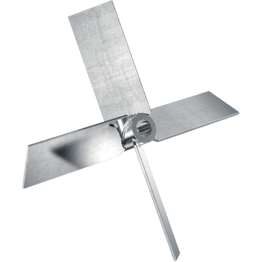
Axial vs Radial Flow Impellers
Axial flow for blending and solids suspension versus radial flow for shear and gas dispersion, compared with power and baffling.
Read the guide →
7 Ways to Improve Mixing Efficiency
Seven practical levers—impeller, baffling, geometry, placement, speed, staging and vortex control—to mix faster on less power.
Read the guide →
High-Shear Mixing: The Complete Guide
Rotor-stator high-shear mixing explained—mechanism, tip speed, emulsification, particle reduction, deagglomeration, batch vs inline.
Read the guide →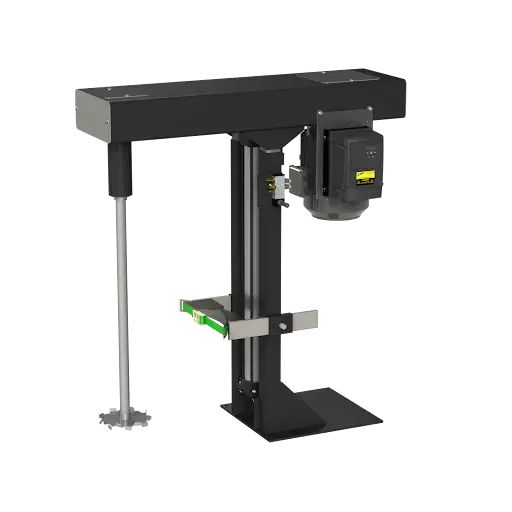
High-Speed Dispersers vs Homogenizers
Sawtooth high-speed disperser versus high-pressure homogenizer—mechanism, particle size, when to use each, and how they combine.
Read the guide →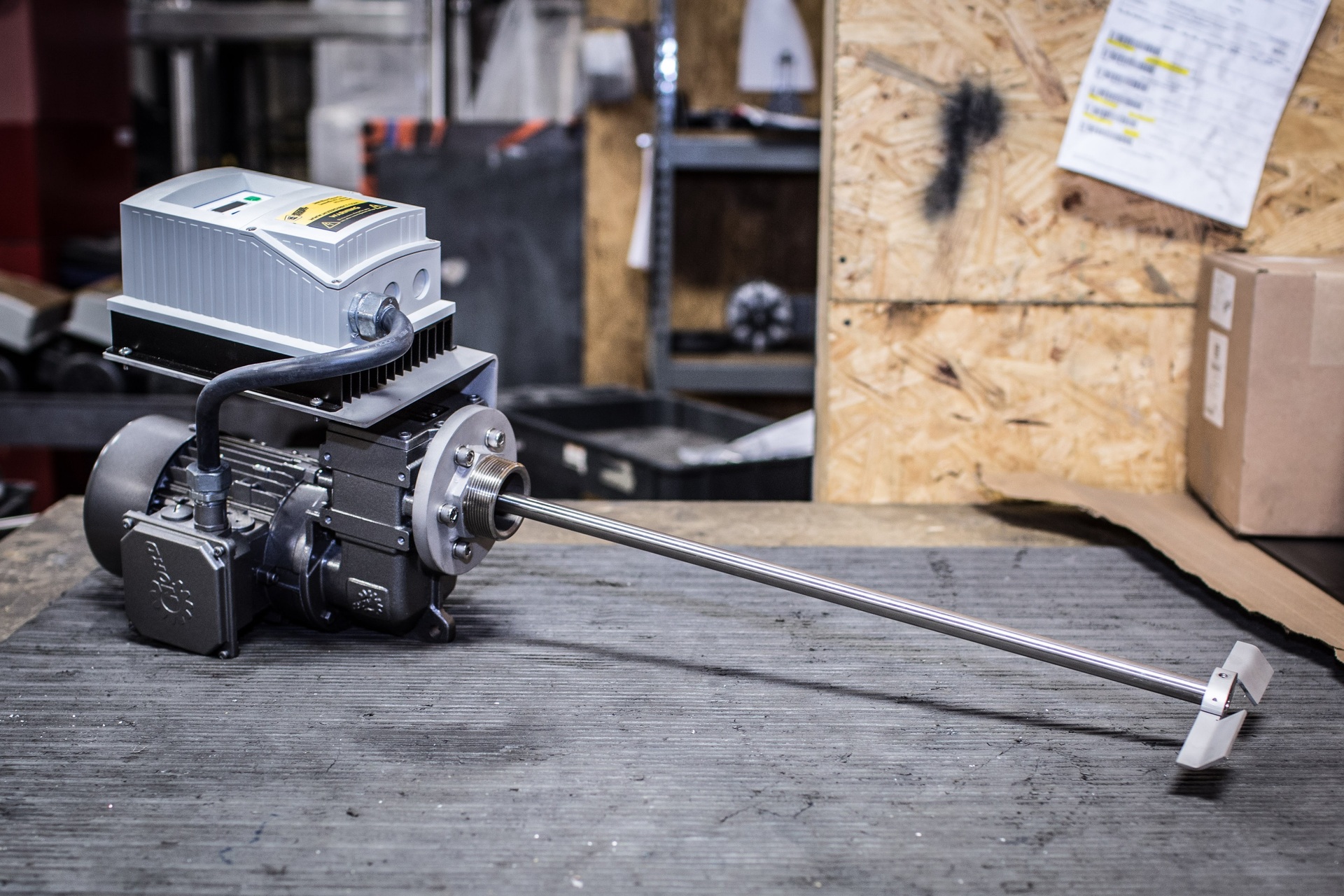
Viscosity & Mixing Equipment
How viscosity and rheology—Newtonian, shear-thinning, thixotropic—govern mixer choice, from turbines to anchors and helical ribbons.
Read the guide →Frequently Asked Questions
- When do I step up from a disperser to a media mill?
- A high-shear disperser wets out and disperses pigment but does not reduce primary particle size. When formulation demands target D90 or D99 particle-size specs (coatings for high-gloss automotive, digital printing ink, specialty inks), a media mill is required after the disperser.
- Horizontal or vertical mill?
- Horizontal mills handle a wider viscosity range, have better bead-retention geometry at high flow rates, and dominate production installations. Vertical mills are compact and common for lower-viscosity products in space-constrained facilities.
- What bead size should I use?
- Bead size is tuned to target particle size: typically bead diameter is 500–1,000 times the target product particle size. 1mm beads for ~1–10 micron product. 0.3mm beads for submicron product. 3mm beads for coarse grinding and feed-stage processing.
- Can a single mill handle both production and lab?
- No. Production mills are scaled for throughput; lab mills are scaled for formulation flexibility with low hold-up volumes. Best practice is a dedicated lab mill (0.5–5L) + pilot mill (25–100L) + production mills (100–10,000L) in a scale-up ladder.
Start a Industrial Mixing Equipment Project
Give us your process specs and we come back with a full engineering package, firm lead time, and a fixed price. Freight quoted separately to your ZIP.
Request a Custom Quote Call 866-418-1777