Stainless 316L vs Polyethylene for Warm DI Water 60-80C at Biotech Scale: Selection Engineering
Stainless 316L vs Polyethylene for Warm DI Water 60-80C at Biotech Scale: Selection Engineering
Filed under: high-purity water, biotech CMC support utilities, tank selection engineering. Companion read: Deionized Water Compatibility Pillar and Sodium Hypochlorite Compatibility for sanitization between batches.
Why this question gets asked at every biotech facility build
Process water for biotech and biopharma is rarely cold tap water. Clean-in-place rinse loops, formulation makeup water, buffer prep, single-use bag fill stations, and chromatography column equilibration loops all consume deionized (DI) or RO/DI water at temperatures from 25C ambient through warm sanitization cycles at 60C, 70C, and increasingly 80C as cGMP facilities tighten bioburden control. The question we hear weekly from facility engineers and CQV teams is the same: do we tank this water in 316L sanitary stainless, or can a high-density polyethylene (HDPE) or crosslinked polyethylene (XLPE) tank do the job at one-fifth the cost?
The honest answer is "it depends on three things" — temperature ceiling, leachables tolerance of the downstream process, and sanitization regime. This guide walks through each variable with engineering reasoning, real OneSource SKUs sized to biotech utility loads, and decision criteria you can hand to a validation team.
The temperature curve is the first gate
Polyethylene is a thermoplastic. Its mechanical properties degrade continuously with temperature, not in a stepwise fashion. Most polyethylene tank manufacturers publish a maximum continuous service temperature of 100F to 120F (38-49C) for 1.0-1.5 specific gravity service. Above that, the hoop-stress safety factor that ASTM D1998 builds into wall-thickness design begins to erode, and at sustained 60C+ the long-term hydrostatic strength of the resin drops materially below the design assumption.
For warm DI water specifically — which is essentially zero specific gravity beyond 1.0 and presents no chemical attack — the mechanical question dominates. Norwesco, Snyder, Chem-Tainer, and Bushman polyethylene vertical tanks are designed against ASTM D1998 with a 0.6 hydrostatic design basis safety factor at ambient temperature for water service. Above ~110F (43C) continuous, that safety factor is consumed by thermal softening. At 60-80C continuous, polyethylene is not a defensible choice for a structural water tank holding hundreds or thousands of gallons.
That is the bright line: if your DI water tank will hold water above 110F for any sustained period, you need either 316L stainless or a polyethylene tank rated explicitly for elevated temperature service (and even those typically cap at ~140F for 1.0 SG). The 60-80C use case sits squarely above the polyethylene structural envelope.
Where polyethylene still belongs in the DI water utility map
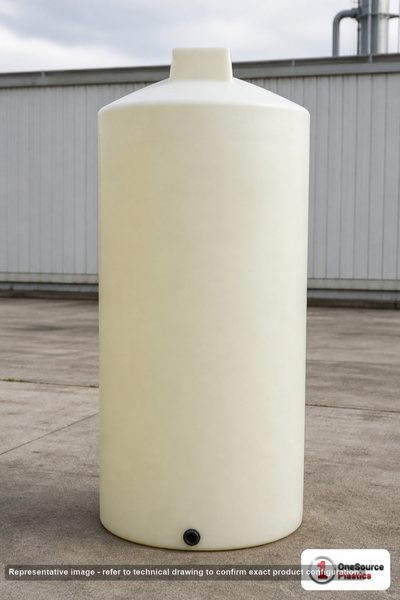
Cold and ambient DI storage is a different conversation. A buffer prep room that draws ambient DI from a polishing loop into a 1100-gallon vertical day tank, recirculates through a 0.2 micron filter, and dispenses cold to formulation operators is a textbook polyethylene application. The water is below 30C, the chemistry is essentially neutral, and the tank simply needs to be a clean structural vessel with a tight-fitting lid, a vent, and a sanitary outlet.
Real OneSource SKUs that are commonly specified into ambient DI utility roles:
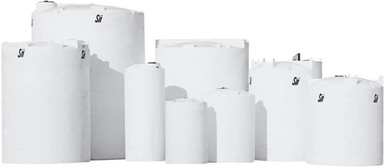
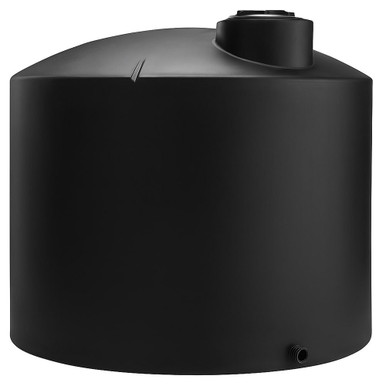
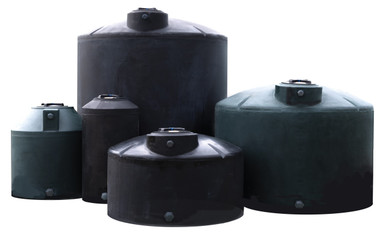
- Norwesco MPN 41500 — 1000 Gallon Vertical Water Storage Tank in Black, listed at $1,699.00. Black resin reduces algal growth in DI loops that see daylight, which matters because even DI water can support pseudomonad colonization once a biofilm starts.
- Norwesco MPN 40892 — 1000 Gallon Vertical Water Storage Tank in Black, listed at $1,699.00.
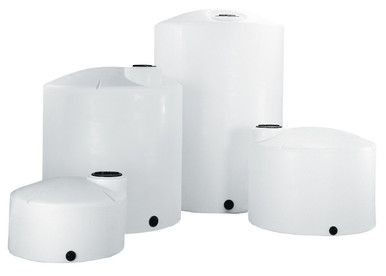
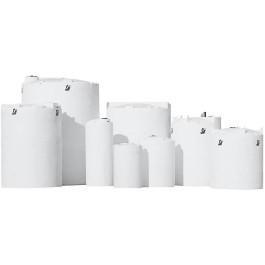
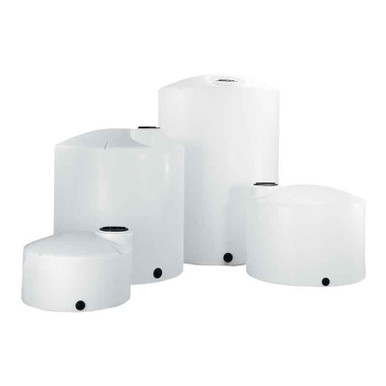
- Enduraplas MPN THV01100WH — 1100 Gallon Plastic Vertical Liquid Storage Tank in White, listed at $1,623.31. White resin is preferred when the tank lives inside a controlled environment and visible inspection of the water column matters.
- Bushman MPN WW-1500-GL-NAT — 1500 Gallon Water Storage Tank Natural, listed at $1,998.99. Natural translucent walls help operators see the water level at a glance, useful for non-instrumented day tanks.
- Chem-Tainer MPN TC8674IA — 1700 Gallon HDPE Vertical Liquid Storage Tank, listed at $3,059.71. The HDPE-rated chemical body is overspec for water but gives you a tank that can be repurposed to a buffer holding role with minimal qualification.
None of those polyethylene tanks belongs upstream of a 60-80C sanitization loop. They belong in the cold and ambient utility chain — RO product storage, polishing loop break tanks, ambient buffer makeup, single-use rinse-water staging, cold WFI condenser feed water for non-injectable use.
The 60-80C envelope is 316L territory — here is why
316L stainless steel is the workhorse alloy for high-purity water service in biotech. The "L" designation indicates carbon content below 0.03 percent, which preserves corrosion resistance through welding without sensitization. Surface finish matters as much as chemistry — internal surfaces are typically electropolished to a 0.4 to 0.5 micron Ra (roughness average) finish per ASME BPE-2022 Part SF for product-contact surfaces in biopharmaceutical service. That finish suppresses both mechanical particle entrapment and the surface area available for biofilm anchor sites.
At 60-80C, 316L offers four advantages that polyethylene cannot match:
- Mechanical integrity. 316L retains its full design stress allowables to well above 100C. ASME BPVC Section II Part D allowables for 316L at 100C are essentially indistinguishable from ambient.
- Steam sanitization. A jacketed 316L vessel can be SIP'd (steam-in-place) at 121C for 30 minutes between campaigns. No polyethylene tank survives that cycle once, much less weekly.
- Chemical sanitization with hot caustic. Periodic hot 1M NaOH sanitization at 80C is standard practice for WFI loops and warm DI loops. 316L tolerates this indefinitely; polyethylene softens and accelerates oxidative degradation.
- Leachables. Even at 80C, 316L contributes essentially zero organic leachables to the water. Polyethylene at elevated temperature begins leaching antioxidant fragments (Irganox, Irgafos breakdown products), which downstream UV/TOC monitors will eventually flag.
OneSource does not sell 316L sanitary vessels — that is a custom-fab category. When a customer's process map needs warm DI storage, we route them to a stainless fabrication partner via the Custom and Specialty Fabrication hub. The polyethylene catalog stays in its lane.
Leachables: what actually moves out of polyethylene at temperature
Polyethylene resins for tank molding are stabilized with phenolic primary antioxidants (commonly Irganox 1010 or 1076), phosphite secondary antioxidants (Irgafos 168), and sometimes UV stabilizers (HALS family for outdoor tanks). At ambient temperature in cold water service, the diffusion of these stabilizers and their oxidation products into the water phase is below the detection threshold of most TOC analyzers operating on a 100 ppb full-scale.
At 60C, the diffusion coefficient of small organic molecules in semi-crystalline polyethylene increases by roughly a factor of 5-10 over ambient. At 80C, you are an order of magnitude higher. The same tank that contributed undetectable TOC at 25C may contribute several hundred ppb at 80C — enough to fail the 500 ppb limit set by USP <643> for Purified Water and far above the 50 ppb practical operating target for Water for Injection systems.
Two practical implications:
- If the downstream process is sensitive to TOC (chromatography column equilibration, mass spec sample prep, biologic formulation), do not let polyethylene see the warm side of the loop.
- If the polyethylene tank is upstream of a TOC-reducing UV/254 polishing unit and the residence time is long enough, ambient polyethylene storage may be acceptable. Validate with measured TOC, not assumption.
Sanitization regime drives the architecture
Here is where the rubber meets the road. Three sanitization architectures dominate biotech DI water systems:
Architecture A — continuous hot recirculation at 70-80C
The whole loop runs hot all the time. No biofilm gets a chance to establish. Storage vessel must be jacketed 316L or, in some EU plants, AL-6XN super-austenitic for chloride margin. Polyethylene is excluded from every wetted surface. Capital cost is high; operating cost is higher (continuous heat input). Risk profile is the lowest. Standard for new aseptic biologics fill lines.
Architecture B — cold loop with periodic hot sanitization at 80C, 1 hour weekly
The loop runs cold most of the time. Once per week, a sanitization sequence heats the loop to 80C for 60 minutes, then cools back down. Tank must tolerate the thermal cycle. 316L is the standard answer; high-grade XLPE rated to 140F continuous and 180F intermittent has been deployed in some non-sterile process water applications, but the validation lift is substantial and most facilities default to 316L. This is the most common architecture for cGMP biopharma utility loops.
Architecture C — cold loop with ozone sanitization (no thermal)
Ozone is generated continuously at 20-200 ppb in the loop, killing pseudomonad before biofilm forms. UV at the point of use destroys residual ozone. Tank stays at ambient temperature. Polyethylene is plausible here, but ozone is an oxidizer and will attack the resin's antioxidant package over time, leading to embrittlement on a 5-10 year horizon. 316L still preferred; FRP and PVDF have niches. This architecture is common in semiconductor UPW and growing in biotech.
The ambient day-tank decision matrix
For the cold-loop break tank or buffer makeup day tank that sits between an RO/DI skid and a downstream draw, here is the decision matrix we walk customers through:
| Service condition | Polyethylene OK? | Notes |
|---|---|---|
| Below 30C continuous, no thermal cycling | Yes | Standard HDPE vertical, black resin if exposed to ambient light |
| 30-43C continuous, no chemical sanitization | Yes with derate | Use HDPE rated for 1.5 SG even though water is 1.0 SG; gives thermal margin |
| Up to 50C intermittent, ambient most of time | Marginal | XLPE preferred; validate with manufacturer for the exact thermal profile |
| 60C+ at any duration | No | 316L territory |
| Hot caustic sanitization at 80C | No | 316L only |
| Steam-in-place at 121C | No | 316L pressure vessel |
| Ozonated cold loop, 20-200 ppb O3 | Marginal | 316L preferred for service life; PE possible if 5-year replacement is acceptable |
Sizing the ambient buffer day tank
Most biotech DI break tanks size to 30-90 minutes of peak loop demand plus a generous freeboard for foam tolerance during fast fills. A formulation suite drawing 5 GPM peak across two simultaneous batch operations needs roughly a 600-1500 gallon day tank to absorb pump cycling and surge. Common picks from the OneSource catalog:
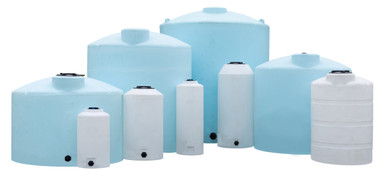
- Enduraplas MPN THV01100FG — 1100 Gallon Vertical in Faint Green (light blocks more than natural, less than black; useful when operators need to see water level), listed at $1,582.92.
- Bushman MPN WW-1500-GL-BLK — 1500 Gallon in Black, listed at $1,998.99. Black for full daylight blocking when the tank lives in a utility room with windows.
- Norwesco MPN 43808 — 1525 Gallon Vertical Water Storage Tank in Black, listed at $1,799.00. Norwesco's 1500-gallon class with proven import history into US biotech sites for cold DI.
Each of those is a defensible specification for ambient DI day-tank service when the upstream loop never warms the water above 30C. Pair with a pleated 0.2 micron vent filter (sized to the maximum drain rate plus a safety factor of 2), a sanitary EPDM-gasketed fill connection, and a bottom drain with a sample valve.
Hybrid loop architecture — polyethylene for cold storage, stainless for hot polishing
The most cost-effective architecture for many midsize facilities is a hybrid: a large polyethylene cold storage tank holds the bulk RO/DI inventory at ambient temperature, and a smaller 316L jacketed polishing loop downstream provides hot recirculation only on the segment that touches process equipment. The cold-side polyethylene tank can be 2000-3000 gallons of buffer at one-fifth the cost of equivalent 316L. The hot-side polishing loop tank is sized to the actual 60-90 minute peak draw, often 100-300 gallons, where 316L cost is manageable.
For the cold-side bulk role:
- Enduraplas MPN THV02500 — 2500 Gallon Vertical in Faint Green, listed at $2,769.85. Sized for a midsize biotech facility's daily cold DI demand.
- Enduraplas MPN TLV02100 — 2100 Gallon Vertical Water Storage Tank in Black, listed at $2,188.40. Black resin for full UV exclusion if any ambient light reaches the tank.
The polyethylene tank in this role is essentially functioning as a clean structural vessel — it holds the water, it has a sealed top and a vent filter, it has a sanitary outlet. Validation focuses on cleaning verification (typical regime is hot 1M NaOH from a temporary heater skid, monthly, with TOC and conductivity verification afterward), bioburden monitoring (weekly TVC samples), and integrity (annual visual plus pressure-decay test of the vent filter housing).
Validation checklist for polyethylene in ambient biotech DI service
Quality and validation teams will ask the following questions before signing off on a polyethylene tank in any DI water role. Have these answers ready before you order:
- Resin certification. Manufacturer must provide a Certificate of Analysis showing the resin meets FDA 21 CFR 177.1520 for olefin polymers in food contact. This does not equal USP Class VI certification, but it is the necessary first credential.
- USP Class VI biocompatibility. Standard rotomolded HDPE tanks are typically FDA 21 CFR 177.1520 compliant but are NOT individually USP Class VI tested. If the downstream process requires Class VI documentation on the tank itself, you need a custom-tested vessel from a specialty molder, not a stock industrial tank. This is a frequent surprise for new biotech customers.
- Surface roughness. Rotomolded interior surfaces are typically 100-200 micro-inch Ra equivalent — much rougher than the 20 micro-inch Ra ceiling for ASME BPE-rated stainless. Acceptable for non-product-contact utility water; not acceptable for product-contact.
- Cleaning verification. TOC swab data after a representative cleaning cycle. Typical pass criterion is below 100 ppb TOC carryover in the rinse water following caustic clean.
- Bioburden trending. First 90 days post-installation, weekly heterotrophic plate count of the tank effluent. Establish baseline before declaring the tank qualified.
When the answer is "neither" — single-use bag systems
The third option that quietly displaced both polyethylene and small stainless DI tanks in biotech over the last decade is the single-use 200-2000L bioprocess bag. For low-volume warm buffer makeup or one-shot rinse water staging, a gamma-irradiated single-use bag in a stainless support frame eliminates cleaning validation entirely. The bag is used once and incinerated. Capital cost per fill is high; total cost of ownership including cleaning validation is often lower than either polyethylene or stainless for batch volumes below 500L.
OneSource does not stock single-use bioprocess bags — that is Saint-Gobain, Sartorius, and Cytiva territory. We mention the option because the honest engineering answer to "polyethylene or stainless?" sometimes is "neither, use a single-use bag for that size class." Larger volumes (1000+ gallons of utility cold DI) still go to one or the other, with stainless winning the warm side and polyethylene winning the cold side at the cost-per-gallon decision point.
Specifying the OneSource polyethylene tank for biotech ambient DI
If you have walked through the decision tree and a polyethylene tank fits your ambient DI role, here is the specification template we recommend writing into the purchase order:
- Resin: virgin medium-density or high-density polyethylene, FDA 21 CFR 177.1520 compliant, with mill test report.
- Color: black for sites with ambient light exposure; white or natural for fully enclosed clean utility rooms.
- Wall thickness: ASTM D1998 design for 1.5 specific gravity service even though the contents are 1.0 SG water — gives a 50% safety margin on hoop stress and accommodates any future buffer or salt-makeup repurposing.
- Lid: bolted gasketed manway, NOT a friction-fit slip lid. Friction fits are not bioburden-tight under positive vent-filter back-pressure.
- Vent: 0.2 micron pleated PTFE vent filter sized to twice the maximum drain rate.
- Fittings: bulkhead fittings with EPDM gaskets, sanitary tri-clamp connection at the outlet for downstream connection to the process loop.
- Contents: ambient temperature water only, no caustic sanitization above 40C, no continuous service above 30C.
- Cleaning: documented monthly clean per CIP procedure; quarterly internal inspection.
The bottom line
Polyethylene is the right answer for ambient biotech DI storage when cost matters and the temperature stays below 30C continuous. 316L stainless is the only defensible answer once the water sees 60-80C for any meaningful duration. The hybrid architecture — polyethylene cold bulk plus stainless hot polishing — is often the most capital-efficient design for midsize facilities. Specify carefully, validate honestly, and do not let a vendor talk you into a polyethylene tank for warm DI service because it is cheaper. Cheaper tank, expensive consent decree.
For ambient cold-side polyethylene tank selection, browse the Vertical Water Storage Tank category. For warm DI service requiring stainless or specialty fabrication, route to the Custom and Specialty Fabrication hub. Freight on any tank is quoted to ZIP through the Freight Cost Estimator or by phone at 866-418-1777.
Recommended Tanks for This Guide
Live pricing, updated automatically · estimate freight to your ZIP.