Bunkered, Buried, and Below-Grade Tank Storage: Site Engineering Reality Beyond AGL Specs
Above-grade-level (AGL) tank installation is the easy version: pad, set, plumb, done. The moment the tank goes below grade — full underground, partially bunkered, vault-installed, or pit-set — every assumption changes. Soil overburden, traffic loading, groundwater buoyancy, anchor design, ventilation, monitoring, and access all become engineering line-items. This guide walks the real reality of below-grade tank installation, with citations to ASTM, AASHTO, and 40 CFR 280, and references to the real Norwesco underground SKUs in the OneSource Plastics catalog.
Below-grade installation falls into four physical configurations: full underground (top of tank below grade), bunkered (top of tank flush with grade or partially exposed), vault (tank installed inside a concrete vault with access from grade), and pit-set (tank in an excavated pit with retaining walls). Each configuration triggers different engineering checks. The federal regulatory hook for petroleum is 40 CFR 280 (Underground Storage Tank rules); for water and septic, the state plumbing code and IAPMO Z1000 govern.
Why Buried Polyethylene Tanks Look Different from Above-Grade
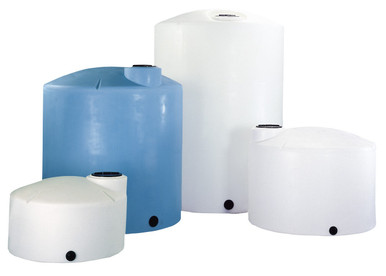
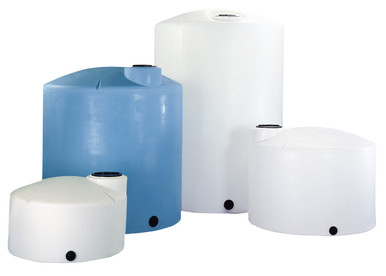
Above-grade vertical tanks are designed for hydrostatic loading from inside out. Hoop stress is the dominant failure mode; ASTM D1998 Section 6.4 sets the design hoop stress at 600 psi with safety factor 1.5. Wall thickness is calculated from fluid SG, diameter, and column height.
Buried tanks are designed for the inverse load: external soil and groundwater loading inward. The dominant failure modes shift to:
- Buckling under external pressure — soil overburden plus saturated groundwater above the tank can push the wall inward.
- Buoyancy uplift — an empty tank in saturated soil floats. Groundwater 1 ft above the tank invert applies enough lift to dislodge a 1,000-gallon underground.
- Differential settlement — uneven bedding causes the tank to crack or warp.
- Live loading from traffic — AASHTO H-20 / HS-20 wheel loading from vehicles overhead can spike point pressure on the tank crown.
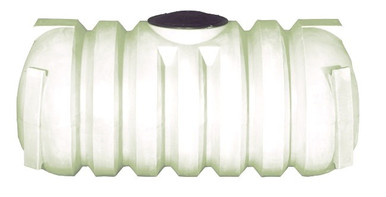
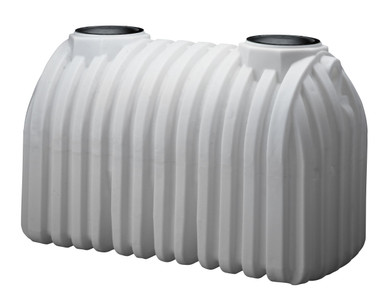
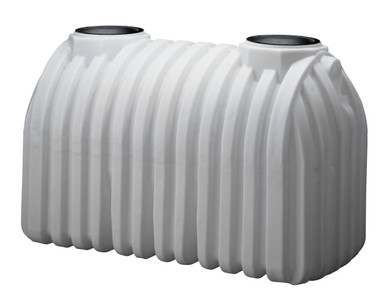
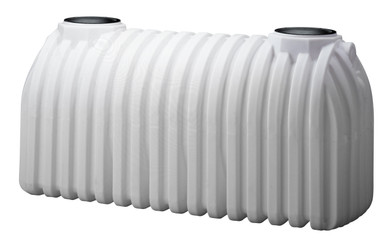
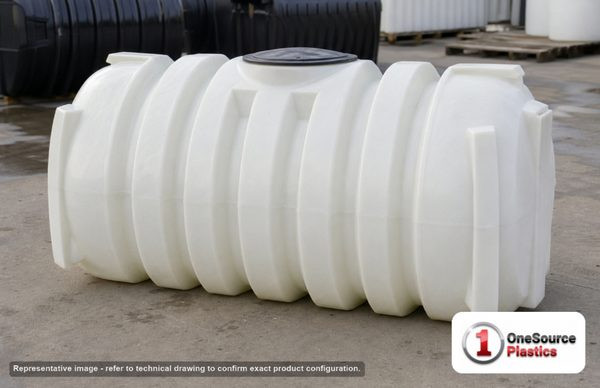
Norwesco engineers their underground line for buried service with ribbed-wall geometry that increases stiffness against external collapse. The N-44876 5,025-gallon underground cistern and N-41734 / N-41820 1,000-gallon multi-use underground tanks are designed for buried installation with specific bedding, backfill, and burial-depth limits.
The Four Below-Grade Configurations
Configuration 1: Full Underground
Top of tank below grade, soil over the crown, access via riser pipes brought to grade. Standard configuration for septic, large underground cisterns, residential gray-water storage, and rainwater capture systems.
Engineering items:
- Burial depth limits — manufacturer specs typical maximum cover (commonly 24-36 inches over crown for plastic, varies by SKU). Norwesco N-44876 has manufacturer-specified maximum cover and minimum cover for traffic vs non-traffic loading.
- Bedding requirement — well-graded gravel or pea stone, 6-12 inches under the tank, compacted to manufacturer spec.
- Backfill requirement — same gravel or sand, placed in lifts of 12-18 inches, compacted around the tank with no voids.
- Anchor strap or ballast — required when groundwater table can rise above tank invert. Concrete deadman or strap-to-pad.
- Riser size and depth — access risers extend from tank lid to grade; minimum 18 inch riser for inspection access, 24 inch for cleanout access on septic.
Common SKUs:
- Norwesco N-44876 — 5,025 gal underground cistern, large-volume rainwater / fire suppression / non-potable storage
- Norwesco N-44877 — same as N-44876 with extended riser package
- Norwesco N-41734 / N-41735 — 1,000 gal multi-use underground (single and dual compartment)
- Norwesco N-41820 — 1,000 gal IAPMO-approved multi-use underground (carries IAPMO Z1000 certification mark for septic service)
- Norwesco N-41772 — 1,500 gal multi-use underground
- Norwesco N-44463 — 1,000 gal multi-use underground with gas check (modified for landfill leachate or methane-prone sites)
Configuration 2: Bunkered (Partially Below Grade)
Top of tank flush with grade or partially exposed; the bottom half buried; the top half open to atmosphere. Used where the site geometry doesn't allow full burial or where topside access is needed.
Engineering items unique to bunkered:
- Differential expansion / contraction at the grade interface as the buried portion stays cool and the exposed portion thermal cycles
- Stress concentration at the grade line; UV degradation of exposed portion combined with soil contact below
- Cap or top closure must be fully sealed against rainwater entry while allowing vent
- Drainage around the exposed portion to prevent ponding water against the wall
Bunkered installations are field-engineered case-by-case. Most plastic tank manufacturers do NOT formally warrant bunkered installation; the warranty is structured around either fully above-ground or fully buried. Verify manufacturer position before specifying bunkered.
Configuration 3: Vault (Inside a Concrete Vault)
Tank installed inside a precast or cast-in-place concrete vault. The vault provides containment, the tank provides chemistry-compatible fluid storage. Common for chemistry tanks where a concrete-only vault would not be chemistry-compatible.
Engineering items:
- Vault sizing — 110% of largest tank for SPCC, plus working clearance for inspection. ASTM C1227 (precast concrete septic tanks) governs precast quality but vaults are typically site-cast.
- Vault drainage — sump at low point with leak-detection sensor; pump-out access.
- Vault ventilation — for chemistry that off-gases, vault headspace requires vent to atmosphere with flame arrestor for VOC service.
- Tank anchor inside vault — tank still needs strap-to-pad or saddle to prevent floating if vault floods.
- Access lid to vault — sized for personnel entry (24 inch typical) plus separate equipment-removal hatch.
Vault installations are common for industrial pretreatment chemistry, bulk caustic and acid storage in chemical plants, and any service where SPCC or RCRA containment is mandated.
Configuration 4: Pit-Set (Excavated Pit with Retaining Walls)
Tank lowered into an excavated pit with timber, sheet pile, or block retaining walls. The pit is open to atmosphere or covered with a hatch. Used for short-term installations, mining sites, construction water, and sites where permanent vault infrastructure isn't justified.
Engineering items:
- Retaining wall design for soil pressure plus surcharge; site geotechnical needed
- Drainage from pit floor to prevent water accumulation around tank
- Tank anchor or ballast against buoyancy if pit can flood
- Cover or hatch for safety; pit is a confined space under OSHA 1910.146 if entered
Soil Mechanics: What Engineers Check Before Burial
The geotechnical analysis covers four soil parameters:
- Soil classification (ASTM D2487 / USCS). Sand and gravel are good backfill; clays and silts are problematic. Tank manufacturer bedding spec calls out USCS classification (e.g., "well-graded gravel GW or poorly graded gravel GP, no fines greater than 12%").
- Bearing capacity. Soil under the bedding must support tank-plus-fluid weight without excessive settlement. 1,500-2,000 psf is typical minimum for plastic underground; structural fill or concrete pad needed if native soil is below.
- Groundwater table elevation. Determines anchor design. Tank empty + groundwater above invert = uplift force; design anchor to resist 1.5x calculated uplift.
- Frost depth. Bedding and tank crown must be below frost depth, OR insulation provided. In northern US, frost depth ranges 24-60 inches; 36 inch minimum cover is common for unprotected installations.
The site geotech report from a licensed engineer is the document that closes the loop. Manufacturer bedding spec + site geotech compatibility = engineered installation. Skipping the geotech and using "general practice" bedding is the most common failure path.
Buoyancy Calculation Worked Example
1,000-gallon Norwesco N-41820 multi-use underground tank installed in a site where seasonal groundwater can reach 1 ft below grade.
Tank volume: 1,000 gallons = 134 cu ft. Empty tank weight: roughly 250 lb. Tank invert depth: 96 inches (8 ft) below grade.
Buoyancy force = volume of water displaced × density of water = 134 cu ft × 62.4 lb/cu ft = 8,362 lb upward.
Net uplift = 8,362 - 250 = 8,112 lb. Required anchor capacity at 1.5x safety factor = 12,168 lb.
Practical anchor: concrete deadman 4 ft × 4 ft × 12 inch thick = 16 cu ft × 150 lb/cu ft = 2,400 lb deadman weight. Two deadmen of this size + soil cohesion = roughly 6,000 lb resistance, NOT sufficient.
Solution: heavier deadmen (6 ft × 6 ft × 12 inch = 5,400 lb each, two units = 10,800 lb plus soil) OR strap-to-foundation-pad with continuous concrete pad below tank. The latter is the more reliable engineered solution and is what manufacturers specify for high-water-table sites.
This calculation is mandatory. Skipping it is how empty tanks float to the surface during the first wet season.
AASHTO Traffic Loading
If a vehicle drives over the tank, AASHTO H-20 (16,000 lb wheel load) or HS-20 (heavier truck) live loading applies. The tank itself rarely sees the full load because soil distributes it; the question is whether the tank crown sees enough point load to buckle.
Practical thresholds for plastic underground:
- No traffic, landscape only: 24 inch minimum cover, 36 inch maximum (varies by SKU)
- Light passenger vehicle: 36 inch minimum cover
- HS-20 truck (refuse, fuel, propane delivery): 48-60 inch minimum cover OR concrete distribution slab over tank crown
- Heavy industrial / military: typically not approved for plastic; specify FRP or precast concrete
Norwesco underground tanks specify maximum bury depth and minimum cover for traffic vs non-traffic loading on the spec sheet. Use those numbers; don't extrapolate from above-ground product.
Riser, Access, and Ventilation Requirements
Once buried, the tank is only accessible through risers extending to grade:
- Cleanout riser — 24 inch minimum for septic per IAPMO Z1000; 18-24 inch for cisterns and multi-use. Brought to grade with locking lid.
- Inspection riser — 12-18 inch typical, brought to grade for visual inspection.
- Vent — atmosphere connection; for septic, 4 inch vent typical. For petroleum, vent piping per 40 CFR 280 with flame arrestor.
- Pump-out access — for septic and grease, sized for tanker truck hose (typically 4-6 inch).
- Level monitoring — for petroleum UST under 40 CFR 280, automatic tank gauging required; for water and septic, manual dipstick or float gauge typical.
Riser design is non-trivial. Risers must seal at the tank top, support their own weight, and resist soil pressure. Cracked or leaking risers are the most common surface defect on buried tanks; specify manufacturer-supplied risers and seal kits.
Federal Regulatory Frameworks for Below-Grade Tanks
Petroleum: 40 CFR 280 (Underground Storage Tank Rules)
Applies to UST storing petroleum or hazardous substances above the de minimis (110 gallons capacity for petroleum). Polyethylene underground tanks are rare in this regulated petroleum space; double-wall fiberglass and steel-clad fiberglass dominate. Plastic underground for fuel is typically only approved for specialty waste-oil or used-fuel collection at small volumes.
- 40 CFR 280.20 — UST design and construction requirements
- 40 CFR 280.40-280.41 — release detection: ATG, line monitoring, vapor monitoring, groundwater monitoring
- 40 CFR 280.50-280.53 — release reporting, investigation, response
- 40 CFR 280.61 — corrective action plan
Septic: IAPMO Z1000 + State Plumbing Code
IAPMO Z1000 governs prefabricated polyethylene septic; some states reference NSF 41 or have state-specific approval. Norwesco N-41820 IAPMO-approved is the typical SKU. Installation per state plumbing code: setback distances from wells, dwellings, property lines vary by state.
Stormwater / Rainwater Harvesting: State + Local Code
No federal framework specifically for rainwater capture; varies by state and local jurisdiction. Some southwestern US states (Texas, Arizona, New Mexico) actively encourage rainwater harvesting with tax incentives; some states have water-rights complications. Verify before specifying a buried cistern.
Industrial Wastewater: 40 CFR 403 + State NPDES
Pretreatment storage that goes below grade triggers both 40 CFR 403 pretreatment and 40 CFR 280 if flow contains regulated petroleum. Vault installations with above-ground tank inside meet the spirit of UST without the 280 designation.
Common Below-Grade Installation Mistakes
Mistake 1: Generic bedding instead of manufacturer spec
"Just put gravel under it" is not engineering. Manufacturer spec calls out USCS classification, gradation, and depth. Native silty soil under a tank fails by differential settlement; manufacturer warranty voids.
Mistake 2: Skipping the buoyancy calculation
Empty tanks float. The first wet season after install brings the tank to the surface, breaks the riser, and floods the site. Run the buoyancy calc; specify anchor; install before any rain.
Mistake 3: Insufficient cover for traffic
Driveway over the tank without 36+ inches of cover and a distribution slab will buckle the tank crown over time. Specify cover; if cover isn't available, route vehicles around or upgrade to FRP.
Mistake 4: Riser-to-grade extension not accounted for
Tank ships with a stub riser; field extension to grade requires additional riser sections, joint seals, and a heavy-duty access cover. Order the full riser kit at PO time.
Mistake 5: Backfilling with native soil that contains rocks
Sharp rocks against the tank wall create stress concentrations and crack initiation sites. Imported clean backfill (sand or fine gravel) within the bedding zone is the manufacturer requirement; native fill outside the bedding zone is acceptable above the tank.
Mistake 6: No leak detection on chemistry vault installations
Vault sump must have leak sensor wired to alarm. Without it, a tank failure inside a vault goes undetected until the vault overflows, creating both spill and vault-decommissioning costs.
Mistake 7: Forgetting frost protection
Tank crown above frost depth in northern US freezes the contents and the wall. Either bury below frost depth, or insulate the tank top, or both. Frost-cracked underground tanks are common and expensive.
Internal Resources
- Aboveground vs Belowground Decision Framework
- Compliance Audit Checklist
- Service Life Methodology
- Freight Cost Estimator
- Contact OneSource — underground tank specification, riser kit ordering, geotech-spec coordination
Source Citations
- 40 CFR 280 — Technical Standards and Corrective Action Requirements for Owners and Operators of Underground Storage Tanks
- 40 CFR 403 — General Pretreatment Regulations
- ASTM D2487 — Standard Practice for Classification of Soils for Engineering Purposes (USCS)
- ASTM C1227 — Standard Specification for Precast Concrete Septic Tanks
- ASTM D1998 — Standard Specification for Polyethylene Upright Storage Tanks
- AASHTO H-20 / HS-20 — Highway bridge design live loading specification
- IAPMO Z1000 — Prefabricated Septic Tanks
- NSF 41 — Wastewater Treatment Systems
- OSHA 29 CFR 1910.146 — Permit-Required Confined Spaces
- Norwesco underground tank specification sheets (N-44876, N-41734, N-41820, N-41772, N-44463)
- OneSource Plastics master catalog data, dated 2026-03-26 snapshot
Recommended Tanks for This Guide
Live pricing, updated automatically · estimate freight to your ZIP.