Plastic Storage Tank Lifecycle: ASTM D1998 Service Life Estimation Methodology
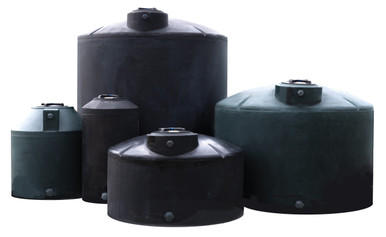
How long does a polyethylene tank actually last? The marketing answers ("decades" or "30+ years") are useless for capital planning. The engineering answer requires reading the manufacturer warranty, the resin technical bulletin, and the ASTM D1998 service-life methodology, then applying environmental and chemistry de-rating factors specific to your service. This guide walks through the math.
The result is a defensible estimate of service life within a 2 to 4 year band, which is what your facility's reliability engineering and capital planning groups need. We'll cite ASTM D1998, ASTM F412, ASTM D1693, the Arrhenius accelerated-aging methodology, and the manufacturer warranty terms for Norwesco and Snyder. Real SKU references are pulled from the OneSource Plastics catalog. No fabricated numbers.
The Three Drivers of Polyethylene Service Life
Polyethylene tanks fail (in declining order of frequency) by:
- Environmental Stress Cracking (ESC). Sustained tensile stress + chemistry exposure causes crazes and cracks in the polymer matrix. ASTM D1693 measures resistance under accelerated conditions.
- UV degradation. Solar UV breaks down the polymer chains, embrittles the wall, and accelerates ESC. UV stabilizers (carbon black for darkest tanks, hindered amine light stabilizers for white/colored tanks) extend life but do not eliminate UV degradation.
- Thermal aging. Long-term temperature exposure accelerates oxidation. Arrhenius equation: every 10C increase in service temperature roughly halves the service life.
Mechanical impact, vandalism, and freeze damage cause acute failures but are not service-life predictors. The three above are what determine whether your 20-year-rated tank actually lasts 20 years.
The ASTM D1998 Framework
ASTM D1998 (Standard Specification for Polyethylene Upright Storage Tanks) governs the design and construction. The standard:
- Sets minimum wall thickness as a function of fluid SG, tank diameter, and column height (Section 6.4)
- Specifies design hoop stress (Section 6.4.1: typically 600 psi for tank-grade HDPE)
- Sets safety factor (Section 6.4.2: minimum 1.5 for static service)
- Specifies hydrostatic test pressure for QA testing
- References ASTM D1693 for ESCR rating
What ASTM D1998 does NOT do:
- Predict service life directly. The standard sets minimum design requirements; service life depends on additional factors.
- Cover chemistry compatibility. That's a separate analysis.
- Cover UV exposure. Tanks for outdoor use require additional UV stabilization beyond D1998 minimum.
The 600 psi design hoop stress at SF 1.5 means the tank wall is engineered for 400 psi continuous hoop stress (600/1.5). The polyethylene resin can sustain this stress for 50+ years at 23C in pure water. The chemistry, UV, and temperature de-rating factors are what reduce 50+ years to your actual service life.
The Arrhenius Service Life Math
Polymer aging follows the Arrhenius equation. For most thermal degradation processes:
t1 / t2 = exp[(Ea/R) × (1/T2 - 1/T1)]
Where t1 and t2 are time-to-failure at temperatures T1 and T2 (Kelvin), Ea is the activation energy of the degradation reaction (typically 80-110 kJ/mol for polyethylene), and R is the gas constant (8.314 J/mol/K).
For a tank rated 20 years at 23C (296 K) with Ea of 90 kJ/mol, service at 35C (308 K, e.g., outdoor in southern US) reduces life to:
t2 = 20 × exp[-(90000/8.314) × (1/296 - 1/308)] = 20 × 0.34 = 6.8 years
The same tank, baseline 20-year rated, only delivers 6.8 years at sustained 35C. That's why outdoor tanks in hot climates earn the lower-end of the warranty range.
Conversely, indoor tanks at 18C (291 K, climate-controlled mechanical room) deliver:
t2 = 20 × exp[-(90000/8.314) × (1/296 - 1/291)] = 20 × 1.85 = 37 years
Climate-controlled service nearly doubles the rated life. That's why pretreatment tanks in mechanical rooms outlast outdoor tanks even when they handle aggressive chemistry, and why outdoor agricultural water tanks in hot climates are the most replacement-prone product class in the industry.
Manufacturer Warranties as Lower-Bound Life Estimates
Manufacturer warranties are conservative lower-bound estimates designed to limit warranty claims. Read them as "we promise the tank will not fail before X years." Actual service life is typically 1.5 to 3x the warranty period under nominal conditions.
Typical polyethylene tank warranty terms in the US market:
- Norwesco — 3-year warranty on standard products; 5-year on potable water tanks; specific exclusions for chemistry outside compatibility list, UV exposure beyond rated formulation, exceeded SG rating.
- Snyder Industries — 3-year warranty on HDPE; 5-year on XLPE chemical tanks; similar exclusion list.
- Chem-Tainer — 3-year warranty on standard products; longer warranty on specialty chemistry tanks per manufacturer documentation.
- Bushman — 5-year warranty on water storage; longer warranties on residential potable units per product line.
Warranty exclusions matter more than the headline period. Common exclusions:
- Chemistry outside published compatibility list
- Service temperature above rated max (typically 100F or 120F)
- SG above rated (running 1.5 SG tank with 1.7 SG fluid voids warranty)
- UV exposure for non-UV-rated tanks (white indoor tanks installed outdoors)
- Negative pressure / vacuum events (closed vent during pump-out)
- Mechanical damage (impact, scraping, drilling additional holes)
- Improper foundation (uneven pad, inadequate support)
Reading the exclusion list is how you predict whether your application falls inside or outside the warranty envelope. If you're outside the warranty (running aggressive chemistry, hot service, or non-standard application), expect actual life closer to 50-70% of the warranty period rather than 150-300%.
Predicted Service Life by Application Class
| Application | Resin | Service Conditions | Expected Life | Example SKU |
|---|---|---|---|---|
| Indoor potable water | HDPE NSF61 | 18-22C, low UV, neutral pH | 25-40 years | N-41527 300gal nat-white |
| Outdoor agricultural water | HDPE black/green | 15-35C cyclic, full UV | 15-25 years | N-43808 1525gal black |
| Indoor caustic 50% NaOH | XLPE 1.9 SG | 20-25C, no UV, alkaline | 15-20 years | SII-1830000N42 |
| Indoor sodium hypochlorite 12.5% | HDPE 1.5 SG | 20C, no UV, oxidative chem | 2-4 years | N-40941 5000gal HDPE |
| Indoor sodium hypochlorite 12.5% | XLPE 1.9 SG | 20C, no UV, oxidative chem | 7-12 years | SII XLPE chemical line |
| Outdoor brine (salt) | HDPE 1.5 SG | -10 to 30C cyclic, full UV | 12-18 years | N-44045 1000gal doorway |
| Outdoor DEF (urea 32.5%) | HDPE NSF61 white | -5 to 25C, full UV, mild | 10-15 years | DEF-class catalog |
| Underground cistern, water | HDPE ribbed-wall | 15C constant, no UV | 30-50 years | N-44876 5025gal cistern |
| Septic tank | HDPE IAPMO | 15C constant, no UV, organic | 20-30 years | N-43512 1500gal septic |
Three patterns in this table:
- Underground installation extends life dramatically. Soil thermal mass holds the tank near 12-15C year-round, eliminating both UV and thermal cycling. Cisterns and septic tanks routinely deliver 30+ years.
- Outdoor service halves the life of the same tank vs indoor. UV plus thermal cycling are the dominant aging factors.
- Aggressive chemistry on standard HDPE is brutal. Sodium hypochlorite at 12.5% on HDPE is a 2-4 year service life. The same chemistry on XLPE is 7-12 years. The XLPE premium pays for itself in a single replacement cycle.
Service Life Estimation Worked Example
You're sizing a 5,000-gallon vertical tank for outdoor sodium hypochlorite 12.5% storage in Phoenix, Arizona. Average annual temperature 23C, peak summer surface temperature on a black tank can reach 60C. UV exposure full-sun.
Step 1: Pick the candidate. SKU N-40941 (5000 Gallon Vertical White HDPE 1.5 SG, $4,799) vs an XLPE 1.9 SG equivalent at roughly $7,000-$8,500 list.
Step 2: Apply de-rating factors:
- HDPE baseline indoor life with sodium hypochlorite: 4 years (per resin technical bulletin)
- Outdoor UV de-rating for white HDPE: x 0.7 (UV degrades white pigment + matrix)
- Phoenix temperature de-rating (avg 23C, peak 60C): Arrhenius gives roughly x 0.6 vs nominal indoor 20C
- Combined de-rating: 4 × 0.7 × 0.6 = 1.68 years
Step 3: Apply same factors to XLPE:
- XLPE baseline indoor life with sodium hypochlorite: 10 years
- Outdoor UV de-rating: x 0.7
- Phoenix temperature: x 0.6
- Combined: 10 × 0.7 × 0.6 = 4.2 years
Step 4: 20-year capital cost:
- HDPE: 20 / 1.68 = roughly 12 replacement cycles. 12 × $4,799 + freight + install = $90,000+ over 20 years.
- XLPE: 20 / 4.2 = roughly 5 replacement cycles. 5 × $7,500 + freight + install = $50,000 over 20 years.
The XLPE choice saves $40,000+ over the 20-year horizon despite a $2,700 higher initial cost. Service-life math is what justifies the premium.
Field Indicators of Approaching End-of-Life
Polyethylene tanks rarely fail catastrophically. They give visible warning signs as they approach end of service life:
- Surface chalking — UV degradation creates a chalky, dull surface on outdoor tanks. White tanks turn off-white or yellow; black tanks fade to gray. First visible sign, typically 50-70% through service life.
- Surface micro-crazing — fine surface cracks visible under sunlight. Indicates ESC-precursor stress redistribution. 70-85% through service life.
- Wall flexure — tank flexes more visibly during fill cycles. Indicates wall has lost some elastic modulus. 80-90% through service life.
- Visible cracks at fittings — stress concentration at bulkhead fittings is the most common crack initiation site. 90-100% through service life. Plan replacement.
- Discoloration of fluid — if the contained fluid develops resin-leached coloration or particulate, the wall is shedding material. Replace immediately.
- Weeping fittings — small leaks at bulkhead seals indicate gasket failure or thread compromise. May be repairable; if leak persists after gasket replacement, wall is the issue.
Inspection cadence: visual every 6 months for chemistry tanks; visual annually for water tanks. Document findings, photograph any observed deterioration, and plan replacement when you see micro-crazing or first cracks at fittings.
Replacement Planning
Tank replacement is more disruptive than tank installation because the existing tank must be drained, cleaned, removed, and disposed of before the new tank arrives. Plan replacement at 80% of expected service life, not at failure:
- Year 80%: order replacement tank, schedule install date, plan operations downtime.
- Year 80% + 30 days: drain existing tank, clean per chemistry (acid wash for caustic, caustic wash for acid, etc.), document final residue for disposal manifest if regulated.
- Year 80% + 31 days: remove existing tank to disposal vendor (polyethylene is recyclable; many vendors take it free or for small fee). Install new tank. Pressure test, leak test, return to service.
The "wait for failure then replace" mode causes unplanned downtime, emergency LTL freight at premium rates, and potential environmental exposure if a chemistry tank fails. Planned replacement at 80% of life is materially cheaper.
Common Service Life Mistakes
Mistake 1: Trusting the warranty as the service life estimate
Warranty is a lower bound. Actual life under nominal conditions is 1.5-3x warranty. Plan around expected life, not warranty period.
Mistake 2: Treating outdoor and indoor tanks as equivalent
UV cuts polyethylene tank life by 30-50%. Specify UV-rated formulation for outdoor service or expect to replace at half the indoor cycle.
Mistake 3: Ignoring temperature exposure
Arrhenius math: 10C above nominal halves life. Hot-climate outdoor tanks, hot-process indoor tanks, exothermic reaction tanks all need temperature-rating verification.
Mistake 4: Skipping the resin technical bulletin
The manufacturer warranty is conservative. The resin manufacturer (LyondellBasell, ExxonMobil, INEOS) publishes ESCR data, thermal aging data, and chemistry compatibility data on the specific resin grade. The resin TDS gives more accurate service life prediction than the tank spec sheet alone.
Mistake 5: Using HDPE for chemistries that require XLPE
The 5-15% premium on XLPE often translates to 3-5x service life under aggressive chemistry. The HDPE choice looks cheaper at PO time and looks expensive at year 4 when you replace.
Mistake 6: Skipping inspection
Tanks that get visual inspection get replaced at 80% of life. Tanks that don't get inspected fail at 100% of life with full disruption. Inspection is free (visual); the value is enormous.
Internal Resources
- How to Read a Tank Spec Sheet — engineering fundamentals
- ASTM Specific Gravity Decoded — SG rating deep dive
- Chemical Compatibility Database — HDPE/XLPE chemistry compatibility
- Pretreatment Tank Selection — companion post
- Freight Cost Estimator — LTL quote to your ZIP
- Contact OneSource — service life consultation, replacement planning
Source Citations
- ASTM D1998 — Standard Specification for Polyethylene Upright Storage Tanks
- ASTM F412 — Standard Terminology Relating to Plastic Piping Systems
- ASTM D1693 — Standard Test Method for Environmental Stress-Cracking of Ethylene Plastics
- ASTM D2837 — Standard Test Method for Obtaining Hydrostatic Design Basis for Thermoplastic Pipe Materials
- ASTM D2143 — Standard Test Method for Cyclic Pressure Strength of Reinforced, Thermosetting Plastic Pipe
- NSF/ANSI 61 — Drinking Water System Components: Health Effects
- Manufacturer warranty terms (Norwesco, Snyder Industries, Chem-Tainer, Bushman) — current production catalog
- Arrhenius equation for polymer thermal aging — standard polymer engineering literature
- OneSource Plastics master catalog data, dated 2026-03-26 snapshot
Related chemical compatibility resources
For deeper engineering specifications on the chemicals discussed above, see our chemical-compatibility pillars:
- Sodium Hypochlorite — storage compatibility, recommended resin grade, fittings, secondary containment.
- DEF (Diesel Exhaust Fluid) — storage compatibility, recommended resin grade, fittings, secondary containment.
- Sodium Hydroxide — storage compatibility, recommended resin grade, fittings, secondary containment.
- Sodium Chloride — storage compatibility, recommended resin grade, fittings, secondary containment.
Recommended Tanks for This Guide
Live pricing, updated automatically · estimate freight to your ZIP.