How to Drill and Install a Bulkhead Fitting on a Polyethylene Tank
Installing a Bulkhead Fitting: Step-by-Step Guide
A bulkhead fitting creates a leak-free connection through the wall of a polyethylene tank. Whether you need an additional outlet, an inlet at a specific height, a sight glass connection, or a drain, drilling and installing a bulkhead fitting is a straightforward job with the right tools and technique. Done correctly, a bulkhead fitting is as reliable as a factory-installed fitting. Done incorrectly, it leaks forever.
What You Need
Parts
- Bulkhead fitting: Sized for your plumbing (3/4", 1", 1-1/4", 1-1/2", or 2" NPT are common). Polypropylene bulkheads are the most common for poly tanks. Stainless steel for heavy-duty applications.
- Gaskets: One EPDM gasket for most applications (included with most bulkhead fittings). Use Viton gaskets for aggressive chemicals or high-temperature applications. Use PTFE gaskets for maximum chemical compatibility.
- PTFE tape: For sealing threaded connections downstream of the bulkhead.
Tools
- Hole saw: Sized for the bulkhead fitting (check the fitting's spec sheet for the required hole diameter). The hole size is NOT the same as the pipe size — a 1" NPT bulkhead typically requires a 1-3/4" to 2" hole.
- Drill: A standard 1/2" electric drill. Use low speed (under 500 RPM) to prevent melting the polyethylene.
- Marker: For marking the hole location.
- Level: For ensuring the fitting is at the correct height.
- Deburring tool or sandpaper: For cleaning the drilled hole edges.
- Adjustable wrenches (2): For tightening the bulkhead nut.
Step 1: Mark the Hole Location
Decide where on the tank wall you want the fitting. Consider:
- Height: An outlet near the bottom drains the most liquid but collects sediment. An outlet 2-3 inches above the bottom drains almost completely while leaving sediment behind.
- Orientation: Position the fitting where the plumbing run is shortest and straightest. Every bend and extra foot of pipe adds friction loss.
- Clearance: Leave enough room below and around the fitting for a wrench to tighten the nut on the inside.
- Tank curvature: On a round tank, the gasket must seal against a curved surface. Most bulkhead fittings include a contoured gasket or a large enough flange to bridge the curvature. For very tight curves (small tank diameter), choose a fitting specifically designed for curved surfaces.
Mark the center point with a marker. Use a level to ensure the mark is at the correct height — measure from the bottom of the tank, not the ground, in case the tank isn't sitting perfectly level.
Step 2: Drill the Hole
This is the critical step. Technique matters more than tools:
- Use a sharp, new hole saw. A dull hole saw generates heat through friction, melting the polyethylene instead of cutting it cleanly.
- Drill at LOW speed — under 500 RPM. High speed melts the plastic and creates a rough, uneven hole that won't seal properly.
- Apply steady, moderate pressure. Let the saw do the cutting. Don't force it.
- Drill from the outside in. This gives you the cleanest edge on the visible side.
- Support the tank wall from inside if possible — pressing against the inside wall prevents the saw from deflecting and creating an oval hole.
Step 3: Deburr the Hole
Remove all burrs, strings, and rough edges from the drilled hole. The gasket must seat against a smooth, flat surface. Use a deburring tool or 120-grit sandpaper. Clean the area thoroughly — any debris between the gasket and tank wall creates a leak path.
Step 4: Install the Bulkhead Fitting
- Place the outer gasket on the fitting body (the side with the flange)
- Insert the fitting through the hole from the outside
- On the inside, place the inner gasket and the locknut
- Hand-tighten the locknut until the gasket is firmly compressed against both sides of the tank wall
- Using two wrenches (one holding the fitting body, one turning the nut), tighten 1/4 to 1/2 turn past hand-tight
- Do NOT overtighten — excessive force can crack the fitting, deform the tank wall, or squeeze the gasket thin enough to leak
Step 5: Test for Leaks
Fill the tank to at least the level of the fitting and let it sit for 30 minutes. Inspect the fitting from both inside and outside for any weeping, drips, or moisture. A properly installed bulkhead fitting should be completely dry. If it weeps, tighten the nut 1/8 turn at a time until the leak stops. If it still leaks after additional tightening, disassemble, check the gasket and hole for damage, and reassemble with a new gasket if needed.
Common Mistakes
- Drilling too fast — melts the plastic, creating a rough hole that never seals right
- Wrong hole size — too big and the gasket can't seal, too small and you can't get the fitting through
- Overtightening — cracks the fitting or deforms the tank wall into a shape the gasket can't seal
- Reusing a damaged gasket — gaskets are cheap, leaks are expensive. Always use a new gasket if you disassemble and reassemble
- Forgetting to deburr — a small burr under the gasket creates a permanent leak path
Need bulkhead fittings, gaskets, or accessories? Browse our fittings catalog or call (866) 418-1777 for sizing help.
Shop Our Most Popular Tanks
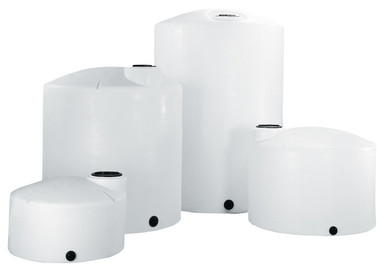
Recommended Tanks for This Guide
Live pricing, updated automatically · estimate freight to your ZIP.