Texas Railroad Commission Statewide Rule 8 to 16 TAC Chapter 4 Transition: Produced-Water Tank Compliance Walkthrough for Operators
The Texas oilfield-waste regulatory framework has changed. For 40+ years operators relied on Statewide Rule 8 (16 TAC 3.8), the Railroad Commission of Texas rule that governed pits, produced-water disposal, and oilfield waste management. Effective July 1, 2025, the RRC retired Statewide Rule 8 and replaced it with 16 TAC Chapter 4, Subchapter A — the most extensive overhaul of Texas oilfield-waste regulation in over four decades. Operators with produced-water storage tanks across the Permian, Eagle Ford, Haynesville, and Barnett are now operating under the new framework. This walkthrough explains what changed, what stayed the same, and what storage-tank specifications matter under Chapter 4 for above-ground polyethylene storage of produced water.
Important upfront caveat: this is a regulatory landscape walkthrough for technical and procurement purposes. It is not legal advice and it does not substitute for review by a Texas-licensed environmental attorney or by the operator's RRC compliance officer. Texas oilfield-waste regulation has site-specific application that depends on permit history, lease type, formation, and proximity to surface water and groundwater. The information here is calibrated to help operators select storage tanks; it is not a compliance certification.
What Statewide Rule 8 Was
Statewide Rule 8 was codified at 16 TAC 3.8 and titled "Water Protection." It regulated the management of oil and gas waste in Texas, including produced water. The rule governed pits (saltwater disposal pits, drilling-fluid pits, workover pits, emergency pits), surface storage, transportation, and ultimate disposal. SWR-8 set the baseline operator obligations to prevent contamination of soil, surface water, and groundwater from oilfield-waste handling. SWR-57 (16 TAC 3.57) operated alongside SWR-8 to govern oilfield-waste reclamation plants.
Under SWR-8, the use of above-ground polyethylene tanks for produced-water storage was a permitted activity subject to operator best-practice obligations. The rule set baseline requirements: tanks had to be in good condition, secondary containment was required for tank batteries above defined volume thresholds, leak detection and reporting obligations applied, and operator records had to track produced-water volumes and disposition.
What Chapter 4 Subchapter A Changed
The new framework consolidates SWR-8 and SWR-57 into a single rule architecture and adds new compliance steps. Headline changes operators should know:
1. Pits Reclassified as Infrastructure
Under the old SWR-8, pits were treated as transient or semi-permanent features of an oilfield operation. Under Chapter 4, pits are reclassified and regulated as infrastructure, with new requirements for registration, liner specification, setbacks from surface water and groundwater protection zones, and closure procedures. This shift is the most significant single change in the framework. Operators with active pits across multiple leases now have a registration burden they did not have under SWR-8.
2. Mandatory Manifesting and Mass Balance
Chapter 4 introduces mandatory manifesting for oilfield-waste transport, requiring that every load of produced water (or other regulated waste) generated, hauled, or received be tracked from origin to disposition. This parallels the federal RCRA cradle-to-grave manifest concept (40 CFR Part 262 for hazardous waste, though produced water is generally not RCRA hazardous waste under the Bevill exemption at 40 CFR 261.4(b)(5)). For Texas oilfield-waste, the new state manifesting is independent of any federal manifesting and applies regardless of whether the waste meets a federal hazardous-waste definition.
3. Mass Balance Obligation
Operators must demonstrate mass balance: the volume of produced water generated at the wellhead must equal the volume disposed (via injection, recycling, evaporation, or off-lease transport) plus the volume in inventory at any reporting period. Mass-balance discrepancies above tolerance must be investigated and explained. This obligation drives operators toward better tank-level metering and toward storage tanks with reliable level instrumentation.
4. Generator/Hauler/Receiver Registration
Anyone who generates, hauls, or receives oilfield waste must register with the RRC under Chapter 4. SWR-8 had narrower registration obligations (mostly for waste-management facilities, not for the operator/generator at the wellhead). Chapter 4 expands the registration scope.
5. Setbacks and Liner Specifications
Chapter 4 strengthens setbacks of pits and waste-management infrastructure from drinking-water wells, surface water bodies, and groundwater protection zones. Liner specifications for new pits are tighter (geosynthetic liner thickness, leak-detection installation, monitoring well requirements at high-volume facilities).
What Stayed the Same: Above-Ground Storage Tanks
Above-ground polyethylene storage tanks for produced water at the wellhead, on a tank battery, or at a centralized storage facility remain a permitted activity under Chapter 4. The shift from SWR-8 to Chapter 4 does not change the basic technology choice. What changed is the surrounding compliance burden: registration, manifesting, mass balance.
For tank-specification purposes, the relevant Chapter 4 obligations are:
- Tanks must be in serviceable condition with no active leaks
- Secondary containment is required for tank batteries above the volume threshold (operator should consult the current Chapter 4 text or RRC compliance staff for the binding threshold; berm or HDPE-lined containment dikes are the typical solutions)
- Tanks must be labeled with capacity and content identification
- Level instrumentation supporting the mass-balance obligation is now operationally necessary even where it was previously optional
- Tank inspection and integrity records must be maintained for the operator's reporting cadence
Polyethylene Tank Selection for Texas Produced-Water Storage
Produced water from Texas oil and gas operations is a complex chemistry. It typically contains:
- Sodium chloride (salinity 30,000 to 200,000+ mg/L depending on formation; Permian basin produced water often runs 100,000-200,000 mg/L TDS)
- Calcium and magnesium chlorides
- Bicarbonate and sulfate
- Trace barium and strontium (NORM precursors)
- Dissolved hydrocarbons (BTEX, dissolved methane)
- Production chemical residues (corrosion inhibitor, scale inhibitor, biocide, surfactants)
- Trace dissolved metals (iron, manganese)
- Possible H2S in sour-service formations
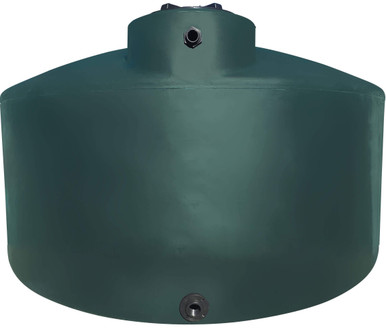
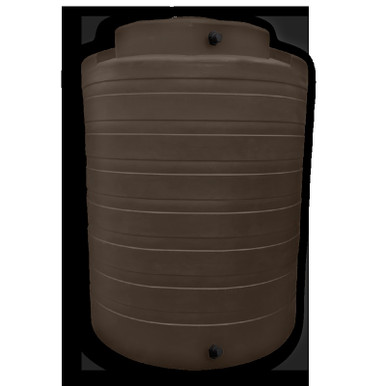
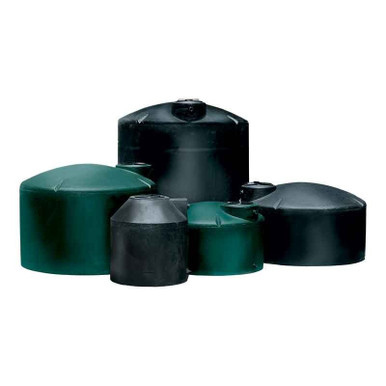
Polyethylene chemistry envelope handles this comfortably for the salt and the inorganic chemistry. The dissolved hydrocarbons are where polyethylene wall degradation can occur over multi-year service. For produced-water tanks intended for indefinite service life, specify XLPE (cross-linked polyethylene) over HDPE for better hydrocarbon resistance. For shorter-service tanks (1-5 year applications, or where the tank will be replaced as part of a wellhead retrofit cycle), HDPE is acceptable.
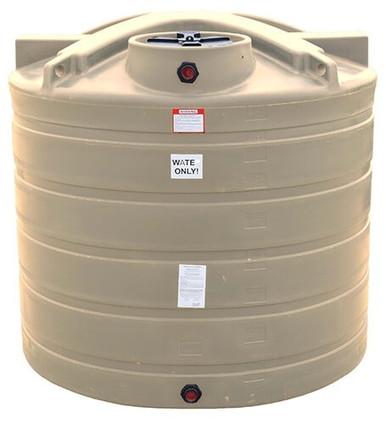
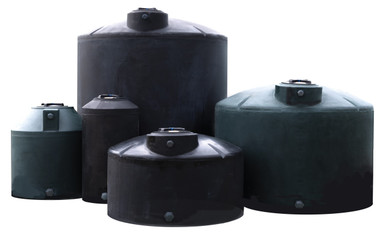
Norwesco Vertical Tanks for Produced-Water Service
- Norwesco 1100 Gallon Vertical Liquid Storage Tank in White (MPN 42591, listed at $1,521.90) — small wellhead or tank-battery service.
- Norwesco 2500 Gallon Vertical Liquid Storage Tank in White (MPN 42382, listed at $2,999.00) — typical wellhead produced-water tank for low-volume completions.
- Norwesco 5000 Gallon Vertical Liquid Storage Tank in White (MPN 40941, listed at $5,599.00) — common selection for tank-battery installations on conventional wells.
- Norwesco 6500 Gallon Vertical Liquid Storage Tank in White (MPN 42315, listed at $9,699.00) — mid-volume battery service.
- Norwesco 10500 Gallon Vertical Liquid Storage Tank in White (MPN 47638, listed at $17,729.26) — high-volume battery storage where freight economics favor the larger single unit over multiple smaller tanks.
Color choice: white pigmentation is the dominant choice for produced-water service in Texas. White reflects more solar gain, keeping internal water temperature lower and reducing sulfate-reducing-bacteria activity in stored produced water. Black tanks are appropriate where freeze protection is more important than thermal management (rare for Texas applications outside the Panhandle).
Snyder Industries Captor Double-Wall for Higher-Risk Sites
For wellhead and tank-battery sites where leak risk is elevated (proximity to surface water, sensitive groundwater, public-attention zones), double-wall containment integrated into the tank is the cleanest design approach. The Snyder Industries Captor double-wall tank line provides the inner storage tank and outer containment shell as one molded unit, eliminating the need for a separate berm or dike around the tank.
- Snyder Industries 1000 Gallon Plastic Vertical Double Wall Liquid Chemical Storage Tank (MPN 5990102N45, listed at $4,208.91) — small-volume containment-included tank.
- Snyder Industries 1550 Gallon Vertical Double Wall XLPE Liquid Chemical Storage Tank (MPN 5490000N42, listed at $10,091.93) — XLPE inner tank for elevated chemistry resistance, double-wall containment integrated.
- Snyder Industries 10,000 Gallon HDLPE Captor Double Wall Liquid Storage Tank (MPN 1006600N43, listed at $70,408.99) — large-volume Captor for high-volume battery service. Eliminates the secondary-containment dike construction cost.
The double-wall approach simplifies the Chapter 4 secondary-containment compliance question. Instead of building an HDPE-lined earthen berm with sufficient volume to contain a tank failure (typically 110% of tank volume per common best practice), the Captor tank includes the containment in the tank package. The interstitial space between inner and outer wall is monitored for leakage; any breach of the inner wall is detected immediately rather than after surface-soil contamination.
Tank Battery Layout Under Chapter 4
For multi-tank batteries, Chapter 4 expectations:
- Berm capacity: secondary containment volume sized to contain the largest tank in the battery plus a freeboard for precipitation. A typical compliant berm holds 110% of the largest tank's volume.
- Liner specification: HDPE or LLDPE geomembrane liner with seam quality controlled by either factory-pre-fabrication or field welding by certified installers. Liner thickness 60 mil (1.5 mm) is the common minimum for produced-water containment, with 80 mil (2.0 mm) preferred for high-salinity service.
- Drainage: berms must be configured to capture spilled liquid without uncontrolled discharge. Manual or auto-actuated drain valves at the low point allow controlled removal of accumulated rainwater (after testing for product contamination).
- Setbacks: Chapter 4 strengthens setbacks from drinking-water wells, surface water, and groundwater protection zones. Operators should consult the current rule text for binding setback distances at their specific site.
- Signage: tanks and berms labeled with capacity, content, operator contact, and emergency contact per RRC guidance.
Mass-Balance Instrumentation
The Chapter 4 mass-balance obligation effectively requires reliable level metering on produced-water tanks. Options:
- Mechanical float-and-tape gauge: cost-economic for non-automated operations. Operator reads the gauge during routine site visits. Low capital cost ($200-$500 per tank). High operator labor.
- Hydrostatic pressure transmitter: 4-20 mA loop-powered transmitter at the tank bottom outlet. Reads back to a SCADA system or local PLC. Mid-cost ($400-$1,500 per tank) but enables automated mass-balance reporting.
- Radar level transmitter: top-mounted non-contact radar. Measures liquid surface from above without contacting the produced water (advantage for foaming or chemistry-aggressive service). Higher capital cost ($2,000-$5,000 per tank) but minimal maintenance.
- Ultrasonic level transmitter: similar to radar in approach. Lower cost than radar but more sensitive to vapor density and temperature. Acceptable for produced-water service in most cases.
For new installations under Chapter 4, the mass-balance obligation makes hydrostatic pressure transmitters or radar transmitters the right capital choice over manual gauging — the operator-labor savings on monthly mass-balance reporting pay back the instrumentation cost within 12-24 months at typical wellhead operations.
Recordkeeping for Mass-Balance Compliance
Operators should maintain at minimum:
- Daily tank-level reading (from instrumentation or manual gauge)
- Hauler manifest for every truck that picks up produced water
- Monthly mass-balance reconciliation: produced volume (from wellhead production reporting) plus opening tank inventory minus closing tank inventory should equal volume removed by haulers plus volume disposed on-lease (if any)
- Discrepancy investigation log for any month where mass balance does not close to within tolerance
- Tank inspection log (monthly visual, annual integrity)
- Berm/secondary-containment inspection log
RRC reporting cadence under Chapter 4 follows the operator's existing W-10 and other production reporting schedule with mass-balance reconciliation tied to that cadence.
Cost Comparison: Chapter 4 Compliance vs SWR-8
For a typical 10-well lease with 5 tank batteries, the additional Chapter 4 compliance burden over SWR-8 includes:
- Generator registration: one-time administrative cost
- Hauler-receipt manifesting: paper or electronic system, integrated with existing produced-water haul-off contracts
- Mass-balance instrumentation upgrade if not already in place: $2,000-$5,000 per tank for radar level transmitters, less for hydrostatic transmitters
- Pit registration if any active pits remain: per-pit one-time cost
- Increased recordkeeping operator labor: 4-12 hours per month per lease at typical operations
For most operators, the incremental Chapter 4 cost is modest relative to the underlying produced-water disposal economics. The bigger question is operational discipline — making sure tank-level reading, hauler manifesting, and monthly reconciliation are happening reliably enough that mass-balance reporting is defensible.
Disposal Path Choices
Chapter 4 does not change the available disposal paths for Texas produced water:
- Class II injection well (the dominant path): produced water injected into a permitted Class II well per 40 CFR 144 and Texas-administered UIC program at the RRC.
- Recycling: produced water treated and reused for completion fluid (frac water makeup). Increasingly common in the Permian. Reduces fresh-water demand and reduces injection volume.
- Off-lease commercial disposal: hauler picks up produced water and transports to a commercial Class II injector or treatment-and-recycle facility. Common for low-volume or remote leases without economic on-lease injection.
- Evaporation: in the West Texas Permian Basin, evaporation pits and evaporation-assisted disposal are common where climate supports it. Chapter 4 strengthens the pit-registration obligation here.
Cross-References to OneSource Pillars
For Texas-specific regulatory context including OSSF (septic) and other above-ground tank rules, see the Texas state regulations pillar. For the underlying chemistry compatibility data on produced-water service, see the sulfuric acid storage page for the high-SG chemistry framing, the calcium chloride brine storage page for the chloride chemistry reference, and the chemical compatibility hub for the complete chemistry envelope catalog.
Closing Notes
The Texas regulatory transition from Statewide Rule 8 to 16 TAC Chapter 4, Subchapter A is operationally significant but not technologically disruptive for above-ground polyethylene produced-water storage. The same rotomolded tank technology is permitted under both regimes; what changed is the surrounding compliance burden around manifesting, registration, and mass-balance reconciliation. Operators with new wellhead and tank-battery installations should specify tanks with reliable level instrumentation from day one, plan secondary containment that meets the strengthened liner and setback requirements, and ensure the manifesting and reporting systems track every load of produced water from generation through disposal.
For tank specification, sizing, and freight quoting on Texas produced-water installations, contact OneSource Plastics at 866-418-1777. Use the freight estimator for tank-delivery quoting to your Permian, Eagle Ford, or Haynesville site.
Recommended Tanks for This Guide
Live pricing, updated automatically · estimate freight to your ZIP.