XLPE vs HDPE for High-SG (1.84) Sulfuric Acid Storage: Why Crosslink Density Stops Helping at 98% H2SO4
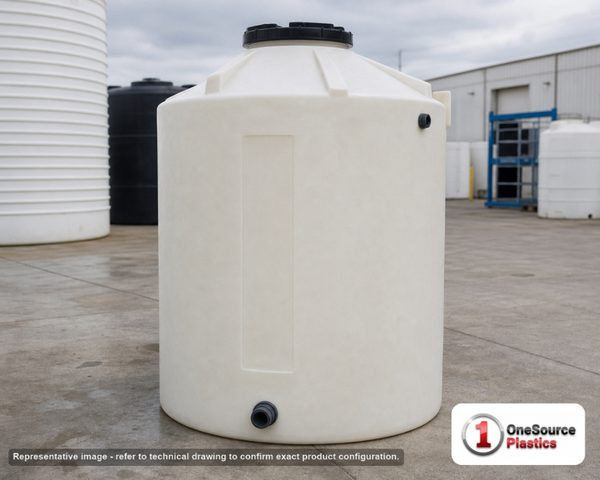
For most aggressive chemistries, cross-linked polyethylene (XLPE) is the upgrade material over linear high-density polyethylene (HDPE). XLPE has higher environmental stress crack resistance, better long-term creep resistance, and better resistance to hydrocarbon swelling. So when an engineer is specifying a tank for 98% sulfuric acid at 1.84 specific gravity, the instinct is to reach for XLPE. That instinct is wrong. For high-concentration sulfuric acid service at 1.84 SG, the manufacturer guidance from Snyder Industries actually points the other direction — toward a specific HDPE resin grade rather than XLPE. This walkthrough explains why crosslink density stops helping when the chemistry is concentrated sulfuric, what the failure mechanism actually is, and how to specify the right OneSource tank for high-SG sulfuric service.
This is a chemistry-specific guide. The HDPE-over-XLPE preference applies to high-concentration sulfuric acid (specifically the 93% to 98% concentration range where SG approaches 1.84). It does not generalize to other acids, to dilute sulfuric, or to other oxidizers. For most chemistries, XLPE remains the upgrade choice. Sulfuric at high concentration is the specific exception that the Snyder Industries chemistry envelope guidance and field experience point to.
The XLPE-Sulfuric Failure Mechanism
Cross-linked polyethylene is produced by adding crosslinking chemistry (typically silane-grafted or peroxide-initiated crosslinking) to the polyethylene matrix during molding. The result is a thermoset network of polyethylene chains chemically tied to one another. The crosslinks deliver several benefits: they raise the melt temperature, they raise the creep modulus at elevated temperature, they substantially raise the environmental stress crack resistance (ESCR) under loading, and they reduce the tendency of the polymer to swell in hydrocarbons.
The crosslink density is the engineering parameter. ASTM D2765 is the test method for crosslink density: a polymer sample is solvent-extracted, the soluble fraction is weighed (the "gel content"), and the swelling ratio of the insoluble network is measured. Higher gel content and lower swelling ratio indicate higher crosslink density. Typical XLPE tank wall has gel content of 60-75% and a corresponding crosslink density that delivers the ESCR upgrade.
Now consider what 98% sulfuric acid does to that crosslinked network. Concentrated sulfuric is a strong dehydrating agent and a strong oxidizing agent at elevated temperature. Over months of contact, the acid attacks the polyethylene through several pathways:
- Oxidation of tertiary carbon-hydrogen bonds: tertiary C-H bonds (the bond at a branch point in the polyethylene chain) are more vulnerable to oxidation than primary or secondary C-H bonds. Concentrated sulfuric acid oxidizes these tertiary positions over time, breaking the polymer chain.
- Sulfonation of the chain: concentrated sulfuric will, at sufficient temperature and contact time, sulfonate the polyethylene chain, introducing -SO3H groups that weaken the chain backbone.
- Embrittlement of crosslinks: the silane or peroxide crosslink chemistry contains structures (Si-O-C bonds for silane crosslinks, ether or carbon-carbon bonds for peroxide crosslinks) that can be hydrolyzed or oxidized by concentrated sulfuric. Once a meaningful fraction of the crosslinks are broken, the network begins to deteriorate from a thermoset behavior toward a thermoplastic behavior, but with embrittled chemistry.
The empirical observation is that XLPE tanks in 98% sulfuric service can fail well before the equivalent HDPE tank in the same service. Field reports of XLPE failures in concentrated sulfuric within 6 months of commissioning have been documented. The HDPE equivalent typically delivers years to decades of service life in the same chemistry, depending on temperature and duty cycle.
Why HDPE Holds Up Better Than XLPE in This Specific Service
Two reasons, both subtle.
First, the linear HDPE chain has fewer tertiary carbon positions than a crosslinked network. The backbone of linear HDPE is essentially all secondary carbons. The crosslinking chemistry of XLPE introduces tertiary carbons at every crosslink junction. More tertiary carbons means more vulnerable sites for sulfuric oxidation.
Second, HDPE in concentrated sulfuric service forms a passivation-style surface layer over the first weeks of contact. The surface polyethylene molecules become slightly oxidized and slightly sulfonated, but the resulting surface chemistry is more polar and presents a partial barrier to further bulk diffusion of acid into the wall. The bulk HDPE underneath the surface layer remains relatively unaffected. XLPE, paradoxically, can swell slightly under the same exposure, opening pathways for bulk diffusion that defeat the surface passivation.
The Snyder Industries technical guidance for sulfuric acid storage points toward a specific HDPE resin grade (Snyder uses an internally designated #880046 resin for 98% sulfuric service) selected for its molecular weight distribution and additive package optimized for this chemistry. Snyder's engineering position on XLPE versus HDPE for this specific service has been consistent in their published technical documentation.
Concentration Threshold: Where Does the Switch Happen?
Sulfuric acid concentration determines which material is appropriate:
- 0-50% sulfuric (battery acid concentrations and below): XLPE is fine. The acid is dilute enough that water dominates the chemistry and the oxidizing potential is muted.
- 50-75% sulfuric: XLPE is acceptable but HDPE is also fine. The chemistry is intermediate.
- 75-93% sulfuric: HDPE preferred. XLPE service life is reduced relative to HDPE.
- 93-98% sulfuric (industrial-strength): HDPE strongly preferred. Specify Snyder Industries chemistry-grade HDPE explicitly. XLPE service life can be substantially reduced.
- Oleum (>100% sulfuric, with free SO3): neither HDPE nor XLPE is appropriate. Polyethylene fails rapidly in oleum. Specify steel with proprietary lining (typically PTFE or perfluoroalkoxy) or solid PTFE/PFA for oleum service.
The 93-98% range is where most industrial sulfuric tanks live. Refinery alkylation units, sulfuric-regen facilities, fertilizer plants making MAP and DAP, copper smelter acid plants — these all run sulfuric in the 93-98% concentration band. For these, HDPE is the rotomolded-polyethylene tank choice, not XLPE.
Snyder Industries Sulfuric-Spec HDPE Tanks at OneSource
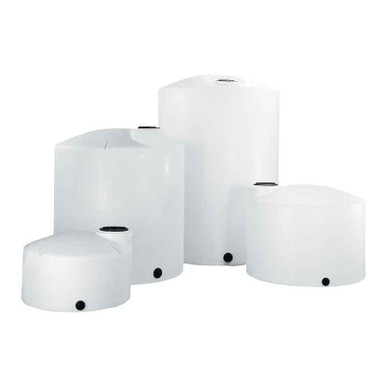
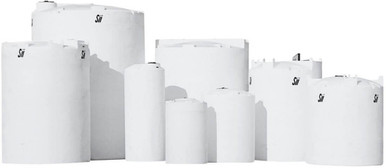
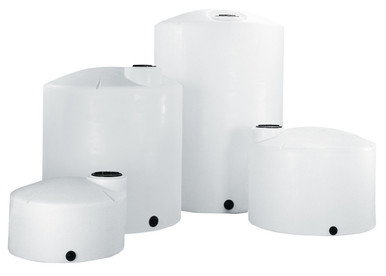
The Snyder Industries chemistry-grade HDPE tank line includes models specifically designated for 98% sulfuric service at 1.84 specific gravity. Available capacities and OneSource catalog cross-reference:
- Snyder Industries 100 Gallon HDLPE Vertical Chemical Storage Tank in White, 1.9 SG (MPN 1012700N45, listed at $832.83) — bench-scale or small-batch sulfuric storage. The 1.9 SG rating exceeds the 1.84 SG of 98% sulfuric with margin, an important specification check.
- Snyder Industries 1100 Gallon HDPE Vertical Chemical Storage Tank in White, 1.9 SG (MPN 1830000N45, listed at $2,658.99) — small process tank for sulfuric distribution within a chemical plant.
- Snyder Industries 1200 Gallon HDPE Vertical Chemical Storage Tank in White, 1.9 SG (MPN 1830200N45, listed at $3,058.99) — slightly larger small-process option.
- Snyder Industries 10500 Gallon HDPE Vertical Liquid Storage Tank in White, 1.9 SG (MPN 5330300C26, listed at $20,128.99) — larger sulfuric storage for industrial-scale receipt and dispensing.
For Comparison: Snyder XLPE Same-Capacity Tanks
- Snyder Industries 100 Gallon XLPE Vertical Chemical Storage Tank in White, 1.9 SG (MPN 1012700N42, listed at $924.89) — the XLPE variant of the same 100-gallon tank, priced at a modest premium over HDPE. Suitable for chemistries where XLPE is the right material, NOT for 98% sulfuric.
- Snyder Industries 1100 Gallon XLPE Vertical Chemical Storage Tank in White, 1.9 SG (MPN 1830000N42, listed at $2,911.09) — XLPE 1,100-gallon variant, similarly suited for non-sulfuric aggressive chemistry like sodium hypochlorite, ferric chloride, urea solution.
The catalog includes both materials for the same capacities deliberately. The chemistry determines the right material; for 98% sulfuric, the HDPE part is the right specification. For sodium hypochlorite, ferric chloride, urea fertilizer solution, peracetic acid, calcium chloride brine, phosphoric acid in food-industry concentrations, the XLPE is the upgrade choice. Specifying material based on chemistry rather than blanket "XLPE is always upgrade" is the engineering discipline that prevents premature failures.
Operating Temperature Considerations
Sulfuric acid in industrial service is often at elevated temperature — either because the sulfuric is generated hot (from a sulfur-burning acid plant), because the operating process delivers hot acid back to storage, or because solar gain in outdoor storage heats the tank. Polyethylene chemistry envelope tightens with temperature. Snyder's published HDPE chemistry envelope for 98% sulfuric is conservative below 100 deg F (38 deg C). Above that, the chemistry envelope erodes substantially. At 140 deg F (60 deg C), HDPE service life in 98% sulfuric is meaningfully shorter than at ambient. At 180 deg F (82 deg C) approaching the polyethylene long-term service-temperature limit, polyethylene is not the right material at all — specify steel with PTFE lining or solid fluoropolymer.
For outdoor sulfuric tanks in hot climates, white pigmentation reduces solar gain and helps keep internal acid temperature within the polyethylene envelope. For acid arriving hot from process, install a heat exchanger upstream of the storage tank to drop the acid to under 100 deg F before it enters the polyethylene shell.
Specific-Gravity Rating Match
The "SG rating" on a polyethylene tank is the manufacturer's spec for the maximum specific gravity of stored product. The rating accounts for the hoop stress at the bottom of the tank, which scales with the product of fluid density and head height. A 1.5 SG-rated tank cannot be used to store 1.84 SG sulfuric without exceeding the design hoop-stress envelope.
The Snyder sulfuric-spec HDPE tanks are rated 1.9 SG, which exceeds the 1.84 SG of 98% sulfuric with about 3% margin. This margin is intentional — it accommodates manufacturing variability in tank wall thickness, allows for the small density variation between 95% and 98% sulfuric concentrations the tank may see in service, and provides a safety buffer for any chemistry-induced wall thinning over service life.
If you are specifying a tank for sulfuric service at any concentration above 75%, verify the SG rating on the manufacturer's spec sheet. Specifying a 1.5 SG-rated tank for 1.84 SG service is a significant safety failure. The OneSource product description for each Snyder chemistry tank includes the SG rating; specify accordingly.
Fittings and Wetted-Path Materials
The HDPE tank shell is the foundation, but the fittings, valves, and downstream piping must also be sulfuric-compatible:
- Bulkhead fittings: PVC is acceptable for ambient 98% sulfuric service short-term; CPVC or polypropylene preferred for long-service-life. Stainless steel 316L is acceptable for sulfuric in some concentration ranges but Type 316 has a chemistry exclusion at 80-95% sulfuric where pitting corrosion can be aggressive. Verify the steel-acid concentration map before specifying stainless.
- Flanges: ANSI 150# flanges in PVC, CPVC, polypropylene, or PVDF are common. PVDF (polyvinylidene fluoride) is the upgrade choice for elevated temperature sulfuric service.
- Gaskets: full-face PTFE gaskets (envelope or pure PTFE). Avoid EPDM and Buna-N (both fail rapidly in concentrated sulfuric).
- Valves: PVC or PVDF ball valves with PTFE seats. For high-cycle service, butterfly valves with PTFE liners.
- Pumps: magnetic-drive PVDF or PTFE-lined steel pumps. For higher-pressure service, vertical mag-drive pumps with PVDF wetted path. See our fluoropolymer pump selection walkthrough for the wetted-path engineering on aggressive chemistry pumps.
Vent Design
Sulfuric acid storage tanks must be vented to prevent vacuum formation during withdrawal and to allow pressure relief during fill. Vent design for sulfuric:
- Sized for the maximum pump-out and pump-in rates with margin. Undersized vents collapse the tank under withdrawal vacuum.
- Vent must NOT discharge to occupied spaces. Sulfuric vapor and any acid mist that escapes during fill must vent to safe atmosphere.
- Specify a vent material compatible with sulfuric vapor. PVC or polypropylene is common. Stainless steel can be used with awareness of pitting risk.
- Consider a vent scrubber on high-volume sulfuric tanks where local air-quality regulations limit acid mist emissions. Caustic or water scrubbers neutralize the vented acid mist.
- Install a vacuum breaker as backup for the primary vent. Tank collapse under withdrawal vacuum is a documented failure mode for under-vented sulfuric tanks.
Inspection Cadence
For a Snyder HDPE tank in 98% sulfuric service, recommended inspection cadence:
- Monthly visual: external inspection for wall stress whitening, cracking, fitting leaks, vent integrity. Internal inspection via manway camera if accessible.
- Annual ultrasonic wall thickness: measure wall thickness at standard-grid sample points around the tank circumference at multiple heights. Trend the data year over year. Normal HDPE wall thinning in concentrated sulfuric service runs 0.5-2.0 mils per year depending on temperature.
- Five-year integrity test: empty the tank, internal visual inspection, ultrasonic wall thickness at full grid resolution, fitting and bulkhead reseal as appropriate.
- End-of-life replacement: when wall thickness drops to 75% of as-new at any sample location, plan for replacement. Continued service below 75% wall is high-risk.
Cross-References
For comprehensive sulfuric acid storage specification, see the sulfuric acid tank selection pillar. For the broader chemistry compatibility catalog, see the chemical compatibility hub. For double-wall containment options where leak risk drives a tank-with-integrated-containment specification, see our walkthrough on Captor double-wall tank engineering.
For pricing, freight, and lead time on Snyder Industries chemistry-grade HDPE sulfuric-spec tanks, contact OneSource Plastics at 866-418-1777. For LTL freight quoting on sulfuric-tank delivery to your facility, use the freight estimator.
Recommended Tanks for This Guide
Live pricing, updated automatically · estimate freight to your ZIP.