
API 650 & API 620 Storage Tanks
API 650 & API 620 Storage Tanks: Built to Petroleum Industry Standards
When a tank gets too big to truck and too important to fail, it leaves the rotomold catalog and enters the world of API field-erected steel — where every shell course, weld, and foundation detail answers to the petroleum industry's storage standards.
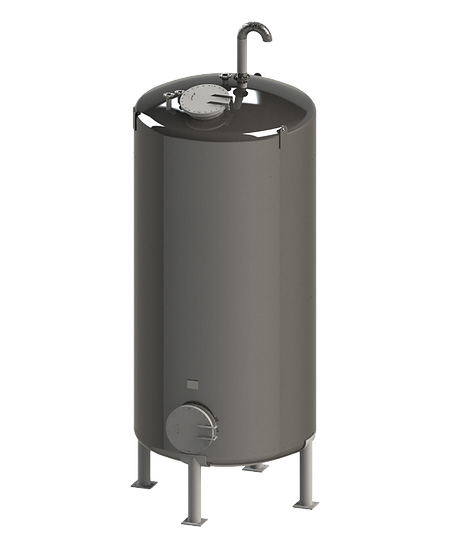
API 650 vs. API 620 vs. API 653
The American Petroleum Institute publishes three storage-tank standards that work together across a tank's life:
- API 650 — the design and construction standard for welded aboveground storage tanks at essentially atmospheric pressure (up to roughly 2.5 psig at the top). This is the workhorse standard for crude, refined products, chemicals, water, and biofuels, in diameters from about 20 feet to well over 300 feet.
- API 620 — extends the framework to low-pressure welded tanks operating up to 15 psig, the territory of refrigerated and pressurized storage such as LNG, LPG, and ammonia. Above 15 psig, the vessel becomes an ASME Section VIII pressure vessel.
- API 653 — governs in-service inspection, repair, alteration, and reconstruction of tanks originally built to API 650. It is how an existing tank stays in safe, legal service for 30+ years.
Shell courses: thickness that steps down with height
An API 650 shell is built from horizontal rings called courses. Because hydrostatic pressure is highest at the bottom of a full tank and drops to zero at the liquid surface, the bottom course is the thickest and each course above it gets progressively thinner. The required thickness of each course is calculated from the product's specific gravity, the fill height above that course, the tank diameter, and the steel's allowable stress — most commonly via the one-foot method or the variable-design-point method in the standard. Getting specific gravity right matters: a tank sized for water (1.0) will be under-built for a denser chemical.
Roof designs
| Roof type | Best for |
|---|---|
| Fixed cone roof | Water, chemicals, and products where vapor loss isn't the primary concern; the simplest, most economical roof. |
| External floating roof | Volatile products (crude, gasoline) — the roof rides on the liquid surface, eliminating the vapor space and cutting evaporative and emission losses. |
| Internal floating roof | A floating deck inside a fixed roof — emission control plus weather protection, common for finished fuels. |
| Geodesic aluminum dome | Self-supporting clear-span cover, often retrofit over floating roofs for weather and emission control. |
Loads beyond the liquid: wind and seismic
A large empty tank is essentially a thin steel drum exposed to the weather, so API 650 requires checks for wind load (overturning and shell buckling, often handled with intermediate and top wind girders) and seismic load (sloshing liquid, base shear, and overturning, which can drive anchorage and annular-plate requirements). The foundation — ringwall, slab, or pile-supported — is engineered alongside the tank, because a storage tank is only as sound as what it sits on.
Field erection and documentation
Anything larger than roughly 12 ft in diameter is field-erected: the shop supplies pre-cut, rolled, and beveled plate, shell courses, roof structure, and appurtenances, and a qualified crew welds the tank up on a prepared foundation on your site. As with all code work, the deliverable is as much paper as steel — material test reports, welder and procedure qualifications, NDE records, and a hydrostatic test of the completed tank before it is handed over.
Frequently asked questions
- What is the difference between API 650 and API 620?
- API 650 covers welded aboveground storage at near-atmospheric pressure (up to about 2.5 psig). API 620 covers low-pressure tanks up to 15 psig, used for refrigerated or pressurized products like LNG, LPG, and ammonia. Above 15 psig the tank becomes an ASME Section VIII pressure vessel.
- When do I need a field-erected tank instead of a shop-built one?
- Roughly when the diameter exceeds what fits on a truck — about 12 ft. Below that, a tank can be shop-fabricated and shipped whole. Above it, the fabricator ships pre-cut plate and components and a field crew erects and welds the tank on your prepared foundation.
- Why is the bottom of the shell thicker than the top?
- Hydrostatic pressure is highest at the base of a full tank and falls to zero at the liquid surface. API 650 builds the shell from stacked courses and sizes each one for the pressure at its height, so the bottom course is thickest and each course above it steps down.
- What does API 653 do for an existing tank?
- API 653 is the in-service standard. It sets the inspection intervals and the rules for repairs, alterations, re-rating, and reconstruction so a tank originally built to API 650 can stay in safe, compliant service for decades.
Scope a code-stamped vessel
Send us your design pressure, service chemistry, dimensions, and the code or jurisdiction you build to. We return a full engineering package, firm lead time, and a fixed quote — freight quoted separately to your ZIP.
Request a Custom Quote Call 866-418-1777