
Reactor Vessels for Chemical Processing
Reactor Vessels: Custom-Engineered for Chemical & Pharmaceutical Processing
A reactor is a pressure vessel with a job to do — it has to add or remove heat fast, keep the batch perfectly mixed, survive the chemistry inside it, and document every weld that holds it together.
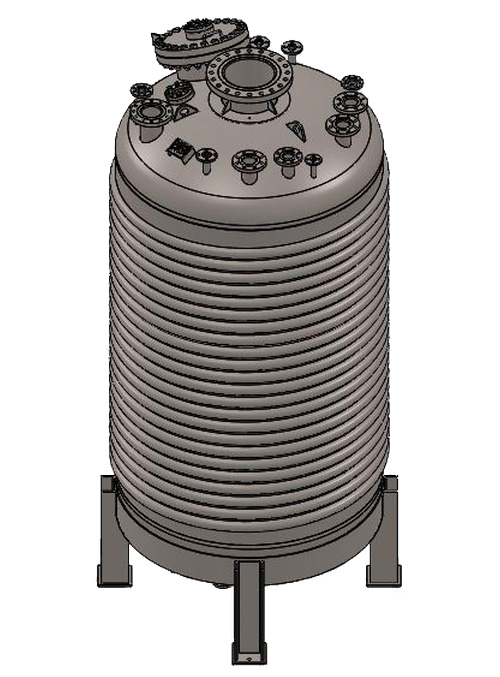
The four problems a reactor has to solve
A batch reactor is judged on four things at once: heat transfer (driving the reaction temperature up or down on schedule), agitation (uniform composition, temperature, and suspension), materials (surviving the chemistry without contaminating the product), and containment (holding pressure and vacuum safely under code). Get any one wrong and the batch — or the vessel — fails. Custom reactor design is the art of balancing all four for one specific process.
Heat transfer: jacket choice drives the schedule
Most reactors move heat through a jacket on the vessel wall. The jacket type sets how fast and how evenly you can heat or cool:
| Jacket type | Character |
|---|---|
| Conventional (annular) jacket | A full outer shell around the wall. Simple and robust; lower velocity and heat-transfer coefficient unless baffled. |
| Dimple jacket | A spot-welded dimpled sheet creating turbulent flow channels. Excellent heat transfer per unit area, lower hold-up volume, good for both heating and cooling. |
| Half-pipe coil jacket | Half-pipe welded in a spiral around the shell. High pressure capability and high, predictable heat transfer — favored for steam and hot-oil service on larger reactors. |
For demanding duties an internal coil or external heat exchanger with a recirculation loop adds surface area beyond what the wall jacket can provide.
Agitation and baffling
The impeller is matched to the job. Low-viscosity blending uses high-flow hydrofoil or pitched-blade turbines; gas dispersion uses Rushton-style radial turbines; heat-sensitive or high-viscosity product uses anchors and close-clearance designs, often with wall scrapers. Baffles — vertical strips at the wall — break the swirling vortex that otherwise just spins the batch in place, converting rotation into the top-to-bottom turnover that actually mixes. The agitator's mechanical seal (single, double, or mag-drive) is specified to the pressure, vacuum, and containment needs of the chemistry.
Materials of construction
The chemistry picks the metal. 316L stainless handles most general and pharmaceutical service; higher alloys (duplex, AL-6XN, Hastelloy) step in for chlorides and aggressive acids; glass-lined steel serves highly corrosive and high-purity batch chemistry. Product-contact surfaces are polished and, on pharmaceutical work, electropolished and documented to a surface-roughness (Ra) spec, then passivated per ASTM A967.
It is still a code vessel
A reactor that operates at or above 15 psig — or under vacuum — is an ASME Section VIII pressure vessel and carries everything that comes with it: design-pressure calculations (including external-pressure/vacuum checks), weld-procedure and welder qualification, radiography of critical welds, a hydrostatic test, and a U-stamped Manufacturer's Data Report. The jacket is its own pressure boundary and is designed and tested as such.
Frequently asked questions
- What jacket type gives the best heat transfer?
- For most modern reactors, dimple jackets and half-pipe coil jackets outperform a plain conventional jacket because they force turbulent, high-velocity flow over the wall. Half-pipe coils also handle higher jacket pressures, which makes them common for steam and hot-oil service on larger vessels. The best choice depends on the media, pressure, and duty.
- Why does a reactor need baffles?
- Without baffles, an agitator just spins the whole batch in a swirling vortex with very little top-to-bottom movement. Vertical wall baffles break that swirl and convert it into vertical turnover, which is what actually blends, suspends solids, and evens out temperature.
- Is a reactor an ASME pressure vessel?
- If it operates at or above 15 psig or under vacuum, yes — it's designed, inspected, and stamped to ASME Section VIII, and the jacket is treated as its own pressure boundary. Strictly atmospheric mixing vessels may fall outside Section VIII, but most jacketed reactors are code vessels.
- What material should my reactor be?
- The chemistry decides. 316L stainless covers a large share of general and pharmaceutical duty; chlorides and aggressive acids push you to duplex or nickel alloys; highly corrosive or high-purity batch chemistry often calls for glass-lined steel. Share your chemistry, temperature, and concentration and the material is selected to match.
Scope a code-stamped vessel
Send us your design pressure, service chemistry, dimensions, and the code or jurisdiction you build to. We return a full engineering package, firm lead time, and a fixed quote — freight quoted separately to your ZIP.
Request a Custom Quote Call 866-418-1777