Calculating Effective Specific Gravity for Blended Tank Chemistry: Mixing Rules, ASTM D1298 Hydrometer Verification, and Why the Wrong SG Value Cracks Tanks
Plastic tank specifications carry a single specific gravity rating - 1.0, 1.5, 1.7, 1.9, sometimes 2.0 for specialty service. The SG rating is the design basis for tank wall thickness; the wall must hold the hydrostatic head of the chemistry at the rated SG without exceeding the polyethylene's allowable hoop stress per ASTM D1998. The complication is that real operating chemistry is rarely a single-component fluid. Ag retailers run UAN 32 fertilizer blended with herbicide premix. Water-treatment plants run sodium hypochlorite cut with sodium hydroxide for pH adjustment. Chemical processors run process intermediates that are 60% solvent, 30% water, 10% dissolved solids. The SG of the blended mixture is what loads the tank wall, and the calculation rules for blended SG are not the obvious arithmetic average that most operators reach for first.
This guide walks the engineering math for effective SG calculation in blended chemistry, the verification protocol using ASTM D1298 hydrometer or ASTM D4052 digital density meter, and the tank-spec consequences of getting the calculation wrong. The reference standards are ASTM D1298 (Density, Relative Density of Crude Petroleum and Liquid Petroleum Products by Hydrometer Method), ASTM D4052 (Density and Relative Density of Liquids by Digital Density Meter), ASTM D1429 (Specific Gravity of Water and Brine), and ASTM D1998 (Polyethylene Upright Storage Tanks).
1. Why Blended SG Is Not a Simple Weighted Average
The first instinct for a blend SG calculation is volume-weighted average. If the blend is 60% by volume of UAN 32 (SG 1.32) and 40% by volume of water (SG 1.00), the operator reaches for 0.6 times 1.32 plus 0.4 times 1.00 equals 1.192. This is correct ONLY when the components mix without volume change - what chemists call "ideal mixing" or "additive volumes."
For most ag and industrial chemistry blends, ideal mixing does not hold exactly. Mixing UAN 32 with water releases hydration heat and the resulting solution has a slightly smaller volume than the sum of the unmixed components - the "excess volume of mixing" is negative. The actual SG of the blend is slightly higher than the volume-weighted average. For dilute blends the error is small (less than 1%) but for concentrated blends like 50% sulfuric acid into water the error can exceed 5% on SG, which translates to a 5% error in tank wall load calculation.
The correct calculation for blended SG uses mass-weighted reciprocals of component densities (the "ideal mixing volume" rule). For two components A and B:
1 / SG_blend = (mass_fraction_A / SG_A) + (mass_fraction_B / SG_B)
This calculation gives the SG of an ideal-mixing blend. For real-world chemistry the ideal-mixing result must be corrected by an excess-volume term derived from published mixing data, or verified by direct hydrometer measurement on the actual blended sample. For most blended ag and water-treatment chemistry, the ideal-mixing calculation is within 2% of the measured value - close enough for tank specification with conservative rounding.
2. Worked Example: UAN 32 Plus Glyphosate Tank Mix for Ground Application
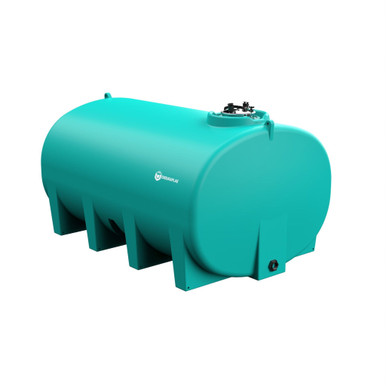
An ag retailer custom-blends UAN 32 (SG 1.32) with glyphosate technical concentrate (SG 1.17) and water for ground application via boom sprayer. The recipe is 50 gallons UAN 32 plus 5 gallons glyphosate plus 45 gallons water, total 100 gallons, in a Norwesco horizontal leg tank.
Component masses:
- UAN 32: 50 gal x 8.345 lb/gal x 1.32 = 550.8 lb
- Glyphosate concentrate: 5 gal x 8.345 lb/gal x 1.17 = 48.8 lb
- Water: 45 gal x 8.345 lb/gal x 1.00 = 375.5 lb
- Total mass: 975.1 lb in 100 gal nominal volume
Effective SG (assuming ideal mixing): 975.1 lb / (100 gal x 8.345 lb/gal) = 1.168 SG. The blend SG is approximately 1.17.
The tank spec implication: any HDPE or XLPE leg tank rated at 1.5 SG or higher is appropriate (the Norwesco N-40089 1,025 gallon leg tank rated at 1.5 SG holds this duty comfortably; the larger N-41877 1,325 gallon HDPE leg tank rated at 1.5 SG holds it as well). A tank rated only for 1.0 SG service - water tank rating - is NOT appropriate; the wall thickness is calculated for water density and the blend at SG 1.17 produces 17% higher hoop stress than the design basis.
3. Where the Math Goes Wrong: The 1.0-SG Water Tank Mistake
The most common SG specification error we see is operators buying a tank rated 1.0 SG (a water tank) for chemistry that is significantly denser. The error pattern:
- Operator searches for "2,500 gallon vertical tank" online.
- The lowest-priced 2,500 gallon vertical tank is rated for water service at 1.0 SG. Wall thickness designed for water hydrostatic head only.
- Operator deploys the tank for fertilizer service, brine service, or chemical service at 1.3 to 1.6 SG.
- Tank wall stress exceeds design basis by 30% to 60%.
- Tank survives short-term but accumulates microcracks at the bottom knuckle (highest hoop stress location). Failure typically appears at 1 to 3 years of service as a leak at the bottom radius. Catastrophic failure (full wall split) is possible in weakened tanks.
The Norwesco product line clearly labels tanks by service: vertical "water storage" tanks rated 1.0 SG vs vertical "liquid storage" or "chemical storage" tanks rated 1.5, 1.7, or 1.9 SG. The Snyder Industries product line uses similar nomenclature. The Enduraplas product line distinguishes water (TLV prefix) from liquid (THV prefix) in the SKU itself. Operators should ALWAYS verify the SG rating before purchase, especially for blended chemistry above SG 1.0.
For more on tank spec interpretation see our spec sheet decoded and SG ratings 1.5 vs 1.9 explained.
4. ASTM D1298 Hydrometer Verification for Blended Chemistry
The defensible engineering practice for any non-trivial blended chemistry application is to measure the blended SG by hydrometer or digital density meter rather than relying solely on calculation. The ASTM D1298 protocol:
- Collect a representative sample of the blended chemistry, minimum 1 liter, in a clean glass container with no air entrainment.
- Bring the sample to the reference temperature - typically 60 deg F (15.56 deg C) for petroleum products or 20 deg C for chemical solutions. Use a circulating water bath or temperature-controlled cabinet.
- Insert a calibrated hydrometer of appropriate range (1.000-1.200, 1.200-1.400, 1.400-1.600 are common range bands) into the sample container. Allow hydrometer to settle without contacting the container walls.
- Read the SG at the bottom of the meniscus (lower edge of the curved liquid surface). Read at the temperature recorded.
- Apply temperature correction if the sample temperature differs from 60 deg F. Correction tables are published in ASTM D1250 (Petroleum Measurement Tables).
- Report the SG to 3 decimal places at the reference temperature.
For chemistry that is corrosive to glass hydrometers (concentrated alkali solutions, hydrofluoric acid containing chemistry), use a digital density meter per ASTM D4052 with PTFE or stainless wetted parts. The digital meter gives 4-decimal accuracy with smaller sample volume (typically 1 mL) and faster turnaround.
The measurement value is then the design basis for tank specification. Tank SG rating must be at least the measured chemistry SG, with engineering margin (10-15% additional capacity for thermal expansion, evaporation concentration, future formulation changes).
5. Temperature Correction: The Often-Forgotten Step
SG is temperature-dependent. As a chemistry warms, density decreases. The published SG values in technical data sheets are typically reported at 20 deg C or 25 deg C. Real operating chemistry can range from 0 deg C in winter outdoor storage to 40+ deg C in southern-latitude summer outdoor storage with solar gain. The temperature correction for water-based chemistry is approximately 0.0002 SG per degree C. Negligible for tank specification at most operating temperature ranges.
Where temperature correction becomes material is for thermal expansion freeboard calculation. A tank filled at 5 deg C in winter that warms to 35 deg C in summer expands the contained chemistry by approximately 0.6% volume (water-based chemistry) or 1.5% volume (alcohol/solvent chemistry). Freeboard sized only for the cold-fill volume can overflow on the warm-day expansion. ASTM D1998 specifies tank fill volumes that include thermal-expansion freeboard for the specified temperature range; users should verify the filling protocol matches the temperature range expected at the installation site.
For more detail on freeboard sizing engineering see our Captor freeboard sizing per ASTM D1998.
6. Stratification and Settling in Blended Storage
Blended chemistry stored in a tank does not always remain homogeneous. Stratification (top layer different SG from bottom layer) and settling (suspended solids accumulate at the bottom) both produce locally higher SG at the bottom of the tank where the hoop stress is already highest. Operational consequences:
- UAN fertilizer + water blends - typically homogeneous, do not stratify under normal storage conditions.
- Glyphosate + UAN tank mix - can stratify if the tank sits more than 24 hours without recirculation. Mix before draw-off via recirculation pump or air sparge.
- Sodium hypochlorite + sodium hydroxide - the higher-SG NaOH layer settles below the hypochlorite. Local SG at the bottom can exceed 1.4 even though the bulk SG is 1.2.
- Lime slurry - calcium hydroxide settles continuously. Bottom SG can approach the suspended-solids density of 2.2 for pure CaO. Cone-bottom tank with continuous mixing required for lime slurry storage.
- Surfactant + water blends - typically homogeneous, do not stratify.
For chemistry that stratifies or settles, the tank SG specification must use the worst-case BOTTOM layer SG, not the bulk-average SG. The Norwesco N-43852 1,000 gallon 45-degree cone-bottom tank and similar cone-bottom configurations are appropriate for chemistry with settling solids; the cone bottom drains accumulated solids to the discharge port and prevents indefinite buildup.
7. Decision Matrix: SG Tank Selection for Common Blends
Summary table of common blended chemistry and the appropriate tank SG rating in our catalog:
- Potable water (cold/hot): SG 1.00. Norwesco water-storage tanks (vertical 1.0 SG product line). Enduraplas TLV prefix.
- Process water with dissolved minerals (less than 1% TDS): SG 1.00. Standard water tanks acceptable.
- Brine (10-20% NaCl): SG 1.07-1.15. Liquid-rated tanks at 1.5 SG. Norwesco N-40146 1,500 gallon vertical or Enduraplas THV prefix.
- UAN 32 fertilizer: SG 1.32. 1.5 SG rated tank at minimum, 1.7 SG preferred. Snyder XLPE preferred for outdoor service.
- Glyphosate concentrate: SG 1.17. 1.5 SG rated tank.
- UAN + glyphosate tank mix: SG 1.15-1.30 depending on ratio. 1.5 SG rated tank.
- Sodium hypochlorite 12.5%: SG 1.20. 1.5 SG rated tank.
- Sodium hydroxide 50%: SG 1.52. 1.7 SG XLPE tank.
- Sulfuric acid 33% (battery acid): SG 1.24. 1.5 SG XLPE tank.
- Sulfuric acid 50% (fertilizer grade): SG 1.40. 1.7 SG XLPE.
- Sulfuric acid 78% (chamber acid): SG 1.71. 1.9 SG XLPE.
- Sulfuric acid 93-98% (smelter / battery / oleum precursor): SG 1.83-1.84. 1.9 SG XLPE - and approaching the polyethylene service envelope. See XLPE vs HDPE high-SG sulfuric guide.
- Phosphoric acid 75% (fertilizer grade): SG 1.58. 1.7 SG XLPE.
- Aluminum sulfate (alum) 48%: SG 1.33. 1.5 SG.
- Ferric chloride 40%: SG 1.41. 1.7 SG XLPE preferred.
- Lime slurry (calcium hydroxide 30% suspended): SG 1.18 bulk; 1.5 SG cone-bottom tank with mixing.
8. Procurement and Operations Action Checklist
For sites running blended chemistry storage, the action items before tank purchase:
- Document the blend recipe. Component identity, mass fraction, source SDS for each component.
- Calculate the ideal-mixing blend SG using the mass-weighted reciprocal formula in section 1.
- Verify the calculation by ASTM D1298 hydrometer measurement on a representative blend sample. Document the measurement temperature and report the SG at the reference temperature.
- Account for stratification, settling, and concentration drift. Use the worst-case bottom-layer SG for tank specification, not the bulk average.
- Specify the tank SG rating at the worst-case chemistry SG plus 15% engineering margin.
- Document the SG basis in the purchase order and the site operating procedure. The tank rating must be re-verified if the recipe changes.
- Specify recirculation, mixing, or cone-bottom drain features for chemistry that stratifies or settles.
- Include thermal-expansion freeboard in the tank fill protocol per ASTM D1998.
- Build periodic SG verification into the inventory operations - quarterly hydrometer check minimum, weekly for high-turnover blended-chemistry sites.
- Document failure mode response - if SG measurement drifts outside the tank rating, the response is "stop loadout, isolate the tank, contact engineering" not "keep running until something cracks."
OneSource Plastics catalogs the polyethylene tank product appropriate for blended-chemistry service across the SG 1.0 to SG 1.9 range. For SG above 1.9 the engineering moves to FRP or specialty composite construction outside our catalog scope. For tank specification on blended-chemistry applications call us at 866-418-1777 with the recipe, calculated and measured SG, daily turnover, and operating temperature range. Reference list pricing: Norwesco N-40146 1,500 gallon vertical at $2,837.16; Norwesco N-40089 1,025 gallon leg at $2,499.00; Snyder SII-5990102N42 1,000 gallon Captor XLPE at $6,798.99. LTL freight quoted via the freight estimator.
For complementary reading on related engineering see chemical compatibility hub, SG vs density vs API gravity, and XLPE vs HDPE crosslinking guide.
Recommended Tanks for This Guide
Live pricing, updated automatically · estimate freight to your ZIP.