Chem-Tainer Cone-Bottom Tanks 30° vs 45°: Drainage Rate, Residual Heel, and Solids-Handling Performance Comparison
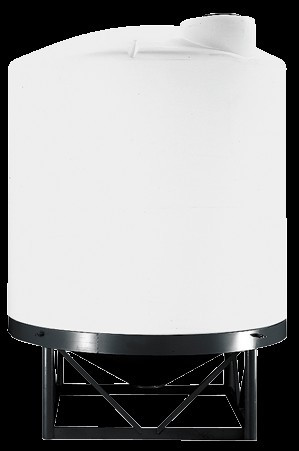
The angle of the cone matters. A 30-degree cone-bottom tank and a 45-degree cone-bottom tank look similar from the outside, ship at similar prices, and store the same volume of fluid. They behave fundamentally differently when it comes to drainage rate, residual heel volume, solids settling, and total dump-out cycle time. For batch chemical processing where the tank fills, mixes, and dumps multiple times per shift, the cone angle is the single design parameter that drives operational economics. For static chemistry storage where the tank fills once and sits for weeks, the cone angle barely matters. Picking the right cone angle for the duty cycle is the engineering question this guide walks, using the Chem-Tainer cone-bottom catalog and the rotomolded geometry math that drives the trade-off.
The cone angle is measured from horizontal. A 30-degree cone has a shallow slope — the tank floor falls 30 degrees below horizontal at the cone wall. A 45-degree cone has a steeper slope, falling 45 degrees. A 60-degree cone (uncommon in rotomolded HDPE, more common in stainless steel processing tanks) falls steeply. Steeper cones drain faster and leave less heel; shallower cones occupy less vertical height and ship cheaper. The trade-off is real and measurable.
Geometry: How Cone Angle Drives Drain Rate and Heel Volume
For a vertical cylindrical tank with cone bottom, the cone height is determined by the cone half-angle and the tank diameter:
Cone height = (D/2) / tan(cone angle from vertical)
Equivalent: cone height = (D/2) * tan(cone angle from horizontal)
For a 75 gallon Chem-Tainer cone-bottom tank with approximately 24 inch diameter:
- 30-degree cone (from horizontal): cone height = 12 x tan(30°) = 12 x 0.577 = 6.9 inches.
- 45-degree cone: cone height = 12 x tan(45°) = 12 x 1.0 = 12.0 inches.
- 60-degree cone: cone height = 12 x tan(60°) = 12 x 1.732 = 20.8 inches.
The 45-degree cone is 5.1 inches taller than the 30-degree cone for the same tank diameter. That extra height affects the tank stand requirement (the stand must be tall enough to clear the cone tip plus discharge plumbing), the overall installed envelope, and the freight cubic-volume rating.
Cone Volume
The volume of the cone section: V_cone = (1/3) x π x r2 x h = (1/3) x π x (D/2)2 x h_cone.
For the 24" diameter example:
- 30° cone: V = (1/3) x π x 144 x 6.9 = 1,041 in3 = 4.50 gallons.
- 45° cone: V = (1/3) x π x 144 x 12.0 = 1,810 in3 = 7.84 gallons.
- 60° cone: V = (1/3) x π x 144 x 20.8 = 3,135 in3 = 13.6 gallons.
The 45-degree cone holds 74% more volume in the cone section than the 30-degree cone at the same diameter. For a 75-gallon nominal tank, that's the difference between a 6% and 10.5% cone-section volume fraction. Most of the tank volume is in the cylindrical section regardless of cone angle.
Residual Heel: The Important Number
Residual heel is the volume that does NOT drain out when you open the bottom outlet. Heel comes from three sources:
- Outlet boss recess: the bulkhead fitting at the cone tip recesses slightly into the tank wall, creating a low spot where fluid pools below the outlet centerline.
- Wetting / surface tension: a thin liquid film clings to the cone wall as drainage finishes, plus a small reservoir at the cone tip held by surface tension at the outlet.
- Solids and sludge: any settled solids accumulate at the cone tip and resist drainage even when the liquid above has drained.
For a clean fluid (no solids) on a clean cone wall:
- 30° cone: typical residual heel 1-3% of tank capacity. Bigger fraction because the shallow slope holds a wider liquid film and a larger pooled volume above any small recessed outlet.
- 45° cone: typical residual heel 0.3-1% of tank capacity. Steeper slope drains the wall film more completely and reduces the pooled volume above the outlet.
- 60° cone: typical residual heel 0.1-0.5%. Near-perfect drainage for clean fluids.
For a 500-gallon tank, the residual heel difference between 30° and 45° cones is about 5-15 gallons. For most chemistries that is manageable. For expensive specialty chemistry where 5 gallons of heel represents $200+ of unrecoverable inventory per dump-out, the steeper cone pays back fast.
Drain Rate: The Hydrodynamic Math
Drainage rate from a cone-bottom tank through a bottom outlet follows the orifice equation modified by the changing head as the tank empties:
Q(t) = Cd * A_outlet * sqrt(2 * g * h(t))
Where h(t) is the head from outlet to fluid surface at time t. For a cylindrical tank without cone, h drops linearly with volume and the drain time follows a square-root relationship. For a cone-bottom tank, the relationship is more complex because as the tank drains into the cone section, the cross-sectional area shrinks and head drops faster.
For a Chem-Tainer 500-gallon 45° cone-bottom tank with a 2" full-port discharge, typical drain time from full to empty is 3-5 minutes for water-viscosity fluids. For a 30° cone-bottom of the same volume, drain time runs 4-7 minutes. The 45° cone drains roughly 25-35% faster because the cone section drains more steeply once the cylindrical section is empty.
For viscous fluids (oil, syrup, polymer solutions, slurries with non-Newtonian behavior), the drain rate diverges further. A 30° cone with a viscous fluid leaves a thicker wall film for longer, slowing the final drain stage substantially. A 45° cone sheds the wall film faster. For honey-viscosity fluids (1,000+ cP), the cone angle difference can mean the difference between a 15-minute drain and a 45-minute drain.
Solids Handling: Where Cone Angle Becomes Critical
The angle of repose of the settled solid determines whether the cone will self-empty or whether solids will bridge across the cone and refuse to flow. Common angles of repose:
- Wet sand: 30-35°
- Dry granular fertilizer: 28-32°
- Coarse aggregate: 35-40°
- Powder products (flour, sugar, dry chemicals): 35-50° depending on moisture
- Activated sludge: 25-30° (wet)
- Calcium carbonate slurry settled solids: 35-45°
- Silica flour settled solids: 35-50°
The rule of thumb: the cone angle from horizontal must exceed the angle of repose by at least 5-10 degrees to ensure the solids will flow. A 30° cone (from horizontal) handles wet sand and activated sludge with margin but bridges on dry fertilizer and powder products. A 45° cone handles essentially all common settled solids with margin. A 60° cone is mandatory for sticky or cohesive solids (clay-bearing slurries, gypsum, gel-forming polymer flocculant).
For the OneSource customer base, the practical guidance:
- Mix-and-dump batch chemistry, no settled solids: 30° cone is fine, ships shorter, costs less.
- Daily dump-out with light suspended solids: 45° cone for reliable solids handling.
- Slurries, sludges, settled solids accumulation: 45° minimum, 60° preferred. 30° will bridge.
- Powder service: 45° absolute minimum; some powders need 60° or even pneumatic fluidization at the cone tip.
Chem-Tainer Cone-Bottom Catalog Comparison
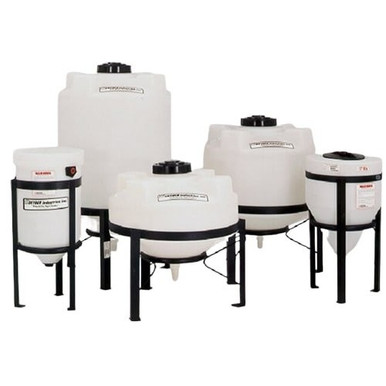
The Chem-Tainer cone-bottom range in the OneSource catalog covers both 30° and 45° options across multiple capacities. The 30° tanks ship in shorter packaging and lower freight class for the same nominal volume; the 45° tanks ship taller but drain faster and handle solids better.
30° Cone-Bottom Selections
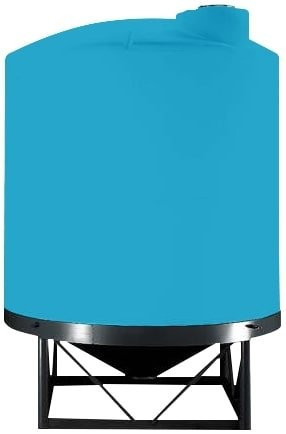
- Chem-Tainer 75 Gallon 30 Degree Plastic Vertical Cone Bottom Tank with Poly Stand (MPN TC3035AP, listed at $1,164.43) — bench-scale batch chemistry, included poly stand for chemistry exposure resistance.
- Chem-Tainer 75 Gallon 30 Degree Plastic Vertical Open Top Cone Bottom Tank (MPN TC3024CA, listed at $626.84) — open-top variant for top-loaded batch operations, lower cost without integrated stand.
- Chem-Tainer 75 Gallon 30 Degree Plastic Cone Bottom Tank (MPN TC3024CB, listed at $879.55) — closed-top configuration for chemistry containment.
45° Cone-Bottom Selections
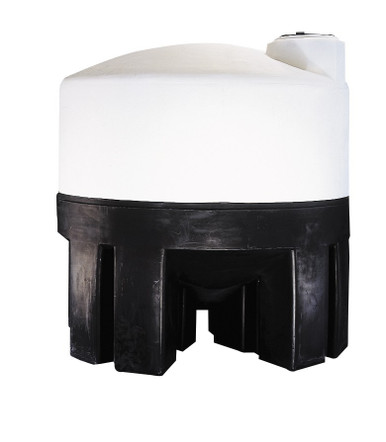
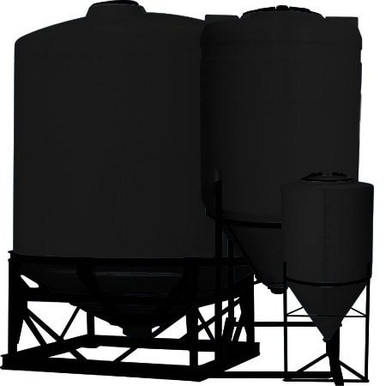
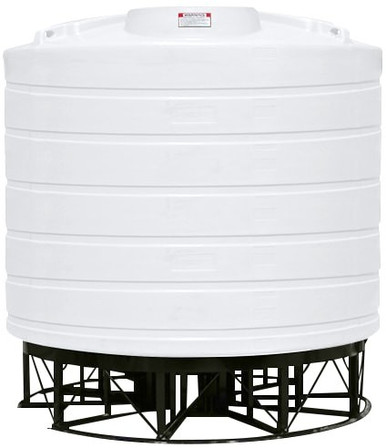
- Chem-Tainer 500 Gallon 45 Degree Cone Bottom Tank (MPN TC6568JC, listed at $1,400.00) — mid-size process tank for daily-dump chemistry duty.
- Stand for Chem-Tainer 500 Gallon 45 Degree Cone Bottom (MPN TC6568JK, listed at $4,498.99) — fabricated steel stand sized for the 45° tank height.
The 30° catalog is dominated by smaller (75-gallon class) bench-scale tanks where the geometric difference is small in absolute terms (less than 5 inches of height delta). The 45° catalog at 500+ gallons is where the angle decision matters most — at the daily-dump processing scale where drain time and residual heel directly affect operational economics.
For larger cone-bottom installations beyond the Chem-Tainer line, see the OneSource Snyder Industries cone-bottom catalog and Norwesco cone-bottom range. Norwesco produces cone-bottom tanks up to 4,000 gallons; Snyder produces up to 5,500 gallons. For volume above that, FRP fabricated cone-bottom tanks from custom suppliers are the practical answer.
Stand Considerations: The Hidden Cost
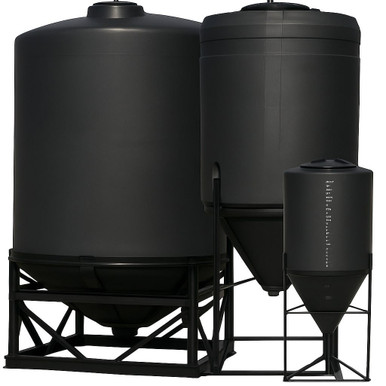
Cone-bottom tanks can't sit flat on the ground — the cone tip needs clearance for the discharge piping, valve, and any bottom-mounted level instruments. Stand height for a 500-gallon 45° cone tank is typically 30-50 inches measured from grade to the top of the stand (where the tank sits). The stand carries the full water-filled tank weight (500 gal x 8.34 lb/gal = 4,170 lb) on 4-6 legs anchored into a concrete sub-pad.
The Chem-Tainer 500 Gallon 45° tank stand (MPN TC6568JK) at $4,498.99 list is more expensive than the tank itself at $4,498.99. This is normal for cone-bottom tanks: the stand often costs 1-3x the tank cost because the stand is a fabricated steel structure with anchorage and bracing engineering, while the tank is rotomolded plastic produced in volume.
Stand material choice: hot-dip galvanized A36 carbon steel is the cost-economic option for non-aggressive chemistry environments. For chemistry exposure (acid fume, chlorine fume, alkaline mist), galvanized steel corrodes and FRP or stainless steel stands are the upgrade. Some applications use poly stands (rotomolded plastic stands) for the smaller tank classes — visible in the Chem-Tainer 75 gallon TC3035AP listing where the poly stand is integrated with the tank purchase. For the 500+ gallon class, fabricated steel is the dominant stand material.
For the foundation under the stand, see our tank stand design walkthrough for the concrete pad and anchor sizing for cone-bottom installations.
Mixer Compatibility
Cone-bottom tanks are often paired with top-mounted agitators for batch mixing. The cone angle affects mixer performance:
- 30° cone: shallow cone leaves a relatively flat tank floor below the cylindrical section. Agitator impellers sized for full-volume mixing work fine. Settled solids accumulate slowly because the slope doesn't drive convergent flow toward the cone tip.
- 45° cone: steeper cone creates a converging flow toward the cone tip when the agitator is running. This naturally lifts settled solids back into suspension during mixing and helps prevent the cake-on-cone-wall failure mode that destroys mixer torque calculations. For mixed slurries, 45° cone with proper agitator sizing keeps solids fluidized throughout the batch.
For agitator sizing in cone-bottom tanks, the operating turnover time (tank volume divided by impeller pumping capacity) should be 30-90 seconds for batch mixing duty. Impeller positioning typically locates the bottom impeller 1.0-1.5 impeller diameters above the cone-cylinder transition (NOT in the cone — placing the impeller down the cone causes air entrainment as the level drops during dump-out).
Outlet Bulkhead Sizing
The discharge outlet at the cone tip determines how fast the tank drains and how completely the heel volume drains. Standard outlet sizes:
- 1.5" bulkhead: appropriate for tanks under 100 gallons or static storage with infrequent drain
- 2" bulkhead: standard for 100-500 gallon process tanks
- 3" bulkhead: 500-1,500 gallon process tanks with daily-dump duty
- 4" bulkhead: 1,500-5,000 gallon production-scale tanks
- 6" bulkhead: 5,000+ gallon production tanks where drain time must be minimized
The bulkhead fitting penetrates the tank shell at the cone tip and includes (typically) a flanged ANSI 150# or 300# face for downstream piping connection. Material: PVC, CPVC, polypropylene, or stainless steel depending on chemistry. For aggressive chemistry, the bulkhead material must match the tank chemistry envelope. PVC for ambient water and dilute acids; CPVC or polypropylene for elevated temperature and stronger chemistry; stainless steel 316L for the broadest chemistry envelope but with chemistry exclusions for hydrofluoric acid and chlorinated solvents (see our fluoropolymer pump and wetted-path engineering walkthrough).
Bottom-Outlet Valve Selection
The valve at the cone tip operates against full hydrostatic head when the tank is full and against partial head as the tank drains. Common architectures:
- Manual ball valve: simplest. Quarter-turn operation. PVC or polypropylene body for chemistry service. Cost $50-$300 depending on size.
- Manual butterfly valve: for larger 4" and up. Quarter-turn. Lower cost than ball at large sizes.
- Pneumatic actuated ball valve: for automated dump-out cycles. Solenoid pilot, plant air supply. Cost $400-$1,200 per valve.
- Electric actuated ball valve: for remote-controlled dump-out without plant air. Cost similar to pneumatic.
- Diaphragm valve: for slurry service where particulates would foul a ball valve. Higher cost, more frequent diaphragm replacement.
For batch processing where the dump cycle runs multiple times per shift, automated valving (pneumatic or electric) pays back in operator labor savings within 6-18 months at typical batch frequencies.
Open-Top vs Closed-Top Cone-Bottom Configuration
Open-top cone-bottom tanks (Chem-Tainer TC3024CA at $533.33) leave the tank top open for direct top-loading of dry materials, slurry pumping, or visual inspection during batch operations. Used widely in batch chemistry mixing applications where the operator adds dry chemistry to a pre-charged liquid, mixes, and dumps. Open-top tanks need rain covers if installed outdoors, splash-proof covers if pumping in slurries that might splash, and dust covers if handling powder products.
Closed-top cone-bottom tanks (Chem-Tainer TC3024CB at $748.00) seal the top with a fitted lid, manway, or vented closure. Used for chemistry containment (preventing fume escape), for outdoor service (preventing rainwater intrusion), and for batch processes where chemistry is pumped in through a fill line rather than top-loaded.
The cost difference (about $215 in this 75-gallon size) is the closed-top molding plus the manway and vent fittings.
Comparative Summary: 30° vs 45° Cone Decision Matrix
- Specify 30° cone when: tank is 75 gallons or smaller, fluid is clean (no solids), drain time is non-critical (less than 1 dump per day), vertical envelope is constrained (low ceiling clearance), shipping cost matters (lower freight class for shorter package), residual heel is operationally tolerable.
- Specify 45° cone when: tank is 100 gallons or larger, fluid carries any settled solids, drain time matters (multiple dumps per shift), residual heel needs to minimize, mixer is installed for batch operations, vertical envelope permits the additional cone height.
- Specify 60° cone when: handling cohesive sludges, sticky polymer flocculant, fine powders that bridge readily, or any service where 45° has historically failed to drain reliably.
For most OneSource customers running batch chemistry, daily-dump operations, or any application with settled solids, 45° is the right default. The shipping economics favor 30° for the small-tank bench-scale class but the operational economics at 100+ gallons favor 45° for nearly all duty cycles.
Pairing with Larger Catalog Options
For cone-bottom requirements above the Chem-Tainer 500-gallon class, the OneSource catalog includes Snyder Industries and Norwesco cone-bottom tanks in sizes from 300 to 5,500 gallons. For each of those, the cone angle decision matrix above applies. Larger cone tanks tend to default to 45° because the operational consequences of a wrong choice scale with tank size.
For sloped-bottom and dished-bottom alternatives where the cone form factor doesn't fit the application, see our sloped-bottom vs cone-bottom drainage engineering walkthrough for the alternative geometry trade-offs.
For chemistry-specific compatibility on the cone-bottom tank shell, the chemical compatibility hub at /chemical-compatibility/ covers the HDPE and XLPE chemistry envelopes for the major industrial chemistries. For sulfuric acid storage where high-SG service drives material choice toward XLPE, see the sulfuric acid storage and tank selection guide. For DEF (diesel exhaust fluid) service, see DEF storage ISO 22241 compliance guide.
Maintenance and Inspection
Cone-bottom tank inspection cadence:
- Monthly: visual inspection of the cone exterior for stress whitening or cracking. The cone-cylinder transition is the highest-stress region of the rotomolded tank shell — any cracking starts there. Inspect the cone tip outlet boss for sealing integrity.
- Quarterly: open and inspect the bottom outlet, clear any settled solids that may have accumulated above the outlet plug. Verify valve actuation is smooth.
- Annually: drain to bottom 5%, inspect interior for solids accumulation, verify wall thickness via ultrasonic gauge in random sample locations. Verify stand anchor bolt torque, tighten if loose.
- Every 5 years: full empty inspection including interior wall scan for ESCR cracking under the operating chemistry, verification of cone tip outlet boss integrity, replacement of any aged elastomers in the discharge valving.
For cone-bottom tanks in chemistry service, the cone-cylinder transition is also where chemistry-induced ESCR (environmental stress crack resistance) failures first appear. Stress whitening at the transition with no visible cracking is an early warning; full crack propagation is a tank failure. ASTM D1693 covers the lab test for ESCR on polyethylene.
For freight estimation on cone-bottom tank deliveries to your ZIP, use the freight estimator. The 45° cone tanks ship at slightly higher freight cost than 30° tanks of the same nominal volume because the taller package occupies more LTL freight cube. For the Chem-Tainer 500-gallon 45° tank shipping nationwide via LTL, freight typically runs $300-$700 depending on origin and destination accessibility. Talk to OneSource Plastics at 866-418-1777 for cone-bottom tank selection assistance — we will run the tank size, cone angle, and stand requirements against your specific batch operation duty cycle.
Recommended Tanks for This Guide
Live pricing, updated automatically · estimate freight to your ZIP.