How to Calculate Tank Volume: Formulas for Every Shape
Tank Volume Calculation: Every Formula You Need
Whether you are verifying a manufacturer's listed capacity, calculating the volume of a partially filled tank, or sizing a tank for a specific application, you need the right formula. This guide covers volume calculations for every common tank shape with worked examples.
Vertical Cylindrical Tanks (Most Common)
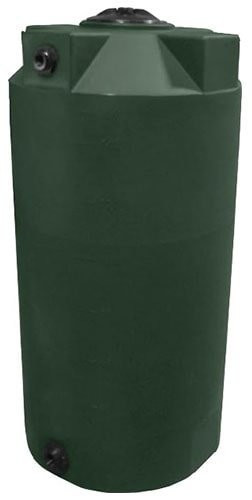
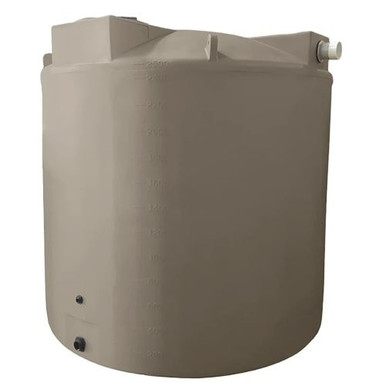
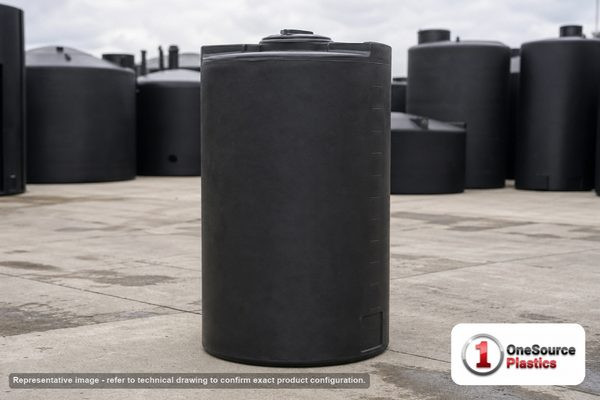
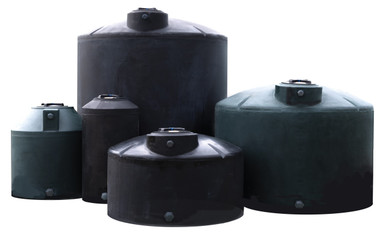
The vast majority of polyethylene storage tanks are vertical cylinders. The volume formula is straightforward:
Volume = π × r² × h
Where r = radius (half the diameter), h = height
For gallons: Volume (gallons) = π × r² × h ÷ 231 (when dimensions are in inches)
Worked Example
A tank measures 48 inches diameter × 73 inches tall:
- Radius = 48 ÷ 2 = 24 inches
- Volume = π × 24² × 73 = π × 576 × 73 = 132,076 cubic inches
- Volume in gallons = 132,076 ÷ 231 = 571.8 gallons
The manufacturer lists this as a 500-gallon tank. The difference (571.8 vs 500) accounts for the dome top curvature, wall thickness reducing interior dimensions, and the working volume being less than total geometric volume.
Horizontal Cylindrical Tanks
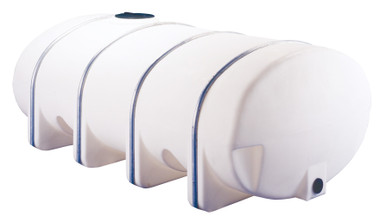
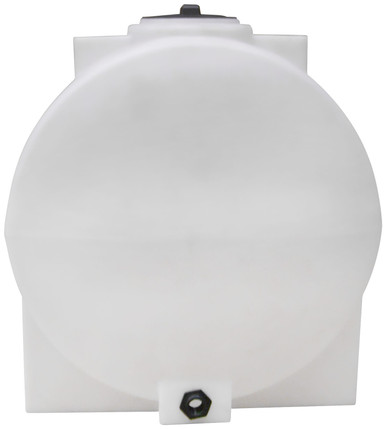
Total volume of a horizontal cylinder uses the same formula as vertical — π × r² × L (where L is the tank length). But the useful calculation for horizontal tanks is usually the volume at a specific fill level, which is more complex:
Volume at height h = L × [r² × arccos((r-h)/r) - (r-h) × √(2rh - h²)]
Where L = tank length, r = radius, h = liquid height from bottom
This formula calculates the area of the circular segment filled with liquid, then multiplies by the tank length. For practical purposes, most people use a tank volume calculator rather than solving this by hand.
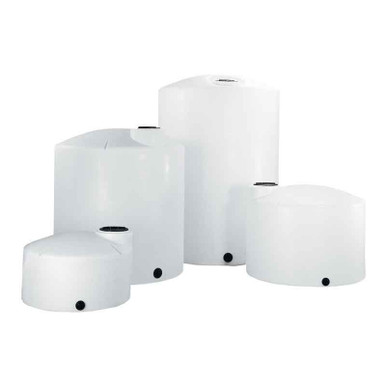
Rectangular/Doorway Tanks
Rectangular tanks use the simplest formula:
Volume = Length × Width × Height
For gallons: Volume (gallons) = L × W × H ÷ 231 (dimensions in inches)
Note that actual interior volume is less than exterior dimensions suggest because of wall thickness. For polyethylene tanks, walls are typically 0.25 to 0.5 inches thick, which reduces each dimension by 0.5 to 1 inch.
Cone Bottom Tanks
A cone bottom tank is a cylinder on top of a cone. Calculate each section separately and add them:
Cylinder volume = π × r² × h_cyl
Cone volume = (1/3) × π × r² × h_cone
Total = Cylinder + Cone
Cone Height from Angle
If you know the cone angle (15°, 30°, or 45° are standard), calculate cone height from the tank radius:
Cone height = r × tan(cone_angle)
- 15° cone, 24" radius: h = 24 × tan(15°) = 24 × 0.268 = 6.4 inches
- 30° cone, 24" radius: h = 24 × tan(30°) = 24 × 0.577 = 13.9 inches
- 45° cone, 24" radius: h = 24 × tan(45°) = 24 × 1.0 = 24.0 inches
Elliptical/Oval Tanks
Elliptical tanks (common in horizontal transport applications) use the ellipse area formula:
Volume = π × a × b × L
Where a = semi-major axis (half the width), b = semi-minor axis (half the height), L = length
Weight Calculations
Once you know the volume, calculate the weight of the liquid:
Liquid weight (lbs) = Volume (gallons) × 8.34 × Specific Gravity
Total weight = Liquid weight + Empty tank weight
Quick Reference: Common Liquid Weights per Gallon
| Liquid | SG | lbs/gallon |
|---|---|---|
| Water | 1.0 | 8.34 |
| UAN-28 Fertilizer | 1.28 | 10.68 |
| UAN-32 Fertilizer | 1.32 | 11.01 |
| 10-34-0 Phosphorus | 1.39 | 11.59 |
| Muriatic Acid (31.5%) | 1.16 | 9.67 |
| Diesel Fuel | 0.85 | 7.09 |
| Maple Syrup | 1.37 | 11.43 |
Foundation Sizing from Weight
Once you know the total loaded weight, calculate the bearing pressure on your foundation:
Bearing pressure (PSF) = Total weight ÷ Tank footprint area (sq ft)
Compare this to your soil's bearing capacity: compacted gravel supports 2,000-3,000 PSF, undisturbed clay supports 1,500-2,000 PSF, and sandy soil supports 1,000-1,500 PSF. If your bearing pressure exceeds the soil capacity, you need a larger pad or a concrete foundation to spread the load.
Practical Tips
- Always use interior dimensions for volume calculations. Exterior dimensions include wall thickness.
- Manufacturer-listed capacity accounts for dome curvature, wall thickness, and fitting intrusions. Your geometric calculation will be higher than the listed capacity.
- Working capacity should be 90-95% of listed capacity to allow for expansion and venting headspace.
- For weight calculations, always use the rated specific gravity, not water weight, to plan your foundation.
- When sizing a tank for an application, calculate your daily usage, multiply by the number of days between refills, and add 20% for safety margin. Then round up to the next standard tank size.
Need help sizing a tank for your application? Call (866) 418-1777 and we'll run the numbers with you.
Understanding Polyethylene Tank Construction
Every polyethylene tank in our catalog is manufactured through rotational molding — a process that creates a seamless, one-piece structure from powdered HDPE resin. The mold rotates on two axes simultaneously while heated, distributing molten resin evenly across all interior surfaces. The result is a tank with no seams, no weld lines, and no potential leak points. This seamless construction is the primary advantage of rotomolded tanks over welded or fabricated alternatives — joints are where tanks fail, and rotomolded tanks have no joints.
The resin itself is not generic plastic. It is a specially formulated compound that includes UV stabilizers (to prevent sun degradation), antioxidants (to prevent thermal degradation during processing and service), and pigments. For potable water applications, the resin meets FDA 21 CFR 177.1520 requirements for food-contact materials. These additives are compounded directly into the resin — not applied as surface coatings — which means the protection extends through the full wall thickness and lasts the life of the tank.
Why Buy from OneSource Plastics?
OneSource Plastics is not just another tank reseller. We are a specialized industrial tank dealer with deep product knowledge, competitive pricing from direct manufacturer relationships, and a commitment to helping you select the right tank for your specific application. Our team handles tank inquiries every day — we know the product lines, the specifications, the common pitfalls, and the solutions.
When you call us, you talk to someone who knows the difference between a 1.5 SG and a 1.9 SG tank, who can explain why a cone bottom is worth the extra cost for your mixing application, and who can tell you exactly what foundation your 2,500-gallon tank needs on your specific soil type. We don't just process orders — we solve liquid storage problems.
Every tank we sell ships with the full manufacturer warranty. We handle freight logistics to all 50 states, and we can coordinate delivery equipment for sites with challenging access. If something goes wrong — a shipping damage claim, a warranty issue, a specification question — we handle it directly. One call to (866) 418-1777 connects you to a real person who can actually help.
Shop Tanks by Size
Related chemical compatibility resources
For deeper engineering specifications on the chemicals discussed above, see our chemical-compatibility pillars:
- Hydrochloric Acid — storage compatibility, recommended resin grade, fittings, secondary containment.
- UAN-28 (Urea Ammonium Nitrate 28%) — storage compatibility, recommended resin grade, fittings, secondary containment.
- UAN-32 (Urea Ammonium Nitrate 32%) — storage compatibility, recommended resin grade, fittings, secondary containment.
Recommended Tanks for This Guide
Live pricing, updated automatically · estimate freight to your ZIP.