Hydrogen Peroxide Tank Selection at 35% vs 50% vs 70% Concentration: Decomposition Kinetics, Passivation Engineering, and the Polyethylene Service Window
Hydrogen peroxide (H2O2) storage is one of the more demanding chemistry duties in industrial bulk handling. The compound is thermodynamically unstable - it wants to decompose into water and oxygen by the reaction 2 H2O2 to 2 H2O + O2 - and the decomposition rate is a function of concentration, temperature, surface contact chemistry, dissolved metals, light exposure, and microbial activity. A storage tank that is well-suited for 35% peroxide can be wholly inadequate for 50% peroxide, and 70% peroxide moves into a regulatory and engineering space where polyethylene is no longer the appropriate primary containment material in most service conditions.
This guide walks the engineering trade-offs for each common concentration band, addresses tank passivation and surface preparation for new vessel commissioning, the decomposition kinetics that determine how often you should be measuring active oxygen, vent sizing for the oxygen byproduct, and the catalog choices in our 5-brand line that fit each service condition. The reference standards are FMC Technical Bulletin 104 (Storage and Handling of Hydrogen Peroxide), Solvay Interox technical literature, ASTM D6593 for chemistry compatibility testing, and the OSHA process safety provisions at 29 CFR 1910.119 Appendix A which lists hydrogen peroxide above 52% concentration as a Highly Hazardous Chemical at threshold quantity 7,500 lb.
1. Why Hydrogen Peroxide Is Different from Other Oxidizers
Sodium hypochlorite, calcium hypochlorite, and other chlorine-based oxidizers are stable at storage concentrations and decompose primarily through hydrolysis or photolysis. Hydrogen peroxide is autocatalytic - the reaction products (water and oxygen) do not slow the reaction the way reaction products usually do. Trace metal contamination (iron, copper, manganese, chromium, nickel - any transition metal in the d-block) catalyzes decomposition at parts-per-billion levels. A new fiberglass-reinforced plastic (FRP) tank with chopped strand glass at the wetted surface will accelerate H2O2 decomposition because the glass binder typically contains iron oxide. A polyethylene tank with carbon black UV stabilizer can promote decomposition due to surface adsorption sites. A stainless steel tank that has not been properly passivated will catalyze decomposition because of free iron at the surface from machining or welding.
The storage engineering challenge is therefore not "what tank holds H2O2" but "what tank holds H2O2 without catalyzing decomposition." Decomposition releases heat (98 kcal per mole of H2O2 decomposed) and oxygen gas. Uncontrolled decomposition produces a runaway thermal event that can rupture the tank, ignite combustible packaging, and create an oxygen-enriched atmosphere that supports flash fire. The 1998 Las Vegas H2O2 truck fire and the 2007 Kingman Arizona H2O2 facility incident both began as decomposition events triggered by contamination in storage.
2. The 35% Concentration Band: Polyethylene Adequate
35% by weight hydrogen peroxide is the workhorse concentration for water treatment, pulp bleaching, textile processing, electronics cleaning, and many environmental remediation applications. At 35%, the active oxygen content is 16.5% and the decomposition rate at 25 deg C in clean storage is approximately 1% per year (loss of active strength). High-density polyethylene (HDPE) and crosslinked polyethylene (XLPE) are both qualified for 35% H2O2 service, with the operational caveats:
- Tank must be commissioned in clean condition - no machining swarf, no weld slag, no carbon black trace contamination above what the resin formulation contains.
- Vent sizing must accommodate the slow oxygen evolution. Even at 1% per year decomposition, a 1,000 gallon tank produces approximately 11 standard cubic feet of oxygen per year (about 1.5 gallons of liquid water plus 11 SCF O2). Vent must remain open and unobstructed.
- Tank should not be installed where direct sunlight raises tank wall temperature above 30 deg C, which doubles decomposition rate.
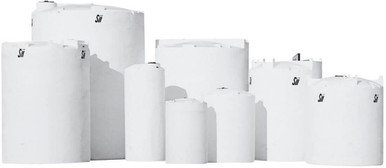
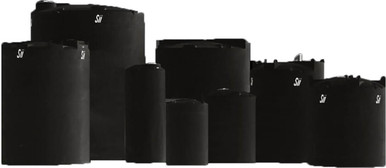
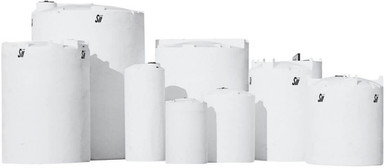
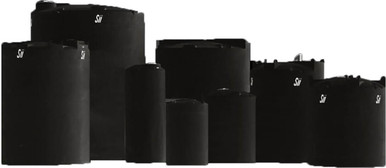
- Tank color preference is white or light translucent - dark colors raise solar gain and decomposition rate. Avoid black tanks for outdoor 35% H2O2 service in southern latitudes.
- Aluminum, copper, brass, bronze, mild steel, galvanized steel - all forbidden in the wetted path. Acceptable wetted-path materials: HDPE, XLPE, virgin PVC, CPVC, PVDF, PFA/FEP/PTFE, 316L stainless steel (passivated with nitric acid per ASTM A380).
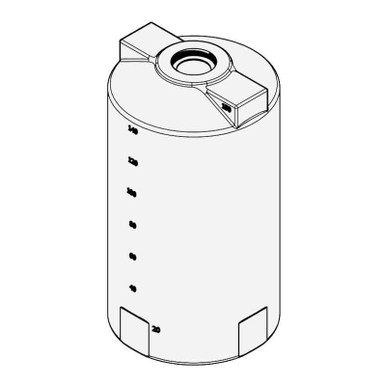
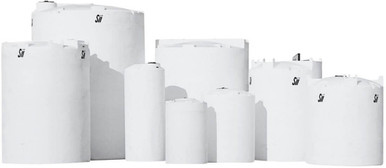
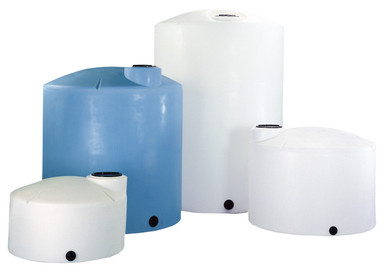
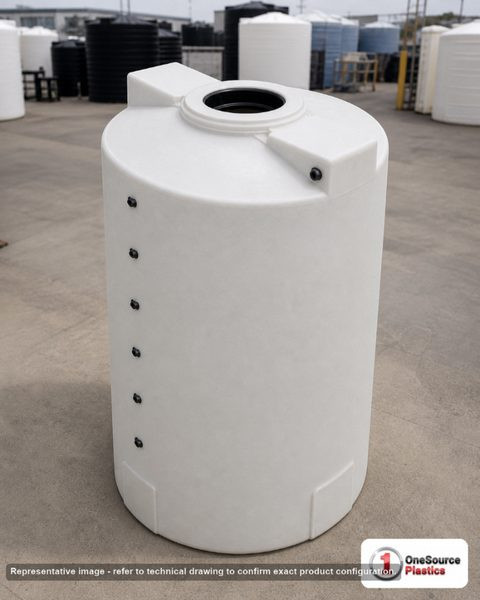
For 35% H2O2 storage in the 1,000 to 2,500 gallon range, our catalog options include the Norwesco N-40146 1,500 gallon vertical liquid storage tank in white HDPE, and the Enduraplas EP-THV02500FG 2,500 gallon vertical for slightly larger duty. Both are HDPE construction with appropriate vent ports for oxygen release.
3. The 50% Concentration Band: XLPE Required, Specialty Engineering
50% H2O2 is used in pulp bleaching at higher production rates, in chemical synthesis (caprolactam, propylene oxide, organic peroxide manufacturing), and in environmental remediation where active oxygen demand is high enough that 35% loadout becomes uneconomic. The active oxygen content at 50% is 23.5%, the heat of decomposition per gallon is 2.7x higher than at 35%, and decomposition runaway has a much shorter induction period. The polyethylene service window narrows substantially:
- HDPE no longer adequate. The lower crosslink density permits permeation of decomposition reaction products into the tank wall, where they accumulate and locally accelerate decomposition.
- XLPE acceptable IF the tank is commissioned with documented passivation cycle - flush with 5% nitric acid, rinse with deionized water, dry, fill with 35% H2O2 and hold 7 days, drain and refill with 50%.
- Tank wall thickness must be specified from chemistry density 1.20 SG (50% H2O2) NOT from 1.0 (water). Snyder Industries XLPE tanks rated for 1.5 or 1.9 SG service handle 50% H2O2 in the wall-thickness dimension.
- Vent sizing is more aggressive. Use a conservation vent or pressure-vacuum relief valve sized for 5x normal decomposition rate to handle excursions.
- Operating temperature must be limited. 25 deg C is the design baseline; insulation and shading required where ambient exceeds 30 deg C.
- OSHA PSM 29 CFR 1910.119 applies above 52% at threshold quantity. 50% is below that threshold by 2 percentage points - operationally close enough that PSM-style risk assessment is recommended even where not strictly required.
For 50% H2O2 storage, the appropriate catalog choices include the Snyder SII-5990102N42 1,000 gallon XLPE Captor double-wall for SPCC-compliant secondary containment, and the Snyder SII-5490000N42 1,550 gallon XLPE Captor double-wall for medium-volume bulk service. The double-wall integrated containment is preferred over open dike at this concentration because the secondary-wall annular space contains any breach without exposing the chemistry to atmospheric metal contamination from rebar in concrete or atmospheric particulate.
4. The 70% Concentration Band: Polyethylene Insufficient, 316L Stainless or Aluminum Required
70% H2O2 (sometimes called "high-test peroxide" or HTP) and the 90% concentration used in aerospace propulsion fall outside the polyethylene service envelope entirely. At 70%, active oxygen is 32.9%, the heat of decomposition per gallon is approximately 5x the value at 35%, and the storage chemistry is regulated under OSHA PSM 29 CFR 1910.119 with a 7,500 lb threshold and DOT classification 5.1 oxidizer. The wetted-surface engineering moves to 316L stainless steel passivated per ASTM A967, or 1100/5052 aluminum passivated with nitric acid - both surfaces have decades of FMC and Solvay validation data showing acceptable decomposition rates below 0.5% per year.
Plastic tank construction is not appropriate at 70%. Polymer permeation, bulk heating from solar gain, and the risk of decomposition autocatalysis from any trace contamination put polyethylene outside the safe envelope. For storage above 52%, customers should source from chemical-tank specialists offering passivated stainless or aluminum vessels with ASME or API stamp, full inspection records, and chain-of-custody documentation on passivation. We do not stock 70% H2O2 storage in the catalog because the product class is steel/aluminum, not plastic.
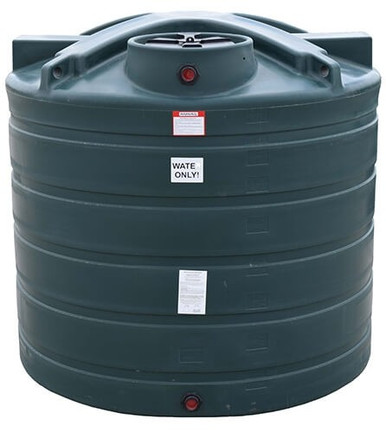
What our catalog does cover well is the upstream and downstream support equipment: the cone-bottom transfer tanks for batch dilution from 70% concentrate to 35% or 50% working strength (Norwesco N-43852 1,000 gallon 45-degree cone bottom, Norwesco N-42064 15 gallon inductor cone bottom for small-batch dilution), and the leg tanks for distributed point-of-use dilute peroxide service (Norwesco N-45191 65 gallon, Norwesco N-43675 925 gallon black for dark-storage applications).
5. Decomposition Rate Measurement and Inventory Reconciliation
H2O2 inventory cannot be managed by tank-level alone because decomposition continuously reduces the active oxygen content while the volumetric inventory stays approximately constant (the decomposition products are water and oxygen; the water stays in the tank, the oxygen vents, and the active strength drops). Two measurement protocols:
- Permanganate titration per ASTM E298 - laboratory titration of a 25 mL sample with 0.1 N potassium permanganate. The endpoint is a faint pink color persisting 30 seconds. Active strength calculated from the volume of titrant. Sensitivity to 0.1% H2O2. Lab time 15 minutes per sample.
- Refractometric correlation - field refractometer calibrated to H2O2 concentration. Sensitivity to about 1% H2O2. Field time 2 minutes per sample. Less accurate than titration but adequate for daily inventory checks.
Recommended cadence: refractometer reading daily, full ASTM E298 titration weekly, with full assay (titration plus dissolved metals analysis by ICP-MS) quarterly. Any drop in active strength faster than the FMC-published baseline rate at the storage temperature triggers a contamination investigation.
6. Vent and Overflow Engineering for Oxygen Release
The oxygen byproduct of H2O2 decomposition must vent freely. A blocked vent on a peroxide tank is a confirmed pressure-vessel failure mode. Engineering controls:
- Vent sizing per API Standard 2000 with 5x normal decomposition rate as the design basis. For a 1,000 gallon 50% H2O2 tank, design vent flow is approximately 60 SCFH oxygen at peak.
- Vent termination must NOT be plumbed into a process header that contains organic chemistry or hydrocarbon vapor. Oxygen-enriched atmosphere plus hydrocarbon equals fire.
- Vent must NOT be screened with brass, bronze, or aluminum mesh - all corrode under H2O2 vapor exposure and shed decomposition catalysts back into the tank. Use 316L stainless mesh or PTFE vent screens.
- Atmospheric vent termination must be at least 12 ft above grade, away from work surfaces, and pointed away from walking surfaces and HVAC intakes.
- Overflow piping must drain to a rinsate containment with at least 110% of tank volume capacity. Overflow water/peroxide mixture must be diluted with copious water before disposal per OSHA HazCom and local discharge permits.
7. Decision Matrix: Concentration vs Tank Selection
The summary decision matrix for H2O2 storage:
- 3% to 8% (consumer grade): HDPE adequate. Standard Norwesco vertical or Enduraplas vertical tanks. No special passivation required.
- 8% to 35% (industrial dilute): HDPE adequate. Vent sizing per oxygen evolution at 1% per year baseline. Tank color white or translucent for solar gain control.
- 35% to 50% (industrial concentrate): XLPE required. Snyder Captor double-wall preferred for SPCC compliance. Documented passivation at commissioning.
- 50% to 52% (high-strength industrial): XLPE acceptable with rigorous passivation, conservative vent sizing, temperature control, and active-strength monitoring weekly. Approaching OSHA PSM threshold.
- 52% to 70% (PSM-regulated): Polyethylene NOT appropriate. 316L stainless or 1100/5052 aluminum, passivated, with full PSM program. Source from chemical-tank specialty fabricator.
- Above 70% (HTP/aerospace): Specialty fabrication only. Beyond OneSource catalog scope.
8. Procurement and Compliance Action Checklist
For sites planning hydrogen peroxide bulk storage, the procurement checklist before tank purchase:
- Document the active concentration. Get the supplier specification sheet and confirm the trade strength.
- Verify the OSHA PSM threshold position. If above 52% and aggregate inventory above 7,500 lb, full PSM program is required including process hazard analysis, written operating procedures, employee training, contractor qualification, mechanical integrity program, and incident investigation protocol.
- Verify SPCC applicability. Above 1,320 gallons aggregate above-ground oil-bearing chemistry triggers SPCC; H2O2 is not "oil" but is regulated separately under EPCRA Section 312 reporting if above threshold (10,000 lb hazardous chemical reporting threshold).
- Verify state and local AHJ requirements. Some states (California, Florida, Washington, Texas) have additional hazardous-materials reporting beyond federal SPCC and EPCRA.
- Specify tank wetted-surface materials in the purchase order. HDPE vs XLPE is concentration-dependent; document the choice with a chemistry compatibility statement.
- Specify passivation and commissioning procedure. Include a 7-day hold on dilute solution before introducing concentrated peroxide.
- Specify vent type, sizing, and termination location. PVRV with 5x decomposition rate flow capacity, 316L mesh screen, 12 ft minimum termination height.
- Specify secondary containment. Snyder Captor double-wall for sites without engineered concrete dike; concrete dike with chemical-resistant liner for fixed-installation sites.
- Specify monitoring instrumentation. Tank-level radar (non-contact, no metal in the wetted path), refractometer, sample port for laboratory titration access.
- Specify emergency response equipment - safety shower within 25 ft, eyewash within 10 ft, copious-flow water supply rated 75 gpm minimum for emergency dilution.
OneSource Plastics carries the polyethylene tank options for 35% and 50% H2O2 service across the Norwesco, Snyder, and Enduraplas lines. We do not stock 70%+ peroxide storage because that product class is appropriately sourced as passivated stainless or aluminum from chemical-tank specialty fabricators. For 35% and 50% H2O2 tank specification, call us at 866-418-1777 with the concentration, daily turnover, ambient temperature range, and SPCC/PSM threshold position. Reference pricing for representative SKUs: Norwesco N-40146 1,500 gallon vertical at $2,837.16 list; Snyder SII-5990102N42 1,000 gallon Captor XLPE at $6,798.99 list; Snyder SII-5490000N42 1,550 gallon Captor XLPE at $10,091.93 list. LTL freight to your ZIP is quoted via the freight estimator.
For complementary reading on chemistry-specific tank selection, see the chemical compatibility hub. For SPCC compliance engineering on the federal layer, see our Captor vs UL-142 steel comparison. For sodium hypochlorite engineering as the related oxidizer chemistry, see our sodium hypochlorite decay rate guide.
Recommended Tanks for This Guide
Live pricing, updated automatically · estimate freight to your ZIP.