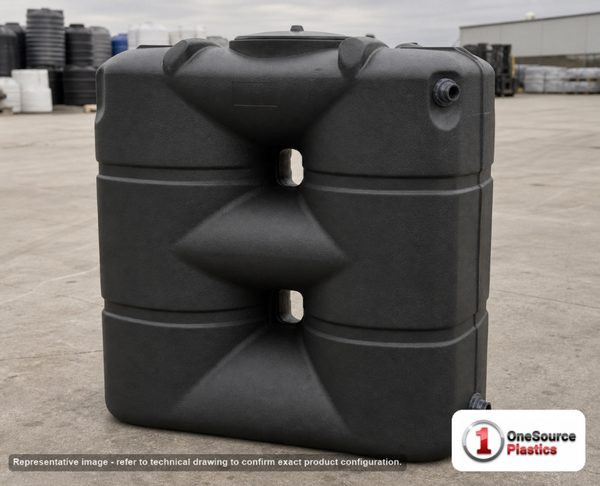
Tank Sodium Hypochlorite Decay Rate: Why Tank Material + Tank Color + Headspace Ventilation All Matter
Sodium hypochlorite (NaOCl) is the workhorse of municipal disinfection, water treatment, paper bleaching, cooling-tower biocide, and food-plant sanitation. It is also the most thermally and chemically unstable common chemical that anyone bulk-stores in plastic tanks. From the moment the delivery truck pumps 12.5% trade-grade bleach into a customer tank, three first-order decay reactions are racing in parallel: spontaneous hypochlorite disproportionation that builds chlorate and oxygen, photochemical decomposition driven by UV ingress through the tank wall, and oxygen displacement of the headspace by chlorine vapor. Get the tank wrong and the active chlorine concentration drops 30 to 60 percent in 90 days, blowing through purchasing budgets and missing CT compliance targets at the same time.
This pillar breaks down each decay mechanism, the engineering response (tank material, tank color, headspace ventilation strategy), and shows real Norwesco SKUs that are spec'd for SG 1.9 hypochlorite service. References include AWWA B300 (hypochlorite manufacture and handling), ASTM D1998 Section 8 (atmospheric tank construction), Snyder Industries chemical resistance guide, and the Powell Fabrication NaOCl decay model that the industry uses for shelf-life prediction.
Three Parallel Decay Reactions
Reaction 1: Disproportionation (heat-driven)
The base hypochlorite decomposition pathway is:
3 NaOCl → NaClO3 + 2 NaCl (chlorate formation, dominant above 70 F)
2 NaOCl → 2 NaCl + O2 (oxygen evolution, dominant at high concentration)
Both reactions are temperature-accelerated. Empirically, NaOCl decay roughly doubles for every 18 F (10 C) rise above 60 F. A delivery at 50 F decays at one rate; the same chemical sitting in a black tank in a Phoenix afternoon at 110 F internal temperature decays at 16 to 32 times the cold rate. Chlorate is also a regulated byproduct (EPA stage 2 D/DBP) so heat-driven decomposition is a compliance issue, not just a budget one.
Reaction 2: Photochemical decomposition (UV-driven)
Hypochlorite absorbs strongly in the 290 to 360 nm UV-B / UV-A band. The photolysis pathway:
2 NaOCl + hν → 2 NaCl + O2
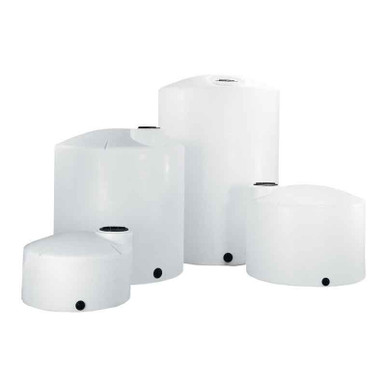
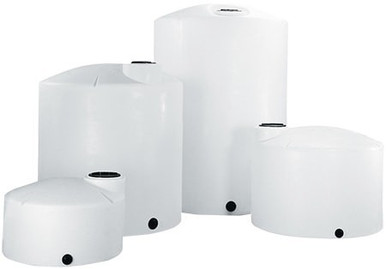
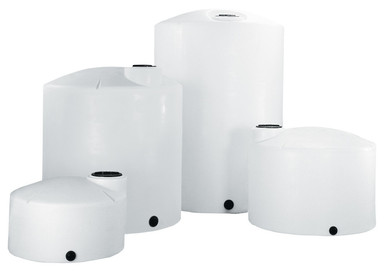
This is the reaction that destroys outdoor pool chlorine within hours when not stabilized. In a tank, photolysis depends on how much UV penetrates the wall. Translucent white polyethylene transmits roughly 1 to 5 percent of incident UV-A through 0.4-inch wall thickness. That's enough that a translucent white tank in full sun loses 10 to 25 percent active chlorine concentration over 30 days from photolysis alone, on top of the thermal decay.
Reaction 3: Headspace oxygen accumulation (vent-driven)
The disproportionation reaction releases oxygen gas. Without a properly sized atmospheric vent, this oxygen accumulates in the tank headspace and pressurizes the dome. Polyethylene atmospheric tanks are not pressure vessels; ASTM D1998 explicitly limits operating pressure to atmospheric. Inadequate venting on hypochlorite service produces visible top-deck bulging, cracked manway hardware, and in extreme cases tank rupture. The AWWA B300 recommendation is for an atmospheric vent oversized one to two pipe sizes beyond the standard tank-vent calculation, terminated outdoors with a chlorine-rated screen.
Tank Material Selection for NaOCl
Polyethylene is the industry default for 12.5% trade-grade hypochlorite tanks. Three sub-grades matter:
HDPE (High-Density Polyethylene)
HDPE handles 12.5% NaOCl at ambient temperature for a decade or more on most installations. Density 0.94 to 0.96 g/cm3. Black HDPE preferred for outdoor service to block UV. ASTM D1998 Type I specification.
XLPE (Cross-Linked Polyethylene)
XLPE is the premium choice for sustained NaOCl service. Cross-linked polymer matrix resists oxidative attack from free chlorine that gradually degrades HDPE. Service life 20+ years. ASTM D1998 Type II classification. Snyder MPN 1006600N42 (10,000 gallon XLPE Captor double-wall, max temp 140 F, 1.9 SG) is the heavy-end reference.
FRP / Vinyl Ester
FRP with vinyl-ester resin is the only realistic option for very large NaOCl tanks above 12,000 gallon, or for installations that need 30+ year service life. Higher capital cost, longer fabrication lead, and FRP repair requires specialized contractors.
What never works
PVC body fittings, PVC bulkheads, and standard EPDM gaskets all degrade on continuous 12.5% hypochlorite contact. Use CPVC bulkheads with Viton (FKM) gaskets. Galvanized hardware corrodes in weeks; specify 316 stainless minimum, Hastelloy or fully encapsulated stainless for the highest-grade installations.
Real SKUs Spec'd for SG 1.9 Hypochlorite Service
The OneSource Plastics master catalog tags products by specific gravity. For 12.5% NaOCl with margin, SG 1.9 is the standard rating. These Norwesco vertical and horizontal tanks ship with the heavier wall-thickness build sheet:
- N-47564: 2,000 gallon Vertical Liquid Storage Tank in Blue, SG 1.9. Norwesco MPN 47564.
- N-42380: 3,000 gallon Vertical Liquid Storage Tank in Blue, SG 1.9. Norwesco MPN 42380.
- N-47620: 6,502 gallon Vertical Liquid Storage Tank in Blue, SG 1.9. Norwesco MPN 47620.
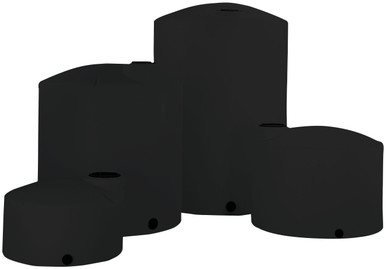
- N-40775: 2,035 gallon HDPE Horizontal Elliptical Leg Tank in Black, SG 1.9. Norwesco MPN 40775. Transport-rated for road-side bleach delivery.
- N-41294: 2,635 gallon HDPE Horizontal Elliptical Leg Tank in Black, SG 1.9. Norwesco MPN 41294.
- N-40283: 2,635 gallon HDPE Horizontal Elliptical Leg Tank in Blue, SG 1.9. Norwesco MPN 40283.
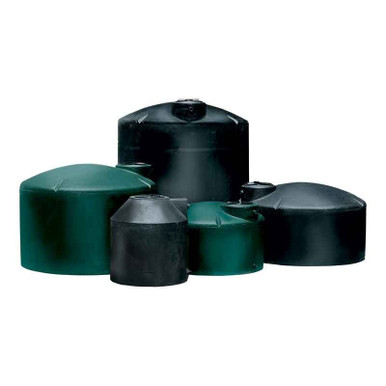
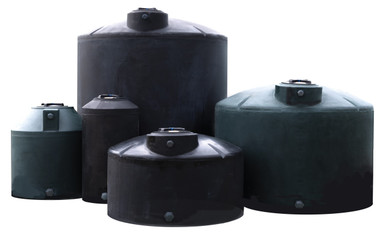
Blue is the industry-conventional color for hypochlorite to visually flag the tank during walkdowns. Blue HDPE pigment is opaque enough to block the bulk of UV-B / UV-A, knocking the photolysis rate down by an order of magnitude versus translucent white.
Color Trade-Off Matrix
| Color | UV Block | Solar Heat Gain | Visual Identification | Recommendation |
|---|---|---|---|---|
| Translucent White | Poor (1-5% UV trans) | Low | Visible level (advantage) | Indoor only |
| Opaque White (pigmented) | Excellent | Low | Generic | Hot climates, outdoor |
| Blue | Excellent | Moderate | Hypochlorite (industry standard) | Default for NaOCl service |
| Black | Total | High | Generic | Cold climates, shaded outdoor |
| Yellow | Good | Moderate | Sulfuric / hazardous flag | Not for NaOCl |
Headspace Ventilation Engineering
The vent on a hypochlorite tank does three jobs: it relieves the oxygen evolved from disproportionation, it equalizes pressure during fill and pump-out, and it allows water vapor (and chlorine off-gas) to escape rather than condensing on the dome interior. Vent sizing rules:
- Minimum vent diameter: 4-inch atmospheric vent for tanks 1,500 to 5,000 gallon; 6-inch for 5,000 to 12,000 gallon. AWWA B300 recommends one nominal pipe size larger than the calculated fill / draw flow rate.
- Vent termination: outdoors, screened (chlorine-rated stainless or HDPE mesh; do not use galvanized which corrodes), turned-down or weather-cap fitted to exclude rain.
- Multi-tank vent headers: only with a vacuum breaker on each tank. Common-vent headers without breakers can collapse one tank during pump-out of another.
- Emergency vent: not required for NaOCl atmospheric tanks (fire is not a primary failure mode), but the standard AWWA atmospheric vent must be sized for full fill rate at minimum.
Powell Fabrication NaOCl Decay Model
The industry-accepted shelf-life model for NaOCl is the Powell Fabrication first-order decay equation. Active chlorine concentration as a function of time and temperature:
[NaOCl]_t = [NaOCl]_0 × exp(-k(T) × t)
where k(T) doubles for every 18 F rise above 60 F
Worked example: 12.5% NaOCl delivered at 60 F, stored in a black HDPE tank that hits 95 F internal in summer. The decay constant at 95 F is 4 times the 60 F rate. After 60 days at 60 F constant, concentration is 11.5%. After 60 days at 95 F average, concentration is around 8.5% — a quarter of the active chlorine has been lost. Same days, different tank temperature, four times the chemistry budget.
Operational Best Practices
- Order to demand. Bulk-buy 30-day supply at ambient sites; 14-day supply at hot sites. Never let a tank sit half-full for more than 60 days without sampling.
- Sample weekly. Free chlorine titration kit (LaMotte or Hach equivalent). Track concentration drift; trigger reorder when below 10% active.
- Shade the tank. A simple shade structure cuts solar heat gain by 60 to 80 percent. Cheap insurance for hot-climate installs.
- Don't blend old and new chemistry. Old hypochlorite has built up chlorate. New product mixed in dilutes the chlorate but starts decaying immediately at the new ratio. Drain to low-level before refilling.
- Containment integrity. Hypochlorite eats concrete; specify HDPE-lined containment per SPCC 40 CFR 112 and AWWA B300.
Common Failures We See in the Field
Failure 1: Translucent white tank in Phoenix
30-day photolysis loss of 20%+ active chlorine. Specify blue or opaque white pigmenting; OneSource stocks Norwesco MPN 47564 / 42380 / 47620 in blue.
Failure 2: HDPE tank rated SG 1.5 used for SG 1.9 hypochlorite
Wall-thickness shortfall. Lower-third bulging within 18 months. Always spec SG 1.9 for 12.5% NaOCl regardless of static head calculation.
Failure 3: 2-inch vent on a 5,000 gallon NaOCl tank
Oxygen evolution pressurizes the headspace. Top-deck bulges within 6 months. Specify 4-inch minimum, 6-inch above 5,000 gallon.
Failure 4: PVC bulkhead with EPDM gasket
PVC plasticizer leaches; EPDM swells. Drips at the gasket within 3-6 months. Specify CPVC body with Viton gasket and 316 stainless or encapsulated stainless hardware.
Failure 5: Common-header vent across three tanks
Pump-out on one collapses an idle one. Add vacuum breakers per tank or split the headers.
Capital Cost Reference (2026)
| Tank | SG Rating | List Range |
|---|---|---|
| 2,000 gal Norwesco vertical blue (MPN 47564) | 1.9 | $1,800-$2,400 |
| 3,000 gal Norwesco vertical blue (MPN 42380) | 1.9 | $2,600-$3,400 |
| 6,502 gal Norwesco vertical blue (MPN 47620) | 1.9 | $5,500-$7,200 |
| 10,000 gal Snyder XLPE Captor (MPN 1006600N42) | 1.9 | $14,000-$18,000 |
Listed at the price ranges above; LTL freight quoted separately to ZIP via the OneSource Freight Estimator.
Internal Resources
- Tank Plumbing System Design Pillar
- Tank Color Selection by Use Case
- HDPE vs XLPE Resin Selection
- ASTM Specific Gravity Decoded
- Tank Vent Engineering Math
- Chemical Compatibility Database
- Freight Cost Estimator
Source Citations
- AWWA B300 - Standard for Hypochlorites
- ASTM D1998 - Standard Specification for Polyethylene Upright Storage Tanks (Section 8: Fittings, Support, Venting)
- NSF/ANSI 60 - Drinking Water Treatment Chemicals
- EPA Stage 2 D/DBP Rule (40 CFR 141 Subpart V) - chlorate as regulated byproduct
- 40 CFR 112 - Spill Prevention, Control, and Countermeasure (SPCC) Plan
- Powell Fabrication NaOCl Decay Model (industry shelf-life standard)
- Snyder Industries Chemical Resistance Guide
- Norwesco SG 1.9 build-sheet specifications
- OneSource Plastics master catalog data, 2026-03-26 snapshot (9,419 products)
Recommended Tanks for This Guide
Live pricing, updated automatically · estimate freight to your ZIP.