Liquid-Asphalt Tank Engineering for Hot-Service Storage: Insulation Architecture, Heat-Trace Selection, Viscosity Management Through Temperature Control, Roof Vapor Handling, and Why Hot-Service Asphalt Sits Outside the Polyethylene Envelope
Liquid asphalt is stored at temperatures well above the polyethylene tank service envelope. The bulk asphalt at terminal storage is held at 275 to 325 degrees Fahrenheit; the asphalt at the paving plant is held at 275 to 350 degrees Fahrenheit; the asphalt being loaded into a haul truck for paving is at 300 degrees Fahrenheit minimum. Polyethylene tanks rated to 140 degrees Fahrenheit do not serve any of these conditions. Liquid-asphalt storage uses steel tanks with engineered insulation, heat tracing, viscosity management, and roof vapor handling. This article walks the engineering of hot-service asphalt storage, the reasons polyethylene cannot serve, the secondary polyethylene tank roles around the asphalt facility (reclaimed-water, polymer-modifier dilution, anti-strip-additive storage), and the procurement considerations for the polyethylene-compatible roles.
The treatment is grounded in standard asphalt-industry hot-storage practice, the Asphalt Institute manuals on terminal operations, and the OneSource Plastics 5-brand polyethylene tank catalog (Norwesco, Snyder, Chem-Tainer, Enduraplas, Bushman) for the polyethylene-compatible auxiliary tanks at asphalt facilities. List pricing on each polyethylene tank product page; LTL freight quoted to your ZIP via the freight estimator or by phone at 866-418-1777.
1. The Hot-Service Asphalt Storage Operating Conditions
Liquid-asphalt storage operates in a temperature regime that places it outside the polyethylene compatibility envelope. The conditions and their constraints:
- The storage-temperature range. Bulk asphalt is held at 275 to 325 degrees Fahrenheit (135 to 163 degrees Celsius) to maintain the viscosity needed for pumping, blending, and transfer. The storage temperature is a tradeoff between viscosity (lower at higher temperature, easier to pump) and oxidative aging (faster at higher temperature, asphalt cement properties shift over time).
- The polymer-modified asphalt temperature. Polymer-modified asphalts (PMA) such as styrene-butadiene-styrene (SBS) modified are typically held at higher temperatures to maintain the polymer dispersion, often 325 to 350 degrees Fahrenheit. The modifier-stability time at these temperatures bounds the storage residence time.
- The cutback-asphalt temperature. Cutback asphalts, which are asphalt cement diluted with petroleum solvents, are stored at lower temperatures (140 to 200 degrees Fahrenheit) because the solvent reduces the viscosity. The lower temperature reduces solvent loss but the temperature is still well above the polyethylene service envelope.
- The emulsion-asphalt temperature. Asphalt emulsions, which are asphalt cement dispersed in water with surfactants, are stored at moderate temperatures (140 to 180 degrees Fahrenheit) to maintain the emulsion stability. Emulsions can be held in polyethylene only at the cooler end of this range and warrant tank-specific verification.
- The viscosity-temperature curve dependence. Asphalt viscosity is highly temperature-dependent following the Walther equation. A small temperature drop dramatically increases viscosity; a large temperature drop solidifies the asphalt. Maintaining the temperature is operationally critical.
- The flash-point and fire-safety implications. Asphalt flash points are typically 450 to 550 degrees Fahrenheit. Hot-service storage operates well below the flash point but the heated-storage condition warrants fire-safety controls (temperature monitoring with high-high alarm, vapor handling, ignition-source elimination).
The temperature regime defines the storage requirement. Polyethylene cannot serve at these temperatures; alternative tank construction is required.
2. Why Polyethylene Does Not Serve Hot Asphalt Storage
The reasons polyethylene tanks are not suitable for hot-service asphalt storage are specific and important to understand for procurement:
- The polyethylene maximum service temperature. Standard polyethylene tank construction is rated to a maximum continuous service temperature of approximately 140 degrees Fahrenheit (60 degrees Celsius). Above this temperature, the polyethylene mechanical properties degrade rapidly. The asphalt storage temperature of 275-plus degrees Fahrenheit is double the polyethylene service limit.
- The thermal-softening mechanism. Polyethylene at temperatures approaching the melting point (approximately 250 degrees Fahrenheit for HDPE) loses load-bearing capacity and sags under its own weight. Storage of liquid asphalt would soften the polyethylene tank wall at every wetted surface, leading to wall sagging, fitting failure, and ultimately catastrophic loss of containment.
- The thermal-cycling stress accumulation. Even if the asphalt storage were operated at a temperature that polyethylene could withstand, the thermal cycling between fill and discharge operations would accumulate fatigue damage rapidly. The polyethylene structural integrity would be compromised on a service-life scale of months rather than years.
- The vapor-pressure considerations. Hot asphalt has measurable vapor pressure of light hydrocarbon volatiles. The vapor space in a polyethylene tank would absorb these volatiles into the polymer wall, plasticizing the polyethylene and accelerating the thermal softening. The combined chemistry-and-temperature attack is more aggressive than either alone.
- The rotational-molding manufacturing constraints. Polyethylene tanks are manufactured by rotational molding, which produces a tank with seamless wall construction but with finite wall thickness uniformity. The residual stresses and the wall-thickness variability that are tolerable at ambient temperature become unacceptable at hot-service temperature.
- The OEM warranty limitations. Every polyethylene tank OEM excludes hot-service-asphalt applications from warranty. The exclusion is not arbitrary; it reflects the engineering constraint that the polyethylene cannot perform the service. Procurement of a polyethylene tank for hot asphalt service voids the warranty and creates liability exposure for the procuring site.
The polyethylene tank market is well-served at the moderate-temperature chemistry-storage applications. Hot-service asphalt is outside the market and warrants the alternative-construction approach described in the next section.
3. Steel Tank Construction for Hot Asphalt Service
Hot-service asphalt storage uses welded steel tanks designed for the temperature, the volatile vapor handling, and the thermal-cycling stress. The construction characteristics:
- The carbon-steel base material. Standard carbon steel (typically ASTM A36 or A283 for atmospheric tanks) is the base construction material. The steel handles the temperature and the chemistry; corrosion is minimal under the asphalt-coating-on-the-inside conditions.
- The API 650 design standard. Atmospheric vertical asphalt tanks are typically designed to API 650, which provides the structural design rules for welded steel storage tanks. The design includes wall-thickness calculation, foundation specification, and roof structure.
- The welding-procedure qualification. The welding procedures for the tank construction are qualified under AWS or ASME welding codes. The welds carry both the structural load and the seal against asphalt leakage. Weld quality is verified through dye-penetrant examination and radiographic examination on critical welds.
- The hydrostatic-test commissioning. The completed tank is hydrostatically tested with water before commissioning. The test verifies the structural integrity and the weld leak-tightness. Asphalt is added only after successful hydrotest.
- The bottom-and-floor design. Vertical asphalt tanks have welded steel bottoms with a slope toward the discharge sump. The slope supports complete tank evacuation and minimizes the stagnant heel that ages over time.
- The thermal-expansion accommodation. Steel tanks at hot-service temperature expand significantly. The expansion is accommodated through expansion joints in connecting piping, foundation design that allows tank movement, and roof construction that flexes with the wall expansion. Failing to accommodate the expansion stresses the connections and produces leaks at piping interfaces.
Steel tank construction is the established hot-service-asphalt platform. The design standards, construction practices, and operating practices are mature and well-documented across the asphalt industry.
4. Insulation Architecture for Heat Conservation
Hot-service asphalt tanks lose heat through the tank wall, roof, and bottom. Insulation reduces the heat loss and the heat-trace power required to maintain the storage temperature:
- The mineral-wool insulation system. Standard asphalt-tank insulation is mineral wool (rock wool or slag wool) at 4 to 8 inch thickness on the wall and 6 to 12 inch thickness on the roof. The mineral wool is faced with aluminum or stainless cladding to weather-protect and to reflect radiant heat. The mineral wool installation is well-established and the materials are widely available.
- The calcium-silicate insulation alternative. Calcium-silicate block insulation provides higher thermal resistance per inch and is sometimes used on premium asphalt installations. The material cost is higher than mineral wool but the heat-loss reduction can justify the cost in cold-climate installations or installations with high heat-trace cost.
- The insulation-thickness optimization. The insulation thickness is optimized against the heat-loss reduction (which reduces heat-trace power) versus the insulation cost (which is the capital investment). The optimization typically converges at 6 to 8 inches on the wall and 8 to 10 inches on the roof for typical installations.
- The roof-insulation special considerations. The roof is the largest heat-loss surface relative to the volume because the air space above the roof is often colder than the bulk environment. The roof insulation is typically thicker than the wall insulation. The insulation must support the roof maintenance access without compromising the thermal performance.
- The bottom-insulation challenges. Bottom insulation is the most difficult because the bottom is loaded by the liquid weight and supported by the foundation. Heat-resistant rigid insulation (calcium silicate or perlite-aggregate concrete) can be installed under the bottom but requires foundation engineering to handle the loads.
- The insulation-cladding maintenance. The insulation cladding (aluminum or stainless sheet) requires periodic maintenance to maintain the weather seal. Damaged cladding allows water infiltration that degrades the underlying insulation. Cladding inspection is part of the regular tank inspection program.
The insulation architecture is the heat-conservation layer that makes hot-service storage economically viable. Well-insulated tanks consume a fraction of the heat-trace energy of poorly-insulated tanks.
5. Heat-Trace Selection and Power Specification
The heat-trace system supplies the heat that maintains the storage temperature against the heat loss through the insulation. The selection and specification:
- The electric resistance heat trace. Self-regulating electric heat trace cable is the standard for most asphalt installations under approximately 50,000 gallons. The cable is installed against the steel tank wall under the insulation. Power output adjusts automatically with cable temperature, providing self-regulating safety.
- The steam heat-trace alternative. Sites with available process steam at 50 to 150 psig may use steam heat trace through external steam-tracer pipes. The steam tracing is more energy-efficient than electric resistance and supports higher heat input but requires the steam-supply infrastructure.
- The hot-oil heat-trace for high-temperature service. Polymer-modified asphalt at 350 degrees Fahrenheit may require hot-oil heat trace through external hot-oil tubes. The hot oil is heated in a dedicated boiler and circulated through the tube bundle. Higher capital cost than electric or steam but supports the highest temperatures.
- The internal-coil heat-up heating. Some tanks have internal heating coils (steam or hot oil) for rapid heat-up of cold or partially-solidified asphalt. The internal coils are used for emergency heat-up rather than continuous storage maintenance.
- The heat-trace controller architecture. The heat trace is controlled by tank-temperature sensors with PID controllers that modulate the heat input. Multiple sensor zones (top, middle, bottom of tank) provide thermal-uniformity control. High-temperature alarms protect against overheating.
- The heat-loss calculation for power sizing. The total heat-trace power is sized to maintain the storage temperature at the worst-case ambient (typical winter low-temperature design point). The calculation includes the wall, roof, bottom, and connection-piping heat losses plus a safety margin. Undersized heat trace allows the storage to cool during cold spells; oversized heat trace wastes capital.
- The piping heat-trace coordination. The transfer piping from the storage tank to the load-out, the truck loading, and the paving-plant feed must also be heat-traced and insulated. The piping heat-trace is selected and specified together with the tank heat-trace as a complete system.
The heat-trace system is the active-temperature-maintenance layer. Combined with the insulation, the system holds the asphalt at the storage temperature against the ambient conditions.
6. Viscosity Management Through Temperature Control
The asphalt viscosity at the storage temperature determines whether the asphalt can be pumped, blended, and transferred. The viscosity-management discipline:
- The temperature-viscosity curve characterization. Each asphalt grade has a published temperature-viscosity curve showing kinematic viscosity in centistokes versus temperature. The curve enables the operator to predict the viscosity at any operating temperature and to set the storage temperature for the required viscosity at transfer.
- The pumpability viscosity threshold. Asphalt is reliably pumpable below approximately 1000 centistokes kinematic viscosity. Standard PG-grade asphalt cement reaches 1000 centistokes at approximately 200 degrees Fahrenheit; storage at 275 degrees Fahrenheit gives a generous margin.
- The mixing-viscosity threshold. Asphalt mixed with aggregate at the paving plant requires viscosity around 100 to 300 centistokes for proper aggregate coating. The required temperature is typically 290 to 320 degrees Fahrenheit for standard PG grades.
- The temperature-set-point selection. The storage temperature set-point is the higher of the pumpability requirement and the safety margin against unexpected cooling. Storage at 290 to 300 degrees Fahrenheit gives margin for cold-weather pumping while staying well below the flash point.
- The cold-spot identification. Tanks may have cold spots near connection penetrations, near uninsulated areas, or at the tank corners. Cold spots can solidify the local asphalt and create plug points that block transfers. Periodic temperature mapping (using infrared imaging or distributed thermocouple measurements) reveals the cold spots before they become operational problems.
- The agitation and circulation requirements. Asphalt that sits without circulation can develop temperature stratification (hotter at top, cooler at bottom). Periodic circulation through external recirculation lines or internal agitation maintains the thermal uniformity. The circulation system is sized to turn over the tank volume in 4 to 8 hours.
- The viscosity-versus-storage-time degradation. Asphalt held at storage temperature ages oxidatively over time. The aging produces gradual viscosity increase as light components volatilize and as oxidation progresses. The storage-residence-time monitoring tracks the aging and triggers tank-turnover before the asphalt drifts out of specification.
Viscosity management is the operational outcome that the storage temperature, insulation, and heat trace are all engineered to support. The viscosity at the discharge connection is the deliverable that the upstream engineering produces.
7. Roof Vapor Handling and Emissions Control
Hot asphalt produces vapor emissions of light hydrocarbons and water vapor. The roof-vapor handling system manages the emissions for safety and environmental compliance:
- The vapor-source characterization. Vapor emissions arise from the volatile fraction of the asphalt cement plus residual water from the upstream processing. The volume of vapor is small relative to the storage volume but is continuous over the storage residence time.
- The conservation-vent design. Conservation vents (pressure-vacuum vents) protect the tank against overpressure during fill and against vacuum during draw. The vents are sized to the maximum fill rate and the maximum draw rate. The vent set-points are typically 0.5 to 2.0 ounces per square inch pressure and 0.5 to 1.0 ounces per square inch vacuum.
- The flame-arrestor protection. Vapor connections to atmosphere include flame arrestors that prevent external ignition from propagating into the tank vapor space. The flame arrestors are sized for the vent flow rate and inspected periodically for cleanliness.
- The vapor-collection-and-recovery system. Sites with multiple tanks may collect the vapors into a common header that feeds a vapor-recovery unit (carbon adsorption, condensation, or thermal oxidation). The recovery system reduces emissions and may capture saleable hydrocarbons.
- The thermal-oxidizer or vapor-combustion option. For higher-emission sites, a thermal oxidizer combusts the collected vapors to convert hydrocarbons to carbon dioxide and water. The oxidizer destruction efficiency is typically 99 percent or better. Air-permit requirements may mandate the oxidizer for permit compliance.
- The water-knockout protection. Asphalt with residual water can produce condensation in vapor lines that freezes in cold weather and blocks the vent. Water knockout pots upstream of the vent prevent the blockage. The knockout is drained periodically.
- The emissions monitoring and reporting. Air-quality permits typically require periodic emissions monitoring (annual stack tests, continuous emissions monitoring on larger sites) and reporting to the state environmental agency. The monitoring data supports the permit compliance demonstration.
The roof-vapor system handles the emissions side of hot asphalt storage. The system is engineered together with the tank construction and the heat-trace system as an integrated installation.
8. Polyethylene Tank Roles in the Asphalt Facility Auxiliary Operations
While the main asphalt storage requires steel construction, the asphalt facility includes auxiliary operations where polyethylene tanks serve effectively. The polyethylene roles:
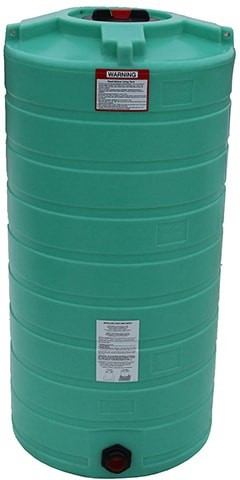
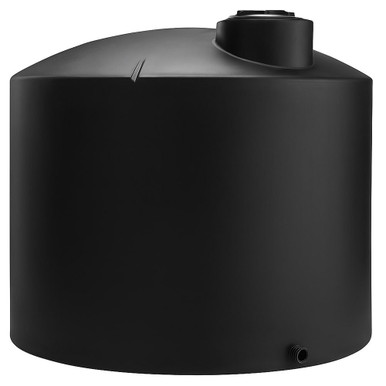
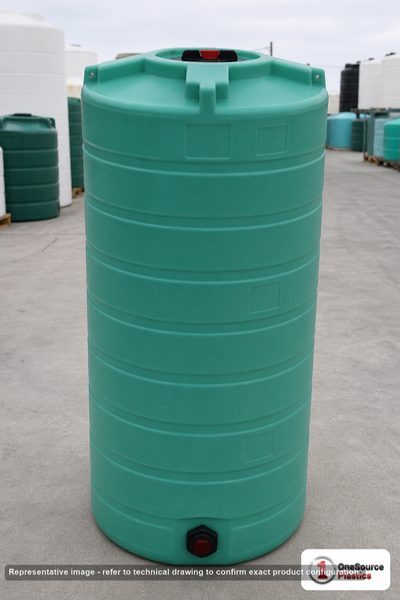
- The reclaimed-water tank. Asphalt facilities collect reclaimed water from runoff, equipment wash, and dust suppression. The reclaimed water is held in polyethylene tanks for reuse in dust suppression or pre-treatment. Reference N-41524 2500 gallon Norwesco vertical as a typical reclaimed-water tank.
- The anti-strip-additive tank. Anti-strip additives (typically liquid amines) are blended into the asphalt at the paving plant to improve aggregate-bond moisture resistance. The additive is held in a polyethylene tank near the blending point. Tank size is typically 500 to 2000 gallons depending on production rate.
- The polymer-modifier dilution-tank. Some polymer-modified asphalt installations dilute concentrated polymer in solvent before adding to the asphalt. The dilution tank is polyethylene at room temperature; the dilution chemistry is solvent-compatible polyethylene. Reference N-40152 1000 gallon Norwesco vertical as a typical mid-size auxiliary tank.
- The dust-suppression-water tank. Water for dust suppression on aggregate stockpiles, haul roads, and loading areas is held in polyethylene tanks. The tanks may include surfactant additives that reduce water consumption.
- The maintenance-fluids storage. Diesel for plant equipment, hydraulic oil for plant machinery, and lubricants for ancillary equipment are held in polyethylene tanks. Standard fuel-grade and lubricant compatibility apply.
- The emulsion-asphalt tank for tack-coat operations. Cooler emulsion-asphalt for tack coat (the bond-coat between asphalt lifts) may be held in polyethylene tanks at the lower end of the emulsion temperature range (under 140 degrees Fahrenheit). Cross-reference the OEM compatibility data for the specific emulsion product.
- The wash-water capture tank. Equipment wash and truck wash produce contaminated water that is collected for treatment. Polyethylene is compatible with the wash-water chemistry.
The polyethylene auxiliary tanks at an asphalt facility are not the high-visibility installations but they are the working storage that supports the daily operations.
9. The Liquid-Asphalt Storage Engineering Conclusion
Liquid-asphalt storage at the 275 to 350 degrees Fahrenheit operating range is outside the polyethylene tank service envelope. The hot-service storage uses welded steel tanks with insulation, heat tracing, viscosity management, and roof-vapor handling as an integrated engineered system. The polyethylene tank role at asphalt facilities is in the auxiliary operations: reclaimed water, anti-strip additives, polymer-modifier dilution, dust suppression, maintenance fluids, and tack-coat emulsions. Sites that build the full hot-service-asphalt installation produce safe and efficient storage; sites that try to substitute polyethylene for the hot-service role produce installations that fail predictably and expose the operator to safety and compliance risk.
OneSource Plastics ships polyethylene tanks across the 5-brand catalog (Norwesco, Snyder, Chem-Tainer, Enduraplas, Bushman) for the auxiliary roles at asphalt facilities and for the broader range of moderate-temperature chemistry storage. Hot-service asphalt storage is referred to specialty steel-tank fabricators with the experience and the design infrastructure for the temperature regime. List pricing on each polyethylene tank product page; LTL freight to your ZIP via the freight estimator or by phone at 866-418-1777.
Recommended Tanks for This Guide
Live pricing, updated automatically · estimate freight to your ZIP.