Methane Offgassing in Anaerobic Digestate Storage Tanks: HDPE Permeation, Vent Sizing for Continuous CH4 Release, and LEL Detection Engineering
Anaerobic digestate is the liquid effluent from anaerobic digesters running on dairy manure, swine waste, food-processing residuals, municipal biosolids, or energy-crop feedstock. The digester itself produces biogas (60-65% methane, 30-35% carbon dioxide, with trace hydrogen sulfide and water vapor) which is captured for energy recovery. The downstream digestate - the liquid solids stream - is often assumed to be biologically stable once it leaves the digester. That assumption is wrong. Digestate continues to produce methane in storage at rates that depend on residence time in the digester, retention time in storage, ambient temperature, and the volatile solids destruction efficiency of the upstream digester. A storage tank designed without explicit consideration of secondary methane production can become a confined-space hazard or, in the worst case, a flammable-vapor ignition source.
This guide walks the engineering reality of post-digestion methane production in storage, the polyethylene permeation behavior that matters for tank wall material selection, vent sizing methodology for continuous methane release, lower explosive limit (LEL) detection placement, and the regulatory framework that applies to digestate storage in the United States. Reference standards include ASTM D1434 for plastic permeability, NFPA 820 for biosolids facility ventilation, OSHA 29 CFR 1910.146 for confined spaces, and the EPA AgSTAR program technical documents on dairy digester design.
1. Why Digestate Keeps Producing Methane in Storage
Anaerobic digesters are typically sized for 20 to 40 days hydraulic retention time (HRT) at mesophilic temperatures around 35-38 degrees C. Volatile solids destruction in that window is generally 40-60% for dairy manure, 50-70% for food waste, and 30-50% for fibrous energy crops. The remaining volatile solids are not inert - they are the slowly-degradable fraction that the digester did not have time to consume. When the digestate leaves the digester at 35 deg C and enters a storage tank that may be uninsulated and unheated, the temperature drops over hours to days toward ambient. Methanogenic archaea remain viable down to 5-10 deg C, and the residual volatile solids continue to ferment, producing methane at a rate that varies with temperature and substrate availability.
The Cornell University AgSTAR digestate research program documented post-digester methane emission rates of 1-5% of upstream digester gas production in long-residence-time storage lagoons, with the range extending to 10-15% in warm climate operation with extended storage periods. Translated to a closed storage tank: a 100,000 gallon digestate tank receiving effluent from a 700-cow dairy digester producing 50,000 SCF/day of biogas may generate 500 to 7,500 SCF/day of secondary methane in storage. That secondary methane must vent somewhere, and if it accumulates in the tank headspace at concentrations above 5% by volume, the headspace becomes a flammable atmosphere.
2. The HDPE Permeation Behavior That Matters
High-density polyethylene is permeable to methane at rates that are small but not zero. The ASTM D1434 permeability of HDPE to methane at 23 deg C is approximately 1.5 to 2.5 cm3 mm / m2 day atm depending on resin density and crystallinity. For a 1,500 gallon HDPE storage tank with a 0.4-inch (10 mm) wall thickness and a wetted surface area of roughly 200 ft2 (18.6 m2), the steady-state methane permeation outward through the wall at 1 atm partial pressure inside is approximately 28 to 47 cm3 per day - a trivial flow compared to the 500 to 7,500 SCF/day secondary methane production rate.
The conclusion: HDPE tank walls do not vent methane effectively. The wall is essentially a methane barrier at the rates that matter. Methane produced in the digestate accumulates in the tank headspace and must vent through engineered openings - tank manway gaskets, vent risers, fill ports, or designed pressure-relief vents - not through the polymer wall. Treat the HDPE tank as a sealed pressure vessel for vent sizing purposes; the wall permeation is below the noise floor.
What HDPE permeation matters for is hydrogen sulfide. H2S permeability through HDPE is roughly 100x higher than methane, and digestate produces 50 to 500 ppm H2S in the headspace at typical sulfur loadings. The H2S that does permeate outward through the tank wall creates an outdoor odor signature that customers notice. For odor-sensitive sites - dairy operations near residential, food-waste digesters near commercial - this drives the choice of XLPE (lower H2S permeability) over HDPE, or specifies a tank with an engineered odor-control liner.
3. Vent Sizing for Continuous Methane Release
The American Petroleum Institute (API) Standard 2000 vent sizing methodology for atmospheric storage tanks treats vent flow as a function of tank in-breathing (during pump-out, ambient cooling) and out-breathing (during fill, ambient heating). For a digestate tank, those two flows are baseline - the methane production overlay adds a continuous out-breathing flow that does not stop when fill stops or when ambient stabilizes.
For a 50,000 gallon digestate tank with measured secondary methane production of 1,000 SCF/day, the methane vent flow is approximately 0.7 SCFM continuous. That seems trivial - until you compare it to the API 2000 thermal in-breathing rate during a 20 deg C diurnal swing, which is on the order of 30 SCFM for a tank of that size. The methane is a small fraction of the total vent flow but it is always there, never reverses direction, and accumulates at the vent termination point if the termination is not designed for it.
The vent sizing rules of thumb for digestate storage:
- Atmospheric vent must remain open continuously. No pressure-vacuum relief valve unless the tank is ASME-stamped pressure vessel construction with appropriate set-points.
- Vent diameter sized for combined API 2000 normal in/out-breathing PLUS 5x measured methane production rate as design margin.
- Vent must terminate at minimum 12 ft above grade, away from work surfaces, away from HVAC intakes, away from electrical equipment, and away from ignition sources.
- Vent termination must NOT be enclosed within a building. Indoor venting requires NFPA 820 ventilation engineering, which is beyond what an open atmospheric vent provides.
- Vent must NOT be screened with brass or copper mesh. Use 316 stainless steel mesh sized to exclude insects without restricting flow more than 5%.
- Vent must include a flame arrestor where the termination is in proximity to potential ignition sources. Detonation-arrestor type per FM 6061 if H2S is present (which sensitizes the methane mixture toward detonation rather than deflagration).
4. LEL Detection Placement and Calibration
Methane lower explosive limit is 5% by volume in air. Upper explosive limit is 15%. Operating philosophy for digestate storage is that the headspace should never exceed 25% LEL (1.25% methane) at any sampled point - this is the OSHA confined-space alarm threshold. The 25% LEL alarm gives the operator time to investigate ventilation failure, fill rate excursion, or methane production spike before the headspace reaches a flammable concentration.
LEL detector placement requires care because methane is lighter than air (specific gravity 0.55 relative to air) and stratifies upward. The detector must be placed at the highest point of the tank headspace, near the vent take-off, NOT at floor level the way you would place an H2S detector. A common mistake is to use a multi-gas confined-space monitor (which puts the LEL sensor in the same enclosure as the H2S sensor at chest height) and rely on the LEL channel to detect methane in a tank headspace - this misses methane that has stratified to the dome.
Calibration cadence per the OSHA Substance-Specific Health Standards: bump test daily prior to use, full span calibration every 30 days, sensor replacement at manufacturer-specified intervals (typically 2 to 5 years for catalytic bead, 2 to 4 years for IR sensors). Document the calibration log because OSHA inspections of regulated facilities will request it.
5. Tank Selection for Digestate Service
The catalog options that fit digestate storage in the 1,000 to 5,000 gallon range cover farm-scale and small commercial digester sites. Larger municipal or food-waste operations typically run 25,000+ gallon storage that is field-erected steel or concrete, beyond polyethylene catalog scope. For the polyethylene catalog range:
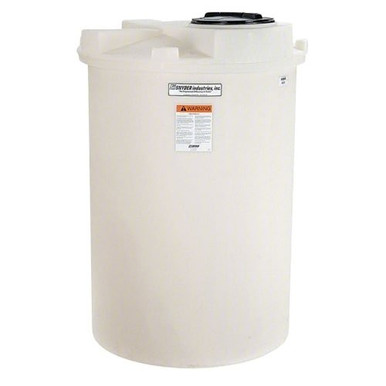
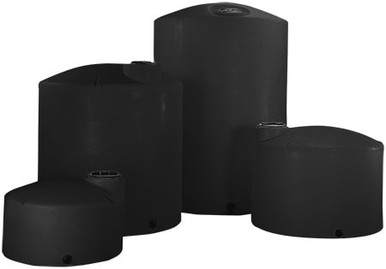
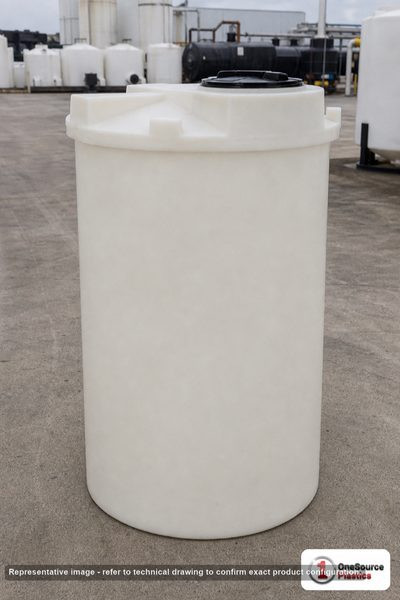
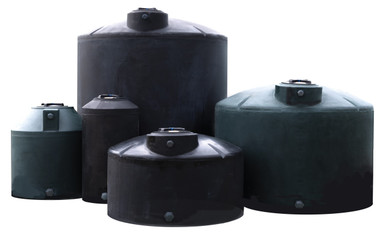
- The Norwesco N-40146 1,500 gallon vertical in HDPE is a workable choice for short-residence digestate storage where odor control is not the dominant concern. Specify white or natural color to limit solar gain on the tank wall (which would accelerate continued methanogenesis).
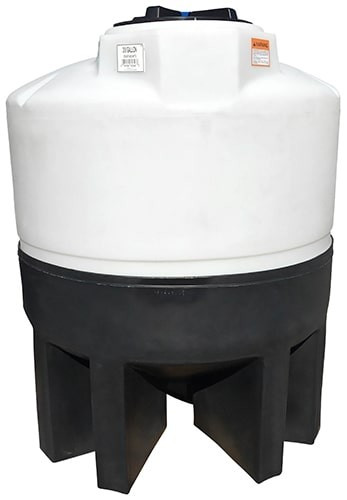
- The Snyder SII-5990102N42 1,000 gallon XLPE Captor double-wall provides integrated secondary containment plus the lower H2S permeability of XLPE. The double-wall annular space is the appropriate place to mount the LEL detector port.
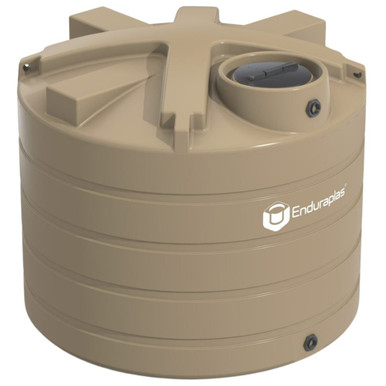
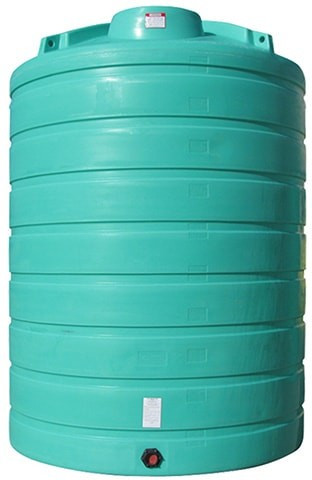
- The Enduraplas EP-THV02500FG 2,500 gallon vertical offers larger volume with the green color-matched aesthetic that some agricultural sites prefer for rural visibility.
For all three options, the procurement specification must include explicit vent location, vent size (3-inch minimum for digestate service), top-fitting layout with provision for an LEL detector port, and a warranty disclosure on whether the manufacturer covers digestate service. Most polyethylene tank warranties specify potable water or industrial chemical service - digestate may be classified separately with reduced warranty terms.
6. Regulatory Framework and AHJ Approvals
Digestate storage falls under multiple regulatory layers depending on site type and feedstock:
- EPA NPDES discharge permit if any digestate or runoff reaches surface water. State-issued under federal authority. Typically requires nutrient management plan and storage capacity sized for the local non-application season (winter in northern climates, wet season in southern climates).
- EPA Concentrated Animal Feeding Operation (CAFO) rule under 40 CFR 122.23 if the upstream operation is a Large CAFO. CAFO rule requires storage capacity, runoff control, and recordkeeping. Digestate is treated as manure for CAFO purposes regardless of digester upstream.
- State agricultural waste regulations - varies widely. Wisconsin, California, Pennsylvania, and Indiana have specific dairy digestate rules. Other states default to general manure storage rules.
- OSHA confined space program under 29 CFR 1910.146 applies to any tank entry. Digestate tank is a permit-required confined space because of the methane and H2S hazard. Entry requires written permit, atmospheric testing, attendant, retrieval equipment, and emergency response procedures.
- NFPA 820 Standard for Fire Protection in Wastewater Treatment and Collection Facilities - applies if the digestate is from municipal biosolids. Specifies area classification (Class I Division 2 for digestate storage areas), ventilation rates, and equipment ratings.
- Local fire code adoption of NFPA 30 or IFC for the methane offgassing hazard. AHJ may require an explosion-proof rating on electrical equipment within 5 ft of the vent termination, even outdoors.
The procurement and installation paperwork should be assembled before tank delivery: NPDES permit (or coverage under a general permit), CAFO nutrient management plan if applicable, OSHA confined-space program documentation, and AHJ pre-installation review of the vent and LEL detector layout. Installing first and getting AHJ approval after is a recipe for a stop-work order.
7. Operational Monitoring Cadence
Routine monitoring during digestate storage operation:
- Daily: Visual inspection of vent for blockage (insect nests, ice accumulation in winter, algal mat in summer if vent termination is wet). LEL detector function check via bump test.
- Weekly: Tank level reading. Sample digestate temperature - drift above 25 deg C in a normally-ambient tank indicates either upstream digester upset (digestate leaving hotter than design) or active methanogenesis in storage producing reaction heat.
- Monthly: Headspace methane concentration measurement at three points (high dome, mid-height, near surface). Three-point measurement reveals stratification gradient and confirms LEL detector placement is reading the highest-concentration zone.
- Quarterly: Vent flow capacity verification by measuring pressure differential across the vent during a forced fill cycle. Vent restriction shows up as a small but measurable backpressure at the fill connection.
- Annual: Tank entry inspection following confined-space permit. Wall integrity, sediment depth, fitting condition, dome accumulation. Document in CMMS for future reference.
8. Failure Modes and Incident Patterns
The documented failure modes for digestate storage tanks:
- Vent obstruction by frozen condensate. Methane saturated with water vapor at 35 deg C condenses in the vent riser as the gas cools toward outdoor ambient. In sub-freezing weather, the condensate freezes, restricts the vent, and tank headspace pressurizes. Mitigation: heat-traced vent riser to 5 deg C minimum, or insulated riser with condensate drain trap.
- Vent obstruction by insect colonization. Mud daubers and similar wasps build nests in vent terminations during summer. The nest mass is sufficient to fully block a 2-inch vent. Mitigation: 316 stainless mesh screen at vent termination, inspected monthly during warm season.
- LEL detector calibration drift. Catalytic bead LEL sensors poison gradually with H2S exposure, reading low even when methane concentration rises. Operator complacency develops because the alarm has not fired. Mitigation: replace LEL sensor every 24 months in H2S-exposed service regardless of manufacturer-stated life; calibrate monthly with span gas.
- Solar-gain methanogenesis acceleration. A black tank in southern latitudes can reach internal temperature of 40 deg C, well into the mesophilic methanogenesis range. Methane production doubles compared to white-tank operation at the same site. Mitigation: white or natural tank color, or insulation jacket, or shade structure.
- Confined-space entry without permit. The single most-recurrent fatal incident pattern in digestate tank operation is unauthorized entry to clear an obstruction or perform a quick fix. Asphyxiation occurs in seconds at full headspace methane saturation. Mitigation: posted permit-required signage, locked manway covers, training documentation for all site staff.
9. Procurement and Action Checklist
Before placing a digestate storage tank order:
- Document the upstream digester volatile solids destruction efficiency. If unknown, assume 50% as design baseline.
- Calculate the expected secondary methane production rate using AgSTAR methodology. Multiply digester biogas production by 0.05 as an upper-bound for storage methane.
- Specify tank size for the local non-application storage capacity requirement (180 days minimum in most northern states for dairy operations).
- Specify XLPE Captor or HDPE based on odor-sensitivity of the site. XLPE preferred where neighbors are within 0.25 mile.
- Specify white or natural color to limit solar gain. Black tanks are appropriate only at northern latitudes with year-round cool ambient.
- Specify 3-inch minimum vent diameter, 12-ft minimum termination height, 316 stainless mesh screen, optional flame arrestor for sites with proximate ignition sources.
- Specify top-fitting layout with provision for an LEL detector port at the highest point of the tank dome.
- Specify confined-space entry hardware: locking manway cover, fall-arrest anchor point, lighting penetration, sample port for atmospheric testing.
- Confirm warranty terms on digestate service. Get written confirmation from manufacturer if standard warranty excludes digestate.
- Pre-coordinate with AHJ on vent location, electrical area classification, and confined-space permit format before tank delivery.
OneSource Plastics carries the polyethylene digestate storage tanks for farm-scale and small commercial digester sites across the Norwesco, Snyder, and Enduraplas product lines. For larger field-erected digestate storage, our role is upstream tank selection (feedstock pre-storage) and downstream nutrient distribution (applicator and field tanks). For digestate tank specification with full vent and LEL engineering review, call 866-418-1777 with the upstream digester capacity, feedstock type, climate zone, and site sensitivity profile. Reference pricing for representative SKUs: Norwesco N-40146 1,500 gallon vertical at $2,837.16 list; Snyder SII-5990102N42 1,000 gallon XLPE Captor at $6,798.99 list; Enduraplas EP-THV02500FG 2,500 gallon vertical at $2,768.85 list. LTL freight to your ZIP is quoted via the freight estimator.
For complementary reading on related industrial-digester-adjacent topics, see the chemical compatibility hub for H2S-resistant material guidance, and our mechanical integrity testing guide for the inspection cadence on long-service tanks. For SPCC and secondary containment context, see our Captor double-wall comparison.
Recommended Tanks for This Guide
Live pricing, updated automatically · estimate freight to your ZIP.