Tank Mechanical Integrity Testing: Hydrostatic vs Vacuum vs UT vs Acoustic Emission
Mechanical integrity testing (MIT) is the umbrella term for the family of in-service inspection methods that determine whether a storage tank can be returned to service or must be repaired or retired. The four dominant methods — hydrostatic pressure test, vacuum test, ultrasonic thickness measurement (UT), and acoustic emission (AE) — each answer a different question, have a different cost envelope, and apply to different tank types. Confusing them is expensive: a tank that passed a tightness test last year is not the same as a tank that passed a structural-integrity inspection.
This guide walks the four methods, the standards that govern each, the failure modes each can and cannot detect, the cost ranges, and the catalog of OneSource tanks where each method applies. Citations are real and verified: API 653, API 12P, ASTM E797, ASTM E976 (acoustic emission), ASME Section V Article 5, AWWA C652, and 40 CFR 280.43 (UST release detection).
The Four MIT Methods at a Glance
| Method | Detects | Tank Types | Cost Range (5K gal) | Time |
|---|---|---|---|---|
| Hydrostatic test | through-wall leaks, structural overload | steel, FRP, HDPE | $500-$2,000 | 4-24 hours |
| Vacuum test | through-wall pinhole leaks | steel, FRP UST | $800-$2,500 | 2-8 hours |
| Ultrasonic thickness | wall-thickness loss, internal corrosion | steel, HDPE | $1,500-$5,000 | 4-16 hours |
| Acoustic emission | active crack growth, leaks under load | steel, FRP | $3,000-$10,000 | 1-4 hours |
Method 1: Hydrostatic Pressure Test
Hydrostatic test is the oldest and most universally accepted MIT. Fill the tank to a specified head height (often the design freeboard plus a safety margin), hold for a defined time, monitor for level drop and visible leakage. If the level holds and no leak is observed at the floor seam, dome flange, or fittings, the tank passes.
Standards Governing Hydrostatic Test
- API 650 Section 7.3.6 — initial hydrostatic test for new welded tanks. Fill rate limited to prevent foundation overload. Hold time per the tank diameter and shell thickness.
- API 653 Section 12.3 — hydrostatic test after major repair. Required if shell-plate replacement, floor replacement, or geometry change exceeds defined thresholds.
- ASTM D1998 Section 13 — for polyethylene tanks, manufacturer's hydrostatic test prior to shipment. Fill with water to overflow elevation, hold 30 minutes, inspect.
- AWWA D101 Section 12 — AST hydrostatic test for water-storage service. Fill to overflow, hold 24 hours, accept if level drop is within evaporation tolerance for the test conditions.
What Hydrostatic Test Does Not Catch
Hydrostatic test is a structural-overload test plus a gross-leak test. It does not catch:
- Internal corrosion or wall thinning that has not yet reached through-wall.
- Active crack growth below the leak threshold.
- Pinhole leaks if the leak rate is below the level-measurement resolution (typically 0.05 in over 24 hours, equivalent to ~0.5 gal/hr on a 12-ft diameter tank).
- Vapor-space defects (the tank is full during the test; the upper shell sees only the head pressure of the test fluid).
For applications where structural-load verification is the primary concern — new tank acceptance, post-repair return-to-service for moderate-pressure water tanks — hydrostatic test is the cost-effective choice. For UST tightness testing, hydrostatic alone is insufficient.
Method 2: Vacuum Test (Tightness Test)
Vacuum test pulls the tank to a defined negative pressure and monitors for pressure recovery. Air ingress through any wall or fitting defect is detectable as pressure rise on the gauge. Vacuum test is the dominant tightness-test method for underground storage tanks (USTs) under 40 CFR 280.43(c).
Standards Governing Vacuum Test
- 40 CFR 280.43(c) — periodic tank tightness testing as one of the allowed UST release-detection methods. Test method must detect a 0.1 gal/hr leak with at least 95% probability of detection and no more than 5% probability of false alarm.
- EPA SIR (Statistical Inventory Reconciliation) — alternative to vacuum test. Uses inventory data over weeks/months instead of a discrete test event.
- NLPA 631 — National Leak Prevention Association standard for tightness testing of UST.
- API RP 575 — Inspection of Atmospheric and Low-Pressure Storage Tanks. Section 6 covers tightness-test methodology for AST applications.
What Vacuum Test Catches and Misses
Vacuum test catches: through-wall leaks, fitting leaks, vapor-space porosity, manway gasket leakage. Vacuum test misses: structural defects that are not yet leaking, wall-thinning that has not breached the wall, and active crack growth that has not yet reached through-wall.
For UST owners, vacuum test plus annual line tightness test plus continuous monitoring (interstitial probe, automatic tank gauge) is the typical compliance package. For AST, vacuum test is occasional and supplemental to hydrostatic and UT.
Method 3: Ultrasonic Thickness (UT) Measurement
UT measures wall thickness by timing the round-trip travel of a high-frequency sound pulse from the outer surface to the inner surface and back. The measurement is local — each measurement covers a few square inches at the transducer location. UT is the primary MIT tool for steel tanks where internal corrosion is the dominant failure mode.
Standards Governing UT
- ASTM E797 — Standard Practice for Measuring Thickness by Manual Ultrasonic Pulse-Echo Contact Method. The reference test method for hand-held UT.
- API 653 Section 6.4 — internal corrosion rate determination from UT data. Defines minimum measurement-grid density and the calculation of remaining corrosion allowance.
- ASME Section V Article 5 — UT examination methodology for pressure vessels (also referenced for tank inspection).
- API 571 — Damage Mechanisms Affecting Fixed Equipment in the Refining Industry. Provides the failure-mode framework that UT-derived corrosion rates feed into.
UT for Polyethylene Tanks
UT works on HDPE with the correct sound-velocity setting. Polyethylene velocity is ~2,400 m/s (vs ~5,920 m/s for carbon steel) and the gauge must be calibrated to the specific resin. UT detects:
- Wall-thickness loss from chemical attack (acid-attack thinning, polymer-swelling thinning).
- Original-spec verification on tanks where wall thickness is in dispute (e.g., contents shifted to higher specific gravity).
- Localized thinning around manways, fitting bosses, where stress concentration plus contents attack accelerates loss.
UT does not detect HDPE crazing or environmental stress crack initiation. Those require visual inspection per ASTM D1693 visual interpretation guidance.
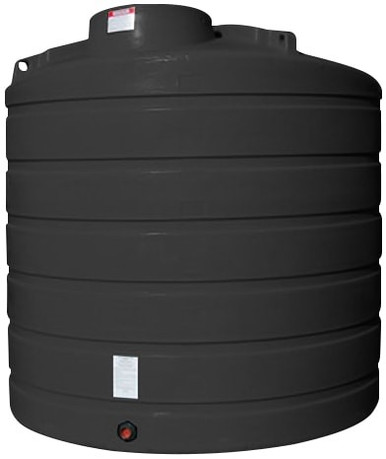
Real catalog HDPE tanks where UT is the diagnostic of choice include the Norwesco MPN 47564 (2,000-gallon vertical blue, SG 1.9), Norwesco MPN 42380 (3,000-gallon blue), and the Norwesco MPN 47638 (10,500-gallon vertical) after 10+ years in chemistry service.
Method 4: Acoustic Emission (AE) Testing
AE detects the elastic-wave transients that active crack growth, plastic deformation, and leak turbulence produce. The tank is loaded (typically pressurized hydrostatically or pneumatically to a defined fraction of design pressure) and an array of piezoelectric sensors on the tank wall captures the AE events. Software locates each event by time-difference-of-arrival across the array.
Standards Governing AE
- ASTM E976 — Standard Guide for Determining the Reproducibility of Acoustic Emission Sensor Response.
- ASTM E1316 — Standard Terminology for Nondestructive Examinations (AE definitions section).
- ASTM E1067 — Standard Practice for Acoustic Emission Examination of Fiberglass Reinforced Plastic Resin Tanks/Vessels. The reference standard for AE on FRP tanks.
- ASTM E1118 — Standard Practice for Acoustic Emission Examination of Reinforced Thermosetting Resin Pipe (RTRP).
- ASME Section V Article 11/12 — AE examination of metallic and FRP pressure vessels.
- API 12P — Specification for Fiberglass Reinforced Plastic Tanks (covers acceptance testing including AE for production tanks).
What AE Catches
AE catches active defects: cracks that grow during the load cycle, leaks that turbulently emit acoustic energy, fiber-matrix debonding in FRP under load. AE does not catch dormant defects — a crack that exists but does not extend during the test event is invisible to AE.
The dominant application is FRP tank periodic inspection per ASTM E1067. Steel-tank AE is supplemental: useful for confirming whether a UT-discovered thinning area is actively cracking under load. AE is rarely the primary MIT for HDPE because polyethylene's viscoelastic behavior produces high acoustic background that complicates detection.
Selecting the Right Method
By Tank Type
- Steel AST, water service — hydrostatic for return-to-service; UT for periodic floor and shell scan; AE only if a structural concern is flagged by UT.
- Steel UST, fuel or chemical service — vacuum tightness test annually per 40 CFR 280.43(c); UT every 5-10 years if access permits; AE if UST is large-volume and access is limited.
- FRP AST or UST — AE periodic per ASTM E1067; vacuum tightness test for UST regulatory compliance.
- HDPE AST — visual inspection per ASTM D1693 guidance; UT for chemistry-service tanks at 10-year mark; hydrostatic only for new acceptance.
By Failure Mode
- Suspect corrosion thinning — UT.
- Suspect leak — vacuum test (UST) or hydrostatic (AST).
- Suspect crack growth — AE.
- Verify structural margin after repair — hydrostatic.
Pre- and Post-Test Disinfection
Water-storage tanks that are taken out of service for MIT must be disinfected before return to service per AWWA C652. The chlorination procedure (Method 1, 2, or 3 of C652) plus the bacteriological-clearance sampling typically adds 24-72 hours to the out-of-service window. Cost-of-downtime planning must include the disinfection cycle, not just the test event.
For potable-water tanks, all interior coatings, gaskets, and any test-water additives must be NSF/ANSI 61 listed. A tank passed mechanical inspection but failed bacteriological clearance is the single most common reason for return-to-service delay.
MIT-Aware Replacement Catalog
If MIT results indicate replacement, OneSource catalog options include:
- Cone-bottom process tanks (gravity drain, full-evacuation) — Norwesco MPN 43852 (1,000-gallon 45-deg cone bottom), Norwesco MPN 44420 (1,020-gallon 15-deg cone), Norwesco MPN 40359 (1,050-gallon 20-deg with stand), Norwesco MPN 44217 (110-gallon full-drain inductor).
- Underground tanks (UST replacement) — Norwesco MPN 41735 (1,000-gallon underground), Norwesco MPN 41772 (1,500-gallon underground).
- Septic tank replacement (failed tightness test) — Norwesco MPN 41718 (1,000-gallon IAPMO), Norwesco MPN 43511 (1,250-gallon two-compartment IAPMO), Norwesco MPN 44482 (1,000-gallon low-profile IAPMO).
- Vertical chemical replacement (UT-flagged thinning) — Norwesco MPN 47564 (2,000-gallon SG 1.9), Norwesco MPN 47620 (6,502-gallon), Norwesco MPN 42380 (3,000-gallon).
List prices are quoted before LTL freight. Use the Freight Cost Estimator for delivered pricing to a specific ZIP, and the Chemical Tank Recommender to confirm material, SG rating, and certification class for chemistry-service replacement.
Cost-of-Test Decision Framework
For a 5,000-gallon AST, typical MIT cost ranges:
- Hydrostatic only — $500-$2,000 depending on water sourcing, disposal, and disinfection. Time: 4-24 hours plus disinfection.
- UT scan, 50-point grid — $1,500-$3,500 including report. Time: 4-8 hours, no out-of-service required.
- UT plus hydrostatic — $2,000-$5,000 combined.
- AE on FRP tank — $3,000-$10,000 depending on tank diameter and access. Time: 1-4 hours, in-service possible if loading can be controlled.
- Full API 653 internal inspection — $15,000-$50,000+ for a 5,000-gallon AST, including out-of-service costs, MFL floor scan, UT shell scan, and inspector report. Time: 1-3 weeks.
The cost of testing should not exceed 10-20% of replacement cost. If cumulative MIT spend over the next inspection cycle exceeds that threshold, replacement is the better economic decision.
Internal References
- State Regulations Hub — UST tightness-test schedules and inspector certification by state
- Chemical Compatibility Reference — failure-mode prediction by contents chemistry
- Freight Cost Estimator — LTL pricing for replacement-tank delivery
- Tank Sizing Calculator — capacity validation for replacement
- Chemical Tank Recommender — material and SG selection for chemistry-service replacement
- Specialty & Metal Fabrication Hub — custom-build replacement options
- Certified Steel Fabrication — API 650-compliant new builds
Source Citations
- API 650 — Welded Tanks for Oil Storage (Section 7.3.6 hydrostatic test)
- API 653 — Tank Inspection, Repair, Alteration, and Reconstruction (Section 6.4 UT, Section 12.3 hydrostatic)
- API 12P — Specification for Fiberglass Reinforced Plastic Tanks
- API RP 575 — Inspection of Atmospheric and Low-Pressure Storage Tanks
- API 571 — Damage Mechanisms Affecting Fixed Equipment in the Refining Industry
- ASTM E797 — Standard Practice for Measuring Thickness by Manual Ultrasonic Pulse-Echo Contact Method
- ASTM E976 — Standard Guide for Determining the Reproducibility of Acoustic Emission Sensor Response
- ASTM E1067 — Standard Practice for Acoustic Emission Examination of Fiberglass Reinforced Plastic Resin Tanks/Vessels
- ASTM E1118 — Standard Practice for Acoustic Emission Examination of Reinforced Thermosetting Resin Pipe
- ASTM E1316 — Standard Terminology for Nondestructive Examinations
- ASTM D1693 — Standard Test Method for Environmental Stress-Cracking of Ethylene Plastics
- ASTM D1998 — Standard Specification for Polyethylene Upright Storage Tanks
- ASME BPVC Section V Article 5 — Ultrasonic Examination Methods for Materials and Fabrication
- ASME BPVC Section V Article 11 — Acoustic Emission Examination of Fiber-Reinforced Plastic Vessels
- AWWA C652 — Disinfection of Water-Storage Facilities
- AWWA D101 — Inspecting and Repairing Steel Water Tanks
- NLPA 631 — Tightness Testing of Underground Storage Tanks
- NSF/ANSI 61 — Drinking Water System Components: Health Effects
- 40 CFR 280.43 — Methods of Release Detection for UST
- OneSource Plastics master catalog data, dated 2026-03-26 snapshot (9,419 products across Norwesco, Snyder, Chem-Tainer, Enduraplas, Bushman)
Recommended Tanks for This Guide
Live pricing, updated automatically · estimate freight to your ZIP.