Norwesco Cone Bottom Tank Buyer's Guide: 15 Degree vs 30 Degree vs 45 Degree Selection
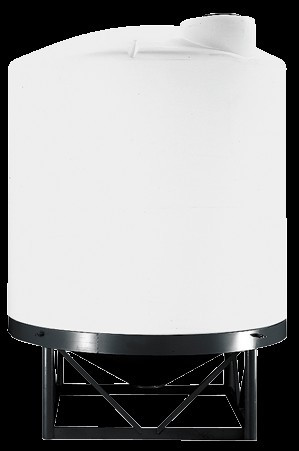
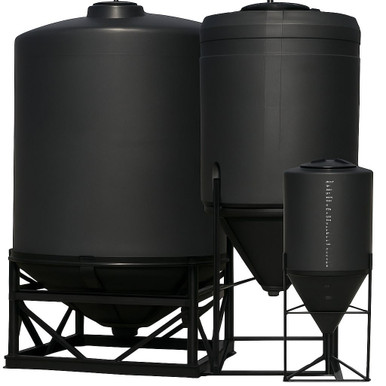
Norwesco produces cone-bottom tanks at three standard cone angles: 15 degrees, 30 degrees, and 45 degrees. The cone angle is measured from horizontal, so a 15-degree cone is shallow (cone tip drops only 15 degrees below the cylinder bottom) and a 45-degree cone is steep (cone tip drops 45 degrees, an aggressive angle that drains rapidly). The choice between the three is not a matter of preference. It is dictated by the fluid you're storing, the residence-time tolerance of your process, the floor-to-ceiling clearance available at the install, and the type of stand the tank sits on.
This guide walks through the engineering basis for cone-angle selection and pairs each angle with the real Norwesco SKUs in the OneSource Plastics catalog. Pricing is list before LTL freight; freight is quoted to ZIP via the Freight Estimator. By the end of this guide you should be able to pick the correct cone angle for your application without guessing and without overpaying for a steeper cone you don't need.
The Physics: Why Cone Angle Matters
A cone-bottom tank exists because flat-bottom tanks accumulate sediment and unrecoverable residue. A flat tank floor drains the bulk volume but leaves a thin film, particles, and any settled solids on the floor. The cone bottom uses gravity to channel solids and residual fluid toward a single low-point outlet, eliminating dead zones.
The cone angle determines three things:
- Drainage rate. Steeper cone means faster gravity-driven flow toward the outlet. A 45-degree cone drains a viscous fluid roughly 3 to 5 times faster than a 15-degree cone of equivalent capacity.
- Settling efficiency. Steeper cone concentrates settled solids in a smaller cross-section at the bottom of the cone, making them easier to draw off through the outlet. A shallow 15-degree cone leaves more residue spread across the cone surface.
- Tank height. Steeper cone makes the tank taller for the same cylindrical capacity. A 1,000 gallon 45-degree cone-bottom is roughly 89 inches tall (cylinder + cone). The same 1,000 gallon capacity at 15-degree cone is roughly 73 inches tall (cylinder + much shorter cone). Floor-to-ceiling clearance becomes the binding constraint at higher capacities.
The trade-off is straightforward: steeper cone = better drainage and settling but taller tank and higher cost (more material in the cone section). Shallower cone = lower height and cost but accepts incomplete drainage of viscous or solids-laden fluids.
The 15 Degree Cone: Shallow, Compact, Water-Service
A 15-degree cone drops only modestly below the cylinder. The cone-to-cylinder transition is gentle, the overall tank height stays manageable, and the cone uses minimal additional material. The cone angle is too shallow to drain viscous fluids efficiently but is well-suited to water and water-like fluids that drain freely under gravity regardless of cone angle.
Best for:
- Potable water storage with periodic full drain-down for tank cleaning
- Irrigation water with minimal sediment loading
- Rainwater harvesting where the inlet filter prevents heavy solids from reaching the tank
- Process water where sub-second drain time is not required
- Low-headroom installations where cone-bottom-tank-on-stand height is constrained by ceiling
Avoid for:
- Viscous chemistry (resins, polymers, syrups, glycerin, any fluid with viscosity above 100 cP)
- Slurries or solids-laden liquids
- Process applications where complete drainage between batches is critical (food, pharmaceutical, biotech)
Norwesco 15-Degree Cone-Bottom SKUs
| MPN | Capacity | Diameter × Height | Stand Type | Color |
|---|---|---|---|---|
| N-44420 | 1,020 gal | 91″ × 53″ | Stand sold separately | Blue |
The 15-degree family at Norwesco is narrower than the 30 and 45 lines because most cone-bottom service applications need the steeper drainage angle. The 15-degree cone is selected primarily for water-service applications where the wide-shallow geometry fits a low-headroom install (the 1,020 gallon at 91-inch diameter and 53-inch height is roughly the height of a kitchen counter, easy to fit under a 7-foot ceiling).
The 30 Degree Cone: The Versatile Mid-Range
A 30-degree cone drops significantly below the cylinder, providing genuine gravity-driven drainage for most chemistry and process applications. The cone is not so steep that the tank becomes ungainly tall; not so shallow that viscous fluids leave a residence film. This is the workhorse cone angle and represents the largest segment of the cone-bottom catalog.
Best for:
- Industrial chemistry (most acids, bases, chlorinated salts at moderate concentration)
- Agricultural fertilizer batch tanks (urea, ammonium nitrate, potassium chloride solutions)
- Wastewater pretreatment (settling tanks where solids drop to the cone tip)
- Brewery and distillery process tanks (mash dump, lauter tun residue, fermenter heel removal)
- Cooling tower side-stream filtration knockout tanks
Avoid for:
- Heavy slurries above 30% solids by mass (the 30-degree angle is at the low end of the solids handling range; 45 is preferred)
- Sub-zero ambient operations where any residence film at the cone is a freeze risk
- Ultra-high-purity applications where every cubic centimeter of residence volume is contamination risk
Norwesco 30-Degree Cone-Bottom SKUs
| MPN | Capacity | Diameter × Height | Stand Type | List Price |
|---|---|---|---|---|
| N-62343 | 300 gal | 42″ × 70″ | Black poly stand | From $895 |
| N-40817 | 1,600 gal | 88″ × 84″ | Stand sold separately | $2,097.99 |
| N-40813 | 1,600 gal | 89″ × 96″ | Poly stand included | $3,448.10 |
Note the price differential between N-40817 (tank only, $2,097.99) and N-40813 (tank with poly stand, $3,448.10). The poly stand adds approximately $1,350 to the base tank price for the 1,600 gallon capacity. For installations where steel framing is preferred or already owned, ordering the tank-only SKU and pairing with a steel stand often comes in below the integrated-stand pricing. See our Cone Bottom Tank Stand Selection guide for the stand decision.
The 45 Degree Cone: Steep, Solids-Capable, Process-Critical
A 45-degree cone drops aggressively below the cylinder. The cone bottom narrows to a point at half the diameter angle of the cylinder, concentrating solids and residual fluid at the smallest possible footprint over the outlet. This angle drains anything you can pour, including viscous chemistry, slurries up to roughly 50% solids, and process residues that would form a residence layer at any shallower angle.
Best for:
- Resin and polymer batching (epoxies, polyols, isocyanates, polyurethane intermediates)
- Food slurry processing (tomato paste, fruit purees, dairy concentrates)
- Mineral slurries (kaolin, bentonite, calcium carbonate suspensions)
- Wastewater sludge handling (concentrated biosolids)
- Pharmaceutical and biotech where complete drainage between batches is mandatory
- Cold-climate applications where any residence volume is a freeze hazard
Trade-offs:
- Tank height is roughly 25 to 35% taller than the equivalent 15-degree at the same gallon capacity
- The cone tip is a stress concentration point. Tanks must be installed on engineered stands, never on bare floor or sand
- Cost premium of approximately 10 to 15% over a 30-degree cone of the same capacity
Norwesco 45-Degree Cone-Bottom SKUs
| MPN | Capacity | Diameter × Height | Lid × Outlet | List Price |
|---|---|---|---|---|
| N-43852 | 1,000 gal | 72″ × 89″ | 16″ × 2″ | $1,606.93 |
| (2,500 gal 45-degree) | 2,500 gal | 72″ × 112″ | 16″ × 2″ | By quote |
The 45-degree cone family is the most specified for chemistry and process applications. The 1,000 gallon at 72-inch diameter and 89-inch height represents the typical mid-range process tank: large enough to feed a multi-day production run, small enough to fit under a standard 9-foot ceiling on most stands. For larger capacities, height becomes the binding constraint and most installs require either a high-bay process room or below-grade pit installation.
Decision Matrix: Cone Angle by Application
| Application | Recommended Cone | Why |
|---|---|---|
| Potable water cistern | 15° | Free-flowing fluid; minimize tank height |
| Irrigation supply | 15° or 30° | Depends on inlet sediment loading |
| Fertigation concentrate | 30° | Periodic full drain for chemistry change |
| Industrial acid storage | 30° | Drainage adequate; avoid 45° height |
| Brewery wort handling | 45° | Trub and protein settling, full drain critical |
| Resin batching | 45° | High-viscosity drainage requires steep angle |
| Food slurry processing | 45° | Solids handling, FDA cleaning protocols |
| Wastewater settling | 30° or 45° | Depends on solids concentration |
| Pharmaceutical batch reactor | 45° | FDA, cGMP cleaning validation |
| Cooling tower blowdown holding | 30° | Light solids, cost-balanced angle |
Drainage-Time Math: How Long Does It Actually Take to Drain?
The Bernoulli-derived drain time for a tank with a sharp-edged orifice at the bottom is approximately:
t = (2 * A_tank / (Cd * A_outlet)) * sqrt(h0 / (2 * g))
Where t is drain time, A_tank is the cross-sectional area of the cylinder, A_outlet is the outlet orifice area, Cd is the discharge coefficient (~0.62 for sharp-edged), h0 is initial fluid height, g is gravitational acceleration.
For a 1,000 gallon tank with 72-inch diameter cylinder and 2-inch outlet, full water drain time is approximately 22 minutes for the cylinder portion. The cone portion adds an additional 5 to 10 minutes depending on cone angle (the cone's narrowing cross-section accelerates the drain rate as fluid level approaches the outlet). This is for free-flowing water only. For viscous fluids (above 100 cP), the drain time increases by a factor of 5 to 50, and the cone angle becomes the dominant factor in residence-film thickness.
Practical implication: if your process requires drain-and-refill in under an hour, a 1,000+ gallon cone bottom needs either a 3-inch outlet or higher, or a discharge pump rather than gravity-only drain. Specify the outlet size against your time budget at order, not after install.
Stand Compatibility by Cone Angle
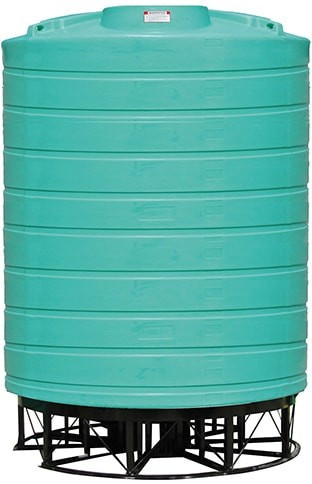
The cone angle dictates the stand geometry. A 15-degree cone tank can sit on a wide, low-profile stand because the cone tip is only modestly below the cylinder. A 45-degree cone tank requires a tall, narrow-base stand to support the full cone height while keeping the tank stable.
Norwesco's poly stands are matched to specific tank MPNs, not to generic cone angles. Always order the stand for the specific tank model; do not attempt to retrofit a stand from a different cone angle. Steel stands are often more flexible because they can be welded to the geometry, but the OEM still publishes a stand drawing for each tank model.
For the full stand-vs-stand decision tree, see our Cone Bottom Tank Stand Compatibility Matrix.
Common Specification Mistakes
Mistake 1: Specifying 45-degree when 30-degree would suffice
The 45-degree premium is real (10 to 15% over 30-degree at equivalent capacity). For water and water-like fluids the 45-degree drainage advantage is invisible because both angles drain freely. Pay for 45-degree only when the fluid genuinely requires it (viscosity above 100 cP, solids handling, or sub-freeze ambient).
Mistake 2: Specifying 15-degree for chemistry service
The 15-degree shallow cone leaves a residence film of 50 to 200 gallons in a 1,000 gallon tank when draining viscous chemistry. If your process requires complete drainage between batch changeovers, the 15-degree angle is wrong for chemistry service regardless of cost savings.
Mistake 3: Forgetting the height clearance during design
The 1,600 gallon 30-degree (N-40817) at 84 inches plus stand height is roughly 9 to 11 feet tall installed. The same capacity at 45-degree would be 11 to 13 feet tall. Many process buildings have 9 or 10 foot ceilings. Verify the install location's clearance before order.
Mistake 4: Pairing a steep cone with a high-viscosity fluid and a small outlet
A 45-degree cone draining maple syrup (viscosity ~3,000 cP at 70F) through a 2-inch outlet takes hours. The cone angle alone doesn't fix slow drainage; outlet size and discharge mechanism (gravity vs pump) matter equally. Specify outlet size and pump requirements alongside cone angle.
Mistake 5: Using a polyethylene stand with a chemistry tank in a fire-load environment
Polyethylene stands burn. In facilities with fire-rated chemistry storage, steel stands are mandatory regardless of cone angle. Check NFPA 30 (Flammable and Combustible Liquids Code) and your local fire marshal's guidance for the install location.
Internal Resources
- Cone Bottom Tanks Catalog — full inventory at all three cone angles
- Cone Bottom Stand Selection — steel vs poly stand decision
- Cone Bottom Stand Compatibility Matrix — stand-to-tank pairing
- Foundation Pad Engineering — the pad your stand mounts to
- Chemical Compatibility Database — verify HDPE compatibility before order
- Freight Cost Estimator — LTL quote to your ZIP
How to Order
The MPNs above are live in our catalog. Click into the product page from the cone bottom tanks category. For specification consultation including cone-angle selection for your specific fluid, viscosity, and outlet sizing, call us at 866-418-1777 or use the contact form. We can pull the OEM spec sheet for any cone-bottom MPN and walk through the drainage and stand requirements for your install.
Source Citations
- Norwesco Cone-Bottom Tank Specification Sheets (current production catalog)
- Norwesco Storage Tank Installation Manual
- OneSource Plastics master catalog data, 2026-03-26 snapshot
- NFPA 30 — Flammable and Combustible Liquids Code
- 21 CFR 177.1520 — FDA polyethylene resin compliance
- ASTM D1998 — Standard Specification for Polyethylene Upright Storage Tanks
- NSF/ANSI 61 — Drinking Water System Components
Related chemical compatibility resources
For deeper engineering specifications on the chemicals discussed above, see our chemical-compatibility pillars:
- Potassium Chloride — storage compatibility, recommended resin grade, fittings, secondary containment.
- Calcium Carbonate — storage compatibility, recommended resin grade, fittings, secondary containment.
- Ammonium Nitrate — storage compatibility, recommended resin grade, fittings, secondary containment.
- Glycerine — storage compatibility, recommended resin grade, fittings, secondary containment.
Recommended Tanks for This Guide
Live pricing, updated automatically · estimate freight to your ZIP.