NPSH-Available vs NPSH-Required for Plastic Tank Bottom-Outlet Pump Suction: Cavitation Engineering Math, Vapor-Pressure Headroom, and the 3-Foot Rule
Net positive suction head (NPSH) is the engineering parameter that determines whether a pump on the discharge side of a plastic storage tank will operate properly or cavitate. NPSH-A (Available) is the absolute pressure available at the pump inlet, expressed as feet of head. NPSH-R (Required) is the absolute pressure the pump impeller needs to avoid cavitation, expressed as feet of head and published on the pump performance curve. The engineering rule is NPSH-A must exceed NPSH-R by a margin (usually 3 feet minimum, sometimes more) for reliable operation. The catalog of plastic-tank installation failures we see at OneSource Plastics is dominated by NPSH-deficient pump suctions: the operator buys the right tank, plumbs the right pump, and the system underperforms or cavitates within months because the suction-side hydraulics were never engineered.
This guide walks the NPSH calculation, the corrections for chemistry vapor pressure, the geometry of plastic tank bottom-outlet plumbing, and the operational consequences of getting it wrong. Reference standards include the Hydraulic Institute Standards (HI 9.6.1, HI 9.6.3) for centrifugal pump engineering, ASME B73.1 for chemical-process pumps, and API 610 for refinery service. The pump categories addressed are the centrifugal, regenerative-turbine, gear, and air-operated diaphragm types most commonly specified for plastic-tank discharge service.
1. The NPSH-A Equation: What Goes In, What Comes Out
NPSH-A is calculated from the suction-side hydraulics as:
NPSH-A = H_atm + H_static - H_friction - H_vapor
Where:
- H_atm - atmospheric pressure expressed as feet of head of the chemistry being pumped. At sea level for water this is 33.96 ft. For chemistry of SG 1.32 (UAN 32) it is 33.96 / 1.32 = 25.7 ft. For chemistry of SG 1.84 (concentrated sulfuric acid) it is 33.96 / 1.84 = 18.5 ft. Higher SG chemistries have lower atmospheric head, which directly reduces NPSH-A.
- H_static - vertical distance from the chemistry surface in the tank to the pump suction centerline. POSITIVE if the tank surface is above the pump (flooded suction), NEGATIVE if the tank surface is below the pump (suction lift). For plastic tank bottom-outlet to pump, the static head depends on tank fill level - low fill produces lower static head than high fill, which is why suction issues often appear only when the tank runs down.
- H_friction - friction loss in the suction piping, fittings, valves, and strainer. Calculated using the Darcy-Weisbach equation or Hazen-Williams equation, plus minor-loss coefficients (K-values) for elbows, tees, valves, and strainers. Long suction runs and undersized suction piping eat NPSH-A quickly.
- H_vapor - vapor pressure of the chemistry at the pumping temperature, expressed as feet of head. For room-temperature water this is about 0.8 ft. For methanol at 25 deg C it is approximately 6.0 ft. For a hot chemistry like 60 deg C ethanol it is approximately 22 ft. High vapor pressure chemistry eats NPSH-A and is the underlying engineering reason that hot or volatile chemistry needs flooded suction with substantial static head.
NPSH-R is read from the pump curve at the operating flow rate. Centrifugal pumps typically show NPSH-R rising from 3-5 ft at low flow to 10-20 ft at design flow to 30+ ft at runout. The pump curve is the manufacturer's published performance for that specific impeller geometry; substitutions and impeller machining change the curve.
2. Worked Example: 1,500 Gallon Norwesco N-40146 with Bottom-Outlet Centrifugal Pump
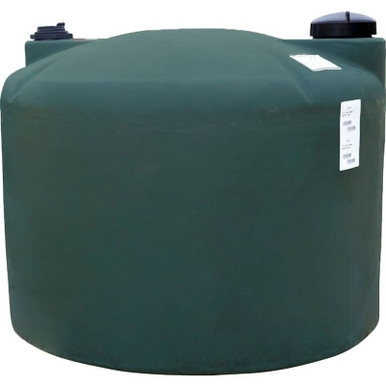
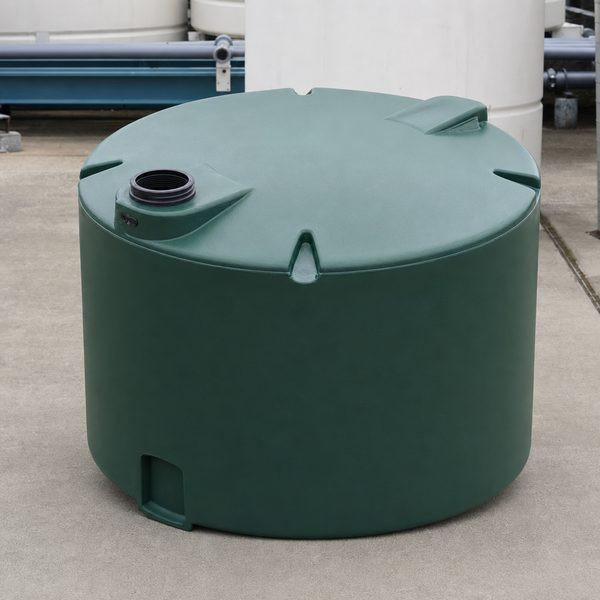
An ag retailer plumbs a centrifugal transfer pump (1.5 hp, 75 gpm at 60 ft TDH, NPSH-R 8 ft at design flow) on the bottom outlet of a Norwesco N-40146 1,500 gallon vertical tank at the loadout pad. Chemistry is UAN 32 fertilizer (SG 1.32, vapor pressure negligible at ambient temperature). Suction piping is 2-inch schedule 80 PVC, 8 feet long with one 90-degree elbow and one ball valve. Tank fill at calculation: 25% (low fill scenario - 375 gallons in tank, surface 28 inches above tank bottom).
NPSH-A calculation at 25% tank fill, sea level:
- H_atm = 33.96 ft / 1.32 SG = 25.7 ft
- H_static = 28 inches / 12 = 2.3 ft (chemistry surface to bottom outlet) plus 0 ft (outlet at pump suction elevation if pump is mounted at tank base) = 2.3 ft
- H_friction at 75 gpm in 2-inch pipe per Hazen-Williams: approximately 1.2 ft (length-related) plus 0.4 ft (elbow K=0.3) plus 0.3 ft (valve fully open K=0.2) = 1.9 ft
- H_vapor = approximately 0.5 ft for UAN 32 at 25 deg C
- NPSH-A = 25.7 + 2.3 - 1.9 - 0.5 = 25.6 ft
NPSH-R from pump curve at 75 gpm = 8 ft. Margin = 25.6 - 8.0 = 17.6 ft. Comfortable. The system runs without cavitation.
Now run the same calculation with the tank near empty (5% fill, surface 5 inches above tank bottom):
- H_static = 5 / 12 = 0.4 ft
- NPSH-A = 25.7 + 0.4 - 1.9 - 0.5 = 23.7 ft
Still well above NPSH-R 8 ft. Margin still comfortable. This is a benign case.
3. Worked Example Where the Math Breaks: Methanol Service at Elevated Temperature
A small biodiesel producer plumbs a similar centrifugal pump on a 1,500 gallon plastic tank holding methanol (SG 0.79). The methanol is at 35 deg C (95 deg F) due to summer ambient and process heat. Suction piping is 2-inch with the same fittings.
NPSH-A calculation at 5% tank fill, 1,000 ft elevation (atmospheric pressure 14.05 psia vs 14.70 at sea level):
- H_atm = (14.05 psia x 2.31 ft/psi) / 0.79 SG = 41.1 ft (less SG raises the head equivalent)
- H_static = 0.4 ft (low fill)
- H_friction = 1.9 ft
- H_vapor = methanol at 35 deg C has vapor pressure 27 kPa = 3.92 psia. Converting to head: (3.92 x 2.31) / 0.79 = 11.5 ft
- NPSH-A = 41.1 + 0.4 - 1.9 - 11.5 = 28.1 ft
Still above NPSH-R 8 ft, but the H_vapor term has consumed 11.5 ft of margin that water service did not consume. If the methanol heats up to 50 deg C (industrial heat-recovery scenario), vapor pressure rises to 56 kPa = 8.13 psia, H_vapor = 23.8 ft, NPSH-A = 41.1 + 0.4 - 1.9 - 23.8 = 15.8 ft. Still above NPSH-R 8 ft but margin is now only 7.8 ft. At 60 deg C methanol vapor pressure climbs to 13 psia, H_vapor = 38 ft, NPSH-A goes negative. The pump cavitates and may not even prime.
This is the engineering reason that volatile-chemistry pump suction must be flooded with substantial static head - the vapor pressure consumes the atmospheric head and only the static head buys back margin.
4. The 3-Foot Rule and Conservative Engineering
The Hydraulic Institute and pump manufacturers commonly recommend NPSH-A exceed NPSH-R by 3 feet minimum at the rated operating point. The 3 ft margin accounts for:
- Pump curve manufacturing tolerance (typically plus/minus 5%).
- Piping installation deviations from the design (extra elbows, longer suction run, undersized strainer).
- Operating excursions - higher flow than design, lower tank level than design, higher temperature than design.
- Pump wear over service life - impeller corrosion, eye-ring wear.
For chemistry with significant vapor pressure or for service where NPSH-A varies substantially across the operating range, the conservative engineering practice is 5 ft minimum margin. For plastic-tank service we recommend 5 ft minimum because plastic tanks typically have flatter aspect ratios than steel pressure vessels - the static head varies more dramatically from full to empty than for a tall narrow steel vessel.
5. Common Plastic Tank Suction Mistakes
Field-verified failure patterns we see on plastic-tank pump suctions:
- Suction piping undersized. Pump nameplate says 2-inch suction port; installer uses 1-inch piping to "match the tank fitting." Friction loss at design flow can exceed 10 ft. NPSH-A drops below NPSH-R; pump cavitates at full flow.
- Excessive suction strainer pressure drop. Strainer specified for slurry service used in clean-liquid service; the small-mesh element is unnecessary and costs 2-3 ft of NPSH-A. Match strainer mesh to actual particulate load.
- Suction lift configuration where flooded suction is required. Chemistry with vapor pressure above approximately 1 psi cannot tolerate suction lift; the pump must be at or below the chemistry surface elevation. For volatile or hot chemistry, mount the pump below the tank bottom outlet.
- Long suction run with multiple elbows. Each 90-degree elbow at high flow costs 0.5-1.0 ft of head. A tortuous suction path with 4-5 elbows can consume 5+ ft. Keep suction runs short and direct.
- Pump rated flow exceeds the suction-side hydraulic capacity. Pump motor sized for 100 gpm but the 1.5-inch tank fitting can only deliver 60 gpm without cavitating. The pump runs 60 gpm at runout, drawing more amps, overheating, and shortening motor life.
- Air entrainment at the tank vent. Pump pulls a vortex from the tank chemistry surface; air entrains into the suction. Pump cavitates from the air pocket, not from vapor flash. Solution: vortex breaker plate at the bottom outlet, or anti-vortex inlet design.
- Tank fill below the bottom-outlet inlet. Pump tries to pump from a tank with chemistry surface below the suction pickup. Pump runs dry, seals fail, motor overheats. Install low-level cutoff sensor and interlock.
6. Pump Selection Categories for Plastic-Tank Service
Common pump types used on plastic-tank discharge and their NPSH characteristics:
- Centrifugal (close-coupled, ANSI B73.1) - the workhorse for plastic-tank transfer service. NPSH-R typically 5-15 ft at design flow. Polypropylene and PVDF wetted-path versions available for chemistry service. Common manufacturers in our specification work include Finish Thompson, Iwaki, Magnatex, Price Pump.
- Regenerative turbine - used for low-flow high-head service such as chemical metering pump feed. NPSH-R typically 8-15 ft.
- Gear pump (positive displacement) - suitable for viscous chemistry. NPSH-R lower than centrifugal at low flow but rises sharply at higher viscosity.
- Air-operated diaphragm (AODD) - the fail-safe choice for plastic-tank service. Self-priming, can run dry briefly, and inherently NPSH-tolerant because the diaphragm action does not require continuous suction-side liquid contact. NPSH-R is essentially atmospheric. Common manufacturers Wilden, Aro, Sandpiper, Yamada.
- Peristaltic (hose pump) - similar NPSH characteristics to AODD. Excellent for slurry and abrasive chemistry.
For most plastic-tank chemistry transfer service in the catalog scope (UAN, glyphosate, sodium hypochlorite, sulfuric acid 33-50%, water, brine, biodiesel), the centrifugal pump with appropriate wetted-path metallurgy is the primary engineering choice and the AODD is the fail-safe alternate. For volatile or thermally elevated chemistry the AODD becomes the primary choice.
For more on pump-type selection see our chemical metering pump selection and fluoropolymer pump selection.
7. Tank Bottom-Outlet Geometry: 1.5-Inch vs 2-Inch vs 3-Inch
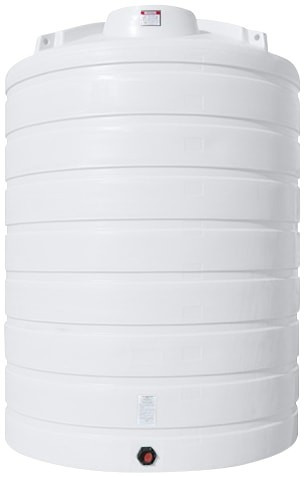
The tank bottom-outlet sizing directly affects suction-side hydraulics. Plastic tanks ship with a range of bottom-outlet sizes; the typical Norwesco vertical liquid tank has a 2-inch bulkhead fitting standard, with 3-inch and 4-inch options on larger sizes. The bulkhead orifice and the immediate downstream piping set the maximum flow that can pass without excessive friction.
Approximate flow capacity (clean liquid, 2 ft static head, no excessive elbow):
- 1-inch bulkhead: 25 gpm at acceptable friction
- 1.5-inch bulkhead: 50 gpm
- 2-inch bulkhead: 100 gpm
- 3-inch bulkhead: 250 gpm
- 4-inch bulkhead: 450 gpm
For higher flow than these limits, use full-port discharge geometry, multiple bottom outlets manifolded together, or a sumped-bottom tank design. For more on bulkhead sizing math see our bulkhead sizing drain-time math.
8. Action Checklist for Suction-Side Engineering
Before specifying a pump on a plastic-tank discharge:
- Document the pumped chemistry: SG, viscosity, vapor pressure at maximum operating temperature, particulate load.
- Document the pump operating point: flow rate, total dynamic head (TDH), expected variation across operating conditions.
- Get the pump curve from the manufacturer. Read NPSH-R at the design flow point and at the runout flow point.
- Calculate NPSH-A at maximum operating temperature, lowest expected tank fill level, and design flow.
- Confirm NPSH-A exceeds NPSH-R by 3 ft minimum (5 ft for plastic-tank service).
- Verify suction piping size is at or above the pump suction port size. Do not reduce.
- Minimize suction-side fittings and elbows. Keep the suction run short and direct.
- Specify strainer mesh appropriate for the chemistry's actual particulate load - not over-engineered.
- For volatile chemistry or elevated temperature chemistry, configure as flooded suction with the pump below the tank bottom.
- Install low-level cutoff and dry-run protection on the pump motor circuit.
- Document all calculations and the final pump selection in the project engineering file.
OneSource Plastics catalogs the polyethylene tank product across the SG, capacity, and configuration range. We do not retail centrifugal or AODD pumps, but we engineer the tank and bottom-outlet specification to match the operator's pump selection. Reference list pricing for tanks: Norwesco N-40146 1,500 gallon vertical at $2,837.16; Snyder SII-5990102N42 1,000 gallon Captor XLPE at $6,798.99; Snyder SII-5490000N42 1,550 gallon Captor XLPE at $10,091.93. LTL freight quoted via the freight estimator.
Call 866-418-1777 with the chemistry, flow rate, and pump selection. We will verify the bottom-outlet sizing, the suction-piping geometry, and the NPSH-A calculation. The pump-curve work is the operator's, but the tank-side engineering is ours and we will not let a customer install an undersized bottom outlet on the wrong pump.
Recommended Tanks for This Guide
Live pricing, updated automatically · estimate freight to your ZIP.