Polyethylene Chemical Compatibility: Complete Guide
High-density polyethylene (HDPE) is one of the most chemically resistant plastics available, but it is not universally compatible with all substances. Understanding what polyethylene can and cannot handle prevents chemical attack, tank failure, contamination, and environmental release. This guide covers the principles of polyethylene chemical resistance and how to verify compatibility for your specific application.
Understanding the technical fundamentals behind polyethylene tank construction, ratings, and specifications helps you make better purchasing decisions and avoid costly mistakes. This guide explains what the numbers actually mean and how they affect real-world performance.
How Chemical Attack Works
Chemical attack on polyethylene occurs through several mechanisms: oxidation (strong oxidizers break down the polymer chains), solvation (organic solvents absorb into and swell the plastic), stress cracking (certain chemicals weaken the bonds between polymer chains under stress), and permeation (some chemicals pass through the tank wall without visibly damaging it). Each mechanism has different warning signs and different prevention strategies.
Generally Compatible Chemicals
Polyethylene handles most inorganic acids (hydrochloric, sulfuric, phosphoric, nitric up to 50%), most bases (sodium hydroxide, potassium hydroxide, ammonia), most salts, alcohols (methanol, ethanol, isopropanol), and water-based solutions. The vast majority of agricultural chemicals, cleaning products, and water treatment chemicals are compatible with HDPE.
Generally Incompatible Chemicals
Polyethylene is NOT compatible with aromatic hydrocarbons (benzene, toluene, xylene), chlorinated solvents (carbon tetrachloride, methylene chloride), strong oxidizers at high concentration (concentrated nitric acid above 50%, fuming sulfuric acid), and fluorine gas. Gasoline and diesel are also problematic — not because they immediately destroy polyethylene, but because they permeate through the walls over time.
The Compatibility Chart Rating System
Chemical compatibility charts use a rating system — typically A through D or 1 through 4. "A" or "1" means excellent resistance with no effect. "B" or "2" means good resistance — minor effect, suitable for most applications. "C" or "3" means fair — limited resistance, short-term contact only. "D" or "4" means not recommended — severe attack, do not use. Always select a tank rated "A" for your primary stored chemical.
When to Request a Compatibility Test
If your chemical is not listed on the standard compatibility chart, or if you are mixing multiple chemicals, request a compatibility test from the tank manufacturer. Custom chemical blends, proprietary formulations, and multi-chemical mixtures can behave differently than their individual components. A 30-day immersion test at your operating temperature provides the most reliable compatibility data.
Temperature and Concentration Effects
Chemical compatibility changes with temperature and concentration. A chemical rated "A" at room temperature may become "C" at 120°F. A chemical rated "A" at 10% concentration may become "D" at 90% concentration. Always check compatibility at your actual operating temperature and concentration — not just the chemical name.
Related Products
Key Takeaways
- Always verify your liquid's specific gravity before selecting a tank — exceeding the rated SG is the most common cause of premature tank failure
- Polyethylene tanks are chemically resistant to most substances but NOT all — always check the compatibility chart for your specific chemical
- Proper installation is more important than the tank itself — a premium tank on a bad foundation will fail before a basic tank on a good foundation
- UV stabilizers extend life but don't eliminate UV damage — shade structures are cheap insurance for tanks in full-sun locations
- Temperature matters — polyethylene softens above 120°F and becomes brittle below -40°F. Plan for your climate extremes.
Questions about tank specifications? Call (866) 418-1777 — we speak fluent tank and can translate technical specs into practical guidance for your application.
Understanding Polyethylene Tank Construction
Every polyethylene tank in our catalog is manufactured through rotational molding — a process that creates a seamless, one-piece structure from powdered HDPE resin. The mold rotates on two axes simultaneously while heated, distributing molten resin evenly across all interior surfaces. The result is a tank with no seams, no weld lines, and no potential leak points. This seamless construction is the primary advantage of rotomolded tanks over welded or fabricated alternatives — joints are where tanks fail, and rotomolded tanks have no joints.
The resin itself is not generic plastic. It is a specially formulated compound that includes UV stabilizers (to prevent sun degradation), antioxidants (to prevent thermal degradation during processing and service), and pigments. For potable water applications, the resin meets FDA 21 CFR 177.1520 requirements for food-contact materials. These additives are compounded directly into the resin — not applied as surface coatings — which means the protection extends through the full wall thickness and lasts the life of the tank.
Why Buy from OneSource Plastics?
OneSource Plastics is not just another tank reseller. We are a specialized industrial tank dealer with deep product knowledge, competitive pricing from direct manufacturer relationships, and a commitment to helping you select the right tank for your specific application. Our team handles tank inquiries every day — we know the product lines, the specifications, the common pitfalls, and the solutions.
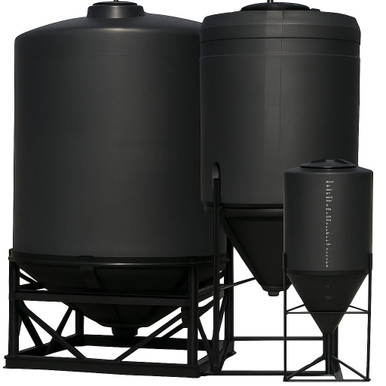
When you call us, you talk to someone who knows the difference between a 1.5 SG and a 1.9 SG tank, who can explain why a cone bottom is worth the extra cost for your mixing application, and who can tell you exactly what foundation your 2,500-gallon tank needs on your specific soil type. We don't just process orders — we solve liquid storage problems.
Every tank we sell ships with the full manufacturer warranty. We handle freight logistics to all 50 states, and we can coordinate delivery equipment for sites with challenging access. If something goes wrong — a shipping damage claim, a warranty issue, a specification question — we handle it directly. One call to (866) 418-1777 connects you to a real person who can actually help.
Related chemical compatibility resources
For deeper engineering specifications on the chemicals discussed above, see our chemical-compatibility pillars:
- Sulfuric Acid — storage compatibility, recommended resin grade, fittings, secondary containment.
- Nitric Acid — storage compatibility, recommended resin grade, fittings, secondary containment.
- Sodium Hydroxide — storage compatibility, recommended resin grade, fittings, secondary containment.
- Potassium Hydroxide — storage compatibility, recommended resin grade, fittings, secondary containment.
Recommended Tanks for This Guide
Live pricing, updated automatically · estimate freight to your ZIP.