Tank Fitting and Bulkhead and Outlet Selection: 1-inch to 6-inch Sizing Decision Tree
Tank failure rarely starts in the wall. It starts at the fitting. The bulkhead at the bottom corner, the side outlet near grade, the top inlet riser, the vent — those are the points where chemistry concentrates, where mechanical stress amplifies, where the gasket sees alternating wet-dry cycles, where over-tightening cracks the boss. The wall is over-engineered relative to the fittings; the fittings are where engineering judgment compounds or fails.
This guide walks the decision tree for tank fittings on industrial polyethylene tanks: bulkhead vs threaded vs flanged, 1-inch through 6-inch sizing, NPT vs BSPT, gasket selection, drain rate calculations, and real SKU references from Norwesco, Banjo, Snyder, and the OneSource Plastics fitting catalog. We cite ASTM D1998 (rotomolded polyethylene tank), ASTM F412 (plastic piping terminology), and ASME B1.20.1 (pipe threads). No fabricated chemistry compatibility — all gasket and fitting compatibility numbers come from manufacturer published data.
The Fitting Family Tree
Polyethylene tank fittings divide into five families by mounting and seal mechanism. Pick the family before sizing.
Bulkhead fittings (compression seal)
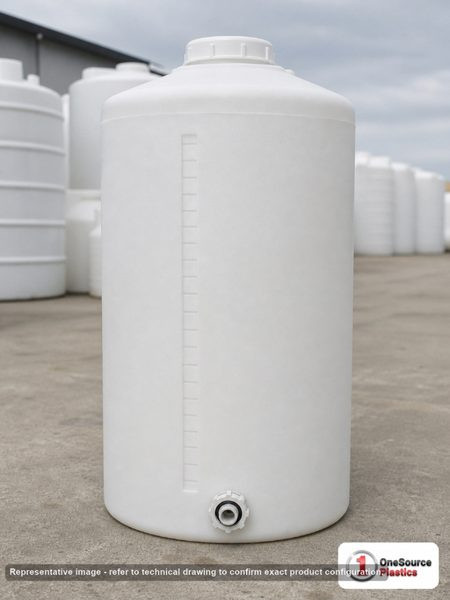
Through-wall fitting with internal nut compressing against the inside of the tank wall and external flange or threaded portion outside. Gasket between nut and wall. The compressive load on the wall, not the fitting threads, is what seals. Common in 3/4 to 4-inch nominal; standard for tank-to-pipe penetrations.
- Polypropylene bulkhead with EPDM gasket: water and mild chemistry, default for water tanks.
- Polypropylene with Viton (FKM): petroleum, mild oxidative chemistry, higher temperature.
- Polypropylene with PTFE gasket: aggressive chemistry where elastomer is the limiting factor.
- PVC bulkhead: chemistry tanks where PVC compatibility is broader than PP at lower cost. Cold-temp brittleness limits PVC outdoors.
Sizing convention: Banjo, Hayward, Spears, and similar mfrs publish bulkhead sizes by NPT thread (1/2, 3/4, 1, 1-1/4, 1-1/2, 2, 2-1/2, 3, 4-inch). Hole diameter required in tank wall is materially larger than the nominal thread — see manufacturer spec sheet for hole-size table.
Threaded fittings (boss-mounted)
Tank wall has a molded-in or weld-fit threaded boss. Pipe nipple threads directly into the boss; the threads themselves seal (with PTFE tape or pipe dope). No through-wall compression. Common on smaller tanks (under 1,000 gallons) and on top-mount fittings.
Threaded fittings are convenient but limited:
- Maximum size typically 2-inch NPT.
- Stress concentration at the thread root; over-tightening cracks the boss.
- No gasket; relies on thread seal.
- Susceptible to thermal-cycle leak as the polyethylene boss creeps.
Flanged fittings
Larger penetrations (3-inch, 4-inch, 6-inch) use flanged fittings. The flange face is bolted to a mating flange with a gasket between. Common on transfer manifolds, process tanks, and any application requiring frequent disassembly.
- ANSI 150 lb flanges are standard for plastic-to-plastic and plastic-to-metal connections.
- Polypropylene flange faces work for most chemistry; PVC for aggressive chemistry up to thermal limit.
- Gasket selection matches the chemistry: EPDM for water, Viton for petroleum, PTFE for aggressive.
Camlock and quick-disconnect
Hose-end fittings for hauling tanks and frequent connect-disconnect service. Standard sizes 1-inch through 4-inch. Aluminum, polypropylene, and stainless camlock bodies; gasket selection drives chemistry compatibility.
Welded saddle and self-tapping
Field-installed saddles for retrofitting fittings to existing tanks. Welded saddles use heat fusion or extrusion welding (HDPE only; XLPE cannot be welded). Self-tapping fittings cut their own thread into the wall — convenient for small instrumentation taps but not load-bearing.
Sizing the Outlet: Drain-Rate Decision Tree
Outlet size determines how fast you can empty the tank. The relationship is not intuitive — doubling the outlet diameter quadruples the drain rate at any given head. Undersizing the outlet is the single most common sizing error.
Drain-rate fundamentals
For a free-discharge outlet at the tank bottom under static head, the flow rate follows the orifice equation:
Q = Cd × A × sqrt(2 × g × h)
Where Q is volumetric flow rate, Cd is discharge coefficient (0.6 typical for sharp-edged orifice, 0.8-0.9 for well-radiused outlet with full-bore valve), A is the outlet cross-sectional area, g is gravitational acceleration, and h is the head (height of liquid above the outlet centerline).
The practical implication: a 2-inch outlet drains roughly four times faster than a 1-inch outlet at the same head, all else equal. A 4-inch outlet drains sixteen times faster than 1-inch.
Drain-time calculation (full to empty)
For a vertical cylindrical tank, the drain time from full to empty under gravity is:
t = (2 × Atank / (Cd × Aoutlet)) × sqrt(h0 / (2 × g))
Approximate drain times for common tank sizes through gravity-only outlets (no pump assist, full-bore valve open, water service):
| Tank Capacity | Tank Height | 1-inch outlet | 2-inch outlet | 3-inch outlet | 4-inch outlet |
|---|---|---|---|---|---|
| 300 gal vertical | 42 in | ~22 min | ~5.5 min | ~2.5 min | ~1.4 min |
| 1,500 gal vertical | 88 in | ~85 min | ~21 min | ~9.5 min | ~5.3 min |
| 3,000 gal vertical | 102 in | ~155 min | ~38 min | ~17 min | ~9.7 min |
| 5,000 gal vertical | 120 in | ~235 min | ~58 min | ~26 min | ~14.5 min |
| 10,000 gal vertical | 155 in | ~535 min | ~134 min | ~60 min | ~33 min |
Times are approximate gravity drain through a full-bore valve at the tank base. Pumped service is faster but limited by the pump curve and outlet line losses. Slurry, viscous, and high-solids fluids drain materially slower.
The 30-minute drain rule (operational)
Many operations specify "drain in under 30 minutes" as an operational target — it bounds shift work and matches typical truck-fill cadence. Use the drain-time table to size accordingly:
- Under 1,500 gallons: 2-inch outlet meets 30-minute target.
- 1,500-3,000 gallons: 3-inch outlet meets 30-minute target.
- 3,000-5,000 gallons: 3-inch or 4-inch outlet.
- 5,000-10,000 gallons: 4-inch or larger.
- Above 10,000 gallons: 4-inch minimum, often 6-inch with pumped assist.
Sizing the Inlet: Fill-Rate Decision Tree
Inlet sizing is determined by the fill source, not the tank. Common fill sources:
| Fill Source | Typical Flow | Inlet Size |
|---|---|---|
| Garden hose (residential) | 5-15 gpm | 3/4 or 1-inch |
| Municipal water main 1-inch service | 15-25 gpm | 1 or 1-1/4 inch |
| Municipal water main 2-inch service | 40-80 gpm | 1-1/2 or 2 inch |
| Well pump (residential) | 8-15 gpm | 1-inch |
| Well pump (agricultural / industrial) | 20-100+ gpm | 1-1/2 to 3-inch |
| Tank truck delivery | 100-400 gpm | 2 or 3-inch camlock |
| Bulk transport (cement, aggregate) | 300-800 gpm | 3 or 4-inch |
| Rainwater roof catchment | peak 50-200 gpm | 2 to 4-inch |
For tank truck fills, the truck pump and hose set determine inlet size, not the tank. 2-inch and 3-inch camlock are the standard truck connections for non-pressurized chemistry; 4-inch is common for water and large-volume agricultural product.
Bulkhead Sizing in Practice
The OneSource fitting catalog carries Banjo, Hayward, Spears, and Snyder bulkhead fittings spanning 1/2-inch through 4-inch nominal. Selection criteria:
1-inch and smaller (instrumentation, small drain, vent)
- 1/2-inch: pressure relief vent, small instrumentation tap, drip emitter
- 3/4-inch: residential hose connection, level switch, pressure gauge
- 1-inch: small pump suction, irrigation tie-in, residential potable
1-1/2 to 2-inch (most-common range)
- 1-1/2 to 2-inch covers the vast majority of bulkhead applications
- Tank truck fill inlet (2-inch camlock backed by 2-inch bulkhead is standard)
- Pump suction for transfer pumps under 100 gpm
- Outlet for 300-1,500 gallon tanks meeting 30-minute drain target
3-inch (mid-size)
- Outlet for 1,500-5,000 gallon tanks meeting 30-minute drain
- Inlet for high-flow agricultural and industrial fills
- Transfer manifold tie-in
4-inch and larger (high-flow)
- Outlet for tanks above 5,000 gallons
- Bulk truck delivery inlet (3-4 inch is the standard truck-side connection)
- Process manifold for batch transfer
- 6-inch fittings exist as flanged designs for very large process tanks; bulkhead style above 4-inch is less common
Thread Standards: NPT vs BSPT vs Metric
Thread mismatch leaks. Identify your thread standard before ordering fittings:
- NPT (National Pipe Taper, ASME B1.20.1): US standard, tapered thread. Thread angle 60 degrees, taper 1:16. Default in North America.
- BSPT (British Standard Pipe Taper, ISO 7-1): UK and Commonwealth standard. Thread angle 55 degrees, same taper 1:16. NOT interchangeable with NPT despite similar appearance.
- BSPP (British Standard Pipe Parallel, ISO 228): Parallel (non-tapered) thread, 55 degree angle. Requires bonded seal washer or O-ring at the face, not thread sealant.
- Metric thread (ISO): Found on European-imported equipment. Adapter fittings required.
Stock polyethylene tanks from Norwesco, Snyder, Chem-Tainer, and Bushman default to NPT in the US market. Imported Enduraplas product may carry BSPT or metric in some configurations — confirm thread standard at order entry. The visual difference between NPT and BSPT is subtle (5 degrees of thread angle) and the leakage failure is silent until product migrates.
Gasket Selection by Chemistry
| Gasket Material | Temp Range | Compatible Chemistry | Avoid |
|---|---|---|---|
| EPDM | -40F to 250F | Water, mild acids/bases, ketones, alcohols | Petroleum, oils |
| Buna-N (NBR) | -30F to 220F | Petroleum, diesel, oils, fuels | Strong oxidizers, ketones |
| Viton (FKM) | -15F to 400F | Hydrocarbons, mild oxidizers, hot service | Strong bases, ketones, amines |
| PTFE | -65F to 500F | Nearly all chemistry | Cold-flow under sustained load |
| Silicone | -65F to 400F | Potable water, food contact | Petroleum, aromatic solvents |
| Hypalon (CSM) | -30F to 250F | Hypochlorite, oxidative chemistry | Ketones, aromatic solvents |
For most water tank applications, EPDM is the default — wide temperature range, water-compatible, low cost. Petroleum service requires Buna-N or Viton. Sodium hypochlorite service requires Viton or Hypalon (EPDM swells and degrades; Buna-N attacks oxidatively). PTFE is the universal solution at premium cost.
Worked Examples
Case 1: 1,500-gallon outdoor stock water tank, residential
Tank: EP-TLV01500BK or N-41464 equivalent. Inlet: 1-inch threaded boss for garden hose (top fill), 1-inch overflow bulkhead at top with EPDM gasket. Outlet: 2-inch bulkhead at base with EPDM gasket and full-bore ball valve. Drain time: ~21 minutes through 2-inch gravity. Total fitting cost: $50-100.
Case 2: 2,500-gallon hypochlorite 12.5% feed tank
Tank: XLPE rated for chemistry (per the polymer-selection guide). Inlet: 2-inch camlock through 2-inch bulkhead with Viton gasket for truck delivery. Outlet: 1-1/2 inch bulkhead with Viton gasket to pump suction; chemistry is dosed at 1-5 gpm so size matches the metering pump, not gravity drain. Vent: 2-inch with ball check or carbon scrubber. Total fitting cost: $200-400 — Viton premium is ~3x EPDM but earned by the chemistry.
Case 3: 5,000-gallon agricultural water transfer tank
Tank: EP-TLV05000BK or equivalent. Inlet: 2-inch top inlet for well pump fill at 50 gpm. Outlet: 3-inch flanged outlet at base for tank-truck loading at 100+ gpm. Drain time at 3-inch: ~26 minutes empty. Top vent: 4-inch atmospheric vent sized to handle the truck-load fill rate (vent must pass at minimum 1.5x the fill rate to prevent over-pressure). Total fitting cost: $300-500.
Case 4: 10,000-gallon outdoor diesel storage with truck delivery
Tank: HDPE double-wall or single-wall in bermed area. Inlet: 4-inch camlock through 4-inch bulkhead with Buna-N gasket — bulk truck delivery at 300-400 gpm. Outlet: 2-inch threaded outlet at base for dispensing pump. Vent: emergency vent sized per NFPA 30 to handle the truck-fill rate plus emergency case. Fill cabinet, overfill alarm, and spill bucket per NFPA 30 / state fuel code.
Case 5: 300-gallon NSF 61 potable water indoor
Tank: N-41527 or Bushman equivalent. Inlet: 1-inch threaded for water service. Outlet: 1-inch threaded with NSF-listed silicone or EPDM gasket. Vent: small atmospheric. NSF-listed gaskets are typically silicone or EPDM with NSF 61 certification — verify the gasket carries NSF marking before installing in potable service.
Fitting Installation Field Notes
Bulkhead torque
Polyethylene wall is plastic — over-tightening cracks the boss or stretches the wall. Use the manufacturer torque spec, typically 15-30 ft-lb for 1-inch through 2-inch bulkheads. Hand-tight plus 1/4 to 1/2 turn is the common rule when no torque value is published. Do not use cheater bars or pipe wrenches.
Hole cutting
Hole saw appropriately sized for the bulkhead — manufacturer publishes the hole size. A 2-inch NPT bulkhead typically needs a 2-7/8 inch hole. Cut clean, deburr both sides, blow out chips. The gasket seats against the cut surface; rough or burred holes leak.
Gasket seating
Lubricate the gasket lightly with food-grade silicone or the chemistry-compatible equivalent before installation. Dry gasket installations bind, twist, and tear during tightening. Lubrication does not affect seal performance once seated.
Thread sealant
NPT threads need PTFE tape (3-4 wraps in the thread direction) or pipe dope. PTFE tape is the default for water and most chemistry. Pipe dope is preferred for petroleum and high-temperature service. Do not use both.
Support and strain relief
Pipe runs into bulkhead fittings need independent support — the bulkhead is not designed to carry pipe weight or thermal expansion load. A 2-inch pipe full of water weighs about 1.6 lb/foot; a 20-foot run unsupported puts 32+ pounds on the fitting plus thermal cycle stress. Support every 5-8 feet for plastic pipe, more often for elevated runs.
Common Fitting Mistakes
Mistake 1: Undersizing the outlet for drain rate
The most common sizing error. Operations buy a 1-inch outlet on a 5,000-gallon tank because it matches the existing pump suction; gravity drain takes 4 hours. Specify outlet size to drain target, not pump match.
Mistake 2: Mixing NPT and BSPT
The threads engage but do not seal. Imported equipment and US-market tanks need adapter fittings, not direct connection. Verify thread standard.
Mistake 3: Wrong gasket for chemistry
EPDM in petroleum service swells and extrudes; Buna-N in hypochlorite service oxidizes and embrittles; Viton in strong-base service degrades. The gasket is the most chemistry-sensitive component in the fitting.
Mistake 4: Over-tightening the bulkhead
Polyethylene boss cracks at 50-75 ft-lb; manufacturer torque spec is 15-30 ft-lb. The 25 ft-lb margin gets eaten quickly with a long pipe wrench. Use a torque wrench or hand-tight-plus-quarter-turn.
Mistake 5: No vent or undersized vent
Tanks under fill or drain need atmospheric communication. A sealed tank under fill goes positive pressure (and ruptures or pops a fitting); under drain goes negative pressure (collapses the wall). Vent at minimum 1.5x the maximum fill or drain rate. NFPA 30 has explicit vent sizing tables for petroleum AST.
Mistake 6: Skipping the fitting on the spec sheet
The manufacturer spec sheet lists factory-installed fittings; field-added fittings are the buyer's responsibility. Verify which fittings come installed and which need field installation. Many quote-vs-receive failures are factory-installed fittings missing or in the wrong locations.
Fitting Sizing Quick-Reference
| Application | Inlet | Outlet | Vent |
|---|---|---|---|
| Residential water (300-1500 gal) | 1 in | 1.5-2 in | 2 in |
| Agricultural water (1500-5000 gal) | 1.5-2 in | 2-3 in | 3 in |
| Bulk water (5000-10000 gal) | 2-3 in | 3-4 in | 4 in |
| DEF (250-660 gal) | 2 in dry-disconnect | 1 in | 1 in filtered |
| Diesel AST (1000-10000 gal) | 2-4 in camlock | 2 in | per NFPA 30 |
| Hypochlorite chemistry feed (500-2500 gal) | 2 in camlock | 1-1.5 in | 2 in carbon |
| Acid storage (1000-5000 gal) | 2-3 in | 2 in | 2 in scrubber |
| Process / mix tank (1000-5000 gal) | 2-3 in | 3-4 in flanged | 3 in |
Internal Resources
- Multi-Tank Manifolding
- Polymer Selection Guide
- Plastic Tank Failure Mode Analysis
- How to Read a Tank Spec Sheet
- Chemical Compatibility Database
- Freight Cost Estimator
- Contact OneSource — fitting sizing consultation, gasket compatibility lookup
Source Citations
- ASTM D1998 — Standard Specification for Polyethylene Upright Storage Tanks
- ASTM F412 — Standard Terminology Relating to Plastic Piping Systems
- ASME B1.20.1 — Pipe Threads, General Purpose, Inch (NPT)
- ISO 7-1 — Pipe Threads Where Pressure-Tight Joints Are Made on the Threads (BSPT)
- ISO 228 — Pipe Threads Where Pressure-Tight Joints Are Not Made on the Threads (BSPP)
- NFPA 30 — Flammable and Combustible Liquids Code (vent sizing)
- NSF/ANSI 61 — Drinking Water System Components: Health Effects
- Manufacturer technical data sheets: Banjo, Hayward, Spears, Norwesco, Snyder, Chem-Tainer, Enduraplas
- OneSource Plastics master catalog data, dated 2026-03-26 snapshot
Related chemical compatibility resources
For deeper engineering specifications on the chemicals discussed above, see our chemical-compatibility pillars:
- Sodium Hypochlorite — storage compatibility, recommended resin grade, fittings, secondary containment.
- DEF (Diesel Exhaust Fluid) — storage compatibility, recommended resin grade, fittings, secondary containment.
Recommended Tanks for This Guide
Live pricing, updated automatically · estimate freight to your ZIP.