Multi-Tank Manifolding: Series, Parallel, and Selective-Drain System Design
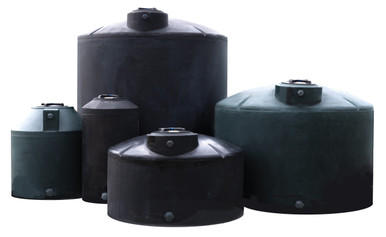

One tank is rarely the right answer above 5,000 gallons of total storage. Manufacturing capacity caps practical tank sizes (Norwesco's largest single vertical is 15,500 gallons; Snyder's is 10,500), freight reaches a regional limit at oversize/overweight (anything above 102 inches diameter requires permitted hauling), and operational reasons (redundancy, maintenance access, batch isolation) all favor multiple smaller tanks plumbed together over a single mega-tank.
This guide is the engineering reference for the three standard multi-tank topologies: series, parallel, and selective-drain. Each has specific use cases, specific piping requirements, and specific failure modes if designed incorrectly. We cover the manifold sizing math, the valve placement decision tree, and the real SKU pairings from the OneSource Plastics catalog that get specified together for multi-tank installs.
Why Manifold Multiple Tanks
Five reasons facilities specify multi-tank instead of single-tank storage:
- Redundancy. If one tank goes out of service for cleaning, repair, or contamination, the others continue operating. Critical for water treatment plants, fire suppression reserves, and any application where storage continuity is required.
- Batch isolation. Chemistry processes that handle multiple batches simultaneously need separate storage volumes. One tank per batch with shared distribution piping is the standard architecture.
- Capacity beyond single-tank limits. Norwesco produces vertical tanks to 15,500 gallons, but installations needing 30,000+ gallons of storage typically use 2 to 4 tanks rather than special-order one giant tank.
- Freight cost. Two 5,000 gallon tanks ship LTL within standard equipment limits. One 10,500 gallon tank may require permitted oversize freight, doubling or tripling the per-gallon delivered cost.
- Footprint flexibility. Installation sites often have an irregular footprint that can accommodate multiple smaller tanks but not one large one. Multi-tank lets you fit storage into the space that exists.
Topology 1: Series Manifold
Tanks are plumbed bottom-to-bottom in a chain. Fluid enters tank 1, flows through to tank 2, then to tank 3, and so on, exiting the system from the last tank in the chain. Each tank's fluid level rises and falls together as the system fills and drains.
Use cases:
- Plug-flow chemistry residence (long settling time, biological treatment, slow reaction)
- Sequential filtration where each tank serves a different process step
- Cascade temperature control where each tank operates at a different temperature
Piping specification: the bottom-to-bottom equalization piping must be sized to handle the system's maximum flow rate without significant pressure drop, otherwise fluid level differences develop between tanks during draw-down. Typical specification: pipe diameter equal to or greater than the system outlet diameter, slope toward the discharge direction at minimum 1/8 inch per foot to prevent settled solids accumulation in the manifold.
Failure modes: series-plumbed tanks share a single failure point. If the equalization piping develops a leak or blockage, the entire system is offline. This is the trade-off for the plug-flow benefit: simpler operation but no redundancy.
Topology 2: Parallel Manifold
Tanks are connected to common header piping at both inlet and outlet. Each tank fills and empties through its own valved tap into the header. Tanks operate independently within shared inlet/outlet plumbing.
Use cases:
- Redundant water reserve (fire suppression, potable water primary)
- Capacity expansion beyond single-tank limits
- Inventory load balancing across multiple identical tanks
- Most general-purpose storage applications
Piping specification: the common header must be sized to carry the full flow rate from any single tank or any combination of tanks operating simultaneously. For two tanks, header diameter typically matches the inlet/outlet pipe size. For 3 or more tanks operating simultaneously, header diameter steps up one nominal size to keep velocity below 5 ft/sec for liquid service. Tap-off connections at each tank should include isolation valves so individual tanks can be removed from service without shutting down the system.
Equalization considerations: if the tanks are at the same elevation with shared inlet and outlet, fluid levels naturally equalize through the header. If the tanks are at different elevations or the header has significant restriction, you may need a dedicated equalization line at tank top or tank bottom to prevent one tank from running ahead of the others during fill-and-draw cycles.
Failure modes: parallel manifolds isolate failures to individual tanks. A leak at one tank is contained by closing that tank's isolation valves. The remaining tanks continue operation. Header failures (pipe breaks, header valve failures) take the whole system offline but are rarer than tank-level failures.
Topology 3: Selective-Drain Manifold
Each tank has independent inlet and outlet plumbing back to a central distribution point. Operations select which tank to draw from or fill into via dedicated valves at the distribution point. This is parallel manifold's more complex sibling: more piping and more valves, but more granular control.
Use cases:
- Multi-product chemistry where each tank holds a different fluid
- Quality segregation (off-spec batches isolated from in-spec batches)
- Chemistry blending operations where ratios from different tanks are dynamically adjusted
- Brewing, distilling, and food processing where batch traceability requires per-tank lot tracking
Piping specification: each tank's inlet and outlet pipe runs back to a central manifold panel. The manifold panel has selector valves (typically diaphragm or full-port ball valves) that direct flow to the appropriate destination tank or from the appropriate source tank. Pipe sizing matches the system flow requirement; valve sizing matches pipe sizing. Avoid undersized valves that create pressure drops, especially for viscous fluids.
Cost implication: selective-drain plumbing typically costs 2 to 4 times more than parallel plumbing for the same number of tanks because of the additional pipe runs and valve count. This is justified for multi-product applications and prohibitive for simple bulk storage.
Manifold Pipe Sizing Math
Header pipe diameter is selected against the design flow rate to keep velocity within safe limits. For polyethylene service the common rule is velocity less than 5 ft/sec for normal flow and less than 8 ft/sec for short-duration peak flow.
v = Q / A
v = (gpm * 0.408) / d^2 (in ft/sec, where d is internal diameter in inches)
For 100 gpm draw-down through a 2-inch nominal pipe (ID ~2.07 inches), velocity is approximately 9.6 ft/sec, which is too high. Stepping to a 3-inch nominal pipe (ID ~3.07 inches) drops velocity to 4.3 ft/sec, comfortably within spec. For typical bulk-storage applications:
| Design Flow | Recommended Pipe | Velocity at Pipe | Application Note |
|---|---|---|---|
| 10 gpm | 1″ | 3.7 ft/sec | Residential cistern, slow drain |
| 25 gpm | 1.5″ | 4.1 ft/sec | Light commercial, irrigation |
| 50 gpm | 2″ | 4.8 ft/sec | Standard commercial fill/draw |
| 100 gpm | 3″ | 4.3 ft/sec | Industrial fill rate, fire pump test |
| 250 gpm | 4″ | 6.0 ft/sec | Bulk delivery from tanker |
| 500 gpm | 6″ | 5.3 ft/sec | Industrial process or fire flow |
For applications where peak flow is significantly higher than average (fire suppression demand, process surge), size for the peak. The economic penalty for oversizing the header is small relative to the operational penalty for under-sizing it.
Valve Selection
Tank Isolation Valves
Full-port ball valves at each tank's tap into the header are the standard isolation. Schedule 80 PVC or HDPE for chemistry compatibility, brass or stainless for water service. Valve must match pipe diameter to avoid creating a flow restriction at the isolation point.
Header Drain and Flush Valves
Low-point drain valves at every dead-leg in the header allow the system to be drained for cleaning, freeze protection, or chemistry changeover. Specify valves at every header transition and at the lowest point in the header run.
Equalization Line Valves
If the design uses a separate equalization line (top-to-top tie between tanks for pressure equalization, or bottom-to-bottom tie for level equalization), include isolation valves on the equalization line so it can be removed from service for maintenance.
Check Valves
For redundant fill systems where multiple sources feed the same header (rainwater + delivery + well water all feeding a single storage system), check valves prevent reverse flow from one source into another. Wafer-style check valves work at any header diameter; specify with EPDM or Viton seats matched to the fluid chemistry.
Pump and Pressure Considerations
Multi-tank systems with shared pumping require careful suction-side design. Two parallel tanks feeding one pump must have their suction lines symmetrically piped (equal lengths, equal elbow counts, equal diameters) so the pump draws evenly from both tanks. Asymmetric piping causes one tank to draw down faster than the other, eventually starving the pump of suction from the higher-resistance tank.
For pumped fill systems, the discharge head from the pump must be sufficient to raise fluid to the highest point in the manifold and overcome friction loss in the header. A typical 2,500 gallon tank has a top fitting elevation of 11 to 12 feet above grade. A pump filling that tank from grade level needs approximately 15 feet of head plus header friction loss, which translates to roughly 7 to 10 PSI discharge pressure.
Real Multi-Tank SKU Pairings
| Application | Tanks | Total Capacity | Topology |
|---|---|---|---|
| Residential rainwater + well buffer | 2 × N-44045 (1,000 gal each) | 2,000 gal | Parallel |
| Agricultural irrigation | 3 × N-43092 (3,000 gal each) | 9,000 gal | Parallel |
| Brewery cold-side rinse | 2 × N-43852 cone-bottom | 2,000 gal | Selective-drain |
| Fire suppression reserve | 4 × N-45246 (3,000 gal each) | 12,000 gal | Parallel with cross-tie |
| Wastewater pretreatment | 3 × cone-bottom in series | 3,000+ gal | Series (sequential settling) |
| Multi-product chemistry | 4 to 8 vertical tanks at central manifold | 10,000+ gal | Selective-drain |
Equalization Line Specifications
For parallel-manifolded tanks at the same elevation with a shared header, the header itself provides level equalization for normal operation. For tanks operating at different fill rates (multi-source fill system, intermittent draw on individual tanks), a dedicated equalization line is required.
Bottom-to-Bottom Equalization (Level Equalization)
A horizontal pipe connecting the bottom outlets of multiple tanks. Fluid flows freely between tanks, equalizing fluid level. Specification: pipe diameter at least equal to the largest single inlet to the system, sloped at 1/8 inch per foot toward the lowest tank for self-draining, with isolation valves at each tank tap.
Top-to-Top Equalization (Vapor Equalization)
A horizontal pipe connecting the vent fittings at the top of multiple tanks. Vapor (air, off-gas, condensate) flows freely between tanks, preventing pressure differentials during fast fill or fast drain. Critical for tanks with small vents or for chemistry tanks with vapor-recovery requirements. Specification: pipe diameter at least 50% of the largest single inlet diameter, no isolation valves on the vapor line (they create pressure-trap conditions if accidentally closed).
Combined Top-and-Bottom Equalization
Both bottom and top equalization lines for fully balanced multi-tank operation. The bottom line equalizes fluid level; the top line equalizes vapor pressure. This is the standard for most permanent commercial and industrial parallel-manifolded installations.
Common Multi-Tank Mistakes
Mistake 1: Undersizing the header for peak flow
Designing the header against average flow leaves the system unable to accept peak fill rates from delivery tankers (typical 250 to 500 gpm) or supply peak draw rates for fire suppression. Always size against peak, not average.
Mistake 2: Skipping the equalization line
Two parallel-manifolded tanks without level equalization will draw down unevenly under any asymmetry in the piping. Within months you'll observe one tank consistently 20 to 40% lower than the other. Add the equalization line.
Mistake 3: Mixing different chemistry tanks on a shared header
Multi-product chemistry storage requires selective-drain topology, not shared-header parallel topology. Cross-contamination through valve leaks, dead-leg residence, or misvalving is a chronic problem with parallel-manifolded chemistry. Specify dedicated piping for each chemistry, with the manifold panel only at the discharge point.
Mistake 4: Locating the manifold panel without service access
The manifold panel, with all its valves and instruments, needs operator access for daily check and maintenance. Locating it behind tanks, in a low ceiling area, or above 6 feet from grade makes routine operation difficult and inspection difficult. Front-of-installation, eye-level, with 36 inches of clear floor space is the rule.
Mistake 5: No dead-leg drain valves
Every header T or elbow creates a potential dead leg where stagnant fluid accumulates. For chemistry service this becomes a contamination source; for water service it becomes a microbial growth site. Always include drain valves at every header low point.
Manifold Material Selection
| Service | Pipe Material | Valve Material | Joint Type |
|---|---|---|---|
| Potable water | PEX or NSF/ANSI 61 PVC | Brass full-port ball | Threaded or solvent weld |
| Irrigation / non-potable water | Schedule 40 PVC | PVC ball | Solvent weld |
| Mild chemistry (pH 4-10) | Schedule 80 PVC or HDPE | PVC or polypropylene ball | Solvent weld or fusion |
| Aggressive acid (pH < 4) | CPVC or PVDF | CPVC or PTFE-lined | Solvent weld or flange |
| Caustic / strong base | HDPE or polypropylene | Polypropylene ball | Heat fusion or flange |
| Hot or freeze-protected | CPVC or stainless 304 | Brass or stainless | Threaded or sweat |
Pipe and valve material must be verified against the fluid chemistry. Use our chemical compatibility database to verify the manifold materials against the service.
Code and Permitting
Multi-tank manifolded systems above certain capacity thresholds trigger plumbing code review. The IPC (International Plumbing Code) and UPC (Uniform Plumbing Code) cover potable and non-potable water systems above 30 gallons of storage. Chemistry tanks over 660 gallons single-tank or 1,320 gallons aggregate trigger SPCC (Spill Prevention Control and Countermeasure) plan requirements under 40 CFR 112. Hazardous chemistry over flammable liquid quantities triggers NFPA 30 review.
For permitted commercial and industrial installations, the manifold drawings should be prepared by or reviewed by a licensed PE in the relevant discipline (mechanical for water, chemical or environmental for chemistry). The PE stamp is what allows the local AHJ to approve the install.
Internal Resources
- Water Storage Tanks Catalog — full vertical tank inventory
- Cone Bottom Tanks Catalog — cone-bottom for multi-tank chemistry
- Chemical Compatibility Database — verify manifold materials against fluid
- Foundation Pad Engineering — pad-sizing for multi-tank installs
- Hurricane Tie-Down Engineering — multi-tank coastal anchorage
- Insulation + Heat Tracing — cold-climate manifold protection
- Freight Cost Estimator — LTL quote on multi-tank shipments
How to Order
For multi-tank procurement consultation including matched-MPN ordering, manifold piping bills of material, and PE-stamped manifold drawings, call us at 866-418-1777 or use the contact form. We can pair the tank order with manifold piping kits sized to your design flow and chemistry.
Source Citations
- International Plumbing Code 2021 (IPC) — potable and non-potable water systems
- Uniform Plumbing Code 2021 (UPC) — potable and non-potable water systems
- 40 CFR 112 — SPCC Plan Requirements (oil and chemistry above threshold quantities)
- NFPA 30 — Flammable and Combustible Liquids Code
- ASME B31.3 — Process Piping Code
- Hydraulic Institute Engineering Data Book, pipe velocity and friction loss tables
- NSF/ANSI 61 — Drinking Water System Components
- OneSource Plastics master catalog data, 2026-03-26 snapshot
Recommended Tanks for This Guide
Live pricing, updated automatically · estimate freight to your ZIP.