Tank Lightning Protection: Grounding Rod vs Bonding Strap vs Ion Capture for Plastic Tanks
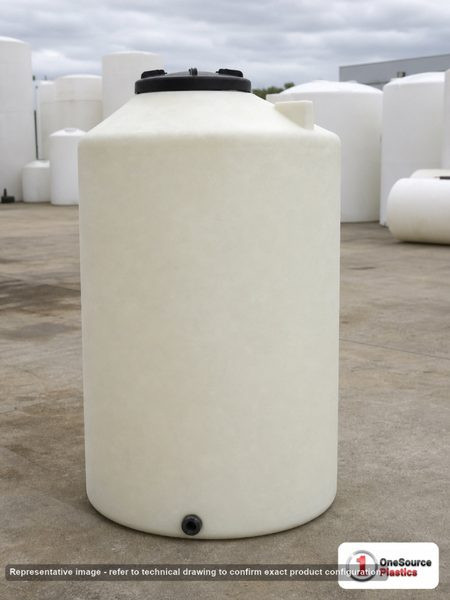
Polyethylene tanks are excellent insulators. That property makes them chemically inert and corrosion-immune, and it makes them lightning death traps if the system around them is wired wrong. The HDPE shell does not conduct the strike — but the metal fittings do, the plumbing manifold does, the steel cone-bottom stand does, the metal handrail catwalk does, and the static charge from filling a flammable solvent through a plastic fill pipe does. Lightning protection on a plastic tank is not about protecting the tank itself. It is about protecting everything around the tank from a strike that is going to happen at some point in the asset's 20-year life.
This guide walks the three lightning-protection strategies most installers consider — grounding rods, bonding straps, and ion-capture (early-streamer-emission) air terminals — and explains where each applies, where each fails, and what the governing standards actually require. We cite NFPA 780 (2023 edition), IEEE Std 142 (Green Book), UL 96A, API 545, API 2003, and ANSI/ESD S20.20. No fabrication; no marketing claims pulled from product brochures.
The Strike Physics
A typical cloud-to-ground lightning strike delivers 30,000 amps over about 30 microseconds, with peak currents reaching 200,000+ amps in 1% of strikes. Charge transferred is 5-30 coulombs. The strike's voltage potential is ~100 million volts. Anything that creates a path-of-least-resistance between cloud and earth becomes a conductor in that moment.
A 1500-gallon polyethylene tank standing alone in a field is NOT the path of least resistance. Polyethylene resistivity is about 10^16 ohm-cm. The strike will preferentially attach to a nearby conductor — a metal handrail, a steel cone-bottom stand, a stainless fill pipe, even a ladder leaning against the tank. The risk to the tank is from secondary effects: induced voltage on metal accessories, electromagnetic pulse damage to instrumentation, and arc-over from those accessories to whatever the polyethylene is in contact with.
The three strategies below are not interchangeable. They address different parts of the strike management problem.
Strategy 1: Grounding Rod (Ground Electrode System)
NFPA 780 Section 4.13 defines the grounding electrode system for lightning protection. Standard practice: minimum 2 ground rods, 5/8-inch copper-clad steel, 8 feet long, driven full depth, spaced minimum 16 feet apart, bonded with 4-AWG copper conductor. Resistance to earth target is 25 ohms or lower; in many soil conditions this requires 3-4 rods or supplementary ground rings.
What Grounding Does
The grounding electrode provides a controlled path for accumulated static charge AND for any direct strike that connects to a metal accessory of the tank system. The cone-bottom steel stand under a Chem-Tainer MPN TC3148JP (100-gallon Chem-Tainer cone bottom tank with poly stand at $1,020 list — note polyethylene stand, not steel) does not require grounding. A steel-stand version of the same cone-bottom tank DOES require grounding. The steel vehicle-loading catwalk above a Snyder Industries 1500-gallon vertical (representative MPN class WB46/WB47 at $1,540 list) absolutely requires grounding.
What Grounding Does NOT Do
A ground rod 20 feet from a tank does not protect the tank from a direct strike. It protects whatever metal IS bonded to it from holding lethal voltage after the strike dissipates. If you have 1,500 gallons of flammable solvent in a polyethylene tank with a steel manhole ring, a steel ladder, and a steel access platform — the ground rod sinks the residual charge from those metal pieces. It does NOT prevent the strike from arcing through the manhole ring into the headspace and igniting vapor. That is what the bonding strap and the air terminal are for.
Soil Resistance and Ground Rod Performance
| Soil type | Resistivity (ohm-cm) | Single 8-ft rod | Effective approach |
|---|---|---|---|
| Wet organic loam | 1,000-5,000 | 5-25 ohms | 2 rods at 16 ft spacing |
| Moist clay | 5,000-10,000 | 25-50 ohms | 3-4 rods, ground ring |
| Sandy loam | 10,000-50,000 | 50-250 ohms | Ground ring, chemical rods |
| Dry sand | 50,000-500,000 | 250-1,000+ ohms | Counterpoise, supplementary |
| Rock / shallow bedrock | 50,000-1,000,000+ | Often unmeasurable | Engineered ground grid |
A site survey for lightning protection STARTS with a fall-of-potential test (IEEE Std 81) to measure actual ground resistance. Don't assume; measure. In dry sand or rocky sites, single ground rods are essentially useless and the system needs a buried counterpoise (continuous ground ring around the tank pad) or chemically-enhanced ground rods.
Strategy 2: Bonding Strap (Equipotential Bonding)
The bonding strap connects all metal components in the tank system to each other AND to the grounding electrode. The point is not to drain charge to earth (that's the rod's job) but to eliminate voltage DIFFERENCES between metal components during a strike or static discharge event.
Where Bonding Matters Most
For flammable liquid service — gasoline, diesel, ethanol, methanol, biodiesel — static accumulation during fill is the more frequent ignition source than direct lightning strike. API 2003 (Protection Against Ignitions Arising Out of Static, Lightning, and Stray Currents) governs petroleum facility bonding. Tank truck delivery to a farm fuel tank is the canonical scenario: truck pulls up, driver runs hose to fill nozzle, nozzle has metal spout, tank has metal fill connection, fill rate produces electrostatic charging in the flowing fuel, charge accumulates on whichever component is electrically isolated, eventually arcs across the gap.
Bonding strap eliminates the gap. Truck chassis bonded to tank, tank bonded to ground, no potential difference, no spark. API 2003 requires bonding before flow begins and maintained throughout transfer.
For polyethylene tanks, bonding the tank shell itself is meaningless (HDPE doesn't conduct). Bond every metal component IN OR ON the tank: the steel manway flange, the metal bulkhead fittings, the metal valve handles, the metal ladder, the metal catwalk. Bond truck to tank via dedicated cable with clamp before fill nozzle is opened. Bond all of it to the ground rod system.
Bonding Conductor Sizing
Per NFPA 780 Section 4.9.2, bonding conductors for ordinary structures are minimum 4 AWG copper or 2 AWG aluminum (Class I) or larger for higher exposure. For petroleum service per API 2003, minimum 6 AWG copper for portable bonding cables; permanent fixed bonding generally 4 AWG copper or larger.
Use bolted connections with anti-oxidant compound (per IEEE Std 837), NOT clamps that vibrate loose, NOT field-soldered joints. Stainless or copper hardware. Inspected annually per NFPA 780 Section 8.
Strategy 3: Air Terminal (Including Early-Streamer-Emission Marketing Claims)
Air terminals are the lightning-rod approach: attract the strike to a designated point above the protected asset, conduct the current to the grounding system, and dissipate it safely. Standard solid-rod air terminals are governed by NFPA 780 Section 4.6 and UL 96A. They work. They have worked since Benjamin Franklin in 1752. The physics is well-understood and the standards are unambiguous.
The ESE / Ion-Capture Question
Some manufacturers market "ion capture" or "early-streamer-emission" (ESE) air terminals claiming dramatically expanded protection radius compared to conventional lightning rods. These are sold under various trade names with claimed protection radii of 50, 100, or even 150 meters from a single terminal.
NFPA 780 Annex L (Lightning Risk Assessment) and the underlying scientific literature do NOT support these expanded protection radii. The current edition of NFPA 780 (2023) explicitly does not recognize ESE devices in the body of the standard. IEEE working groups (IEEE Std 142 commentary), the American Geophysical Union, and the U.S. National Fire Protection Association have all rejected ESE expanded-radius marketing claims based on independent test data.
This is not a "we don't sell those" disclaimer. It is a citation to the standards. If your jurisdiction has adopted NFPA 780 (most have), your AHJ will require conventional Franklin-rod-style air terminals sized per the rolling-sphere method (NFPA 780 Section 4.8.3) — typically 150-foot protective radius for Class I structures, 100-foot for Class II. ESE devices are not approved substitutes.
Do Plastic Tanks Need Air Terminals?
The strike-attachment risk for a stand-alone polyethylene tank is governed by what's around it. A 5,000-gallon Norwesco vertical (representative MPN 41504 1500-gallon at $1,389 list, scaling up) at the edge of an open field with no taller structure within 100 feet is a strike attractor — its top is the highest point in the local watershed. A similar tank between two 30-foot trees and a barn is mostly shielded.
The risk-assessment process in NFPA 780 Annex L calculates expected annual strike frequency and consequence. For tanks holding flammable liquid, the consequence weight justifies an air terminal almost always. For tanks holding water, the cost-benefit usually does not. For tanks holding chemistry that becomes hazardous on accidental release (chlorine bleach, ammonia, caustic), the consequence weight justifies the air terminal.
Tank Type Risk Profile
| Tank service | Strike-attachment risk | Static accumulation risk | Recommended protection |
|---|---|---|---|
| Water (fresh, irrigation, rainwater) | Low | Negligible | Ground metal accessories only |
| DEF (urea solution) | Low | Negligible | Ground metal accessories only |
| Diesel / motor fuel | Moderate (open area) | High during fill | Bonding strap + ground per API 2003 + air terminal if isolated |
| Gasoline / ethanol / biodiesel | Moderate | Very high during fill | Full bonding + ground + air terminal mandatory |
| Sodium hypochlorite (bleach) | Low-moderate | Low | Ground metal accessories; air terminal if isolated |
| Sulfuric acid 93% | Low-moderate | Negligible | Ground metal accessories; air terminal if isolated |
| Methanol / ethanol fuel-grade | Moderate | High during fill | Full bonding + ground + air terminal |
Where Each Strategy Applies
Use Grounding Rod When:
- Tank has any metal accessories that can hold residual charge: steel cone-bottom stand, ladder, manhole ring, valve handle, fill manifold
- Tank is on a steel cone-bottom stand (Chem-Tainer poly-stand variants like MPN TC3148JP eliminate this need; steel-stand variants require grounding)
- Tank is connected to plumbing that runs to a metal pump, mixer, or building electrical system
- Site has been struck within the last 5 years (regional lightning maps inform this — Florida, Louisiana, eastern Texas, Mississippi see 10+ strikes/sq km/year)
Use Bonding Strap When:
- Tank stores flammable liquid (Class I or II per NFPA 30 — gasoline, diesel, ethanol, methanol, biodiesel)
- Tank is filled by tank truck (bond truck-to-tank during transfer)
- Tank has multiple metal accessories that can develop voltage difference during a strike
- Tank is co-located with sensitive electronic instrumentation (level sensors, leak monitors, smart pump controllers)
Consider Air Terminal When:
- Tank is the highest object in a 100-foot radius
- Tank stores flammable liquid AND consequence of strike-induced ignition is high (proximity to occupied structure, fuel volume above 1,000 gallons)
- NFPA 780 Annex L risk assessment indicates expected annual strike frequency above the protection threshold for the structure class
- Insurance carrier or AHJ requires it
Reject ESE / Ion-Capture Devices Unless:
- Your AHJ explicitly approves them in writing (rare in U.S.)
- You are in a jurisdiction that recognizes the alternate French NF C 17-102 standard (some international locations) AND your AHJ accepts it
- The installation is supplementary to a NFPA 780-compliant system (not a substitute for it)
Worked Install: Farm Diesel Bulk Tank
Site: 1,000-gallon Norwesco MPN 41464-class vertical tank (representative pricing $400-450 for 100-gal class; 1000-gal class scales accordingly) holding off-road diesel. Open pasture, no structure within 200 feet. Lightning frequency 4 strikes/sq km/year (central Texas).
- Ground rod system: 2 × 8-foot copper-clad steel rods, 16 feet apart, bonded with 4 AWG copper, target 25 ohms or lower. Soil clay loam — 2 rods plus continuous ground ring around tank pad recommended.
- Bonding: 6 AWG copper from steel manway flange, fill connection, ladder, vent stack, all connected to ground ring. Truck-to-tank bonding cable stored on permanent reel at fill point with check-before-flow inspection.
- Air terminal: One 24-inch Class I solid copper air terminal centered above tank, mounted on dedicated dielectric mast extending 2 feet above tank top. Down conductor 2 AWG copper to ground ring on opposite side from fill point (so down conductor isn't above driver during fill).
- Inspection: annual visual + biennial fall-of-potential ground resistance test per NFPA 780 Section 8.
Total install cost typically $1,500-3,500 depending on soil and contractor. Insurance discount on farm policy often offsets payback in 2-4 years.
Worked Install: Sodium Hypochlorite Bleach Tank at Water Treatment Plant
Site: 1,500-gallon vertical XLPE tank. Building-attached on west wall. Adjacent metal HVAC stack 5 feet from tank rises 8 feet above tank. Region: coastal North Carolina, 6 strikes/sq km/year.
- HVAC stack already taller than tank → tank is shielded by stack. NFPA 780 rolling-sphere analysis confirms tank in protective zone.
- Air terminal on tank itself NOT required if HVAC stack has compliant air terminal (verify with electrical contractor — most don't).
- If HVAC stack is unprotected, install air terminal on stack (not tank) — extends building lightning protection over tank.
- Ground all metal accessories on tank to building grounding electrode system (already in place per NEC). 6 AWG copper.
- Bonding for chlorine service — low static risk, low ignition risk, but conductive metal accessories in chlorine vapor environment require corrosion-resistant bonding (use stainless or tinned-copper conductor).
Common Lightning Protection Mistakes
Mistake 1: Trusting the polyethylene shell as insulation
The shell is insulation. The metal fittings are not. A direct strike to a metal manhole ring on an insulated tank produces extreme arc-over potential — the strike has nowhere to go EXCEPT to bond to whatever metal accessories are present. Without grounding, that's a fire hazard.
Mistake 2: Single ground rod in dry soil
An 8-foot rod driven into dry sandy soil can have 500+ ohm resistance to earth. NFPA 780 target is 25 ohms. Without measurement, the system is decorative.
Mistake 3: Buying ESE air terminals based on marketing claims
The expanded-radius claims do not survive NFPA 780 review. If your AHJ adopted NFPA 780, the ESE device fails inspection.
Mistake 4: Skipping truck-to-tank bonding on fuel deliveries
API 2003 mandates bonding BEFORE flow begins. The driver who skips this step is the variable. Permanent reel + visual cue at fill point makes the procedure unmistakable.
Mistake 5: Bonding aluminum to copper without protection
Aluminum-copper galvanic corrosion in outdoor exposure produces high-resistance joint within 2-5 years. Use bimetallic connectors (anti-oxidant compound, listed crimp connectors per IEEE Std 837) or stick to all-copper bonding hardware.
Mistake 6: No annual inspection
NFPA 780 Section 8 requires annual visual inspection plus continuity test on bonding conductors. Ungrounded tank systems pass inspection year 1 and fail by year 5 due to corrosion of buried conductors.
Standards Reference Quick-Sheet
- NFPA 780 (2023) — Standard for the Installation of Lightning Protection Systems. Foundational document for U.S. installations.
- UL 96A — Installation Requirements for Lightning Protection Systems. Listing program for installers.
- IEEE Std 142 (Green Book) — Recommended Practice for Grounding of Industrial and Commercial Power Systems.
- IEEE Std 81 — Guide for Measuring Earth Resistivity, Ground Impedance, and Earth Surface Potentials.
- IEEE Std 837 — Standard for Qualifying Permanent Connections Used in Substation Grounding.
- API 2003 — Protection Against Ignitions Arising Out of Static, Lightning, and Stray Currents.
- API 545 — Recommended Practice for Lightning Protection of Aboveground Storage Tanks for Flammable or Combustible Liquids.
- NFPA 30 — Flammable and Combustible Liquids Code (referenced for classification).
- NFPA 70 (NEC) — Article 250 Grounding and Bonding (referenced for bonding to building electrical system).
- ANSI/ESD S20.20 — Protection of Electrical and Electronic Parts, Assemblies and Equipment (electrostatic discharge handling).
Internal Resources
- Tank Foundation Pad Engineering
- Hurricane Tie-Down + Anchor Engineering
- Secondary Containment Volume Math
- Tank Storage Compliance Audit Checklist
- Sodium Hypochlorite Storage
- Methanol Storage
- Freight Cost Estimator
- Contact OneSource
Source Citations
- NFPA 780 (2023 Edition) — Standard for the Installation of Lightning Protection Systems
- UL 96A — Installation Requirements for Lightning Protection Systems
- IEEE Std 142 — Recommended Practice for Grounding of Industrial and Commercial Power Systems (Green Book)
- IEEE Std 81 — Guide for Measuring Earth Resistivity, Ground Impedance, and Earth Surface Potentials
- IEEE Std 837 — Standard for Qualifying Permanent Connections Used in Substation Grounding
- API 2003 — Protection Against Ignitions Arising Out of Static, Lightning, and Stray Currents
- API 545 — Recommended Practice for Lightning Protection of Aboveground Storage Tanks
- NFPA 30 — Flammable and Combustible Liquids Code
- NFPA 70 — National Electrical Code, Article 250
- ANSI/ESD S20.20 — Protection of Electrical and Electronic Parts, Assemblies and Equipment
- NF C 17-102 — French standard, ESE air terminal specification (cited for non-U.S. context only)
- OneSource Plastics master catalog data — 9,419 products, 2026-03-26 snapshot
Recommended Tanks for This Guide
Live pricing, updated automatically · estimate freight to your ZIP.