Buying Tanks for Hurricane Season: Tie-Down, Strap, and Anchor Engineering
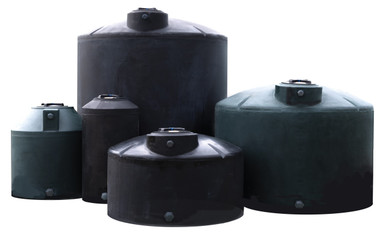
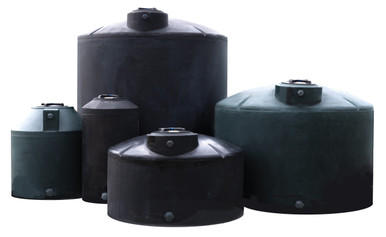
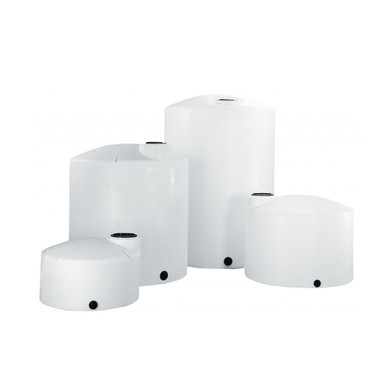
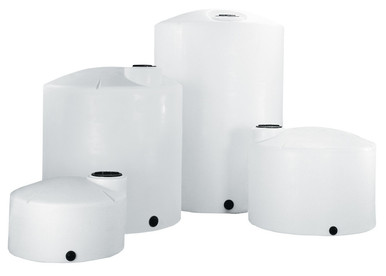
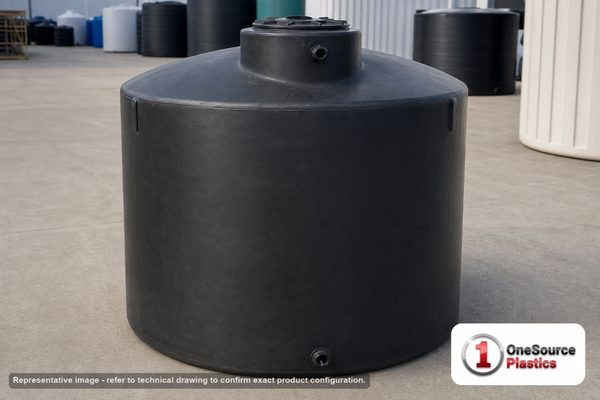
An empty 2,500 gallon polyethylene vertical tank weighs roughly 350 pounds and presents a 7-foot-tall by 8-foot-wide profile to the wind. At 130 mph (Category 4 hurricane) the lateral wind load on that tank exceeds 5,000 pounds. The tank either lifts and rolls, or it stays put. Whether it stays put depends entirely on the tie-down engineering, and the tie-down engineering depends on the foundation, the anchor hardware, the strap rating, and the tank's own anchor-point geometry.
This guide is the field-grade engineering reference for procuring and securing polyethylene tanks in hurricane-prone regions: the coastal (Texas to Florida), the Atlantic Coast (Florida to North Carolina), and the islands and territories (Puerto Rico, USVI). We cover the wind load math, the regulatory requirements (FBC HVHZ, NCSBC, Texas TDI windstorm), the strap and anchor hardware specs, the tank-side reinforcement options, and the real SKUs in our catalog that ship to coastal customers.
Why Empty Tanks Are the Hazard, Not Full Tanks
A 2,500 gallon vertical tank full of water weighs roughly 21,200 pounds. At a 95-inch diameter footprint that's about 430 PSF holding the tank in place. No wind in any tropical cyclone produces an uplift force that exceeds 21,000 pounds on that footprint, so a full tank is functionally self-anchoring against wind.
The hazard is the empty (or partially empty) tank. After a long dry summer, after a maintenance drain, after a chemistry changeover, the tank is sitting empty waiting to be refilled when the storm arrives. Or the tank gets emptied during the storm because the operator opened the valves to prevent freeze damage from the storm's cold air mass. An empty tank with a 56 square foot wetted-cross-section profile under 130 mph wind is a 5,000+ pound projectile waiting to leave the foundation.
The 2017 ASCE 7-16 wind load methodology gives the basic equation: F = qz * G * Cf * Af, where qz is the velocity pressure at tank height, G is the gust effect factor, Cf is the force coefficient, and Af is the projected area. For a 2,500 gallon vertical tank in a Category 4 wind zone (V = 130 mph), with terrain Exposure C, the lateral load resolves to:
| Wind Speed | Velocity Pressure (qz) | Lateral Load on 56 ft² Profile | Tropical Storm Class |
|---|---|---|---|
| 75 mph | 14.4 psf | ~1,210 lb | Tropical Storm |
| 95 mph | 23.1 psf | ~1,940 lb | Cat 1 |
| 110 mph | 31.0 psf | ~2,600 lb | Cat 2 |
| 130 mph | 43.3 psf | ~3,640 lb | Cat 4 |
| 150 mph | 57.6 psf | ~4,840 lb | Cat 4 high end |
| 175 mph (FBC HVHZ) | 78.3 psf | ~6,580 lb | Cat 5 / FBC HVHZ |
Numbers above are simplified; actual ASCE 7-16 calculation includes G factor (typically 0.85), Cf factor for cylindrical tanks (typically 0.7 to 0.8 depending on slenderness ratio), and importance factor (1.0 for residential, 1.15 for essential facilities). For permitted installations a licensed PE should run the full calculation against your local design wind speed. The numbers above set the order of magnitude for procurement decisions.
Florida HVHZ and the 175 MPH Design Standard
Miami-Dade County and Broward County are designated High-Velocity Hurricane Zones (HVHZ) under Section 1620 of the Florida Building Code. Construction in these zones is designed to a 175 mph ultimate wind speed, with components and cladding evaluated against missile-impact and pressure-cycle test protocols (TAS 201, TAS 202, TAS 203 product approval). Polyethylene tanks installed permanently in HVHZ require either:
- Permanent removal during named-storm advisories (impractical for 2,500+ gallon tanks), OR
- Tie-down to an HVHZ-rated foundation with engineered anchorage capable of resisting the calculated 175 mph wind load, OR
- Installation inside a designed enclosure (block building, hurricane-rated shed) that bears the wind load instead of the tank.
For most Miami-Dade installations, the third option is what gets built: the tank lives inside a CMU block enclosure that is itself wind-rated to HVHZ. The tank tie-down then only needs to resist enclosure-internal pressures from infiltration, which are an order of magnitude smaller.
Outside HVHZ but inside Florida (most of the rest of the state), the FBC main wind speed map ranges from 130 mph (interior) to 170 mph (coastal). The same engineering principles apply with adjusted design wind speeds.
Texas Coastal Counties and TDI Windstorm Inspection
Texas has 14 first-tier coastal counties (Aransas, Brazoria, Calhoun, Cameron, Chambers, Galveston, Harris [eastern portion], Jefferson, Kenedy, Kleberg, Matagorda, Nueces, Refugio, San Patricio, Willacy) under the Texas Department of Insurance Windstorm Inspection program. Permanent installations in these counties require WPI-3 inspection certification and adherence to the Texas Windstorm Insurance Association (TWIA) construction requirements.
For polyethylene tanks, the TWIA construction requirements specify anchor-bolt embedment, strap rating, and foundation design against the design wind speed for the specific county. Galveston County design wind speed is 140 mph. Cameron County (Brownsville) is 150 mph. Harris County (Houston) ranges 130 to 140 mph depending on location.
Carolina Coast, ASCE 7, and IBC
The North Carolina coast and South Carolina coast use the ASCE 7-16 wind speed map adopted by the IBC. Outer Banks design wind speed reaches 150 mph; Charleston SC is 140 mph; the inland Piedmont drops to 110 mph. Permitted installations require engineered tie-down meeting the local design wind speed.
Tank Side: Wind-Rated Construction and Anchor Points
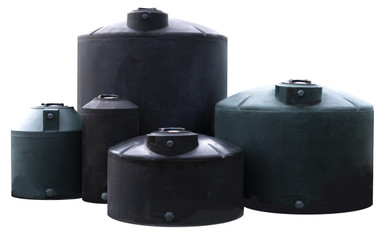
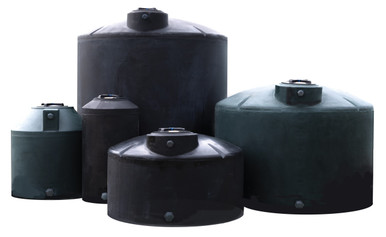
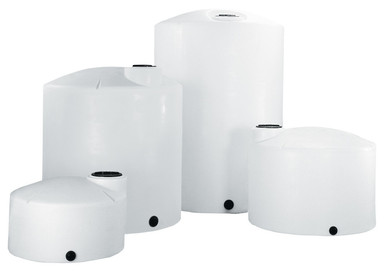
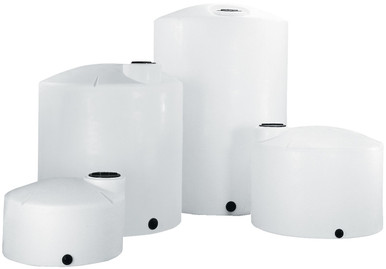
Norwesco and Snyder both produce vertical tanks with explicit wind-load ratings. The wind rating is a function of wall thickness (heavier wall resists deformation and uplift), anchor-point reinforcement (molded-in lugs at the base or molded-in straps at the shoulder), and overall geometry (taller and narrower tanks see higher wind loads per gallon of capacity than shorter and wider tanks).
Representative SKUs from our catalog with documented hurricane-zone deployment history:
| MPN | Capacity | Diameter × Height | Empty Weight | Wind Profile (Empty) |
|---|---|---|---|---|
| N-43092 (Norwesco) | 3,000 gal | 95″ × 124″ | 490 lb | ~82 ft² |
| N-45246 (Norwesco) | 3,000 gal | 102″ × 102″ | 560 lb | ~72 ft² |
| N-44045 (Norwesco doorway) | 1,000 gal | 92″ × 89″ | 384 lb | ~25 ft² narrow face |
| N-43852 (Norwesco cone-bottom) | 1,000 gal | 72″ × 89″ | 239 lb (tank only) | ~45 ft² (incl. stand) |
The N-45246 102-inch-diameter version trades height for diameter at the same 3,000 gallon capacity. In hurricane zones the wider-shorter geometry is preferable because it presents less wind profile and concentrates more weight per unit of footprint. When you're comparing two tanks of the same gallon capacity, always pick the shorter-wider one for hurricane-zone installation if other factors are equal.
Tank Anchor-Point Types
Molded-in lugs at base. Norwesco's wind-rated tank line includes molded HDPE lugs at the base, typically 4 to 6 around the perimeter, drilled to accept 3/4-inch anchor bolts. The lugs are integral to the tank wall and do not stress the tank when loaded in tension. This is the preferred anchor type for hurricane-zone installations.
Strap-over-shoulder. Many vertical tanks without molded lugs are anchored by passing a wide nylon or polyester strap over the top shoulder of the tank and securing the strap ends to the foundation. The strap distributes the uplift load over a wide section of the tank wall. Specification: minimum 4-inch wide woven polyester strap, rated 10,000+ pound break strength, UV-stabilized for outdoor service, attached to foundation via 5,000+ pound rated D-ring or pad-eye anchors.
Cable-and-turnbuckle over crown. Industrial installations often use 1/4 to 3/8 inch stainless steel cable run over the tank crown and tensioned by turnbuckles to embedded foundation anchors. The cable is point-load and requires a wear pad (urethane or rubber) where it contacts the tank shoulder. Less elegant than strap, but appropriate for tanks in chemical service where strap UV degradation is a concern.
Tank-internal ballast. An alternative to mechanical tie-down: keep the tank at minimum 25% capacity at all times during hurricane season. A 2,500 gallon tank with 625 gallons of water (5,200 pounds) plus its own 350 pound mass is anchored by 5,500+ pounds of static weight, exceeding the calculated wind uplift even at Cat 4 wind speeds. This approach requires operational discipline and works only for water-service tanks (chemistry tanks usually cannot accept arbitrary ballast water).
Foundation Side: Anchor Hardware and Embedment
The foundation must be capable of accepting and holding the anchor hardware. Concrete pads are the only realistic foundation option for permanent hurricane-zone tank installations. Compacted gravel does not have the cohesion to hold mechanical anchors against 5,000+ pound uplift loads. See our companion post on foundation pad engineering for the foundation specification basics.
Embedded Anchor Bolts
Cast 3/4-inch or 1-inch diameter J-bolts or threaded studs into the concrete pad at the time of pour, positioned to align with the tank's molded lugs. Embedment depth: minimum 8 inches for 3/4-inch bolts, 12 inches for 1-inch bolts (or per the specific anchor manufacturer's load chart for your concrete strength). Embedded anchors are stronger than post-installed anchors and are the preferred specification for new construction.
Post-Installed Mechanical Anchors
For retrofits to existing concrete pads, use wedge anchors or epoxy-set threaded rod sized for the calculated uplift. Hilti HSL-3 wedge anchors at 3/4-inch diameter and 5-1/2 inch embedment provide approximately 8,000 pound tension capacity in 3,000 PSI concrete. Epoxy-set 3/4-inch all-thread (Hilti HIT-RE 500 V3 or Simpson SET-3G) provides similar capacity with better cyclic loading performance, which matters because hurricane wind loads are cyclic, not static.
Pad Eyes and D-Ring Anchors
For strap-over-shoulder anchorage, embed pad eyes or weld-on D-rings into the concrete pad. Crosby G-2130A bolt-type shackles with 5/8-inch pin and 6,500 pound working load limit are the field-standard choice. Each anchor point should be on a directly cast-in-place embedment, not a post-installed expansion anchor, because cyclic wind loading rapidly fatigues expansion-anchor wedges.
Ground Anchors (No-Foundation Option)
Where a concrete pad is not feasible, helical ground anchors (auger-style screw-in anchors) can resist uplift in dense soils. Typical specification: 1-1/4 inch shaft, 8-inch helix, 48-inch driven depth. A four-anchor pattern with strap-over-shoulder rigging gives roughly 4,000 to 6,000 pound combined uplift capacity in dense clay or compacted granular fill. Ground anchors are less reliable than concrete-embedded anchors and should not be used for permanent installations in HVHZ or design-wind-speed-above-130-mph zones.
Procurement Timing: When to Order
The Atlantic hurricane season runs June 1 through November 30, with peak activity August through October. The Gulf hurricane season runs the same calendar with peak activity September. Tanks ordered in May ship in early June and arrive in time for installation before hurricane risk peaks. Tanks ordered after the first named storm of the season see freight and inventory disruption: trucks get diverted to evacuation logistics, manufacturers prioritize emergency-supply orders over standard orders, and lead times stretch from 7 to 14 days to 21 to 45 days.
If you're procuring for a coastal facility, order before May 15 every year. The post on tank procurement lead time covers the full lead-time picture.
Pre-Storm Operational Checklist
72 hours before forecast landfall:
- Verify all tie-down hardware is intact. UV-degraded straps, corroded D-rings, loose anchor bolts, missing turnbuckles. Replace anything questionable.
- Fill water-service tanks to 50% capacity minimum. Static ballast against wind uplift. Higher fill is better up to the tank's safe operating max (typically 90 to 95% to allow head space for thermal expansion).
- Drain chemistry tanks to safe operating minimum. Reverse logic for chemistry: chemistry release in flood is an environmental and life-safety hazard, so chemistry tanks should be at minimum operating volume during forecast events. Do not empty completely (the tank loses its ballast); maintain 15 to 25% to retain sufficient mass to resist wind uplift.
- Secure all loose fittings, lids, sight gauges, and external piping. These items see flying-debris impact and become projectiles themselves if torn off.
- Photograph all tank installations with date stamp. Pre-storm condition documentation is required for most hurricane property insurance claims under Florida Statute 627.70152 and similar Texas statutes.
24 hours before landfall:
- Final visual inspection of straps and anchors.
- Confirm all valves on chemistry-service tanks are closed and locked. Open valves under flood inundation cause chemistry release.
- Move surrounding vehicles, equipment, and loose materials clear of tank fall radius. Even a properly anchored tank can suffer impact damage from a flying car or downed tree.
Post-Storm Inspection
After the storm passes and the area is safe to enter:
- Inspect tank for impact damage. Visible cracks, deformation, fitting damage, lid damage. Document with photographs before any cleanup.
- Inspect tie-down hardware. Stretched straps, deformed D-rings, pulled anchor bolts. Replace any compromised hardware before refilling the tank.
- Test the tank for leak integrity if any deformation is observed. Fill to 25% capacity, leak-check around the floor and lower wall for 24 hours before returning to service.
- If chemistry release occurred, follow your facility's spill response plan and report per 40 CFR Part 302 (federal Clean Water Act) and your state's specific reporting threshold.
Insurance Implications
Property insurance for tanks in named-storm zones is sold through specialty carriers (Lloyd's syndicates, surplus-lines carriers) with coverage explicitly conditioned on documented compliance with the local building code's wind-load specifications. An uncertified tie-down installation is a coverage exclusion. Florida Citizens Property Insurance Corporation (the state-managed insurer of last resort) explicitly excludes wind damage to non-anchored or improperly-anchored above-ground tanks in HVHZ. Texas Windstorm Insurance Association requires WPI-3 inspection.
The cost of properly engineered tie-down (typical retrofit: $400 to $1,200 in hardware plus 2 to 4 hours of installer labor) is substantially less than a single hurricane-loss claim deductible. It is also the difference between an insured loss and an uninsured one if the storm hits.
Quick Procurement Reference for Coastal Customers
| Application | Recommended Tank Type | Tie-Down Specification |
|---|---|---|
| Residential water reserve, FL non-HVHZ | Vertical 1,500 to 3,000 gal w/ molded lugs | 4 anchor bolts, 3/4″, 8″ embedment, concrete pad |
| Commercial fire reserve, FL HVHZ | Inside CMU enclosure, vertical 5,000+ | Enclosure carries wind load; tank anchor 4 bolts |
| Agricultural water, TX coast | Wider-shorter vertical 2,500 to 5,000 gal | Strap-over-shoulder + 4 D-rings + concrete pad |
| Industrial chemistry, NC coast | Heavy-wall 1.9 SG vertical, low profile | Cable-over-crown + 4 turnbuckles + embedded anchors |
| Cone-bottom processing, any coast | Cone-bottom on steel frame | Frame anchored to pad; tank anchored to frame |
Internal Resources
- Water Storage Tanks Catalog — full vertical and cone-bottom catalog
- Foundation Pad Engineering — companion post, foundation that anchors mount to
- Cone Bottom Stand Selection — stand-foundation interface for cone-bottom tanks
- Florida Tank Regulations — FBC HVHZ and statewide tank rules
- Texas Tank Regulations — TDI windstorm and TWIA requirements
- Freight Cost Estimator — LTL quote to your coastal ZIP
How to Order
For coastal-zone procurement consultation including pre-engineered tie-down kits, call us at 866-418-1777 by May 15 of the year you plan to install. Outside the May 15 cutoff we'll do our best to source and ship before the season peaks but we cannot guarantee against hurricane-driven freight disruption. Contact form at /contact-us/.
Source Citations
- ASCE/SEI 7-16 — Minimum Design Loads and Associated Criteria for Buildings and Other Structures, Chapter 26 to 31 (Wind Loads)
- Florida Building Code 8th Edition (2023), Section 1620 High-Velocity Hurricane Zone
- Florida Building Code Test Application Standards TAS 201, 202, 203
- Texas Department of Insurance, Texas Windstorm Inspection Program
- Texas Windstorm Insurance Association Construction Requirements
- International Building Code 2021, Chapter 16 Structural Design
- NOAA National Hurricane Center, Saffir-Simpson Hurricane Wind Scale
- 40 CFR Part 302 — Designation, Reportable Quantities, and Notification
- Florida Statutes Chapter 627.70152 — Hurricane property insurance claim requirements
- Norwesco Storage Tank Installation Manual, wind-load anchorage section
- OneSource Plastics master catalog data, 2026-03-26 snapshot
Recommended Tanks for This Guide
Live pricing, updated automatically · estimate freight to your ZIP.