Tank Material Selection: HDPE vs XLPE vs Steel vs FRP — Cost-Performance Trade-Off Analysis
Most tank-buyer guides stop at "polyethylene vs steel." That framing is incomplete. The real material short-list for industrial liquid storage in North America is four families: high-density polyethylene (HDPE), cross-linked polyethylene (XLPE), carbon or stainless steel, and fiberglass-reinforced plastic (FRP). Each family has a price point, a chemistry envelope, a temperature ceiling, and a 20-year total cost of ownership profile that swings the answer toward different products depending on service. This guide walks the trade-offs in operating order so you can pick the family before you pick the SKU.
OneSource Plastics' commodity catalog is concentrated in HDPE and XLPE because rotomolded polyethylene wins on cost-performance for the majority of water, agricultural, fertilizer, septic, hauling, light chemistry, and bulk-storage applications. Steel and FRP enter the conversation when chemistry, temperature, pressure, or fire-code drivers exclude polyethylene. We sell the polyethylene side and we will tell you when steel or FRP is the engineered answer instead. Honest specification beats catch-and-replace.
Quick Family-Level Decision Framework
The four-question screen, in order:
- Is service temperature continuous above 140F? Polyethylene is out. Move to FRP or steel.
- Is the tank pressure-rated above atmospheric (a true ASME pressure vessel)? Polyethylene rotomolded tanks are atmospheric only. Move to steel.
- Does fire code or NFPA listing require steel (UL-142, UL-2085)? Polyethylene is excluded for most aboveground petroleum storage above the small-tank thresholds. Move to steel.
- Is the chemistry on the polyethylene-incompatible list (concentrated oxidizers, aromatic solvents, hot caustic above 140F)? Move to FRP or specialty alloy.
If all four screens pass, polyethylene wins on cost-performance for almost every remaining service. The HDPE vs XLPE sub-decision is covered in our resin decision-tree pillar; this guide focuses on the cross-family comparison.
Family Profiles
High-Density Polyethylene (HDPE)
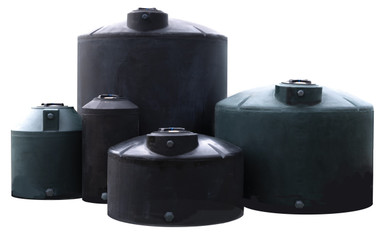
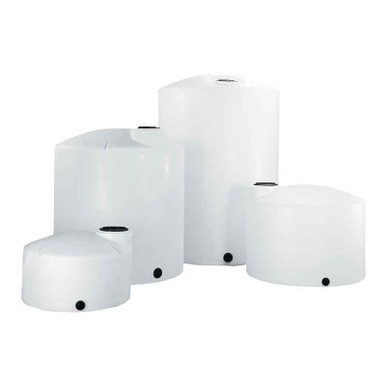
- Manufacture: rotational molding of HDPE resin pellets in heated aluminum molds. Seamless wall, monolithic construction.
- Typical density: 0.940-0.955 g/cc.
- Design hoop stress: 600 psi at 73F per ASTM D1998 Section 6.4.1.
- Maximum specific gravity: 1.5 SG standard product; 1.7 SG on heavy-wall variants.
- Maximum continuous temperature: 100-120F.
- UV stabilization: standard on all reputable manufacturers (carbon black for dark, HALS for natural / white).
- Cost basis (1.0x baseline): Norwesco MPN 41464 (100-gallon vertical black) at $393.86 list. Norwesco MPN 41861 (100-gallon vertical white) at $319.99 list. Snyder, Chem-Tainer, Bushman, Enduraplas all ship comparable HDPE in equivalent capacities.
- Typical service life: 15-25 years on water; 2-15 years on chemistry depending on aggressiveness.
- Repairability: hot-plate fusion, extrusion welding, and patch repair are all standard practice.
- End of life: recyclable through HDPE plastics processors (recycling code 2). Many operators repurpose retired water tanks as livestock troughs or rain barrels.
Cross-Linked Polyethylene (XLPE)
- Manufacture: rotational molding with peroxide-initiated or thermal cross-linking during the cure cycle. Three-dimensional polymer network instead of separate chains.
- Maximum specific gravity: 1.9 SG standard, some 2.0 SG.
- Maximum continuous temperature: 140F.
- ESCR (ASTM D1693): effectively unlimited under standard test conditions.
- Cost basis: 1.3-1.6x HDPE for equivalent geometry.
- Typical service life: 7-25 years on aggressive chemistry, 3-5x life vs HDPE on bleach, caustic, sulfuric, ferric chloride.
- Repairability: mechanical fasteners and epoxy patch only. XLPE cannot be re-melted.
- End of life: not directly recyclable through HDPE streams because the cross-link prevents re-melt; can be ground for fill or repurposed structurally.
Carbon and Stainless Steel
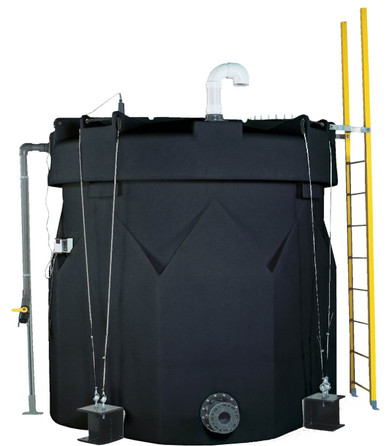
- Manufacture: welded plate (carbon steel) or rolled-and-welded sheet (stainless). Field-erected for large capacities; shop-fabricated for skid units.
- Carbon steel: A36 / A572 plate, typical 3/16 to 3/8 inch wall thickness. Carbon steel requires interior coating for water and chemistry.
- Stainless steel: 304L for general service, 316L for chloride / pharmaceutical. No interior coating required for most chemistries.
- Maximum continuous temperature: carbon steel 600F+ (limited by coating); stainless 800F+ (limited by gasket and seal materials).
- Pressure rating: ASME Section VIII Division 1 stamped vessels available.
- Cost basis: stainless typically 5-10x HDPE for equivalent capacity. Coated carbon steel 2-4x HDPE.
- Typical service life: stainless 30-50 years. Carbon steel 10-25 years depending on coating system and chemistry.
- Repairability: highly repairable by certified welder. Failed coatings can be re-applied.
- End of life: high-value scrap stream. Stainless commands $0.50-1.50 / lb scrap in 2026 market.
OneSource carries select stainless products. Snyder Industries MPN 6984000B51318 (245 gallon 304 stainless Supertainer with side drain) is a representative SKU for stainless tote-class storage. Fluidall MPN 1032203N95401 (120 gallon Cubetainer with stainless dispense fitting) shows hybrid HDPE-tank-with-stainless-fitting construction.
Fiberglass-Reinforced Plastic (FRP)
- Manufacture: filament-wound or hand-laid fiberglass with thermoset resin matrix. Resin chemistry tailored to service: polyester, vinyl ester, epoxy, furan.
- Maximum continuous temperature: 180-250F depending on resin system.
- Pressure rating: atmospheric standard; pressure-rated FRP available for specialty service.
- Chemistry envelope: vinyl ester FRP is the workhorse for concentrated sulfuric acid, sodium hypochlorite, hydrochloric acid, and hot caustic.
- Cost basis: 4-8x HDPE for equivalent capacity.
- Typical service life: 20-40 years in correctly-specified service; 3-8 years if resin system is mismatched to chemistry.
- Repairability: field-repairable by certified FRP technician using compatible resin and fiber.
- End of life: not recyclable; landfill or industrial-waste stream.
OneSource does not stock production FRP tanks directly. For FRP we route through our Specialty & Metal Fabrication hub; the appropriate path for FRP is a fabricator with the resin chemistry expertise to specify correctly.
Cross-Family Comparison Table
| Property | HDPE | XLPE | Coated Carbon Steel | 304/316 Stainless | Vinyl Ester FRP |
|---|---|---|---|---|---|
| Cost vs HDPE baseline | 1.0x | 1.3-1.6x | 2-4x | 5-10x | 4-8x |
| Max continuous temp | 100-120F | 140F | 600F+ | 800F+ | 180-250F |
| Max specific gravity | 1.5 | 1.9 | unlimited | unlimited | unlimited |
| Pressure capable | No (atm) | No (atm) | Yes (ASME) | Yes (ASME) | Limited |
| Concentrated H2SO4 (93%) | No | Yes (1.84 SG OK) | No (without lining) | No | Yes |
| Sodium hypochlorite 12.5% | 2-4 yr | 7-12 yr | No (without lining) | No (chloride pitting) | 15-25 yr |
| Petroleum / diesel fuel | Yes (single OK) | Yes | Yes (UL-142 std) | Yes (overkill) | Yes |
| Potable water (NSF 61) | Yes (most SKUs) | Available | Yes (lined / coated) | Yes | Yes (specific resin) |
| UV resistance | Excellent (stabilized) | Excellent | N/A (steel UV-stable) | Excellent | Good (gel coat) |
| Field repair | Hot-plate weld | Mechanical only | Welder + recoat | Welder | FRP technician |
| Recyclable end of life | Yes (PE2) | Limited | Yes (scrap steel) | Yes (high-value) | No |
| Lead time (typical) | 2-4 weeks | 3-6 weeks | 8-16 weeks | 10-20 weeks | 10-24 weeks |
20-Year Total Cost of Ownership Worked Examples
Capital cost is one input. The right metric is dollars-per-gallon-year over the asset's expected service life, including replacement, downtime, freight, install, demolition, and salvage credit. We model three real cases.
Case A: 2,500-gallon agricultural water storage, outdoor, 20-year horizon
- HDPE option: Norwesco 2500-gallon vertical black tank, list approximately $1,400 (illustrative; actual list verifies via catalog). Service life 20-25 years on water with UV stabilizer. Single asset over the 20-year horizon. Total: $1,400 capital + minimal maintenance.
- Coated carbon steel option: $3,500-5,000 capital + interior coating refresh at year 10 ($800-1,200) + repaint exterior at year 12 ($600-1,000). Total: $4,900-7,200 over 20 years.
- Stainless option: $12,000-18,000 capital, no maintenance over the 20-year horizon. Asset retains 60-70% of capital as scrap value at end of life. Net: $4,800-7,200.
- FRP option: $7,000-11,000 capital, no maintenance. Total: $7,000-11,000.
- Winner: HDPE by 3-8x on TCO. No water-storage condition justifies stainless or FRP economics.
Case B: 1,500-gallon sodium hypochlorite 12.5% feed tank, 20-year horizon
- HDPE option: $1,200 capital × 5-7 replacements over 20 years (life 3-4 years) = $6,000-8,400. Add $500 each replacement for crane and rigging = $2,500-3,500. Add downtime cost. Total: $8,500-12,000+ before downtime.
- XLPE option: $1,800 capital × 2-3 replacements over 20 years (life 7-10 years) = $3,600-5,400. Plus $1,000-1,500 rigging. Total: $4,600-6,900.
- FRP vinyl ester option: $7,000-9,000 capital, no replacement over 20 years (life 20-25 years). Total: $7,000-9,000.
- Stainless 316L option: chloride pitting risk on 12.5% bleach. Not recommended.
- Winner: XLPE on direct cost; FRP slightly higher but eliminates replacement disruption. The HDPE economy disappears once you count the replacement cycles.
Case C: 5,000-gallon diesel fuel aboveground storage, fire-code regulated, 20-year horizon
- HDPE option: excluded by NFPA 30 / UL listings for most aboveground petroleum storage above small-tank thresholds. Out.
- UL-142 carbon steel double-wall option: $8,000-14,000 capital + interior coating inspection year 10 + paint refresh year 12. Total: $9,500-16,000 over 20 years.
- UL-2085 protected (insulated, fire-rated) carbon steel option: $20,000-35,000 capital, no maintenance for 20 years. Total: $20,000-35,000.
- Stainless option: overkill for diesel; $35,000-55,000 capital. Not justified.
- Winner: UL-142 carbon steel double-wall by code requirement and economics. Polyethylene is not on the table for this service.
Material-by-Application Quick Reference
| Application | Best Material | Reason |
|---|---|---|
| Outdoor water (agricultural / livestock) | HDPE | UV-stabilized HDPE delivers 20+ year life at lowest capital |
| Indoor potable water | HDPE NSF 61 | NSF 61 certified HDPE matches stainless on safety at 1/8 cost |
| Underground water / septic | HDPE ribbed-wall | Norwesco / Snyder underground HDPE is the industry standard |
| DEF (urea 32.5%) | HDPE NSF 61 | DEF requires food-grade ingress prevention; NSF 61 HDPE delivers |
| Sodium hypochlorite 12.5% | XLPE (or FRP for >15-yr horizon) | XLPE 3-5x life vs HDPE; FRP for plant-life service |
| Concentrated sulfuric acid 93% | XLPE (1.9 SG) or vinyl ester FRP | XLPE rated to 1.9 SG covers 1.84 SG sulfuric; FRP for hot service |
| UL-142 aboveground diesel / gasoline | Carbon steel double-wall | Code-required; polyethylene not listed for most petroleum AST |
| Pharmaceutical / food-grade process | 316L stainless | Required by 3-A Sanitary Standards / FDA / cGMP |
| High-pressure (above atmospheric) | ASME-stamped carbon or stainless steel | Polyethylene rotomolded tanks are atmospheric-only |
| Portable transport (NPP-rated hauling) | HDPE / XLPE | DOT-49-CFR-178.500 NPP plastic packaging is the industry standard |
| Fertilizer (UAN 28% / 32%) | HDPE (XLPE for >1.5 SG variants) | UAN well within HDPE; specific gravity drives XLPE upgrade for higher concentrations |
| Hot caustic (NaOH above 140F) | FRP or stainless | Polyethylene thermal limit exceeded |
Hidden Costs by Material Family
HDPE / XLPE hidden costs
- Crane and rigging at install and replacement: $400-1,500 per event for tanks 1,000-5,000 gallon. Larger sizes need full crane crews.
- Foundation pad: ASTM D1998 requires flat sand or compacted-soil pad with no point loads. Concrete pad with embedded anchor-bolt rings is the upgrade for high-wind locations.
- Heat tracing / insulation in cold climates: retrofit kits $300-800 for tanks under 3,000 gallon; engineered systems for larger.
- Replacement disruption on chemistry service: downtime cost can dwarf the tank itself for production-critical service.
Steel hidden costs
- Interior coating system: $1.50-4.00 per square foot installed for epoxy or specialty linings. Re-coat at 8-12 year intervals on water service.
- Cathodic protection on buried steel: $1,000-5,000 install plus $200-500 per year monitoring.
- Welder qualifications: AWS D1.1 or ASME Section IX certified welder required for code repairs. Hourly rates 2-4x general fabrication.
- Permit and inspection: ASME stamped vessels and UL-listed AST require permitting that adds weeks to schedule.
FRP hidden costs
- Resin-system specification: wrong resin can fail in months. Vinyl ester for oxidizers and chlorides; isophthalic polyester for general acid; furan for specialty.
- Gel-coat refresh on UV-exposed FRP: $0.75-2.50 per square foot at 7-12 year intervals.
- Field-repair specialist availability: certified FRP technicians are concentrated regionally; remote installations face long mobilization times.
- End-of-life disposal: FRP is not recyclable. Landfill or industrial-waste disposal may require manifesting depending on residual chemistry.
Common Material-Selection Mistakes
Mistake 1: Buying steel because it "feels stronger"
Polyethylene at the right SG and chemistry rating outlasts coated carbon steel on water service by every economic measure. The intuition that steel = durability comes from infrastructure exposure (bridges, buildings); the chemistry-storage reality is different.
Mistake 2: Buying polyethylene where UL-142 is required
Aboveground petroleum storage above small-quantity thresholds requires UL-142 (or UL-2085 for protected tanks). Most municipalities will reject a polyethylene AST permit for fuel storage at any meaningful capacity. Verify with your AHJ before specifying.
Mistake 3: Specifying FRP for benign service
FRP at 4-8x HDPE cost is wasted capital on water, septic, agricultural fertilizer, or DEF storage. FRP earns its premium only when chemistry, temperature, or fire code excludes polyethylene.
Mistake 4: Ignoring lead time
Polyethylene tanks ship in 2-4 weeks from regional manufacturer warehouses. Steel and FRP custom fabrications run 8-24 weeks. If construction schedule has 6 weeks of float, polyethylene is the only option even when other materials are technically eligible.
Mistake 5: Mixing materials in a single system without compatibility review
Galvanic corrosion at dissimilar-metal junctions (stainless to carbon, copper to aluminum) and gasket-material mismatch (EPDM eats petroleum, Viton hardens on caustic) cause more system failures than tank-shell issues. Specify the gasket and fitting materials with the same rigor as the tank shell.
How OneSource Specifies
Our default for inbound buyer questions follows the four-screen sequence at the top of this guide. We recommend HDPE when the chemistry, temperature, pressure, and code envelope all permit it. We recommend XLPE when chemistry or SG pushes past HDPE limits but temperature stays under 140F. We route to Specialty & Metal Fabrication when the engineered answer is FRP or stainless. We never substitute a polyethylene SKU into an application that the code or chemistry says requires steel; the savings are illusory and the failure is yours.
Product callouts pulled from the OneSource catalog this guide references include Norwesco MPN 41464 / 41861 / 41464 (HDPE vertical water class), Snyder Industries MPN 6984000B51318 (245 gallon stainless Supertainer), and Fluidall MPN 1032203N95401 (HDPE Cubetainer with stainless dispense fitting). Every list price quoted is the BigCommerce list — LTL freight is quoted separately per ZIP via the Freight Estimator or by phone at 866-418-1777.
Internal Resources
- HDPE vs XLPE Resin Decision Tree
- ASTM D1998 Service Life Methodology
- Spec Sheet Engineering Guide
- Chemical Compatibility Database (309 chemicals)
- Specialty & Metal Fabrication
- Freight Cost Estimator
Source Citations
- ASTM D1998 — Standard Specification for Polyethylene Upright Storage Tanks
- ASTM D1693 — Standard Test Method for Environmental Stress-Cracking of Ethylene Plastics
- ASTM A36 / A572 — Carbon Steel Plate Specifications
- ASTM A240 — Stainless Steel Plate Specifications (304L, 316L)
- ASME Boiler and Pressure Vessel Code Section VIII Division 1 — Pressure Vessel Fabrication
- NFPA 30 — Flammable and Combustible Liquids Code
- UL 142 — Steel Aboveground Tanks for Flammable and Combustible Liquids
- UL 2085 — Protected Aboveground Tanks for Flammable and Combustible Liquids
- NSF/ANSI 61 — Drinking Water System Components: Health Effects
- 3-A Sanitary Standards — food and dairy process equipment
- OneSource Plastics master catalog data, dated 2026-03-26 snapshot (9,419 products)
Related chemical compatibility resources
For deeper engineering specifications on the chemicals discussed above, see our chemical-compatibility pillars:
- Sodium Hypochlorite — storage compatibility, recommended resin grade, fittings, secondary containment.
- Sulfuric Acid — storage compatibility, recommended resin grade, fittings, secondary containment.
- DEF (Diesel Exhaust Fluid) — storage compatibility, recommended resin grade, fittings, secondary containment.
- Hydrochloric Acid — storage compatibility, recommended resin grade, fittings, secondary containment.
Recommended Tanks for This Guide
Live pricing, updated automatically · estimate freight to your ZIP.