Tank UV-Resistant Color Selection: Black vs White vs Translucent Reality Check by Latitude
Solar UV is the largest single service-life variable on an outdoor polyethylene tank. Chemistry, freight handling, and seismic loads each matter, but each is bounded - chemistry can be selected against, freight is a one-time event, seismic is a code-defined design case. UV is continuous, cumulative, and its annual dose varies by a factor of nearly two-and-a-half across the latitudes the United States actually populates. A 1,500-gallon vertical HDPE tank installed at 25 degrees North (Miami, Houston, Phoenix) absorbs roughly 2.4x the annual UV-B dose of an identical tank at 60 degrees North (Anchorage, Fairbanks). That ratio governs why the same Norwesco MPN 41464 (100 gallon vertical, black) routinely makes 25+ years on a coastal Maine farm and starts to show oxidation chalking in 12-15 years on a Phoenix rooftop.
This guide cuts through the marketing claims around tank color. The data: ASTM G154 accelerated weathering chamber results, NREL Typical Meteorological Year solar resource maps, manufacturer-published service-life envelopes, and the chemistry of why black, white, and translucent natural HDPE each fail differently when over-exposed.
The Photo-Oxidation Mechanism
HDPE wall sections fail under UV by chain scission. Solar UV-B photons (280-315 nanometers) carry enough energy (380-430 kJ/mol) to break the C-C and C-H bonds in the polyethylene backbone (bond energies 348 and 414 kJ/mol respectively). Oxygen attacks the resulting free radicals, forming carbonyl groups, and the chain fragments. The visible signature is chalking on the outer surface; the structural signature is loss of tensile elongation, which in turn lowers hoop-stress capacity and seismic-shear resistance.
Three additive strategies counter this:
- Carbon black (1.5-3.0% loading): absorbs UV before it reaches the polymer chain. Industrial-grade carbon black at 2.5% loading is the most aggressive UV defense available in commodity rotomolded HDPE.
- Hindered Amine Light Stabilizers (HALS) and UV absorbers (Tinuvin-class): intercept the radical-formation step. Used in white, blue, green, and color-pigmented tanks to extend service life without the optical penalty of carbon.
- Pigment opacity (titanium dioxide for white, iron oxide for green/red): reflects and scatters UV before it penetrates the wall. Translucent natural HDPE has none of this.
The 25-year manufacturer warranty floor for properly stabilized HDPE outdoor tanks (see ASTM D1998 Standard Specification for Polyethylene Upright Storage Tanks, Section 6) assumes adequate UV stabilization for the installation latitude. Translucent natural HDPE is explicitly outside that warranty envelope when installed in direct sunlight.
Latitude UV Dose: The Hard Numbers
NREL's National Solar Radiation Database publishes Typical Meteorological Year (TMY) UV-A and UV-B dose maps. Key reference points (annual UV-B dose in MJ/m^2/year):
| Location | Latitude | Annual UV-B (MJ/m^2) | Multiplier vs Anchorage |
|---|---|---|---|
| Anchorage, AK | 61.2 N | ~165 | 1.0x baseline |
| Seattle, WA | 47.6 N | ~245 | 1.5x |
| Chicago, IL | 41.9 N | ~290 | 1.8x |
| Atlanta, GA | 33.8 N | ~340 | 2.1x |
| Houston, TX | 29.8 N | ~370 | 2.2x |
| Phoenix, AZ | 33.4 N | ~395 | 2.4x |
| Miami, FL | 25.8 N | ~395 | 2.4x |
Two effects amplify the latitude variance: altitude (Phoenix at 1,100 ft sees clearer atmospheric path than Miami at sea level despite higher latitude) and atmospheric clarity (low cloud-cover in the desert Southwest delivers more dose per cloudy hour than cloudy Pacific Northwest). The 2.4x ratio between Anchorage and Phoenix understates the effective service-life delta because temperature also accelerates oxidation kinetics by an Arrhenius factor of roughly 2x per 10C wall-temperature increase.
Color-by-Color Service-Life Reality
Black HDPE - The UV Champion
Industrial carbon black at 2.0-2.5% loading is the most aggressive UV defense available. Carbon-black HDPE fails by:
- Surface chalking (cosmetic; carbon dust film) - first 2-5 years even in extreme exposure.
- Outer-wall oxidation chain scission - typically beyond 25 years even in Phoenix-class exposure.
- Structural service-life loss approaches 50% only past 30+ years of continuous outdoor exposure at low latitude.
Trade-off: the carbon-black wall absorbs solar IR. A black tank in direct sun in Phoenix can run 10-20F higher wall temperature than an identical white tank, which accelerates chemistry inside (biofilm growth in stored water, evaporation, head-space pressure cycling). Black is the right answer for outdoor potable, fire reserve, and irrigation service where UV dose dominates and content temperature isn't quality-critical.
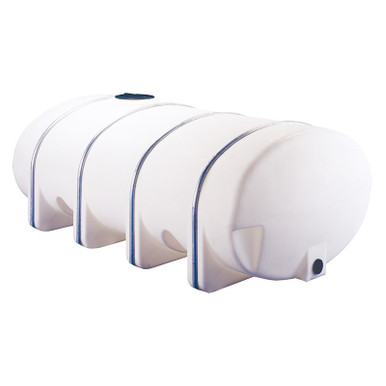
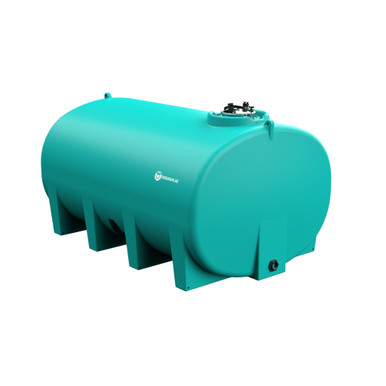
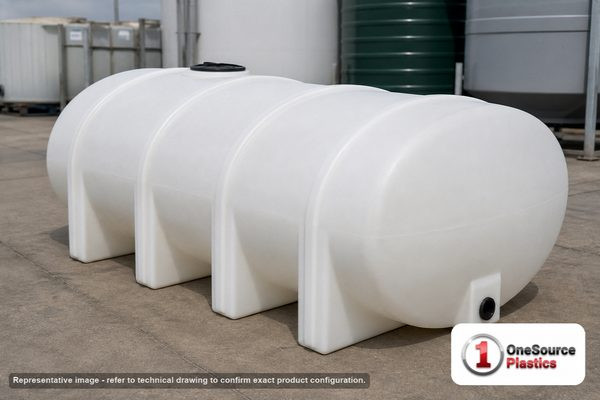
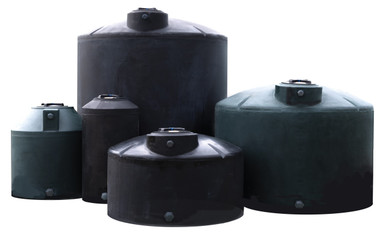
Representative SKUs: Norwesco MPN 41464 (100 gal vertical, black), MPN 41500 (1,000 gal vertical, black), MPN 47109 (2,000 gal vertical, black), MPN 42044 (5,000 gal vertical, black), MPN 40775 (2,035 gal HDPE elliptical leg tank, black), MPN 41294 (2,635 gal elliptical leg, black).
White HDPE - The Light-Sensitive Content Choice
White HDPE uses titanium dioxide (TiO2) pigment plus HALS-class stabilizers. UV-B is reflected and scattered before reaching the polymer chain. Wall surface stays cooler than black by 10-20F under direct sun, slowing internal content degradation. Trade-offs:
- Manufacturer-rated 25-year service in mid-latitude (35-50 N); 15-25 years in low-latitude (25-35 N) when stabilizer package is intact.
- Stabilizer depletion is the failure mode - HALS gets consumed over years; once depleted, the white tank loses UV defense and chain scission accelerates rapidly.
- Color-shift (yellowing) is visible 5-10 years before structural failure. Treat yellowing as an inspection trigger.
White is the right answer for chemistry storage where content temperature matters (sodium hypochlorite degrades exponentially with temperature; loses 10% concentration per 10C above 20C ambient), water tanks where biofilm risk is concentration-sensitive, and any indoor storage where UV is incidental rather than continuous.
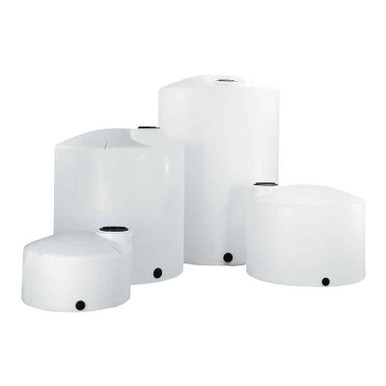
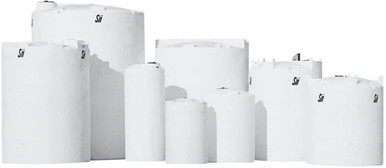
Representative SKUs: Norwesco MPN 41861 (100 gal vertical, white), MPN 42382 (2,500 gal vertical, white), MPN 45246 (3,000 gal vertical, white), MPN 40941 (5,000 gal vertical, white), MPN 47638 (10,500 gal vertical, white), MPN 42595 (1,550 gal vertical, white).
Translucent Natural HDPE - The Indoor-Only Option
Translucent (or "natural white") HDPE has no carbon, minimal TiO2, often only basic HALS. The transparent wall lets users gauge fill level visually. The trade-off is severe: in direct sun, translucent natural HDPE service life drops to 3-7 years at low latitude and 7-12 years at mid-latitude. Without continuous UV stabilization, chain scission is rapid.
This is not a defect; it is a design decision. Translucent natural HDPE is intended for indoor storage, partial-shade installation, or applications where visual fill gauging outweighs service life. Manufacturer warranties typically void on direct outdoor exposure.
Translucent makes sense in:
- Indoor chemical batch tanks (warehouse-installed, no UV).
- Greenhouse irrigation feed tanks (filtered light through polycarbonate or polyethylene roof).
- Below-grade or under-shade outdoor (north-side of building, deep eaves, dedicated tank shelter).
- Short-cycle service where the tank is consumable rather than capital (small dose tanks, lab feed tanks).
Representative SKUs: Chem-Tainer MPN TC3172IA (200 gal natural white vertical), MPN TC3581IA (300 gal natural white vertical), MPN TC6446IA (500 gal natural white vertical), MPN TC750XIA (750 gal natural white vertical), MPN TC8657IA (1,150 gal natural white vertical), MPN TC1500IA (1,500 gal natural white vertical), MPN TC8765IA (1,550 gal natural white vertical), MPN TC1701IA (1,700 gal natural white vertical).
Pigmented Color (Green, Blue, Red) - Aesthetic + Function
Iron oxide and chromium oxide pigments at 0.5-1.5% loading provide UV defense through opacity and reflection, similar to TiO2 white but tuned for landscape blending. Service life sits between black and white - typically 15-25 years across the latitude band. Used heavily in:
- Agricultural water reserve where regulators prefer non-black aesthetic (California green, blue for fertilizer service).
- Residential rural water haul where green or "California green" blends with vegetation.
- Color-coded chemistry for safety identification (blue = water, yellow = caustic, red = fuel).
Representative SKUs: Norwesco MPN 41465 (100 gal vertical, green), MPN 41375 (5,000 gal vertical, California Green), MPN 47564 (2,000 gal vertical, blue), MPN 40283 (2,635 gal elliptical leg, blue).
Latitude-Based Color Selection Matrix
| Latitude band | Examples | Black HDPE | White HDPE | Translucent natural |
|---|---|---|---|---|
| 25-30 N (low) | Miami, Houston, Phoenix | 25-30 yr | 15-22 yr | 3-7 yr (indoor only) |
| 30-35 N | Atlanta, Dallas, San Diego | 28-32 yr | 18-25 yr | 5-9 yr (indoor only) |
| 35-45 N (mid) | Denver, Kansas City, Sacramento | 30+ yr | 22-28 yr | 7-12 yr (indoor preferred) |
| 45-55 N (upper) | Seattle, Minneapolis, Boston | 30+ yr | 25+ yr | 10-15 yr (some outdoor OK) |
| 55-65 N (high) | Anchorage, Fairbanks | 30+ yr (UV not limiting) | 25+ yr | 15+ yr (outdoor viable) |
Content-Driven Overrides
Latitude sets the UV bound; content sets the override. Three cases force a non-default color:
Sodium hypochlorite (12.5% bleach) at any latitude
Bleach degrades exponentially with temperature. Field measurements show 12.5% NaOCl loses 10-15% available chlorine over 30 days at 30C wall temperature; the same bleach in a black tank at 40C wall temperature loses 20-25%. Use white only. See sodium hypochlorite compatibility pillar.
Liquid fertilizer at low latitude
Urea-ammonium nitrate (UAN 28% and UAN 32%) crystallizes at 30-32F and decomposes above 90F wall temp. White preferred at any latitude below 40 N. See UAN 32 compatibility.
Potable water in Sun Belt
NSF/ANSI 61 certification is independent of color, but biofilm growth doubles for every 10F temperature rise above 65F. White or green outperforms black on water quality below 35 N latitude. Black wins on UV-driven service life; white wins on biofilm and taste.
Real-World Failure Patterns I See in the Field
Pattern 1: Translucent natural in Phoenix rooftop
An Arizona car wash used a 1,500-gallon translucent vertical for surfactant feed mounted on a flat roof. Year 4 the wall thinned from 0.32 to 0.21 inches. Year 5 it ruptured under thermal cycling. Translucent in direct Phoenix sun is a 3-5 year tank, not a 15-year tank. Replacement: Norwesco MPN 42595 (1,550 gal white vertical). Service life now projected at 18-22 years.
Pattern 2: Black tank with sodium hypochlorite in Houston
Black hypochlorite tank in coastal service ran 50-55F internal temperature in summer. Bleach concentration dropped from 12.5% to 9.8% available chlorine over 60 days. Plant operator was dosing 28% extra to hit free-chlorine residual. Replacement with white tank cut chemistry cost by 21% over 12-month measurement.
Pattern 3: White tank with "decorative" pigmented over-spray
Customer painted a white HDPE tank brown to blend with the barn. Paint flaked in 8 months. Worse, the painted surface trapped heat and accelerated wall oxidation under the paint. Never paint HDPE. If aesthetic matters, order pigmented color (green, brown, "California green") from the factory.
Pattern 4: Black water tank above-ground in Minnesota
Black 2,000-gallon Norwesco MPN 47109 ran ice-tight in winter (latent heat of carbon-black wall absorbed enough solar in shoulder seasons to delay freeze). Same property in white tank froze at the bottom outlet 6 weeks earlier. Black wins on freeze-thaw cycling at high latitude where UV is not the limiting factor.
Cost vs Service Life: The 25-Year ROI
List price differential between black and white (same capacity, same wall, same manufacturer) is typically 5-12% with white commanding the premium. Translucent is usually priced equal to or slightly below white. Service-life differential at low latitude (Sun Belt) makes black the better dollar value when:
- Content is UV-tolerant water or fire reserve.
- Site does not need biofilm or temperature management.
- Tank is structural rather than process.
White wins the dollar fight when content quality, biofilm, or chemistry-temperature degradation cost exceeds the 5-12% color premium - which is virtually any chemistry application.
Specification Checklist for Outdoor Tanks
- Latitude. Pull the install ZIP from the project; confirm latitude band.
- Content. Light-sensitive (bleach, UAN, peroxide) -> white. Light-tolerant water/fire reserve -> black or green at site preference.
- Standard. ASTM D1998 wall-thickness rating + manufacturer published UV-stabilization spec.
- Certification. NSF/ANSI 61 for potable; FDA-CFR-21 177.1520 for food contact.
- Site exposure. Direct sun, partial shade, full shade. Site full-shade allows translucent to perform like white.
- Replacement budget cycle. Plan for 25 years on black/white in mid-to-upper latitude; 15-22 years for white in Sun Belt; 3-7 years for translucent in any direct sun.
Internal Resources
- Chemical Compatibility Library
- Sodium Hypochlorite Storage Pillar
- UAN 32 Storage Pillar
- State Regulations Hub
- California Tank Regulations
- Florida Tank Regulations
- Tank Sizing Calculator
- Freight Cost Estimator
Source Citations
- ASTM D1998-21 - Standard Specification for Polyethylene Upright Storage Tanks
- ASTM G154-23 - Standard Practice for Operating Fluorescent Ultraviolet (UV) Lamp Apparatus for Exposure of Materials
- ASTM G7-21 - Standard Practice for Atmospheric Environmental Exposure Testing of Nonmetallic Materials
- NSF/ANSI 61 - Drinking Water System Components - Health Effects
- FDA 21 CFR 177.1520 - Olefin Polymers (food-contact)
- NREL National Solar Radiation Database (NSRDB) - Typical Meteorological Year v3 (TMY3)
- NIST Building Materials Outdoor Weathering data (Carbon black UV stabilization, 1995-2018)
- OneSource Plastics master catalog data, 2026-03-26 snapshot (9,419 SKUs)
Recommended Tanks for This Guide
Live pricing, updated automatically · estimate freight to your ZIP.