
Oil-Water Separators (API 421)
Oil-Water Separators (API 421)
Free oil and water do not mix, and an oil-water separator turns that simple physics into a reliable way to keep oil out of a discharge. The design choice comes down to how small the droplets are.
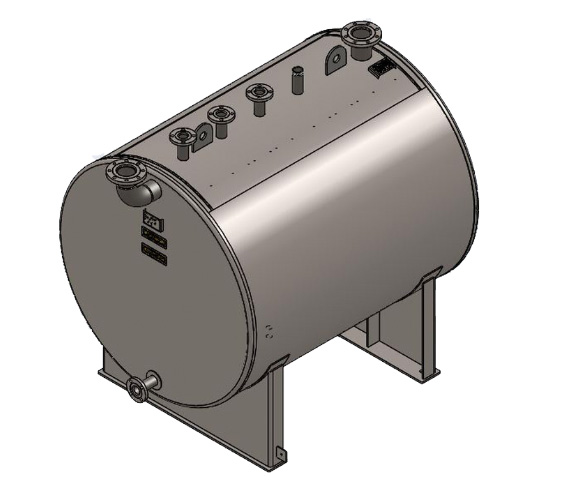
The Physics of Separation
An oil-water separator exploits the density difference between oil and water. Oil is lighter than water, so given enough quiet residence time, oil droplets rise to the surface where they can be skimmed off, while any heavier solids settle to the bottom as sludge. The governing relationship is Stokes' law, which states that the rise velocity of a droplet increases with the square of its diameter and with the density difference between the two phases, and decreases with the viscosity of the water. The practical consequence is decisive: large droplets rise quickly and are easy to remove, while very small droplets rise so slowly that simple gravity cannot catch them in a reasonable tank size.
This single fact — that separability collapses as droplet size shrinks — explains the entire family of separator designs. Because rise velocity scales with the square of diameter, a droplet half the size rises only a quarter as fast, so halving the target droplet quadruples the tank a gravity unit would need. It also explains why emulsified oil, where droplets are chemically stabilized at a few microns, generally cannot be removed by physical separation at all and instead requires chemical demulsification, dissolved air flotation, or membrane treatment.
Three categories of oil are usually distinguished. Free oil exists as large, readily rising droplets and is the easy target of any separator. Dispersed oil consists of finer droplets that need coalescing assistance. Emulsified oil is stabilized at the micron scale and is effectively invisible to physical separation. Knowing which fraction dominates a given wastewater is the first step in selecting equipment, because a separator that works on free oil will pass emulsions straight through.
Gravity Separators and API 421
The classic gravity separator is the API separator, named for the design methodology published by the American Petroleum Institute. The reference document, API Publication 421, provides the engineering basis for sizing rectangular gravity separators so that the slowest design droplet has time to rise to the surface before the flow carries it to the outlet. The method targets a specific design droplet size — commonly 150 microns — and sizes the tank so that droplet's rise time is shorter than the water's horizontal travel time through the separator. In effect the separator is dimensioned so the slowest droplet reaches the surface just before the water it rode in on reaches the exit.
A conforming API separator includes more than an empty tank. Flow-distribution baffles spread the incoming stream evenly across the cross section to prevent short-circuiting, where a fast jet of water cuts straight to the outlet and steals residence time from the rest. A surface skimmer, slotted pipe, or rotating drum continuously removes the floating oil layer before it re-entrains, and a sludge hopper with a bottom scraper collects settled solids for periodic removal. Because the separator handles flammable hydrocarbons and can release vapors, fire-safety provisions such as covers and vapor control are standard. API separators are robust, handle large and variable flows, and are forgiving of solids, but they cannot capture the fine droplets that pass through.
Coalescing-Plate Separators
To capture droplets smaller than gravity alone can manage, a coalescing separator inserts closely spaced inclined plates — corrugated parallel plates or tilted-plate packs — into the flow path. The plates work in two ways. First, they dramatically shorten the distance any droplet must rise: instead of climbing the full depth of the tank, a droplet only has to rise the small gap to the underside of the plate above it, where it collects and slides up the incline to the surface. Second, the oleophilic plate surfaces encourage small droplets to wet, gather, and merge, or coalesce, into larger droplets that then rise far more readily once they detach.
By providing a large effective settling area in a compact footprint, a coalescing-plate separator removes much smaller droplets — commonly down to around 20 microns — than a bare gravity tank of the same size. This makes coalescing designs the standard where space is limited or where the discharge limit is tight. They are not a cure-all: chemically stabilized emulsions still pass through, and the plate packs require periodic cleaning to prevent fouling, sediment buildup, and biological growth that would blind the channels. The plate spacing is a balance — tighter packs give more area but clog faster on solids-bearing streams — so a pre-settling chamber often precedes the pack on dirty water.
| Attribute | API Gravity Separator | Coalescing-Plate Separator |
|---|---|---|
| Sizing basis | API Publication 421 rise-time method | Effective plate settling area |
| Typical droplet removal | Down to roughly 150 microns | Down to roughly 20 microns |
| Footprint | Large for a given flow | Compact |
| Internals | Baffles, skimmer, sludge scraper | Inclined coalescing plate packs |
| Solids tolerance | High; forgiving of grit and sludge | Lower; packs blind without pre-settling |
| Maintenance | Sludge removal, skimming | Plate-pack cleaning, fouling control |
| Limitation | Misses fine droplets | Cannot break stable emulsions |
Where Separators Are Used
Oil-water separators appear wherever water and hydrocarbons mix. In refineries and petrochemical plants they treat process drainage, desalter effluent, tank-farm drainage, and storm runoff from process areas before that water moves on to biological treatment. In general industry they serve maintenance shops, vehicle wash bays, equipment washdown areas, and machining operations where cutting and lubricating oils enter the wastewater. They are also a fixture of stormwater management on fuel-handling sites, capturing the sheen of oil washed off paved areas during rain so it does not reach a storm drain.
In a typical treatment train the separator is a first or pre-treatment stage rather than a polishing one. It removes the bulk free oil and gross solids so that downstream processes — dissolved air flotation, biological treatment, or filtration — receive a manageable load and are not overwhelmed, blinded, or fouled by free product. Asking a separator to meet a stringent final limit on its own usually fails; pairing it with the right downstream polishing step is what achieves compliance reliably.
Operation and Maintenance
A separator only performs as well as it is maintained, and the most common reason for an effluent excursion is neglected housekeeping rather than a flaw in the design. Three routines keep a separator healthy. First, the recovered oil must be skimmed off and removed regularly; if the oil layer grows too thick it re-entrains into the outgoing water and the separator quietly fails its limit. Second, the settled sludge in the bottom hopper must be pumped out on a schedule, because accumulated solids reduce the effective volume, shorten residence time, and can resuspend during flow surges. Third, on coalescing units the plate packs must be inspected and cleaned before fouling blinds the channels and short-circuits the flow.
Hydraulic loading is the other discipline. A separator is sized for a design flow, and surges well above that flow scour settled material and carry oil straight through. Where a site sees sharp peaks — a sudden washdown, a storm, a batch dump — an upstream equalization tank that buffers the flow protects the separator and the downstream treatment alike. Treating the separator as a living unit with a defined inspection and cleaning schedule, rather than a passive tank installed and forgotten, is what keeps it in compliance year after year.
Regulatory Context and Materials
The reason a facility installs an oil-water separator is almost always regulatory. Under the Clean Water Act, discharges to surface waters require a National Pollutant Discharge Elimination System permit, and discharges to a municipal sewer are governed by local pretreatment standards. Both routes set limits on oil and grease in the effluent, and the separator is the engineered means of meeting them. Operators must sample, monitor, and document performance to demonstrate ongoing compliance, and an undersized or poorly maintained separator that exceeds its oil-and-grease limit is a direct permit violation.
Construction depends on the service. Carbon steel, concrete, and stainless steel are all used for separator vessels, with stainless or coated steel preferred where the wastewater is corrosive or where long, low-maintenance life is required. The internal plate packs and skimmers are frequently molded from corrosion-resistant polymers that resist the hydrocarbons and the wet, mildly corrosive environment without warping. As with any oil-handling vessel, fire-code provisions and, where the separator sits near bulk storage, secondary containment are part of a complete installation, so that a separator failure does not itself become the spill it was meant to prevent.
Frequently asked questions
- How does an oil-water separator actually work?
- It uses the density difference between oil and water: because oil is lighter, droplets rise to the surface during quiet residence time and are skimmed off, while heavier solids settle as sludge. The rate of separation follows Stokes' law, so large droplets rise quickly and small ones slowly. That is why design choices revolve around the size of droplet the separator must capture.
- What is API 421 and why does it matter?
- API Publication 421 is the American Petroleum Institute's engineering methodology for sizing gravity oil-water separators. It sizes the tank so that the slowest design droplet, often 150 microns, has time to rise to the surface before the flow carries it out. It also specifies internals such as flow-distribution baffles, surface skimmers, and sludge collection that make a gravity separator perform as intended.
- When do you need coalescing plates instead of a plain gravity separator?
- When you must remove droplets smaller than a gravity tank can catch, or when space is limited. Coalescing plates shorten the distance a droplet has to rise and encourage small droplets to merge into larger ones, pushing removal down to roughly 20 microns in a compact footprint. They cannot, however, break chemically stabilized emulsions, which require chemical or membrane treatment.
- What regulations require oil-water separators?
- The Clean Water Act drives most installations. Discharging treated water to surface waters requires a National Pollutant Discharge Elimination System permit, and discharging to a municipal sewer falls under pretreatment standards, both of which limit oil and grease in the effluent. The separator is the engineered means of meeting those limits, and operators must monitor and document its performance.
Scope your custom build
Send us your volume, service chemistry, dimensions, and finish or code requirements. We return a full engineering package, firm lead time, and a fixed quote — freight quoted separately to your ZIP.
Request a Custom QuoteCall 866-418-1777