
ASME Section X FRP Pressure Vessels
ASME Section X FRP Pressure Vessels
An open atmospheric FRP tank and an FRP vessel holding pressure are governed by completely different rules. Above a threshold, the code takes over.
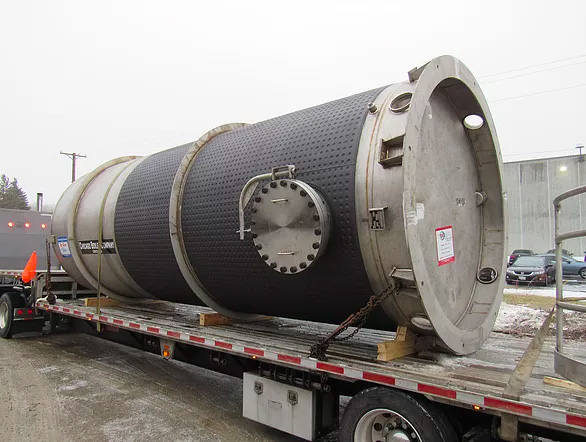
When a Tank Becomes a Pressure Vessel
Most fiberglass tanks are atmospheric: they hold liquid at little more than the static head of their own contents and vent freely to the surroundings. Those tanks are typically built to construction standards for FRP equipment, but they are not pressure vessels in the regulatory sense. The picture changes the moment an FRP vessel is required to hold internal pressure, or full vacuum, above a defined threshold. At that point it can fall under the ASME Boiler and Pressure Vessel Code, and specifically Section X, Fiber-Reinforced Plastic Pressure Vessels, which is the part of the code written exclusively for composite pressure equipment.
This distinction matters because pressure failure in a composite is unforgiving. A metal vessel that is overstressed often yields and deforms visibly before it ruptures, giving warning. A fiber-reinforced plastic that is overloaded can fail more abruptly and is far more sensitive to how it was laid up, cured, and detailed. Section X exists precisely because composite pressure equipment cannot be designed with the same intuition and rules of thumb used for atmospheric FRP tanks or for steel.
What Section X Covers
Section X provides the rules for design, fabrication, inspection, testing, marking, and certification of FRP pressure vessels. It addresses the realities specific to composites: that the material properties depend on the fiber type, resin, fiber orientation, and the laminate sequence; that the vessel and its material are essentially created at the same time during fabrication; and that quality is built into the laminate rather than verified afterward in a finished plate of known properties. The code therefore couples vessel design tightly to demonstrated material performance and to controlled, documented fabrication.
Within Section X there are different design approaches. One path qualifies a specific vessel design by destructive proof testing of a representative vessel, demonstrating by burst and cyclic testing that the design carries a large margin over its rated pressure. Another path relies on a more analysis-driven, mandatory design-by-rule approach with stress analysis and acceptance criteria. The common thread is that the qualified design, the materials, and the fabrication procedure become a locked package; you cannot freely substitute a different resin, fiber, or layup and still claim the same qualification.
When the Code Stamp Is Required
Whether an FRP vessel must be built and stamped to Section X is, in the end, a jurisdictional and contractual question, not purely a technical one. Pressure-vessel requirements are set by the jurisdiction where the equipment is installed and operated, and many jurisdictions adopt the ASME code by reference for vessels above a defined pressure and size. As a practical matter, a code stamp is generally triggered when a vessel will operate above the small pressure threshold the code recognizes, exceeds a minimal size, and is not otherwise exempted. Atmospheric storage tanks usually fall outside it; vessels designed to hold meaningful internal pressure or full vacuum usually fall inside it.
The right way to resolve this is never to guess. Confirm with the authority having jurisdiction and the project specification whether a Section X stamp is required for the specific service, and design accordingly from the start. Retrofitting code compliance onto a vessel that was built as an atmospheric tank is generally impossible, because the qualification, traceability, and inspection had to be in place during fabrication.
Atmospheric FRP Tank vs Section X Vessel
| Aspect | Atmospheric FRP Tank | ASME Section X Vessel |
|---|---|---|
| Internal pressure | Essentially vented / static head | Designed to a rated pressure or vacuum |
| Governing rules | FRP construction standards | ASME BPVC Section X |
| Design qualification | By recognized construction practice | By proof test or design-by-rule |
| Material control | Specified barrier and laminate | Locked resin, fiber, layup, cure |
| Certification | Manufacturer documentation | Code stamp and data report |
| Inspection | Visual and dimensional | Code-required inspection and testing |
Why Composite Pressure Design Is Different
Designing a pressure vessel in steel leans on well-known, isotropic material properties and decades of plate-and-weld rules. A composite is anisotropic: its strength differs along the fiber and across it, so the laminate must be engineered so the reinforcement runs where the stress runs. In a cylindrical pressure vessel the hoop stress is twice the longitudinal stress, which is exactly why filament-wound pressure vessels are wound with carefully chosen helix and hoop angles to put glass where it is needed. Section X formalizes this thinking and the testing that proves it, rather than leaving it to the fabricator's judgment.
Practical Specification Guidance
For anyone procuring an FRP vessel that will see pressure or vacuum, a short discipline avoids expensive mistakes. First, establish the true design pressure, design vacuum, and design temperature for the worst-case operating and upset conditions, including events like steam-out or a blocked vent that can pull a strong vacuum. Second, confirm with the jurisdiction and the project specification whether a Section X stamp is required, and require it explicitly in the purchase documents if it is. Third, recognize that a code vessel is a qualified, documented, inspected package, not merely a thicker tank, and that the resin, fiber, layup, and fabricator's procedures are part of what is being certified. Specified this way from the outset, an FRP pressure vessel delivers the corrosion resistance of composite construction with the integrity assurance of the pressure-vessel code.
The Two Design Routes in More Detail
Section X recognizes more than one way to demonstrate that a composite pressure vessel is safe, and the distinction shapes how a vessel is procured. One route is qualification by destructive proof testing of a representative production vessel. Here a vessel built to the exact design, materials, and procedure is taken to failure to demonstrate that it carries a large margin over its rated pressure, and cyclic fatigue testing confirms it will tolerate repeated pressurization over its life. Once that prototype qualifies the design, production vessels made to the identical locked recipe inherit the qualification. The other route is a more analysis-driven, design-by-rule approach, in which stress analysis against code acceptance criteria, combined with mandatory examinations and a documented procedure, establishes the vessel's adequacy. Both routes share the same underlying logic: because the material is created during fabrication, the code must tie the proof of strength to a frozen combination of resin, reinforcement, orientation, and process.
The practical consequence for a buyer is that a Section X vessel cannot be casually modified. Substituting a different resin to improve chemical resistance, changing the fiber, or altering the layup invalidates the qualification, because those are the very variables the qualification fixed. Any such change has to be re-qualified. This is the opposite of how people sometimes treat atmospheric FRP, where a fabricator may swap a corrosion-barrier resin to suit a new fluid; under the code that freedom is gone, and that loss of flexibility is part of what the certification buys in return for assured integrity.
Vacuum: The Overlooked Load
Pressure is obvious, but vacuum is the load that most often surprises people with FRP vessels, and it is squarely within Section X's scope. A thin composite shell is far weaker against external pressure (buckling) than against internal pressure, so even a modest vacuum can collapse a wall that easily holds internal pressure. Full vacuum can arise in service for mundane reasons: pumping liquid out faster than air can enter through a blocked or undersized vent, condensing vapor after a hot fill cools, or a steam-out followed by sealing and cooling. A vessel intended for pressure service must therefore be evaluated for the worst credible external pressure too, and stiffening rings or increased wall thickness are common code-driven outcomes. Ignoring vacuum has crushed otherwise sound vessels, which is why a complete design basis always states both the design pressure and the design vacuum.
Inspection, Marking, and Records
A finished Section X vessel is distinguished from an ordinary FRP tank by its paper trail and its markings as much as by its construction. The code calls for required examinations during fabrication, a pressure test of the completed vessel, a nameplate carrying the code symbol and the vessel's rating, and a data report that documents the design conditions, materials, and the qualification basis. Those records are not bureaucratic overhead; they are the evidence that the vessel in front of you is the same qualified design that was proven, made from the same locked recipe by a controlled procedure. For the owner, retaining these records is also what supports later in-service inspection, repair decisions, and any re-rating. A composite pressure vessel without this documentation cannot be treated as a code vessel no matter how well it appears to be built, which underlines the central message: code compliance is a planned, documented condition, not an attribute that can be inferred from a finished wall.
Frequently asked questions
- What is ASME Section X?
- ASME Section X is the part of the ASME Boiler and Pressure Vessel Code written specifically for fiber-reinforced plastic pressure vessels. It provides rules for the design, fabrication, inspection, testing, marking, and certification of composite pressure equipment. It exists because composite pressure vessels cannot be designed with the same rules used for steel or for atmospheric FRP tanks.
- When does an FRP tank need to be built to Section X?
- Generally when the vessel is designed to hold internal pressure or full vacuum above the small threshold the code recognizes, exceeds a minimal size, and is not exempted. Atmospheric storage tanks usually fall outside it, while vessels that hold meaningful pressure usually fall inside it. The requirement is ultimately set by the jurisdiction where the vessel operates and by the project specification, so it should always be confirmed rather than assumed.
- Why are composite pressure vessels designed differently from steel ones?
- A composite is anisotropic, meaning its strength differs along the fibers versus across them, so the reinforcement must be oriented to follow the stresses. In a cylindrical vessel the hoop stress is twice the longitudinal stress, which is why filament-wound vessels use carefully chosen winding angles. The vessel and its material are also created at the same time during fabrication, so the code controls resin, fiber, layup, and cure together.
- Can an existing atmospheric FRP tank be upgraded to a code vessel?
- Generally no. A Section X vessel is a qualified, documented, and inspected package whose material control and testing had to be in place during fabrication. Because the laminate and its qualification cannot be reconstructed after the fact, code compliance must be designed in from the start rather than retrofitted.
Scope your custom build
Send us your volume, service chemistry, dimensions, and finish or code requirements. We return a full engineering package, firm lead time, and a fixed quote — freight quoted separately to your ZIP.
Request a Custom QuoteCall 866-418-1777