
Choosing the Right Piping Materials
Choosing the Right Piping Materials
The tank is only as good as the pipe feeding it. Match the piping to the same chemistry, temperature, and pressure, or the leak starts at the line.
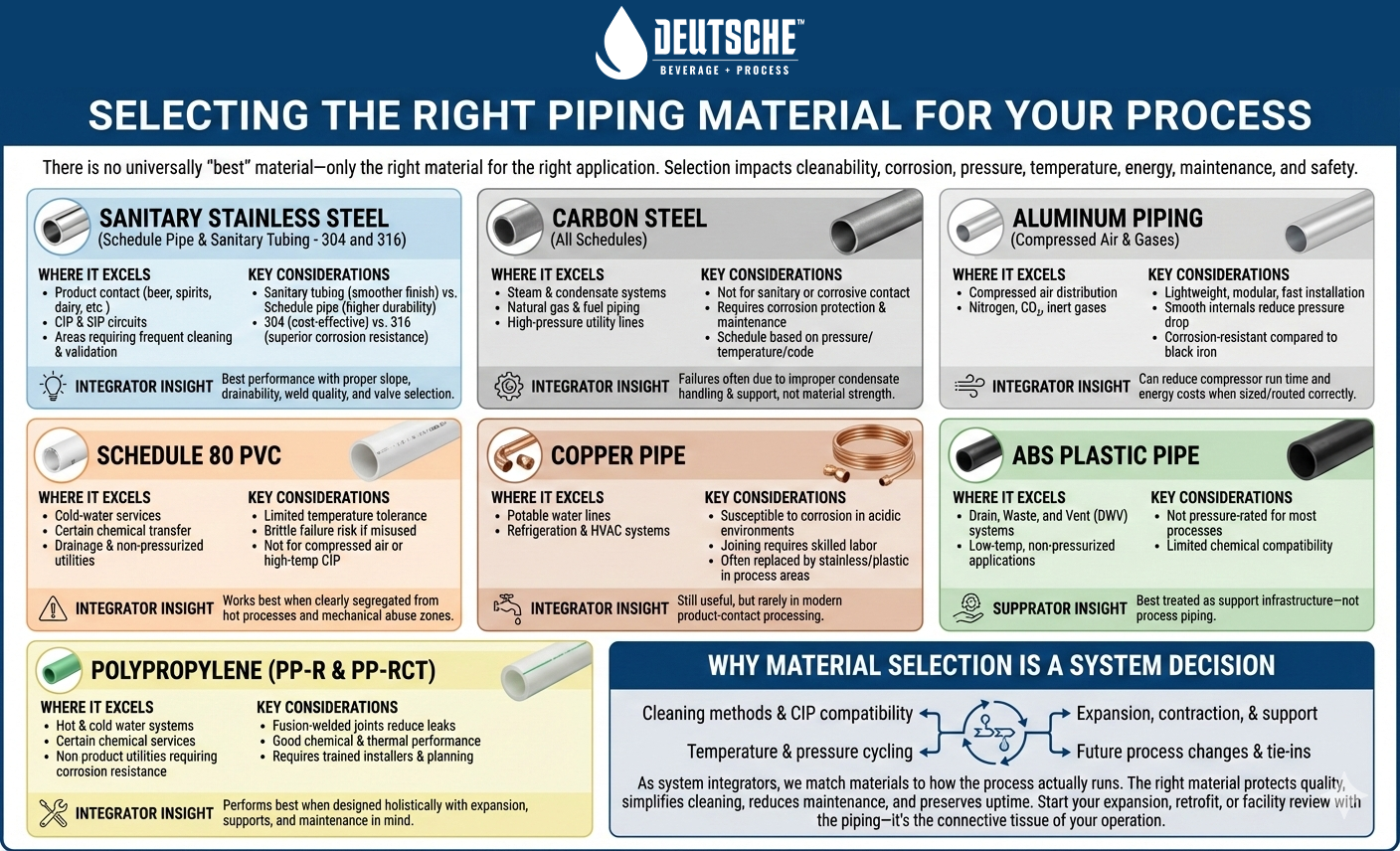
Match the Pipe to the Whole Service
Piping selection follows the same logic as tank selection, but with extra pressures of its own. A length of process pipe must resist the same chemistry and temperature as the vessel it serves, while also carrying the line pressure, accommodating thermal expansion, and surviving the mechanical realities of supports, valves, and flanged joints. A common and costly mistake is to specify a chemically perfect tank and then feed it through piping chosen on price or habit, so that the first failure is a dripping union rather than the tank wall. The discipline is to select piping against the worst-case fluid, concentration, temperature, and pressure, and to keep it consistent with the tank material wherever practical.
The main candidates for chemical-service piping are metals (chiefly stainless steel), fiberglass (FRP), the thermoplastics PVC and CPVC, the fluoropolymer PVDF, and lined metal pipe. Each sits in a different region of the chemistry-temperature-pressure space.
Stainless Steel Piping
Stainless steel piping (commonly 304 or, for chloride and pitting resistance, 316/316L) brings high strength, high-temperature capability, and the ability to hold significant pressure. It is the default for hygienic process lines, steam and hot-water service, many caustic streams, and any duty where mechanical robustness and cleanability matter. Its limitation is the familiar one for stainless: chlorides and certain acids attack it, causing pitting and stress-corrosion cracking, so it is the wrong choice for many halide and strong-acid lines. Where stainless is unsuitable but metal-level strength or temperature is required, lined steel pipe is the fallback.
PVC and CPVC Piping
Thermoplastic PVC and CPVC piping is the economical mainstay of chemical lines within their temperature range. PVC offers good resistance to a broad set of acids, bases, and salts at ambient and mildly elevated temperatures, with easy solvent-cement jointing and low cost. CPVC raises the temperature ceiling meaningfully and broadens the chemical range somewhat, which makes it a standard for hot acid and chlorinated-water service. Both are limited by temperature and by pressure that falls as temperature rises, both are attacked by many solvents and strong oxidizers, and both become brittle at low temperature. Within their envelope they are an excellent value for corrosive aqueous service.
PVDF and Fluoropolymer Piping
PVDF piping is the premium thermoplastic for severe chemical lines. As a fluoropolymer it resists strong acids, halogens, oxidizers, and many solvents at temperatures well above what PVC or CPVC can tolerate, while remaining a true plastic with no metallic corrosion concerns. It is the choice for high-purity, ultrapure-water, and aggressive halogen and acid service where the lesser thermoplastics fail. Its trade-off is cost and the more specialized fusion-welding techniques it requires for jointing. For the harshest chemistries, PVDF (and other fluoropolymers) close the gap that PVC, CPVC, and many resins cannot.
FRP and Lined Piping
Fiberglass piping mirrors FRP tanks: a resin-and-glass composite with a corrosion barrier matched to the chemistry, suited to larger-diameter corrosive lines, good temperature tolerance with the right resin, and freedom from chloride and galvanic concerns. It is common where the tank itself is FRP, keeping the system in one material family. Lined metal pipe (carbon steel lined with rubber, a thermoplastic, or fluoropolymer) provides a strong metal exterior with a chemically inert interior for the most aggressive high-pressure duties, at the cost of lining inspection and the difficulty of field modification. Both are specialized solutions for services that defeat the simpler thermoplastics.
Piping Material Comparison
| Material | Temperature | Pressure | Strong oxidizers | Typical niche |
|---|---|---|---|---|
| PVC | Low | Moderate (falls with heat) | Poor | Ambient acid / water lines |
| CPVC | Moderate | Moderate | Fair | Hot acid, chlorinated water |
| PVDF | High | Good | Very good | Halogens, high purity, harsh acid |
| FRP | Moderate to high | Good (designed) | Resin-dependent | Large corrosive lines, FRP systems |
| Stainless | High | High | Variable | Hygienic, steam, caustic, pressure |
| Lined steel | High | High | Lining-dependent | Severe high-pressure chemical duty |
Beyond Chemistry: The Mechanical Realities
Choosing piping is not only a compatibility problem. Several mechanical factors decide whether a chemically correct line actually survives in service:
- Pressure derating with temperature: Thermoplastic pipe pressure ratings fall sharply as temperature rises; the rating at ambient is not the rating at operating temperature.
- Thermal expansion: Plastics expand far more than metals, so hot lines need expansion loops, offsets, or flexible joints to avoid buckling and overstressed connections.
- Support spacing: Plastics are less stiff and sag between supports, especially when warm, so they require closer, well-designed supports than metal pipe.
- Jointing method: Solvent cement, fusion welding, flanging, and threading each have their own integrity and skill requirements; the joint is usually where leaks begin.
- UV and abrasion: Outdoor and slurry service add ultraviolet and erosion demands that may override a purely chemical choice.
A Repeatable Selection Process
The reliable method is the one used for tanks, applied to the line. Define the worst-case fluid, concentration, temperature, and design pressure, including cleaning and upset conditions. Check published compatibility data for each candidate at that worst case, not at ambient alone, and confirm the pressure rating at operating temperature. Prefer consistency with the tank material to simplify the system and avoid galvanic and compatibility mismatches at the joints. Finally, account for the mechanical realities of expansion, support, and jointing so the line is not merely compatible on paper but durable in the field. Done this way, the piping is as well matched to the service as the tank it feeds, and the system fails nowhere.
Jointing: Where Most Leaks Begin
The pipe wall rarely fails first; the joint does, so the jointing method deserves as much thought as the material. Each material has its characteristic joining technique with its own integrity profile. PVC and CPVC are most often joined by solvent cement, which chemically fuses the socket and spigot into a continuous wall when done correctly, but which is unforgiving of inadequate cure time, contamination, or poor fit. Thermoplastics like PVDF and polypropylene are joined by thermal fusion (butt, socket, or electrofusion welding), producing a homogeneous joint when the procedure and operator are sound. FRP pipe is joined by adhesive-bonded bell-and-spigot connections or by laminated (butt-and-wrap) overlays that rebuild the corrosion barrier across the joint. Metal pipe is welded or flanged. Across all of them, flanged connections introduce a gasket, and the gasket material must itself be chemically compatible with the fluid, a detail that is easy to overlook and a frequent source of small persistent leaks. Specifying the joining method, the qualification of those making the joints, and the gasket and seal materials is part of specifying the piping, not an afterthought.
Pressure Rating and Temperature Together
A number that causes repeated trouble is the pipe's pressure rating, because for thermoplastics it is strongly temperature-dependent. A thermoplastic pipe stamped for a given pressure at ambient may be derated substantially at elevated temperature, sometimes to a fraction of the ambient value, as the polymer softens. Sizing a hot line to its ambient rating is a classic and dangerous error. The correct practice is to read the pressure rating at the actual maximum operating temperature, apply the appropriate derating factor from the pipe maker's data, and add margin for surge and water hammer, which can momentarily spike pressure well above the steady-state value. Metal and FRP pipe are far less temperature-sensitive in this respect but still have rated limits that must be honored. The principle is the same as for resins and liners throughout chemical-service design: the rating that matters is the one at the worst-case condition, not the convenient ambient figure.
Thermal Movement, Support, and Routing
Plastic piping moves with temperature far more than metal, and a hot chemical line that is rigidly anchored at both ends will buckle, bow, or tear its connections as it grows and shrinks. The remedy is to design for the movement rather than against it: expansion loops and offsets that let the pipe flex, anchors and guides placed so movement is directed where it can be absorbed, and connections to pumps and tanks that do not transmit pipe expansion into nozzle loads. Support spacing is the companion problem, because thermoplastic and FRP pipe are far less stiff than steel and sag under their own weight and contents, with the sag worsening as the line warms and the polymer softens. Closer, well-padded supports prevent the line from drooping into a low spot that holds liquid or stresses a joint. Continuous support is sometimes used for the most flexible thermoplastics in hot service. These mechanical provisions are not optional refinements; for plastic chemical lines they are as load-bearing on reliability as the compatibility choice itself.
Outdoor, Abrasive, and Special Conditions
Some services impose demands that override a purely chemical material choice. Outdoor lines face ultraviolet exposure, which embrittles many thermoplastics over time unless they are UV-stabilized, painted, or insulated, and FRP exteriors benefit from a UV-inhibited resin-rich coat for the same reason. Lines carrying slurries or abrasive solids erode from the inside, which can favor tougher or abrasion-resistant materials and generous radii over sharp elbows. Lines that can freeze need heat tracing and insulation, and the brittleness of some thermoplastics at low temperature must be respected. High-purity service, conversely, pushes toward fluoropolymers that will not leach or contribute extractables. Each of these conditions is a reminder that piping selection is a multivariable engineering problem: the right pipe is compatible with the chemistry, rated for the pressure at temperature, detailed for thermal movement and support, joined by a sound method with compatible seals, and suited to the environment it runs through. Hold the line to that same standard as the tank it serves, and the whole system, not just the vessel, earns its service life.
Frequently asked questions
- Should piping match the tank material?
- Wherever practical, yes. Keeping the piping in the same material family as the tank, such as FRP pipe with an FRP tank or stainless pipe with a stainless tank, avoids mismatched chemical compatibility, simplifies jointing, and removes galvanic surprises at the connections. Where the tank material is impractical for the line, choose piping that is independently compatible with the same worst-case chemistry, temperature, and pressure.
- When should I choose CPVC over PVC for chemical lines?
- Choose CPVC when the service temperature exceeds PVC's comfortable range, since CPVC offers a meaningfully higher temperature ceiling and a somewhat broader chemical range. It is a standard for hot acid and chlorinated-water duty. Below that temperature, and for compatible chemistry, PVC is the lower-cost choice.
- What is PVDF piping used for?
- PVDF is a fluoropolymer piping material used for the harshest chemical lines, resisting strong acids, halogens, oxidizers, and many solvents at temperatures well above PVC or CPVC. It is common in high-purity, ultrapure-water, and aggressive halogen and acid service. Its trade-offs are higher cost and the specialized fusion-welding techniques it requires for jointing.
- Why does thermoplastic pipe need extra mechanical consideration?
- Thermoplastic pipe loses pressure rating sharply as temperature rises, expands far more than metal so it needs expansion loops or flexible joints, and sags between supports because it is less stiff, especially when warm. These factors mean a chemically correct plastic line can still fail mechanically if it is not properly rated for operating temperature and supported and routed for thermal movement. Joint integrity and, outdoors, UV resistance also have to be designed in.
Scope your custom build
Send us your volume, service chemistry, dimensions, and finish or code requirements. We return a full engineering package, firm lead time, and a fixed quote — freight quoted separately to your ZIP.
Request a Custom QuoteCall 866-418-1777