
Dual-Laminate FRP Construction
Dual-Laminate FRP Construction
When even vinyl ester is not enough, you stop relying on resin chemistry and bond a true thermoplastic liner inside the tank. That is dual laminate.
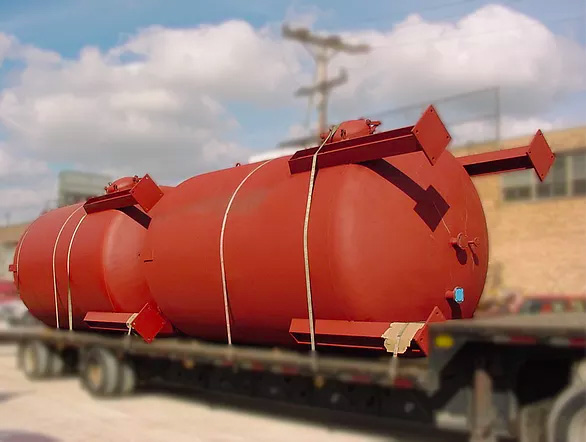
When Resin Alone Is Not Enough
A conventional chemical FRP tank relies on a resin corrosion barrier to face the fluid. That works across a wide band of chemistry, but there is an upper tier of service where no economical thermoset resin survives: certain concentrated acids, strong oxidizers, hot aggressive solutions, halogen chemistry, and solvents that swell or dissolve the resin matrix. For these duties the answer is to stop asking the resin to be the chemical barrier and instead bond a genuine thermoplastic liner to the inside of the tank, backed by a structural FRP wall. This is dual-laminate construction: a chemically inert thermoplastic skin combined with the strength and stiffness of fiberglass.
The principle is a division of labor taken to its logical end. The thermoplastic liner does one job: resist the chemistry. The FRP backing does the other: carry the pressure, vacuum, hydrostatic, wind, seismic, and nozzle loads that a thin plastic liner could never bear on its own. Neither material could do the whole job alone in severe service, but bonded together they cover both requirements.
Anatomy of a Dual Laminate
A dual-laminate wall is built from the inside out. The wetted face is a sheet of engineered thermoplastic, typically a few millimeters thick, selected purely for compatibility with the stored chemical. The back of that liner sheet is given a bondable surface so the FRP will adhere to it. The two most common bonding methods are a backing fabric heat-fused to the liner (a non-woven that the resin can saturate and grip) or a flame/corona-treated and resin-tackified surface. Over that bonded face, the FRP structural laminate is applied by hand layup or filament winding using a vinyl-ester or epoxy resin and glass reinforcement, building up the wall thickness needed for the mechanical loads.
The integrity of dual-laminate construction lives at the liner-to-FRP bond and at the welded seams of the liner itself. Liner sheets are joined by thermoplastic welding (hot-gas or extrusion welding with matching filler), and those welds are routinely inspected, frequently with high-voltage spark testing of the wetted surface to confirm there are no pinholes through which fluid could reach the FRP. A flaw in the liner defeats the entire design intent, so weld quality control is central to a credible dual-laminate fabrication.
The Thermoplastic Liner Materials
The choice of liner is driven entirely by the chemistry and temperature of the service. Each thermoplastic occupies a different niche on the cost-versus-resistance ladder.
- PVC (polyvinyl chloride): The economical entry point. Good resistance to many acids, bases, and salts at moderate temperature, but limited in heat tolerance and attacked by many solvents and strong oxidizers.
- CPVC (chlorinated PVC): A higher-temperature relative of PVC with a similar but somewhat broader chemical range and a useful step up in service temperature, popular for hot acid and chlorinated-water duty.
- PP (polypropylene): Excellent resistance to a broad range of acids, alkalis, and many solvents, with good high-temperature behavior; a very common general-purpose liner. Polypropylene is not suited to strong oxidizers.
- PVDF (polyvinylidene fluoride): A fluoropolymer offering outstanding resistance to strong acids, halogens, oxidizers, and many solvents at elevated temperature. A premium liner for severe service.
- ECTFE (ethylene chlorotrifluoroethylene): A fluoropolymer with exceptionally broad chemical resistance, including to strong oxidizers, concentrated caustics, and aggressive halogen chemistry, often chosen where even PVDF is marginal.
Comparing Liner Options
| Liner | Relative cost | Heat tolerance | Strong oxidizers | Typical niche |
|---|---|---|---|---|
| PVC | Lowest | Low | Poor | Moderate acids, ambient duty |
| CPVC | Low | Moderate | Fair | Hot acid, chlorinated water |
| PP | Low to moderate | Good | Poor | Broad acid/alkali/solvent duty |
| PVDF | High | High | Very good | Halogens, strong acids hot |
| ECTFE | Highest | High | Excellent | Most severe oxidizer / halogen |
Where Dual Laminate Earns Its Cost
Dual-laminate tanks cost more than a single-resin FRP tank, both in materials and in the skilled thermoplastic-welding labor they demand. They earn that premium in services where a resin barrier would fail prematurely: concentrated mineral acids, oxidizing acid blends, strong sodium hypochlorite and other bleach chemistries, halogen and acid-chloride service, and hot aggressive solutions. In these duties the alternative is exotic alloy or lined-steel construction, against which a thermoplastic-lined FRP tank is frequently lighter, fully corrosion-proof on the wetted face, and free of the galvanic and crevice-corrosion concerns of metals.
Fabrication and Inspection Discipline
Because the design stakes everything on the liner, a credible dual-laminate build is defined as much by quality control as by material choice. The liner welds should be made by qualified procedures and inspected; spark (high-voltage holiday) testing of the wetted face is the standard way to find pinholes. The liner-to-FRP bond should be verified, and the structural FRP should follow recognized construction practice for laminate sequence and thickness. Nozzles, manways, and fittings are the highest-risk details, since every penetration is a place where the liner must be carried through and re-welded without a flaw. Specified, witnessed, and documented inspection of these points is what separates a dual-laminate tank that lasts decades from one that leaks in months.
Bonded vs Loose (Adhered vs Free-Standing) Liners
Dual laminates come in two broad construction philosophies, and the difference affects both performance and inspectability. In a bonded (adhered) dual laminate, the liner is fully fused to the FRP across its entire back face through the backing fabric, so liner and structure act as one wall. This gives the stiffest, most damage-tolerant result and lets the thin liner draw support from the FRP against vacuum, but it also means the liner cannot move independently to relieve thermal stress. In a loose-lined or free-standing arrangement, the thermoplastic liner is a self-supporting shell held within an FRP shell that is built around it, mechanically captured rather than chemically bonded everywhere. Loose liners better accommodate the large difference in thermal expansion between thermoplastic and FRP, which matters in hot or thermally cycling service, but they need careful design against vacuum collapse because the liner is not continuously backed. Choosing between the two is a deliberate engineering decision driven by temperature, thermal cycling, and vacuum, not a fabricator's default.
The Thermal-Expansion Problem
The defining engineering challenge of dual-laminate construction is that thermoplastics expand and contract with temperature far more than the FRP that backs them. When a bonded liner is heated, it wants to grow much more than the stiff composite will allow, putting the bond and the liner welds under stress; cooling reverses the stress. Over many cycles this can fatigue the bond or crack a weld if the design ignores it. Fabricators manage this through the choice of bonded versus loose construction, through liner thickness and weld detailing, and by respecting the maximum service and excursion temperatures for the specific liner. It is also why the design temperature for a dual-laminate tank must include cleaning and steam-out conditions, not just normal operation, since a hot caustic wash or a steam sterilization can impose the most severe thermal load the liner ever sees.
Detailing the Penetrations
Every flaw statistic in dual-laminate service points back to the penetrations: nozzles, manways, drains, level connections, and the liner-to-flange transitions. At each one the continuous thermoplastic liner has to be carried out through the FRP wall and terminated in a way that keeps the wetted face unbroken, typically with a flared liner face or a thermoplastic stub welded into the liner and then captured by the FRP. These transitions concentrate both thermal and mechanical stress and are the most demanding welds in the whole vessel. Good practice clusters and minimizes penetrations where possible, uses generous radii, supports nozzle loads externally so piping does not pry on the liner, and subjects each penetration to the same spark testing and visual inspection as the main shell. A dual-laminate tank rarely fails in the middle of a clean wall; it fails at a hurried fitting, which is why the penetration details deserve the most scrutiny in both design and inspection.
Dual Laminate Versus Solid Thermoplastic and Lined Steel
It helps to place dual laminate against its two nearest alternatives. A solid thermoplastic tank, built entirely of welded PP, PVDF, or similar sheet, offers the same chemical-facing material but relies on the plastic alone for structure, which limits its size, pressure capability, and resistance to mechanical loads and demands heavy walls or external reinforcement to stand up at scale. Dual laminate keeps the same inert wetted surface but hands the structural duty to the FRP, allowing larger, stronger, and pressure-capable vessels with thinner liners. Lined steel takes the opposite tack: a strong metal shell with a bonded chemical-resistant lining inside. Lined steel wins where very high pressure or temperature is required, but it reintroduces the metal's corrosion-monitoring burden on the exterior and the difficulty of inspecting and renewing an internal lining inside an opaque shell. Dual laminate occupies the middle ground that is right for a great many aggressive services: corrosion-proof wetted face, composite strength, lighter weight than steel, and no exterior metal corrosion to manage.
Specifying a Dual-Laminate Tank
A sound specification for a dual-laminate vessel reads almost like a checklist, and getting it complete up front is what prevents disputes and early failures. It should state the worst-case fluid, concentration, and the full temperature range including cleaning and steam-out; the selected liner material and thickness; whether the construction is bonded or loose-lined; the structural resin and the laminate design basis; the design pressure and, critically, the design vacuum; and the inspection regime, naming spark testing of the wetted face, weld inspection, and acceptance criteria for the liner-to-FRP bond. It should also specify how each penetration's liner transition is detailed and tested. Treating these as required deliverables, witnessed and documented, is what turns dual-laminate construction from a promising idea into a vessel that genuinely lasts in the severe service it was chosen for.
Frequently asked questions
- What is a dual-laminate tank?
- A dual-laminate tank has a thermoplastic liner bonded to the inside of a structural FRP wall. The liner is selected purely for chemical resistance and the FRP carries the mechanical loads. It is used for severe chemistries where a resin corrosion barrier alone would fail prematurely.
- How do I choose between PVC, CPVC, PP, PVDF, and ECTFE liners?
- The choice is driven by the specific chemistry and temperature. PVC and CPVC suit moderate acid and chlorinated-water duty, PP handles a broad range of acids, alkalis, and solvents, and the fluoropolymers PVDF and ECTFE handle strong oxidizers, halogens, and hot aggressive chemistry. Cost rises as you move toward the fluoropolymers, so the cheapest liner that fully resists the worst-case fluid is the right answer.
- How is the liner bonded to the FRP?
- The back of the thermoplastic liner is given a bondable surface, usually a heat-fused backing fabric or a flame or corona treatment, so the FRP resin can grip it. The structural FRP laminate is then applied over that prepared face. Liner sheets and penetrations are joined by thermoplastic welding with matching filler.
- How is a dual-laminate liner inspected?
- Liner welds are typically spark tested with high voltage, which finds pinholes by arcing through any flaw to the conductive FRP behind it. The liner-to-FRP bond and the laminate construction are also verified, and nozzles and manways get special attention because every penetration is a place the liner must be carried through and re-welded without a defect.
Scope your custom build
Send us your volume, service chemistry, dimensions, and finish or code requirements. We return a full engineering package, firm lead time, and a fixed quote — freight quoted separately to your ZIP.
Request a Custom QuoteCall 866-418-1777