
Axial vs Radial Flow Impellers
Axial vs Radial Flow Impellers
Every agitator pushes liquid one of two ways: down the axis or out to the wall. That single choice decides whether you blend or you shear.
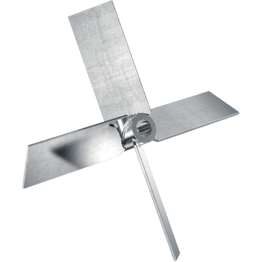
Two Flow Patterns, Two Jobs
Impellers are sorted into two broad classes by the direction in which they discharge liquid. An axial-flow impeller pushes liquid parallel to the shaft — usually downward — so the fluid travels down the center, sweeps across the bottom, rises along the walls, and returns to the impeller in a single large top-to-bottom loop. A radial-flow impeller throws liquid outward, perpendicular to the shaft, toward the tank wall, where the stream splits into two loops, one circulating above the impeller and one below. These two patterns are not interchangeable; they suit fundamentally different process duties.
The reason this distinction matters is that axial flow is efficient at bulk circulation and radial flow is efficient at localized energy dissipation. Axial impellers turn the whole tank over with relatively gentle, low-power motion, which is exactly what blending and solids suspension require. Radial impellers concentrate energy near the blades, creating the intense shear and the trailing vortices that gas dispersion and droplet breakup require. Picking the wrong class is one of the most common and expensive mixing mistakes.
Axial-Flow Impellers
Hydrofoils, marine propellers, and pitched-blade turbines are the principal axial-flow geometries. Their defining virtue is a high pumping-to-power ratio: they circulate a large volume of liquid for the power they consume. That makes them the default choice for the most common mixing duties.
- Liquid blending: Combining miscible liquids quickly and uniformly depends on bulk turnover, which is the axial impeller's specialty.
- Solids suspension: Lifting settling particles off the tank bottom requires the strong downward-then-up flow that an axial impeller produces; the bottom sweep keeps solids from accumulating.
- Heat transfer: Moving warm and cool liquid past a jacketed wall is a flow problem, and axial circulation maximizes the rate at which the bulk contacts the heat-transfer surface.
Because they are flow machines, axial impellers generate comparatively little shear. That is a feature when product is fragile — living cells, crystals, or shear-thinning gels — but a limitation when the process actually needs energy concentrated at the blade.
Radial-Flow Impellers
The flat-blade or Rushton turbine is the archetypal radial impeller. Its flat blades present maximum resistance to the liquid, so it draws a high power number and dissipates that energy as turbulence and shear right at the blade edge. The outward discharge slams into the wall and divides into upper and lower loops, which means a radial impeller actually creates two mixing zones rather than one.
- Gas dispersion: A disk-style turbine traps gas introduced beneath it and the blades chop it into fine bubbles, maximizing interfacial area for mass transfer — the standard arrangement for aeration and gas-liquid reactions.
- High-shear duties: Breaking liquid droplets to form emulsions or tearing apart loose agglomerates needs the high local velocity gradient a radial turbine delivers.
- Immiscible liquid contacting: Creating and maintaining fine dispersions of one liquid in another relies on sustained shear, which radial flow provides.
The price of that shear is power. Radial turbines have high power numbers, so they cost more energy per unit of bulk circulation, and their two-loop pattern is less efficient at turning over a tall tank than a single axial loop. They also depend absolutely on baffling.
Side-by-Side Comparison
| Characteristic | Axial flow | Radial flow |
|---|---|---|
| Discharge direction | Parallel to shaft (downward) | Perpendicular to shaft (outward) |
| Circulation | One large top-to-bottom loop | Two loops, above and below impeller |
| Power number | Low to moderate | High |
| Dominant effect | Bulk flow | Shear and turbulence |
| Best for | Blending, suspension, heat transfer | Gas dispersion, emulsification, dispersion |
| Energy efficiency for turnover | High | Lower |
Why Baffles Decide the Outcome
Neither flow pattern develops properly in an unbaffled vertical tank. Without baffles, a top-entering impeller drives the liquid into solid-body rotation: the whole batch swirls around the shaft, a deep central vortex forms, air gets entrained, and there is almost no vertical mixing. Four flat baffles set against the wall — typically each about one-tenth of the tank diameter wide, with a small wall gap to prevent solids buildup — interrupt that rotation and force the liquid into the vertical and radial currents the impeller is designed to create. For a radial turbine this is non-negotiable; for axial impellers it is what converts swirling into genuine top-to-bottom turnover.
Combining Both in One Vessel
Many real processes need bulk turnover and intense shear at the same time, and tall vessels especially benefit from more than one impeller. A common arrangement places a radial turbine low on the shaft, near a gas sparger or at the point where shear is needed, and one or more axial impellers higher up to circulate the whole batch and prevent dead zones near the surface. This lets the engineer assign each impeller the job it does best rather than forcing a single geometry to compromise. The number and spacing of impellers is set by the liquid aspect ratio: as a guideline, add an impeller for roughly every tank-diameter of liquid height so the circulation loops overlap and the column mixes as one.
The takeaway is simple. Decide first whether the duty is flow-controlled or shear-controlled, choose axial or radial accordingly, baffle the tank so the flow pattern is real, and stack impellers in tall vessels so the whole volume participates. Get those four decisions right and the rest of mixer sizing follows.
Power, Flow and the Numbers Behind Them
The difference between axial and radial flow shows up clearly in the dimensionless numbers used to characterize impellers. The power number describes how much power an impeller draws relative to its speed and diameter; radial turbines have high power numbers because their flat blades meet the liquid head-on and convert that resistance into turbulence, while axial impellers have low power numbers because their angled or shaped blades slice through the liquid. The flow or pumping number describes how much liquid the impeller circulates per revolution, and here axial impellers lead. Dividing pumping by power gives a measure of mixing efficiency for bulk turnover, and on that measure axial impellers win decisively — they move more liquid per unit of energy.
This is why energy cost so often points toward axial flow for large tanks. A blending or suspension duty run with a radial turbine will draw far more power than the same duty served by a properly sized axial impeller, because much of the radial turbine's power is being spent on shear that the duty does not need. The flip side is equally important: when shear is genuinely required, that radial power draw is not waste — it is the product. The numbers do not say one class is better; they say each class is efficient at a different job, and using the wrong one is what wastes energy.
Reading the Flow Pattern in Practice
Operators can often diagnose an impeller's flow class by what the tank surface and contents do. A well-functioning axial impeller produces a gentle, rolling surface motion and visibly turns floating material down into the batch, a sign that the single top-to-bottom loop is working. A radial impeller, by contrast, drives strong outward currents that can show as upwelling near the wall and a quieter zone over the impeller, the signature of the split upper and lower loops. A flat, swirling surface with a growing central depression means the tank has gone into solid-body rotation and the impeller's flow class is irrelevant until baffles are added.
Solids behavior is another tell. If particles pile in a ring partway out on the tank floor, the bottom sweep is too weak and either the impeller is set too high, too small, or is the wrong class for the suspension duty — usually a cue to move toward a larger axial impeller closer to the bottom. If gas is being fed but escapes in large, lazy bubbles rather than fine dispersion, the impeller is not generating enough localized shear and the duty wants a radial turbine. Learning to read these cues turns the axial-versus-radial choice from an abstract decision into something verifiable on the running tank.
Common Mistakes
Two errors recur. The first is reaching for a high-shear radial turbine on a simple blending job because it feels more powerful; it draws more energy, can damage shear-sensitive product, and turns over a tall tank less efficiently than the axial impeller that should have been chosen. The second is expecting an axial hydrofoil to perform a shear duty such as emulsification or fine gas dispersion; it will circulate beautifully and accomplish almost none of the intended droplet or bubble breakup. Matching the flow class to whether the problem is one of moving everything or concentrating energy at the blade prevents both.
Flow Class and Tank Shape
The choice between axial and radial flow interacts with the shape of the vessel, and the two should be decided together. A tall, narrow tank favors axial flow, because a single top-to-bottom loop can reach the whole height and, where the column is very tall, several axial impellers can be stacked so their loops overlap and turn the entire vessel over as one body. A radial impeller in the same tall tank would split the contents into stacked pairs of loops with weak communication between them, leaving the duty poorly served unless many radial stages are used. A short, wide tank is more forgiving of radial flow, since the outward currents reach the wall quickly and the upper and lower loops cover most of the modest height.
The tank bottom shape matters too. A dished or coned bottom helps an axial impeller's downward stream sweep solids toward a central outlet, improving suspension and drainage, while a flat bottom with sharp corners tends to trap settled material in the corners regardless of flow class. Considering flow pattern and vessel geometry as a single design decision — rather than choosing an impeller and then accepting whatever tank is available — is what lets the chosen flow class actually do its job throughout the vessel.
Frequently asked questions
- When should I use an axial-flow impeller versus a radial one?
- Use axial flow when the duty is bulk circulation: blending miscible liquids, suspending settling solids, or moving heat to a jacket. Use radial flow when the duty is localized energy: gas dispersion, emulsification, or breaking up agglomerates. Axial impellers move a lot of liquid efficiently, while radial impellers concentrate shear at the blade at the cost of higher power.
- Why does a radial impeller create two circulation loops?
- A radial impeller discharges liquid outward toward the tank wall, and when that stream hits the wall it splits into one loop that rises above the impeller and one that descends below it. This produces two distinct mixing zones rather than the single top-to-bottom loop of an axial impeller. It is part of why radial turbines are less efficient at turning over a tall tank.
- Do I really need baffles with an axial impeller?
- Yes. Without baffles a vertical tank goes into solid-body rotation, forming a central vortex and entraining air, with very little vertical mixing regardless of impeller type. Four wall baffles break that swirl and let an axial impeller produce real top-to-bottom turnover. The effect is even more critical for radial turbines, where baffling is essential to develop the intended flow pattern.
- Can I mix axial and radial impellers on the same shaft?
- Yes, and it is common in tall vessels or dual-duty processes. A typical setup puts a radial turbine low for shear or gas dispersion and one or more axial impellers higher up for bulk turnover. This assigns each impeller the job it does best instead of compromising with a single geometry, and the spacing is set so the circulation loops overlap.
Scope your custom build
Send us your volume, service chemistry, dimensions, and finish or code requirements. We return a full engineering package, firm lead time, and a fixed quote — freight quoted separately to your ZIP.
Request a Custom QuoteCall 866-418-1777