
Viscosity & Mixing Equipment
Viscosity & Mixing Equipment
Viscosity decides whether your liquid even circulates. Get rheology wrong and your turbine carves a cavern while the rest of the tank sits still.
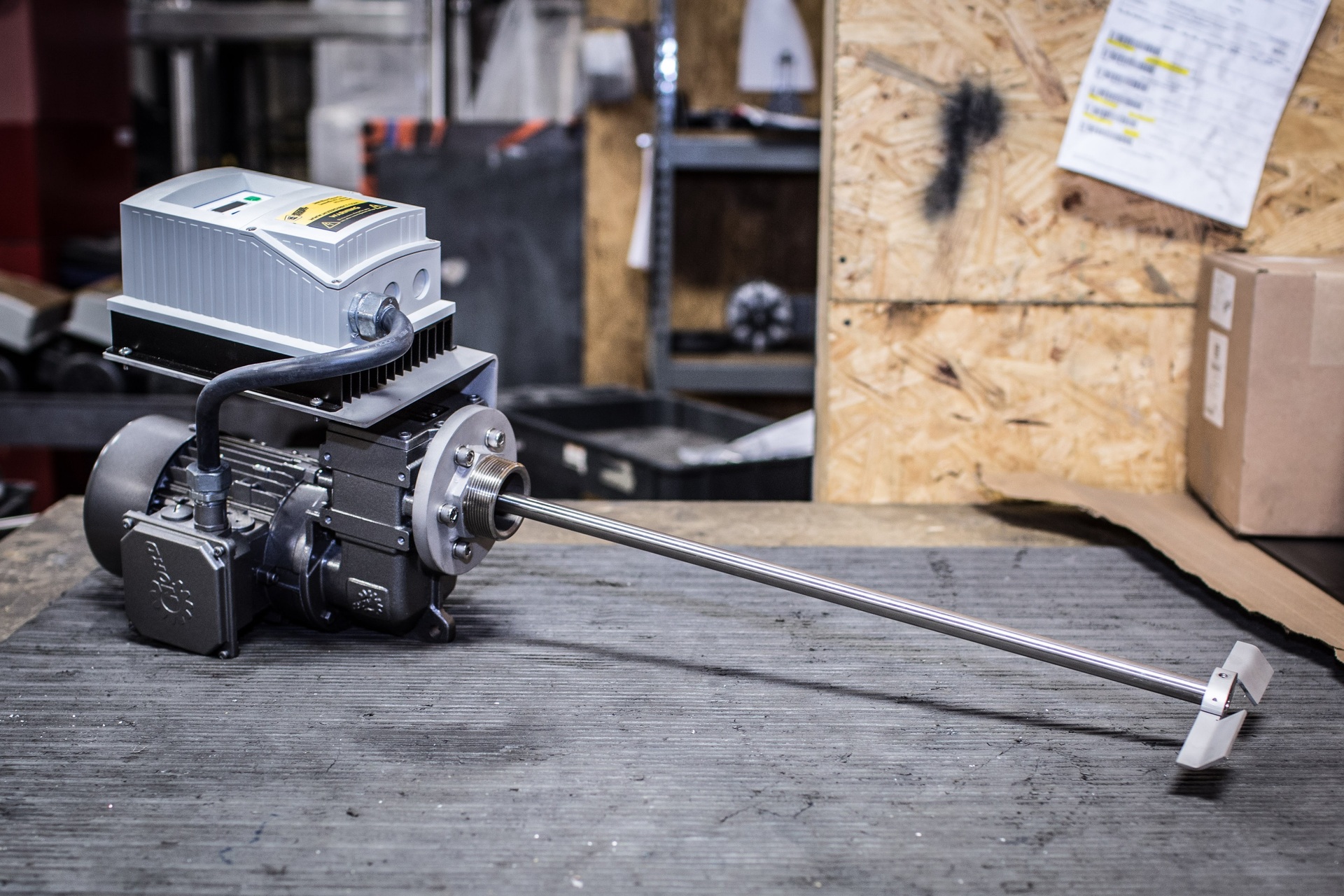
Why Viscosity Governs Mixer Selection
Of all the properties of a process fluid, viscosity has the largest single influence on which mixer will work. Viscosity is the fluid's resistance to flow, and it determines whether an impeller can circulate the whole tank or only a region around itself. A turbine that turns a thin liquid over effortlessly will, in a thick paste, do little more than spin a cavity of moving fluid while the bulk sits stagnant. Selecting a mixer therefore begins with knowing not just the viscosity but how that viscosity behaves — the fluid's rheology — because many industrial materials do not have a single fixed viscosity at all.
The Reynolds Regime: Turbulent, Transitional, Laminar
The behavior of a mixer is captured by the impeller Reynolds number, which expresses the ratio of inertial forces to viscous forces. It rises with impeller speed and diameter and falls as viscosity rises. The regime it lands in dictates the mixing mechanism:
- Turbulent regime (high Reynolds, low viscosity): inertial forces dominate, eddies form, and a small fast impeller can turn over a whole tank efficiently. This is the home of propellers, hydrofoils, and turbines.
- Laminar regime (low Reynolds, high viscosity): viscous forces dominate, there are no eddies, and the impeller must physically drag liquid throughout the vessel. Only large, slow, close-clearance impellers can mix here.
- Transitional regime (between the two): a blend of both mechanisms, where impeller and tank geometry must be chosen carefully because neither pure turbulent nor pure laminar rules apply.
As viscosity climbs, the same impeller drops from turbulent through transitional into laminar behavior, which is precisely why a turbine that works at low viscosity fails at high viscosity. The cure is to increase the impeller-to-tank diameter ratio and slow down — trading speed and turbulence for the size and torque needed to sweep a viscous mass.
Rheology: Not All Fluids Behave Alike
Newtonian Fluids
A Newtonian fluid has a constant viscosity regardless of how hard it is sheared — water, light oils, and simple solvents behave this way. Their viscosity is a single number, and mixer selection follows the Reynolds regime directly.
Shear-Thinning (Pseudoplastic) Fluids
A shear-thinning fluid gets less viscous as it is sheared faster, and most non-Newtonian industrial materials — many polymers, gels, slurries, paints, and food products — are shear-thinning. This creates a characteristic problem: near a fast impeller the high shear thins the fluid and it flows easily, but far from the impeller, where shear is low, the fluid stays thick and barely moves. The result can be a well-mixed cavern around the impeller surrounded by a stagnant mass. Mixing shear-thinning fluids well usually means using a larger impeller, or a close-clearance impeller, so shear is distributed across the whole vessel rather than concentrated in one zone.
Thixotropic Fluids
A thixotropic fluid is time-dependent: its viscosity drops as it is sheared and then recovers over time once shearing stops. Many gels, certain coatings, and some food and personal-care products are thixotropic. The practical consequences are that the fluid may resist initial start-up because it is at its highest viscosity at rest, and that gentle continued motion keeps it workable while letting it sit causes it to rebuild structure. Mixers for thixotropic materials must provide enough torque to break the structure on start-up.
Matching Equipment to Viscosity
As viscosity rises, mixer selection moves through a recognizable progression, from fast turbulent impellers to slow high-torque close-clearance designs.
| Viscosity range | Regime | Typical impeller | Speed and torque |
|---|---|---|---|
| Thin (water-like) | Turbulent | Propeller, hydrofoil | High speed, low torque |
| Low to medium | Turbulent | Pitched-blade or flat-blade turbine | Moderate speed |
| Medium to high | Transitional | Large turbine, gate | Lower speed, higher torque |
| High (pastes, gels) | Laminar | Anchor, helical ribbon | Slow, high torque |
| Very high (heavy pastes) | Laminar | Helical ribbon/screw, planetary | Very slow, very high torque |
The key insight in this progression is the shift from speed to torque. Thin liquids are mixed by fast impellers generating turbulence and bulk flow; thick materials are mixed by slow impellers generating the high torque needed to physically move a resistant mass and sweep the whole tank. A drive sized for a thin liquid will stall in a paste, and a slow high-torque drive is wasteful and ineffective on a thin liquid.
Close-Clearance and Specialized Mixers
When the fluid is firmly in the laminar regime, the impeller must reach the whole vessel because there are no eddies to carry mixing outward from a small blade. Anchors follow the tank contour with a small wall gap, sweeping and scraping the heat-transfer surface; they move the bulk and prevent burning on jacketed walls but provide limited top-to-bottom turnover on their own. Helical ribbons wrap the shaft in a spiral that deliberately pumps material up at the wall and down at the center (or the reverse), giving genuine vertical turnover in very viscous fluids. For the thickest pastes and doughs, planetary mixers move the blade through every part of the vessel along an orbiting path, ensuring no material is left untouched.
Designing for the Worst Case
The right design approach is to characterize the fluid across the shear rates and conditions it will actually see — including start-up from rest for thixotropic materials — and to size the mixer for the most demanding condition rather than an average. Heat changes the picture too: viscosity usually falls sharply as temperature rises, so a jacketed tank may be far easier to mix warm than cold, and the start-up condition with cold, structured fluid can govern the torque requirement. Get the rheology characterized first, choose the impeller class that suits the regime, and size the drive for torque, not just power, and the mixer will perform across the full range of the product rather than only on a good day.
Viscosity That Changes During the Batch
Many of the hardest mixing problems are not steady at all — the viscosity rises or falls as the process runs, and the mixer that was right at the start becomes wrong by the end. A polymerization or curing reaction can take a thin liquid and build it into a thick mass over the course of a batch; a dissolution can do the reverse, starting with a viscous slurry that thins as solids dissolve. In a thickening batch, an impeller that began in the turbulent regime slides into the transitional and then the laminar regime, and a turbine that mixed beautifully at the start ends up carving a cavern in a paste. The robust answer is either a close-clearance impeller chosen for the final, worst-case viscosity, or a variable-speed and sometimes variable-geometry arrangement that can adapt as the fluid changes. Either way, the design has to be governed by the most difficult point in the batch, not by the convenient starting condition.
Yield Stress and the Mixing Cavern
A particular class of fluids has a yield stress: they behave like a solid until a threshold stress is exceeded, and only then do they begin to flow. Many concentrated suspensions, gels, and pastes fall into this group. In a tank, this produces the classic mixing cavern — a zone of moving fluid around the impeller where the local stress exceeds the yield point, surrounded by an unyielded, motionless region that never participates in mixing. Increasing impeller speed enlarges the cavern only modestly, so the answer is rarely more speed. Instead, a larger-diameter or close-clearance impeller is used to put moving fluid in contact with a far greater fraction of the vessel, breaking down the unyielded region by reaching into it mechanically. Recognizing a yield-stress fluid early prevents the wasteful and futile attempt to mix it with a small, fast turbine.
Measuring Rheology Before Specifying
Because so much depends on how viscosity behaves rather than a single number, characterizing the fluid properly is the foundation of every good mixer specification. A rheometer or viscometer that can sweep across a range of shear rates reveals whether the fluid is Newtonian, shear-thinning, or yield-stress, and a time-dependent test reveals thixotropy. Doing this at the temperatures the process will actually run — including the cold start — turns mixer selection from guesswork into engineering. The cost of the measurement is trivial next to the cost of installing a drive that stalls in a paste or a turbine that spins uselessly in a gel, and it is the single step most often skipped on viscous-fluid projects.
Heat Transfer in Viscous Service
Viscosity does not only decide whether a fluid mixes; it also governs how well a tank can be heated or cooled, and the two problems are linked. Heat moves between a jacket and the batch only as fast as fresh liquid is brought to the wall, and in a viscous fluid the layer clinging to the wall barely moves, forming an insulating film that throttles the heat transfer. A turbine that cannot circulate the bulk will also fail to renew that wall layer, so the batch heats slowly and unevenly and can even scorch against a hot wall. This is a major reason close-clearance impellers dominate viscous service: an anchor or helical ribbon sweeps directly along the wall, continuously scraping away the stagnant film and dragging fresh, cooler or warmer liquid into contact with the heat-transfer surface.
The practical lesson is that for viscous, temperature-controlled processes the impeller must be selected for heat transfer and mixing at once, not for mixing alone. A close-clearance impeller with a small, deliberate wall gap, sometimes fitted with scrapers, keeps the wall renewed and the batch uniform in temperature as well as composition. Treating the agitation and the heat-transfer duty as one coupled problem — rather than sizing the jacket and the mixer independently — is what makes viscous heating and cooling reliable instead of a source of off-spec, scorched, or stratified batches.
Frequently asked questions
- Why does my turbine work in a thin liquid but fail in a thick one?
- As viscosity rises, the impeller Reynolds number falls and the same turbine drops from turbulent into laminar behavior, where there are no eddies to carry mixing outward from the blade. The result is a moving cavern of fluid around the impeller while the bulk sits stagnant. The fix is a larger, slower close-clearance impeller, like an anchor or helical ribbon, that physically sweeps the whole vessel.
- What is a shear-thinning fluid and why does it complicate mixing?
- A shear-thinning fluid gets less viscous the harder it is sheared, which describes most non-Newtonian industrial materials like gels, slurries and many polymers. Near a fast impeller the high shear thins it and it flows, but far from the impeller it stays thick and stagnant, creating a well-mixed cavern surrounded by an unmixed mass. Distributing shear with a larger or close-clearance impeller is the usual answer.
- How is a thixotropic fluid different from a shear-thinning one?
- Shear-thinning is rate-dependent: viscosity drops with how fast you shear and recovers instantly when shearing stops. Thixotropic is time-dependent: viscosity drops as you keep shearing and then rebuilds over time once motion stops. Thixotropic fluids are at their thickest at rest, so the mixer must supply enough torque to break the structure on start-up before normal mixing can proceed.
- Should I size a viscous-fluid mixer for power or torque?
- Size it for torque. Thin liquids are mixed by fast impellers generating turbulence, but thick pastes and gels are mixed by slow impellers that must physically drag a resistant mass and sweep the whole tank, which demands high torque at low speed. Size the drive for the most demanding condition, including a cold or structured start-up, rather than for an average, or it will stall.
Scope your custom build
Send us your volume, service chemistry, dimensions, and finish or code requirements. We return a full engineering package, firm lead time, and a fixed quote — freight quoted separately to your ZIP.
Request a Custom QuoteCall 866-418-1777