
High-Speed Dispersers vs Homogenizers
High-Speed Dispersers vs Homogenizers
Both reduce particle size, but they work in completely different ways—and confusing them leaves you with a grainy product or a wrecked one.
Two Tools, Two Mechanisms
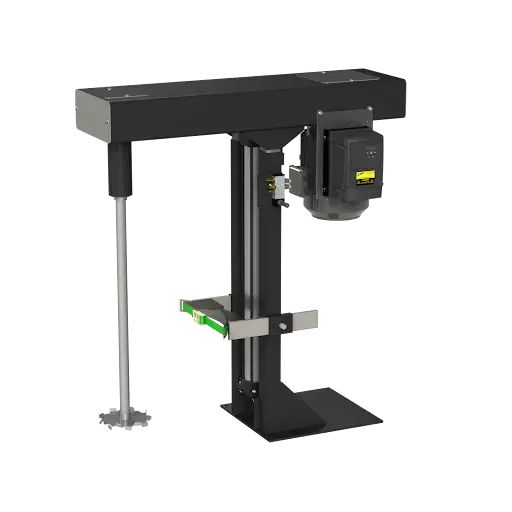
High-speed dispersers and homogenizers both reduce particle or droplet size, which is why they are often confused, but they achieve it through entirely different physics and they belong to different stages of a process. A high-speed disperser uses an open, toothed blade spinning at high tip speed to wet out powders, disperse solids into a liquid, and break loose agglomerates. A homogenizer forces a pre-mixed fluid through an extremely restrictive gap or orifice under high pressure to shatter droplets and particles down to very fine, uniform sizes. The disperser does coarse-to-medium work efficiently and cheaply; the homogenizer does the fine, demanding finish.
The High-Speed Disperser
The classic disperser blade is a flat, open sawtooth (cowles-type) disk mounted on a vertical shaft and run at high tip speed without a stator. Its toothed edge creates a strong radial flow and a controlled surface vortex that draws powder down from the liquid surface into the high-shear zone at the blade, where it is wetted and dispersed. The mechanism is dominated by:
- Powder incorporation: the vortex pulls dry material into the liquid, eliminating floating, unwetted clumps.
- Agglomerate breakup: the high tip speed and the turbulence around the toothed edge tear loose clusters of particles apart.
- Bulk dispersion flow: the radial discharge distributes the dispersed material through the batch.
Dispersers excel at making well-mixed dispersions, slurries, and pastes — paints, inks, coatings, and filled liquids where solids must be uniformly wetted and distributed. What a disperser cannot do is produce the sub-micron droplet sizes of a true fine emulsion; its open blade simply does not impose the extreme, confined pressure drop that fine emulsification requires.
The Homogenizer
A high-pressure homogenizer is a positive-displacement pump that drives a coarse pre-mix at very high pressure through a tiny, adjustable homogenizing valve or interaction chamber. As the fluid is forced through the gap it accelerates to extreme velocity, and the combination of intense shear in the gap, sudden pressure drop with cavitation, and high-velocity impact downstream shatters droplets to a fine, narrow size distribution. The result is a stable, often sub-micron emulsion or dispersion that resists separation.
Homogenizers are the standard for products where droplet fineness and long-term stability are critical — dairy and beverage emulsions, fine cosmetic emulsions, pharmaceutical suspensions and emulsions, and similar high-value formulations. They require a reasonably uniform feed, which is why they almost always follow a coarse mixing or dispersion step rather than replacing it.
Side-by-Side Comparison
| Characteristic | High-speed disperser | High-pressure homogenizer |
|---|---|---|
| Mechanism | Open toothed blade, high tip speed | High-pressure flow through tight valve |
| Primary job | Wet out, disperse, deagglomerate | Fine emulsification, droplet reduction |
| Particle/droplet size | Coarse to medium | Fine, often sub-micron |
| Size distribution | Broader | Narrow, uniform |
| Feed requirement | Can take dry powder and liquid | Needs a uniform pre-mix |
| Typical use | Paints, inks, slurries, pastes | Dairy, fine emulsions, pharma |
How to Choose
Start from the result you need. If the requirement is to incorporate powders into a liquid, break up loose agglomerates, and produce a uniform dispersion, slurry, or paste, a high-speed disperser is the right and most economical tool. If the requirement is a fine, stable emulsion with a narrow droplet distribution that will not separate on the shelf, you need a homogenizer — and you will usually need a disperser or other mixer ahead of it to prepare the feed. Asking a disperser to make a fine emulsion leaves you with a coarse, unstable product; asking a homogenizer to incorporate dry powder risks blocking the valve and damaging the machine.
Where the Rotor-Stator Fits
A rotor-stator high-shear mixer sits between these two in capability. With its closed stator it produces finer results than an open disperser blade and is excellent at emulsification and deagglomeration, while being simpler and gentler on the machine than a high-pressure homogenizer. Many formulations are made entirely with a rotor-stator; the homogenizer is reserved for the finest, most demanding emulsions where sub-micron uniformity and shelf stability justify the added pressure and complexity.
Using Them Together
In practice the three devices form a sequence. A high-speed disperser or rotor-stator wets out powders and creates a uniform coarse pre-mix; the homogenizer then refines that pre-mix to the final fine droplet size. Designing the process as stages — coarse incorporation first, fine reduction second — protects the homogenizer from oversized feed, keeps each device working in its efficient range, and produces a better, more consistent product than trying to force a single machine to do everything. Match each step to the size reduction it does best, and the whole line runs smoother.
How Each Device Reduces Size
The reason these machines occupy different size ranges comes down to how each delivers energy to the dispersed phase. A high-speed disperser works mainly through turbulence and the shear field around its toothed edge. That field is intense at the blade but falls off quickly with distance, and the energy is spread over a relatively large volume, so the disperser is excellent at wetting and breaking weak agglomerates but cannot impose a uniform, extreme stress on every droplet. The droplet distribution it produces is therefore broad — many particles are reduced well, but some larger ones survive.
A homogenizer concentrates its energy into a tiny gap through which every element of product must pass at the same high velocity and pressure drop. Because the stress is applied uniformly and at very high intensity, the droplet distribution it produces is narrow and the mean size is small. The trade is volume: only a small flow can be pushed through that gap at once, and reaching the finest sizes often takes more than one pass. This is the fundamental reason a disperser is a high-volume coarse-to-medium tool and a homogenizer is a lower-volume fine-finishing tool — their geometries dictate how broadly or narrowly the size-reducing energy is applied.
Stabilizing the Result
Reducing droplet or particle size is only half of making a stable product; the new surface area created has to be protected, or the dispersion will simply re-coalesce or re-agglomerate. For emulsions this means an emulsifier or surfactant that adsorbs to the fresh droplet surface and prevents droplets from merging when they collide. For solid dispersions it means a wetting agent or dispersant that keeps particles separated rather than re-clustering. The mixing equipment and the formulation work together: a homogenizer can make beautifully fine droplets, but without adequate stabilizer those droplets will coalesce and the fineness is lost on the shelf. This is why scaling a disperse-then-homogenize process is as much a formulation exercise as an equipment one, and why the order of addition — getting stabilizer into the system before or during size reduction — matters to the final result.
Selecting for Throughput and Cleaning
Beyond particle size, two practical factors steer the choice between these machines. The first is throughput. A disperser in an open tank is simple and handles large batches with minimal infrastructure, while a homogenizer's limited gap flow means high production volumes require either a large machine or continuous operation with the homogenizer sized to the line rate. The second is cleaning and changeover. An open disperser blade is easy to inspect and clean between products, which suits operations that run many short batches; a homogenizer with its tight internal passages and valve seats needs careful clean-in-place and is better suited to longer runs of the same product. Matching the equipment to how the plant actually operates — few long runs versus many short ones — is as important as matching it to the target particle size.
Common Misconceptions
A few persistent misunderstandings cause these machines to be misapplied. The first is that a more powerful disperser will eventually make a fine emulsion if run long enough; it will not, because the open-blade geometry simply does not impose the confined, uniform stress that fine droplet breakup requires, and extended running mostly adds heat. The second is that a homogenizer can replace the upstream mixing step; in reality it depends on a uniform pre-mix and will choke or wear if asked to swallow raw powder or oversized particles. The third is that finer is always better; over-processing can heat or degrade some products, destabilize certain emulsions, and waste energy past the point where the size meets specification.
The clearest way to avoid all three is to think in terms of stages and targets rather than machines. Decide what size distribution the finished product must have and how stable it must remain, then assign the coarse incorporation to a disperser or rotor-stator and the fine reduction to a homogenizer only if the target genuinely requires it. Many good products never need a homogenizer at all, and recognizing that saves both capital and the cleaning burden a high-pressure machine carries. Specifying from the result backward keeps each device doing the job it is actually good at.
Frequently asked questions
- What is the main difference between a disperser and a homogenizer?
- A high-speed disperser uses an open toothed blade at high tip speed to wet out powders, disperse solids and break loose agglomerates, producing a coarse-to-medium dispersion. A homogenizer forces a pre-mixed fluid through a tight high-pressure valve to shatter droplets down to a fine, often sub-micron, narrow distribution. The disperser does coarse work; the homogenizer does the fine emulsifying finish.
- Can a high-speed disperser make a fine emulsion?
- No, not a truly fine one. A disperser's open blade does not impose the extreme confined pressure drop needed for sub-micron droplets, so it produces a coarser, broader distribution suited to slurries, pastes and dispersions. For a fine, stable emulsion you need a homogenizer or at least a closed rotor-stator, usually fed by a disperser that prepares the pre-mix.
- Why does a homogenizer need a pre-mix?
- A homogenizer drives fluid through a very tight valve at high pressure, so oversized particles or unwetted powder can block the gap and damage the machine. It also works best refining an already-uniform feed rather than incorporating raw ingredients. That is why a disperser, mixer or rotor-stator almost always runs ahead of the homogenizer to wet out and coarsely disperse the batch first.
- Where does a rotor-stator fit between the two?
- A rotor-stator high-shear mixer sits between an open disperser and a high-pressure homogenizer. Its closed stator produces finer emulsification and deagglomeration than an open blade while being simpler and gentler on the equipment than a high-pressure unit. Many products are made entirely with a rotor-stator, with the homogenizer reserved for the finest, most shelf-stable emulsions.
Scope your custom build
Send us your volume, service chemistry, dimensions, and finish or code requirements. We return a full engineering package, firm lead time, and a fixed quote — freight quoted separately to your ZIP.
Request a Custom QuoteCall 866-418-1777