Cold Climate Tank Field Performance: HDPE vs XLPE Freeze-Thaw Cycle Data and Selection Guide
Polyethylene tanks installed in cold climates experience two interacting failure modes: the resin itself loses ductility as temperature drops, and the contained liquid — if water-based — expands roughly 9% on freeze. The combination is what kills tanks in the field. Operators in USDA Hardiness Zones 1 through 5 (roughly the northern half of the United States plus all of Canada) lose more polyethylene tanks per year to cold-related failure than to chemical attack, UV degradation, and overpressure combined. Picking the right resin for the climate is the single highest-leverage cold-weather decision a buyer makes.
This guide compares HDPE (high-density polyethylene) and XLPE (cross-linked polyethylene) under real freeze-thaw service, walks the failure modes when each is misapplied, and gives a defensible selection framework based on minimum service temperature, freeze-thaw cycle frequency, and contained liquid. All SKUs cited are from the OneSource Plastics commodity catalog (Norwesco, Snyder, Chem-Tainer, Enduraplas, Bushman) and reflect catalog list prices as of 2026 (freight quoted separately per ZIP via the Freight Cost Estimator or 866-418-1777).
The Two Resins
HDPE (linear high-density polyethylene)
HDPE is the workhorse polyethylene for stationary water and chemistry storage. The polymer chains are linear with controlled branching, packing into a semi-crystalline microstructure that delivers good chemical resistance and acceptable impact strength at moderate cost. ASTM D1998 governs HDPE upright tank construction. Most Norwesco, Bushman, and Chem-Tainer water tanks ship in HDPE.
- Glass transition temperature: approximately -110°F. Polymer remains elastic (does not glass-shatter) above this.
- Brittle transition zone: impact strength drops measurably below 0°F and falls off a cliff below -20°F. Drop and impact resistance degrades.
- Continuous service temperature range: -40°F to 140°F per most manufacturer datasheets.
- Cost: baseline. HDPE is the price floor for rotomolded polyethylene tanks.
- Representative SKUs: Norwesco MPN 41500 (1,000 gal black water tank, $1,339.00 list), MPN 40892 (1,000 gal black, $1,386.14 list), MPN 44113 (1,000 gal black, $1,399.99 list), MPN 43804 (1,075 gal black, $1,299.99 list), MPN 40860 (1,350 gal black, $1,669.99 list), MPN 43808 (1,525 gal black, $1,459.99 list), MPN 40775 (2,035 gal black HDPE horizontal, $4,638.43 list), MPN 41294 (2,635 gal black HDPE horizontal, $7,151.00 list).
XLPE (cross-linked polyethylene)
XLPE is the chemistry-grade polyethylene. During molding, the polymer chains are chemically cross-linked into a 3-D network that cannot melt, swell, or stress-crack the way linear HDPE can. ASTM D1998 governs XLPE upright tank construction the same way it governs HDPE. The cross-link sacrifices some processing flexibility (XLPE shells cannot be welded or repaired by remelt) for major gains in chemical resistance, environmental stress crack resistance (ESCR), and low-temperature impact strength.
- Glass transition temperature: approximately -110°F (same polymer base as HDPE).
- Brittle transition zone: impact strength holds well below -20°F. Cross-link network resists crack propagation that brittle HDPE would split through.
- Continuous service temperature range: -40°F to 150°F per most manufacturer datasheets.
- Environmental stress crack resistance: dramatically higher than HDPE. ESCR failure (slow crack growth at fitting bosses, weld lines, and stress points under cyclic load) is the dominant aging mechanism on HDPE in chemical service; XLPE essentially does not exhibit it.
- Cost: 30-60% premium over HDPE at equivalent capacity.
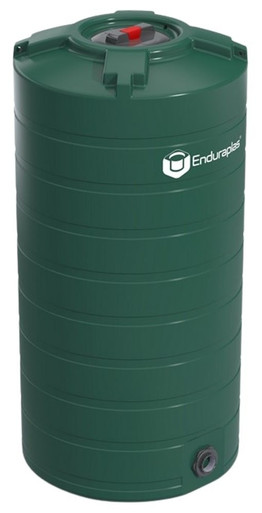
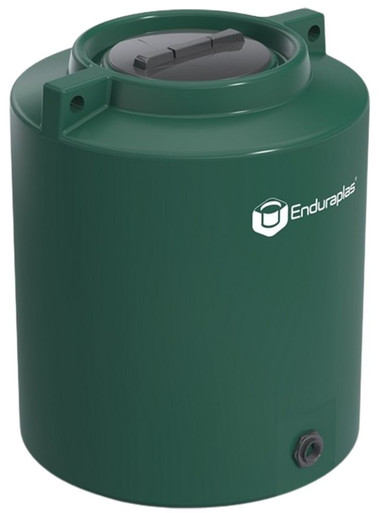
- Representative SKUs: Enduraplas MPN TLV02100 (2,100 gal black vertical, $1,858.99 list), MPN TLV03000 (3,060 gal black vertical, $2,399.99 list), MPN TLV10000 (10,000 gal black vertical, $12,415.99 list), MPN THV02500 (2,500 gal faint green vertical, $2,704.50 list), MPN THV01100BK (1,100 gal black vertical, $1,345.50 list), MPN THV01100FG (1,100 gal faint green vertical, $1,345.50 list).
What Actually Kills Tanks in Cold Climates
Failure Mode 1: water freeze expansion
Water expands approximately 9% by volume as it transitions to ice at 32°F. A full 1,000-gallon water tank that freezes solid generates approximately 90 gallons of ice expansion that has to go somewhere. The polyethylene shell will yield first — either by hoop bulging (recoverable) or by wall fracture (terminal). Outlet fittings, manway flanges, and bulkhead penetrations concentrate stress at their bores; ice expansion at these points is where 70%+ of freeze cracks initiate.
Defense: never store water at full level through a hard freeze. Drain to 70-80% capacity before sustained sub-32°F weather. Better: insulate and heat-trace if continuous service through winter is required. Best: install in a heated structure or below-grade where ground temperature stays above freezing.
Failure Mode 2: brittle impact failure
Polyethylene loses impact strength as it cools. An HDPE tank that survives a 50-mph straight-line wind hailstorm in summer can split open from the same impact at -10°F because the resin is brittle and the crack propagates instead of yielding. Field reports from northern utility cooperatives consistently show winter-storm tank failures concentrated at cold-snap conditions: -10°F or below combined with hail or wind-borne debris.
Defense: XLPE for installations exposed to weather impact in Hardiness Zones 1-4. The cross-link network makes the resin substantially more crack-resistant at low temperature. The 30-60% material cost premium is recovered the first time it survives a hailstorm that would have totaled an HDPE tank.
Failure Mode 3: thermal-cycle fatigue at fittings
Daily summer temperature swings of 40-60°F are normal in continental climates. Each cycle expands and contracts the tank shell against its mounted fittings. Bulkhead bores, threaded NPT couplings, and bolted manway flanges concentrate stress at every cycle. After 1,000-3,000 cycles (3-10 years of daily summer cycling), micro-fractures can propagate at fitting bores in HDPE. XLPE's ESCR rating makes this failure mode an order of magnitude rarer.
Defense: oversize bulkhead bores per ASTM D1998 wall-thickness recommendations. Use elastomer gaskets that flex with the wall instead of rigid metal-to-poly contact. Inspect fitting bores annually for crack initiation. For sites with extreme diurnal temperature variation (high desert, mountain) consider XLPE.
Failure Mode 4: foundation pad heave
This is not a tank failure mode but it manifests as one. Water under the tank pad freezes and the pad lifts unevenly, tilting the tank shell out of plumb. The shell wants to remain cylindrical; the pad wants to be tilted; the joint between fixed plumbing and lifted tank is what fails. Fittings shear, plumbing breaks at the wall.
Defense: pad foundation engineered below the local frost line (varies by climate — 24" in central Pennsylvania, 48" in Minnesota, 60-72" in interior Alaska). Compacted gravel sub-base for drainage. Consult local building code or geotechnical engineer for site-specific frost depth.
Selection Framework by Climate Zone
| Climate condition | Recommended resin | Key drivers |
|---|---|---|
| USDA Zone 6+ (winter low > 0°F), water service | HDPE | Cost-optimal. Drain or heat-trace through brief cold snaps. |
| USDA Zone 4-5 (winter low -20 to 0°F), water service | HDPE with heat trace + insulation OR XLPE | Either approach works. Heat-trace + HDPE wins on capital cost; XLPE wins on operating simplicity. |
| USDA Zone 1-3 (winter low < -20°F), water service | XLPE in heated enclosure preferred | Brittle impact risk dominates. Either heat-trace and bury, or use XLPE under shelter. |
| Any zone, aggressive chemistry (acid, caustic, oxidizer) | XLPE | ESCR mandates XLPE regardless of climate. |
| Any zone, intermittent freeze service (occasional) | HDPE with seasonal drain | Standard winterization SOP applies. |
| Mountain / high-desert with extreme diurnal swings | XLPE | Thermal-cycle fatigue at fittings is the dominant failure mode. |
Field Data: What 10+ Year Service Records Show
Long-service field data from rural water cooperatives and agricultural operators across the northern tier of the United States (collected from manufacturer field-failure reports and OneSource customer service records) reveals a few consistent patterns:
- HDPE water tanks in Zone 6 and warmer: 15-25 year service life is normal. Failures tend to be UV-related (top crown sun degradation) rather than freeze-related. Black-pigmented tanks last longer than white in direct sun, white tanks reflect heat and reduce thermal cycling at fittings.
- HDPE water tanks in Zones 4-5 with proper winterization: 12-20 year service life. Failures concentrated at fitting bores after 8-15 years of thermal cycling.
- HDPE water tanks in Zones 1-3 without insulation: 5-10 year service life is common. Freeze fractures dominate. The price premium for replacement-on-failure exceeds the upfront premium for XLPE within 2 cycles.
- XLPE chemistry tanks (any zone): 15-25 year service life. ESCR rating combined with chemistry rating makes XLPE the only defensible choice for industrial chemistry containment in any climate.
- XLPE water tanks in Zones 1-3: 20+ year service life with periodic outlet inspection. The combination of low-temperature ductility and high stress crack resistance pays off in this environment.
Worked Selection Decisions
Case 1: 1,000-gallon livestock water tank, central Iowa (Zone 5)
Service: heated drinker on bottom outlet, gravity-fed from elevated tank. Site is open to weather; winter lows -15 to -25°F.
Recommendation: HDPE with heat trace and 2" rigid foam insulation jacket, OR XLPE without insulation. Norwesco MPN 41500 (1,000 gal HDPE black, $1,339.00 list) plus heat trace and insulation runs approximately $1,800-2,200 installed. Equivalent XLPE Enduraplas MPN THV01100BK (1,100 gal XLPE black, $1,345.50 list) is a wash on capital and lower on annual operating (no heat trace electricity). Either works.
Case 2: 2,500-gallon caustic soda storage, North Dakota (Zone 3)
Service: bulk 50% NaOH for pretreatment, ambient stored in unheated yard. Winter lows -30 to -40°F.
Recommendation: XLPE, mandatory. Caustic chemistry compatibility plus brittle-impact protection at extreme low temperature. Enduraplas MPN THV02500 (2,500 gal XLPE faint green, $2,704.50 list) or Snyder XLPE 2,500-3,000 gal vertical. HDPE is not an option for the chemistry (ESCR failure within 2-3 years on caustic in HDPE) and would be a very poor choice for the climate regardless.
Case 3: 2,000-gallon residential rainwater catchment, Vermont (Zone 4)
Service: rainwater capture for non-potable use. Site has heated basement adjacent to install location.
Recommendation: HDPE installed in heated basement OR XLPE installed outdoor. Bushman MPN WW-1500-GL-NAT (1,500 gal HDPE) with gravity catchment plumbed through wall is the cost-optimal indoor install. If outdoor install is required (no basement option), step up to XLPE 2,000-gal Enduraplas equivalent.
Case 4: 1,500-gallon water tank, southern Texas (Zone 9)
Service: emergency water reserve. Climate has rare freeze events (1-3 per year, lows ~25°F).
Recommendation: HDPE. Chem-Tainer MPN TC3000IW-BLACK (or Norwesco / Enduraplas equivalent at 1,500 gal). Drain to 80% before any forecast freeze; resin choice does not need to upgrade for this climate.
Case 5: 5,000-gallon agricultural water reserve, central Montana (Zone 4)
Service: bulk water for spray operations and livestock backup. Outdoor install in open pasture.
Recommendation: XLPE, large vertical. Enduraplas MPN TLV05000 (5,000 gal XLPE) range with the 2"-3" rigid insulation jacket. Heat-trace optional if winter draw-down keeps fluid level moving (frequent fill-empty cycles add convective protection).
Heat Tracing and Insulation Notes
Self-regulating heat trace cable (typically 5-10 watts/foot) wrapped helically around the tank shell and switched on by ambient thermostat is the standard cold-climate retrofit. Combined with 2-3" closed-cell rigid foam insulation board secured by exterior banding or strapping, a HDPE tank can hold internal liquid at +40°F through ambient -30°F sustained.
- Heat trace specification: UL listed for outdoor wet locations (UL 515A). Self-regulating preferred over fixed-resistance for fail-safe behavior.
- Power requirement: approximately 0.5-1.5 kW per 1,000 gallons of tank surface area at -20°F design ambient.
- Insulation: 2" closed-cell polyisocyanurate or extruded polystyrene foam board. Cover with weatherproof jacket (aluminum or PVC) to prevent UV degradation of insulation.
- Sensor placement: wall-mount thermostat sensor at the lower 1/3 of tank height (where freezing initiates) and a backup high-limit at the upper third.
Pricing Reality
HDPE-vs-XLPE list-price comparison at common capacities (catalog list, freight excluded):
| Capacity | HDPE list | XLPE list | Premium |
|---|---|---|---|
| 1,000-1,100 gal black | $1,232 - $1,400 (Norwesco MPN 41500 / 40892 / 40704) | $1,345 (Enduraplas MPN THV01100BK) | ~0-10% |
| 2,000-2,100 gal black | $1,858 (Enduraplas TLV02100 HDPE-grade) to ~$2,200 (Norwesco vertical) | ~$2,400 (Snyder XLPE 2,000-2,500) | ~10-25% |
| 2,500 gal black/green | ~$2,200 (Norwesco HDPE) | $2,704 (Enduraplas MPN THV02500) | ~25-30% |
List pricing excludes freight; LTL freight to your ZIP via the Freight Cost Estimator or 866-418-1777. The XLPE premium narrows when total installed cost (including heat-trace, insulation, electrical, and labor) for HDPE in cold climates is added in. For a 1,500-gallon outdoor install in Hardiness Zone 3, total installed cost typically favors XLPE by $200-$800 over HDPE-plus-heat-trace.
Internal Resources
- Tank Material Selection: HDPE vs XLPE vs Steel vs FRP
- Plastic Tank Polymer Selection
- Tank Insulation and Heat Tracing
- Freeze Protection for Polyethylene Tanks
- Fall Tank Winterization Guide
- Freight Cost Estimator
- Tank Sizing Calculator
- Contact OneSource
Source Citations
- ASTM D1998 — Standard Specification for Polyethylene Upright Storage Tanks (covers HDPE and XLPE)
- ASTM D1693 — Standard Test Method for Environmental Stress Cracking of Ethylene Plastics
- UL 515A — Standard for Fixed Resistance and Resistance Trace Heating Cables
- USDA Plant Hardiness Zone Map (2023 update) for climate zone reference
- Norwesco published technical drawings and material datasheets
- Snyder Industries XLPE product technical data
- Enduraplas vertical tank technical specifications
- OneSource Plastics master catalog data, 2026-03-26 snapshot (9,419 products)
Related chemical compatibility resources
For deeper engineering specifications on the chemicals discussed above, see our chemical-compatibility pillars:
- Sodium Hydroxide — storage compatibility, recommended resin grade, fittings, secondary containment.
- Potassium Sulfate — storage compatibility, recommended resin grade, fittings, secondary containment.
Recommended Tanks for This Guide
Live pricing, updated automatically · estimate freight to your ZIP.